
When embarking on any academic or professional writing project that requires adherence to specific formatting guidelines, understanding the nuances of each section is paramount. For those working within fields that heavily intersect with technology, branding, and finance – from software developers crafting a research paper on AI advancements to marketing strategists analyzing brand perception in the digital age, or financial analysts presenting findings on investment trends – the American Psychological Association (APA) style is a common and respected standard. Among the various components of an APA-formatted document, the abstract page holds a distinct and crucial role. It’s not merely a summary; it’s a powerful introduction that can significantly influence how your work is perceived and understood.
The Purpose and Importance of an Abstract Page in APA
At its core, an abstract is a concise, self-contained summary of your entire paper. It provides a brief overview of the research question, methodology, key findings, and implications of your work. In the context of APA style, the abstract is typically placed on its own page, immediately following the title page and before the main body of the text. Its primary purpose is to allow readers to quickly grasp the essence of your study without having to read the entire document. This is particularly vital in today’s fast-paced information landscape, where professionals in Tech, Brand, and Money often skim articles and reports to determine their relevance to their immediate needs.
For the Tech Professional: Streamlining Innovation and Understanding
In the realm of technology, where advancements are rapid and the volume of research is immense, an effective abstract is a gatekeeper to understanding. Whether you’re developing a new AI tool, analyzing cybersecurity threats, or reviewing the latest gadgets, your research needs to be accessible. A well-crafted abstract can:
- Highlight Novelty and Impact: Clearly articulate the technological innovation you’ve developed or analyzed. For example, if your paper is about a new algorithm for personalized marketing, the abstract should immediately convey its novelty and potential impact on customer engagement.
- Communicate Methodology Efficiently: Briefly explain the technical approach taken. This could be the programming languages used, the dataset size, the simulation environment, or the user testing methodology. This allows other tech professionals to quickly assess the rigor and validity of your work.
- Signal Key Findings for Application: Summarize the most important results. In a review of productivity apps, this might be which app offers the best balance of features and usability for remote teams. For an AI tool, it could be the accuracy improvements achieved or the computational efficiency gained.
- Aid in Knowledge Discovery: Make your research discoverable. Journals and databases often index abstracts, and a well-optimized abstract can improve the chances of your work being found by relevant researchers and practitioners.
For the Brand Professional: Communicating Strategy and Reputation
The world of branding is driven by perception, strategy, and effective communication. In this domain, an abstract can serve as a powerful executive summary for busy decision-makers. Whether you’re presenting a case study on a successful rebranding campaign, analyzing the impact of social media on corporate identity, or outlining a new personal branding strategy, your abstract should encapsulate the core message. It can:
- Articulate Strategic Objectives: Clearly state the branding problem you addressed or the strategic goal you aimed to achieve. For a corporate identity study, this might be the challenge of maintaining brand consistency across diverse markets.
- Summarize Brand Research Insights: Present the key findings from your market research, consumer surveys, or sentiment analysis. For example, an abstract could highlight how a specific marketing campaign influenced brand perception among a target demographic.
- Convey the Efficacy of Branding Tactics: Briefly describe the methods employed in your brand strategy. This could include design principles, communication channels, or stakeholder engagement strategies.
- Reinforce Brand Value and Reputation: The abstract should implicitly or explicitly communicate the value or improved reputation derived from the brand initiatives discussed in the paper.
For the Money Professional: Presenting Financial Insights and Investment Opportunities
In the dynamic world of finance, clarity, conciseness, and actionable insights are paramount. Whether you are analyzing investment trends, developing a personal finance strategy, or evaluating the financial performance of a business, your abstract needs to quickly convey the essence of your financial analysis. It can:
- Define the Financial Problem or Opportunity: Clearly state the financial question you investigated or the investment opportunity you explored. For a paper on online income, this might be the potential of a specific side hustle to generate sustainable revenue.
- Outline the Financial Methodology: Briefly explain the analytical tools, models, or data sources used. This could include financial ratios, econometric models, or case studies of business finance.
- Present Key Financial Findings and Projections: Summarize the most significant financial results, trends, or projections. For an investment analysis, this could be the projected ROI of a particular asset class or the risk assessment of a new venture.
- Highlight Financial Implications and Recommendations: Conclude with the practical implications of your findings or offer concise recommendations for financial decision-making. This could be advice on optimizing personal finance or strategies for improving business finance.
Crafting an Effective APA Abstract: Key Components and Best Practices

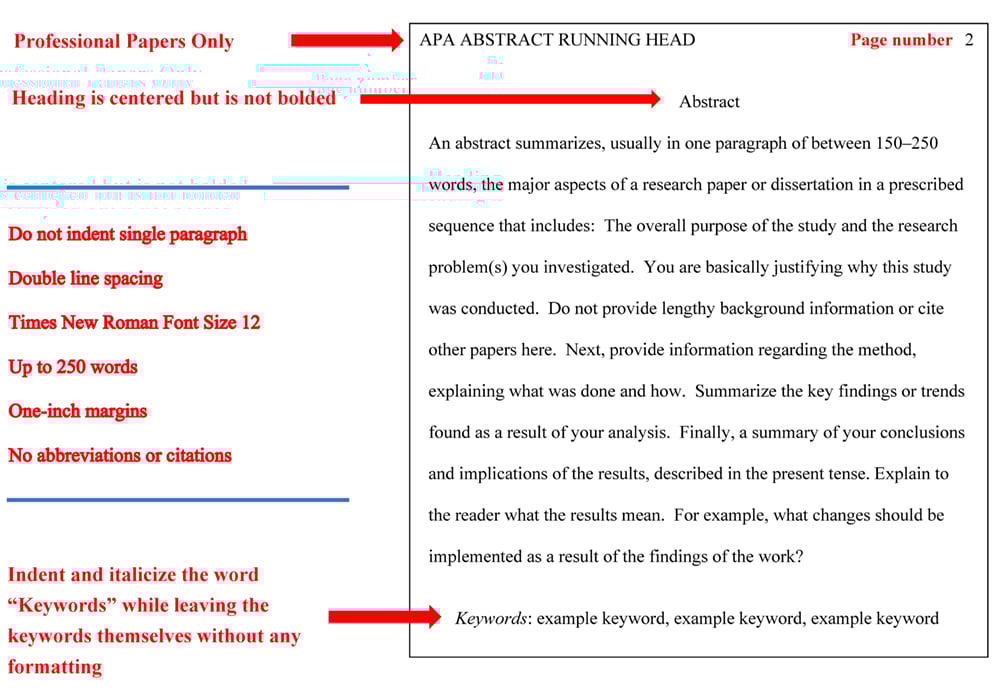
Creating a compelling abstract requires a strategic approach, ensuring it accurately reflects the content of your paper while adhering to APA guidelines. The specific requirements can vary slightly depending on the publication or institution, but generally, an APA abstract is a single paragraph, approximately 150-250 words in length. It should be written in a clear, objective, and concise manner, avoiding jargon where possible unless it’s essential for the specific field.
Key Elements to Include:
- Problem Statement/Purpose: Briefly state the research problem or the objective of your study. What question are you trying to answer? What gap are you trying to fill?
- Methodology: Provide a concise overview of how you conducted your research. This might include the type of study (e.g., experimental, survey, qualitative), the participants, the materials used, and the data analysis techniques.
- Key Findings/Results: Summarize the most important outcomes of your research. This should be presented objectively and without interpretation.
- Implications/Conclusions: Briefly discuss the significance of your findings and their potential implications. What does your research mean for the field, for practice, or for future research?
Best Practices for Writing:
- Write it Last: It is often best to write your abstract after you have completed the main body of your paper. This ensures that your summary accurately reflects the final content and findings.
- Be Concise and Direct: Every word counts. Avoid unnecessary verbiage, lengthy sentences, and passive voice. Get straight to the point.
- Use Keywords: While not a separate section in the APA abstract itself, consider the keywords that readers would use to find your paper. Incorporate these naturally within your abstract to improve discoverability.
- Avoid Citations: Generally, abstracts should not include citations. The abstract is meant to be a standalone summary, and readers should refer to the main text for references.
- Accuracy is Crucial: Ensure that the abstract accurately represents the content of your paper. Do not introduce information that is not present in the main body.
- Review and Revise: After drafting your abstract, review it carefully for clarity, conciseness, and grammatical errors. It’s often helpful to have a colleague or peer review it as well.
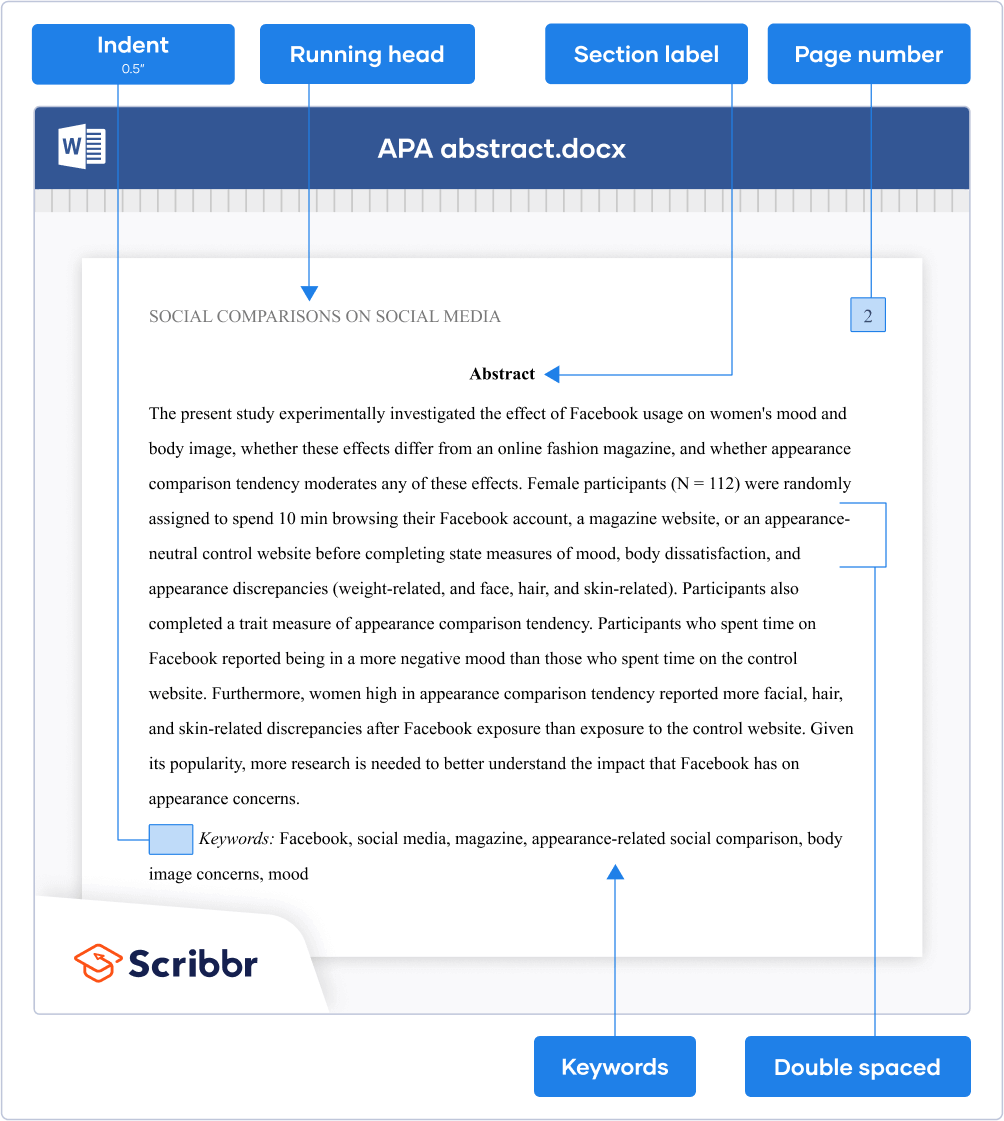
The Abstract Page Format in APA
The APA abstract page follows a specific format to ensure consistency and ease of reading.
Formatting Requirements:
- Placement: The abstract page is the second page of your document, immediately following the title page.
- Heading: The word “Abstract” should be centered and in bold at the top of the page.
- Content: The abstract itself should be a single, double-spaced paragraph. Do not indent the first line of the abstract.
- Keywords (Optional but Recommended): Following the abstract paragraph, you may include a line for keywords. This line should be indented, and the word “Keywords” should be italicized and followed by a colon. The keywords themselves should be listed in alphabetical order, separated by commas.
Example of Keywords in an APA Abstract:
…These findings suggest a significant impact on user engagement.
Keywords: artificial intelligence, machine learning, user experience, personalization, predictive analytics
This structure ensures that the abstract is easily identifiable and that the keywords are clearly presented, aiding in the indexing and retrieval of your work.
Conclusion: Making Your Abstract Work for You
In the interconnected worlds of Tech, Brand, and Money, where information overload is a constant challenge, a well-crafted APA abstract is an indispensable tool. It’s your elevator pitch, your executive summary, and your first impression all rolled into one. By understanding its purpose, adhering to APA formatting guidelines, and employing best practices in its writing, you can ensure that your research, ideas, and innovations are effectively communicated, understood, and valued by your intended audience. Whether you are presenting groundbreaking technological advancements, strategic brand initiatives, or crucial financial insights, a strong abstract is the key to unlocking the full impact of your work.
aViewFromTheCave is a participant in the Amazon Services LLC Associates Program, an affiliate advertising program designed to provide a means for sites to earn advertising fees by advertising and linking to Amazon.com. Amazon, the Amazon logo, AmazonSupply, and the AmazonSupply logo are trademarks of Amazon.com, Inc. or its affiliates. As an Amazon Associate we earn affiliate commissions from qualifying purchases.