
In the intricate world of computer networking, understanding fundamental concepts is crucial for effective communication and robust system design. One such foundational element, often encountered when dealing with IP addressing and network segmentation, is the broadcast address. While seemingly simple, the broadcast address plays a vital role in how devices within a network communicate with each other, facilitating everything from initial network discovery to the dissemination of critical information. This article will delve into the nature of broadcast addresses, exploring their purpose, mechanisms, types, and implications within modern networking environments.
Understanding the Essence of Broadcast
At its core, a broadcast address represents a special IP address within a network that signifies a message intended for all devices that are currently connected to that specific network segment. Imagine sending a letter to every single resident of an apartment building simultaneously, rather than addressing it to an individual. That’s essentially what a broadcast address achieves in the digital realm.
The Purpose of Broadcast Communication
The primary purpose of broadcast communication is to enable efficient one-to-many communication. Instead of an application or a network service needing to know the individual IP addresses of every device it needs to reach on a local network, it can simply send a message to the broadcast address. All devices listening on that network segment will receive and process the message. This is particularly useful for:
- Network Discovery: Protocols like ARP (Address Resolution Protocol) rely heavily on broadcast messages to discover the MAC addresses of other devices on the local network. When a device needs to send data to another device on the same network, it first broadcasts an ARP request to find the destination’s MAC address.
- Service Advertisement and Discovery: Many network services, such as DHCP (Dynamic Host Configuration Protocol) for automatic IP address assignment, use broadcast messages to announce their presence and listen for requests from clients. A new device joining a network will broadcast a DHCP discover message to find a DHCP server.
- Updating Network Information: Certain network protocols might use broadcasts to disseminate updates or status information to all participating devices on a segment.
Distinguishing Broadcast from Unicast and Multicast
It’s important to differentiate broadcast addresses from other forms of IP communication:
- Unicast: This is the most common form of communication, where a message is sent from one specific source to one specific destination. Think of a direct phone call or sending an email to a single recipient.
- Multicast: In multicast, a message is sent from one source to a defined group of destinations. It’s like sending a message to a specific mailing list or a conference call with pre-selected participants. While it’s one-to-many, it’s not to all devices, but to a specific, subscribed group.
- Broadcast: As discussed, this is one-to-all communication within a given network segment.
The key difference lies in the intended audience. Unicast targets one, multicast targets a selected group, and broadcast targets everyone on the local network.
The Mechanics of Broadcast Addresses
The structure and behavior of broadcast addresses are tied to the underlying IP addressing scheme and subnetting.
IP Addressing and Subnet Masks
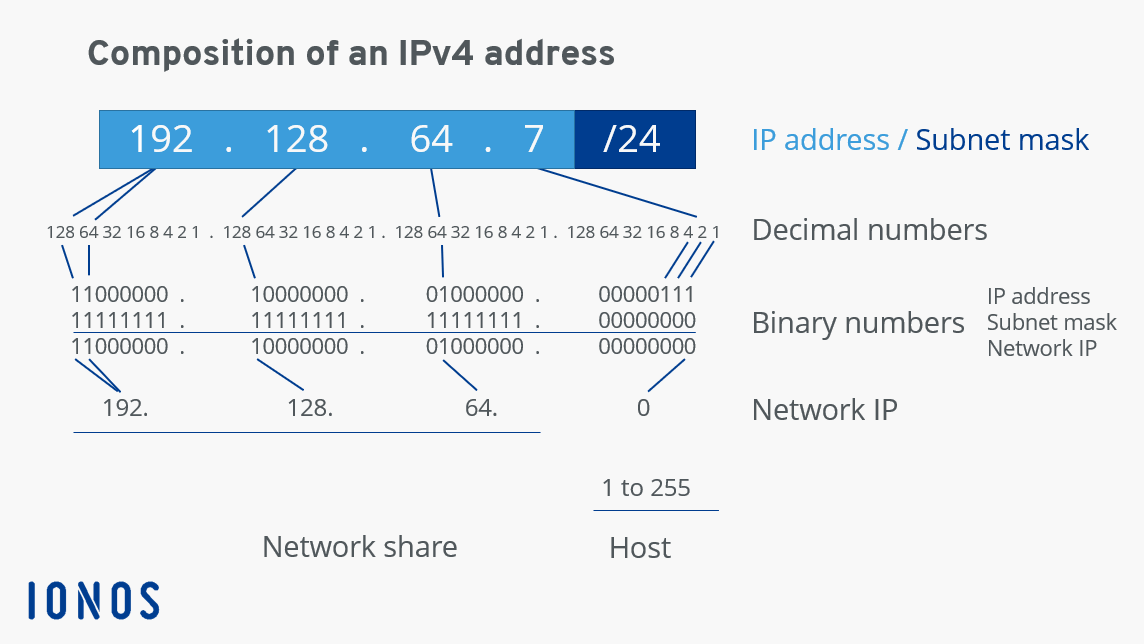
Every device on a network is assigned an IP address, which uniquely identifies it. This IP address, along with a subnet mask, defines the network segment to which the device belongs. The subnet mask essentially divides an IP address into two parts: the network portion and the host portion.
For example, in the IP address 192.168.1.100 with a subnet mask of 255.255.255.0, the first three octets (192.168.1) represent the network address, and the last octet (100) represents the host address. This means all devices with IP addresses ranging from 192.168.1.0 to 192.168.1.255 are considered to be on the same local network segment.
Constructing the Broadcast Address
Within a given network segment, the broadcast address is derived by setting all bits in the host portion of the IP address to ‘1’.
Let’s revisit our example:
- IP Address:
192.168.1.100 - Subnet Mask:
255.255.255.0
In binary, the subnet mask 255.255.255.0 indicates that the first 24 bits are for the network, and the last 8 bits are for the host.
- Network portion (first 24 bits):
11000000.10101000.00000001 - Host portion (last 8 bits of
192.168.1.100):01100100
To find the broadcast address, we take the network portion and append ‘1’s for the host portion:
- Network portion:
11000000.10101000.00000001 - Host portion (all ‘1’s):
11111111
Combining them gives us the binary representation of the broadcast address: 11000000.10101000.00000001.11111111.
Converting this back to decimal, we get 192.168.1.255. This is the broadcast address for the 192.168.1.0/24 network. Any packet sent to 192.168.1.255 will be received by all devices within that 192.168.1.x subnet.
Special Broadcast Addresses
There are two key types of broadcast addresses to be aware of:
Directed Broadcast Addresses
A directed broadcast address is a broadcast message that is specifically destined for all hosts within a particular subnet, but the broadcast is initiated from a different subnet. For instance, a device on the 10.0.0.x network could send a directed broadcast to the 192.168.1.x network by addressing it to 192.168.1.255.

Historically, directed broadcasts were used for network management and remote administration. However, they pose a significant security risk. Attackers could exploit directed broadcasts to launch Denial of Service (DoS) attacks, flooding a target network with unwanted traffic. This is known as a “Smurf attack” or “distributed reflection attack” if multiple sources are used. Due to these security concerns, most modern routers and firewalls are configured to block directed broadcasts by default, preventing them from traversing between different subnets.
Limited Broadcast Addresses
The limited broadcast address is 255.255.255.255. This address is always used to broadcast messages to all hosts on the local network segment only. It is never routed by routers. When a device sends a packet to 255.255.255.255, it signifies a message that should be delivered to every device connected to the same physical network segment or broadcast domain as the sender.
Limited broadcasts are commonly used for initial network configuration and discovery when a device doesn’t yet have an IP address or network configuration. For example, a device booting up might use a limited broadcast to find a DHCP server. It’s important to note that the limited broadcast address is only meaningful within the local network and cannot be used to reach devices on other subnets.
Broadcast Domains and Their Implications
The concept of a broadcast domain is crucial for understanding the scope and impact of broadcast messages.
Defining a Broadcast Domain
A broadcast domain is a logical segment of a network in which broadcast messages are propagated. All devices within the same broadcast domain will receive broadcast traffic originating from any other device in that same domain.
- Layer 2 Broadcast Domains: Typically, a single VLAN (Virtual Local Area Network) or a physical Ethernet network segment (connected by hubs or unmanaged switches) forms a broadcast domain. A switch, by default, forwards broadcast frames to all its ports, effectively extending the broadcast domain.
- Routers and Broadcast Domains: Routers, by their nature, operate at Layer 3 and are designed to connect different networks (and thus different broadcast domains). Routers do not forward broadcast traffic by default. This is a fundamental aspect of routing that helps to contain broadcast traffic and prevent network storms. When a router receives a broadcast packet on one interface, it will not forward it to any other interface.
The Impact of Broadcast Traffic
While essential for certain network functions, excessive broadcast traffic can have detrimental effects on network performance.
- Broadcast Storms: In a network with misconfigurations or a faulty device, broadcast messages can multiply exponentially, creating a “broadcast storm.” This flood of traffic consumes significant network bandwidth and CPU resources on all devices within the broadcast domain, rendering the network unusable.
- Performance Degradation: Even without a storm, high volumes of broadcast traffic can degrade network performance. Every device within the broadcast domain must receive and process every broadcast packet, regardless of whether it’s relevant to that device. This consumes processing power and can slow down legitimate network operations.
Strategies for Managing Broadcast Traffic
Effective network management involves strategies to control and minimize the impact of broadcast traffic.
- VLAN Segmentation: Implementing VLANs is a primary method for segmenting large networks into smaller broadcast domains. By placing devices into different VLANs, broadcast traffic is confined to the devices within that specific VLAN, reducing the overall broadcast scope and improving network efficiency.
- Subnetting: Proper subnetting also helps in dividing networks logically. While subnetting itself doesn’t directly limit broadcast domains (that’s the role of routers and VLANs), it ensures that broadcast addresses are contained within their intended network segments.
- Router Configuration: Configuring routers to filter or rate-limit broadcast traffic can further help manage network congestion. As mentioned, blocking directed broadcasts is a critical security measure.
- Efficient Protocols: Network administrators should ensure that network protocols are configured to minimize unnecessary broadcasts. For example, using static ARP entries in critical scenarios where broadcast ARP requests might cause issues.
Broadcast in Modern Networking Technologies
While the core concept of broadcast remains, its application and management have evolved with advancements in networking.
Broadcast in IPv6
IPv6, the successor to IPv4, handles broadcasts differently. It largely replaces the traditional IPv4 broadcast address with a more efficient mechanism called multicast.
- No Broadcast Address (255.255.255.255): IPv6 does not have a direct equivalent to the IPv4 limited broadcast address (
255.255.255.255). - All-Nodes Multicast Address: For scenarios where IPv4 used broadcasts to reach all nodes on a local link, IPv6 uses specific multicast addresses. The
ff02::1address is the “all-nodes” multicast address, meaning any packet sent to this address will be received by all IPv6-enabled nodes on the local link. - Solicited-Node Multicast Address: IPv6 also uses multicast for address resolution (equivalent to ARP in IPv4) through a mechanism called Neighbor Discovery Protocol (NDP). It utilizes “solicited-node” multicast addresses, which are derived from the target’s unicast address.
While IPv6 doesn’t use broadcasts in the same way as IPv4, the principle of one-to-many communication is still achieved through its advanced multicast capabilities, offering greater efficiency and control.
Wireless Networking and Broadcasts
In wireless networks, broadcast mechanisms are also in play, though often managed differently.
- SSID Broadcasting: The Service Set Identifier (SSID) of a wireless network is often broadcast by the access point. This allows client devices to discover available networks. However, for enhanced security, administrators can choose to “hide” the SSID, meaning the access point won’t broadcast it, and clients must manually configure the network name.
- Discovery Protocols: Wireless networks utilize various discovery protocols that may involve broadcast or multicast messages to locate devices and services within the local wireless segment.
Cloud and Virtualization Environments
In cloud computing and virtualized environments, the concept of broadcast domains can be managed at a more abstract level. Software-defined networking (SDN) and virtual switches provide sophisticated ways to control network traffic, including broadcasts, within virtualized infrastructure. Administrators have granular control over how broadcast traffic is handled within virtual networks, allowing for better isolation and security.

Conclusion: The Enduring Relevance of Broadcast
The broadcast address, whether the limited 255.255.255.255 or its more specialized forms, is a fundamental building block of IP networking. It enables essential network functions, from initial device discovery to service advertisement, ensuring that devices can effectively communicate and find each other on a local network. While directed broadcasts have largely been mitigated due to security risks, the limited broadcast remains vital for certain low-level network operations.
As networking technologies evolve, with the advent of IPv6 and sophisticated cloud environments, the methods of achieving one-to-many communication may change, often favoring more efficient multicast mechanisms. However, understanding the principles behind broadcast addresses provides invaluable insight into the foundational workings of computer networks, empowering network professionals to design, manage, and troubleshoot effectively. By appreciating the scope and implications of broadcast traffic, administrators can ensure robust, secure, and high-performing network infrastructures.
aViewFromTheCave is a participant in the Amazon Services LLC Associates Program, an affiliate advertising program designed to provide a means for sites to earn advertising fees by advertising and linking to Amazon.com. Amazon, the Amazon logo, AmazonSupply, and the AmazonSupply logo are trademarks of Amazon.com, Inc. or its affiliates. As an Amazon Associate we earn affiliate commissions from qualifying purchases.