
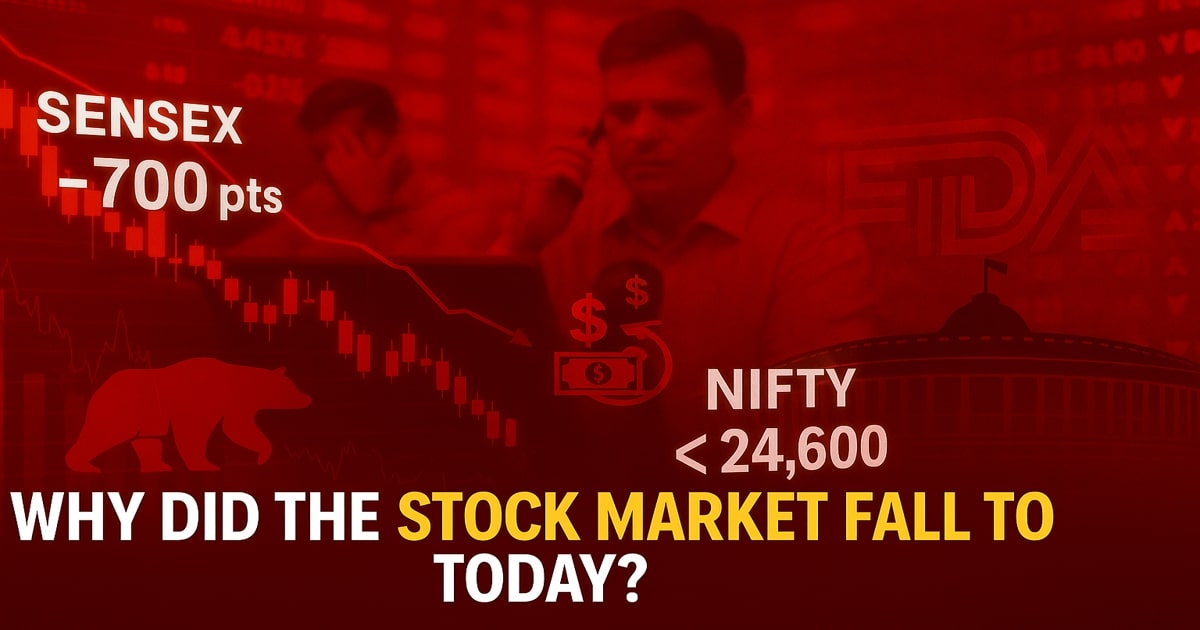
Investors frequently wake up to red screens, watching indices like the S&P 500, the Nasdaq Composite, and the Dow Jones Industrial Average tumble in unison. The immediate question—”why did the market fall today?”—rarely has a single, isolated answer. Instead, market downturns are typically the result of a complex interplay between macroeconomic data, corporate performance, geopolitical shifts, and the psychological state of the global investing community.
To understand a market decline, one must look past the surface-level tickers and examine the structural shifts occurring in the financial landscape. Whether it is a routine correction or the beginning of a sustained bear market, the catalysts usually fall into several distinct categories that dictate how capital flows out of equities and into safer havens.
Macroeconomic Catalysts: The Role of Interest Rates and Inflation
The most common driver of a broad market sell-off in the current economic era is the shifting landscape of monetary policy. Central banks, particularly the Federal Reserve in the United States, wield immense power over equity valuations through their control of interest rates.
The Federal Reserve’s Hawkish Stance
When the Federal Reserve signals a “hawkish” stance—meaning it intends to raise interest rates or keep them elevated for longer—the market often reacts negatively. Higher interest rates increase the cost of borrowing for corporations, which can compress profit margins and slow down expansion plans. For the investor, higher rates also mean that the “discount rate” used to value future cash flows increases. Since a stock’s price is theoretically the present value of all future earnings, a higher discount rate mathematically lowers the current value of those stocks. This is why high-growth sectors, such as technology, are often the hardest hit during interest rate spikes.
Inflationary Pressures and Consumer Spending
Inflation acts as a silent tax on both corporations and consumers. When the Consumer Price Index (CPI) or the Producer Price Index (PPI) prints higher than expected, the market anticipates that the Fed will have to intervene with tighter monetary policy. Furthermore, persistent inflation erodes consumer purchasing power. If the average household is spending more on gasoline, groceries, and housing, they have less discretionary income to fuel the earnings of publicly traded companies in the retail, travel, and entertainment sectors. A market drop is often a preemptive adjustment to the reality of cooling consumer demand.
Corporate Earnings and Growth Deceleration
While macroeconomic trends set the stage, individual corporate health provides the script. Earnings season is a period of heightened volatility where the fundamental reality of business performance meets investor expectations.
Missed Estimates and the “Whisper Number”
A market often falls when bellwether companies—large, influential firms like Apple, Microsoft, or Walmart—miss their earnings estimates. However, it isn’t just about missing the official consensus. Markets often operate on “whisper numbers,” or unofficial expectations that are higher than published analyst forecasts. Even if a company reports solid growth, the stock may fall if that growth wasn’t as explosive as speculators hoped. When several major players across different sectors report lackluster results simultaneously, it can trigger a systemic sell-off as investors reassess the “earnings power” of the entire index.
Forward Guidance: The Ghost of Recessions Past
Often, the reason the market falls today isn’t because of what happened in the last quarter, but because of what management says about the next one. Forward guidance is the outlook provided by corporate executives during earnings calls. If CEOs express caution regarding supply chain disruptions, rising labor costs, or waning demand, investors will “de-risk” by selling off shares. This forward-looking nature of the market means that stocks can crash even amidst record profits if the “narrative” suggests that those profits have peaked.
Geopolitical Uncertainty and Global Supply Chains

Financial markets loathe uncertainty. While economic data is quantifiable, geopolitical events are often unpredictable and binary, leading to rapid “risk-off” movements where investors flee equities in favor of gold, government bonds, or cash.
Energy Prices and Commodity Spikes
Geopolitical tensions in oil-producing regions can lead to immediate spikes in energy prices. Because energy is an input cost for almost every industry—from manufacturing to shipping—a surge in crude oil or natural gas prices acts as a massive headwind for the global economy. When the market falls due to geopolitical strife, it is often reflecting the increased cost of doing business and the potential for a “supply shock” that could stall economic growth.
International Trade Tensions and Currency Fluctuations
In a globalized economy, trade wars or the imposition of tariffs can disrupt the flow of goods and increase costs for multinational corporations. Furthermore, volatility in the currency markets—such as a rapidly strengthening U.S. Dollar—can hurt the domestic market. A strong dollar makes American goods more expensive for foreign buyers and reduces the value of international revenue when it is converted back into USD. For the S&P 500, which derives a significant portion of its revenue from overseas, currency headwinds are a frequent culprit behind sudden market dips.
Technical Factors and Investor Psychology
Not every market decline is rooted in “hard” fundamental data. Sometimes, the mechanics of the market itself and the collective psychology of its participants drive prices downward in a self-reinforcing cycle.
Profit Taking and Resistance Levels
After a period of sustained gains, many institutional investors and algorithmic trading systems look for opportunities to “lock in” profits. When an index hits a psychological “resistance level” (a price point it has historically struggled to move past), a wave of selling can occur. This profit-taking can trigger “stop-loss” orders—automated sell instructions that execute once a stock hits a certain price. As more stop-losses are triggered, the volume of selling increases, causing the price to drop further and creating a feedback loop.
The Fear Factor: VIX and Panic Selling
The CBOE Volatility Index (VIX), often called the “Fear Gauge,” measures the market’s expectation of 30-day volatility. When the VIX spikes, it indicates that investors are buying “put options” to hedge against a downturn. High levels of fear can lead to irrational panic selling, where investors ignore fundamentals and sell positions simply because they see the market falling. This emotional contagion is often exacerbated by 24-hour financial news cycles that amplify negative headlines, causing retail investors to exit the market at the worst possible time.
Navigating the Downturn: Strategies for Long-Term Investors
While a falling market can be unsettling, it is a natural and necessary part of the market cycle. Significant wealth is rarely built in a straight line; rather, it is built by those who can remain disciplined when the market turns sour.
Dollar-Cost Averaging in a Bearish Climate
For the long-term investor, a falling market is often a buying opportunity disguised as a crisis. Dollar-cost averaging (DCA)—the practice of investing a fixed amount of money at regular intervals regardless of share price—allows investors to buy more shares when prices are low and fewer when prices are high. This strategy removes the emotional burden of trying to “time the bottom” and ensures that the investor benefits from the eventual recovery.
Rebalancing and Risk Mitigation
A market downturn is an excellent time to review asset allocation. If a portfolio was heavily weighted in high-beta tech stocks that have plummeted, it might be an indication that the portfolio’s risk profile was too high for the investor’s actual tolerance. Rebalancing involves selling assets that have performed relatively well (like defensive stocks or bonds) and buying those that have become undervalued. This disciplined approach forces the investor to “buy low and sell high,” adhering to the most fundamental rule of investing.
The Importance of Liquidity and Time Horizons
The reason most people lose money when the market falls today is that they are forced to sell. Whether due to a margin call or a sudden need for cash, selling during a downturn crystallizes losses. Maintaining an adequate emergency fund and ensuring that money needed within the next three to five years is not tied up in volatile equities is the best defense against market crashes.
In conclusion, when the market falls, it is rarely the result of a single factor. It is the culmination of interest rate expectations, corporate health, global stability, and the mechanical realities of trading. By understanding these drivers, an investor can transition from a state of reactive fear to one of proactive strategy, recognizing that while the market may fall today, the long-term trajectory of disciplined investing remains the most proven path to wealth creation.
aViewFromTheCave is a participant in the Amazon Services LLC Associates Program, an affiliate advertising program designed to provide a means for sites to earn advertising fees by advertising and linking to Amazon.com. Amazon, the Amazon logo, AmazonSupply, and the AmazonSupply logo are trademarks of Amazon.com, Inc. or its affiliates. As an Amazon Associate we earn affiliate commissions from qualifying purchases.