
The Invesco QQQ Trust, often referred to by its ticker symbol QQQ, is one of the most widely recognized and heavily traded exchange-traded funds (ETFs) in the global financial market. Since its inception in 1999, it has become synonymous with growth, innovation, and the digital economy. For investors looking to build wealth through exposure to the largest non-financial companies listed on the Nasdaq Stock Market, understanding exactly which companies are in QQQ—and why—is fundamental to a sound investment strategy.
Understanding the Structure of the Invesco QQQ Trust
To understand what companies are in QQQ, one must first understand the index it tracks: the Nasdaq-100 Index. This index is comprised of the 100 largest non-financial organizations listed on the Nasdaq based on market capitalization. This specific focus on non-financial entities means you will not find banks, insurance companies, or brokerage firms in this particular fund.

The Methodology of Inclusion
The QQQ portfolio is not chosen by a fund manager’s subjective whim but rather by a strict set of quantitative rules. To be eligible for inclusion, a company must have its primary listing on the Nasdaq. While many assume the QQQ is strictly an American fund, it actually includes several international companies, provided they are listed on the Nasdaq exchange and meet liquidity requirements.
A company must also maintain a minimum average daily trading volume to ensure that the ETF can buy and sell shares without causing massive price swings. Furthermore, the index is a modified market-capitalization-weighted index. This means that the larger the company’s total market value, the larger its slice of the QQQ pie. However, there are “caps” or weighting adjustments made periodically to ensure that a single company does not overwhelm the entire fund, maintaining a level of diversification despite its concentrated nature.
Rebalancing and Reconstitution
The makeup of QQQ is not static. The Nasdaq-100 undergoes an annual reconstitution every December. During this process, the market caps of all eligible companies are reviewed. Some companies that have seen significant growth may be added, while those that have shrunk in value or shifted to other exchanges are removed. Additionally, the index undergoes quarterly rebalancing to adjust the weights of the holdings based on recent price movements. For the investor, this means that QQQ is a self-cleaning vehicle; it automatically sheds laggards and increases exposure to the market’s newest winners.
The Dominant Players: Top Holdings and the “Magnificent Seven”
When you look at the list of companies in QQQ, the top of the list is dominated by a group of names that have redefined the global economy over the last two decades. Because the fund is market-cap weighted, these giants dictate the direction of the ETF’s performance more than any other group.
The Influence of Big Tech
As of the current market cycle, the “Magnificent Seven”—Apple, Microsoft, Alphabet (Google), Amazon, Nvidia, Meta Platforms (Facebook), and Tesla—represent a massive portion of the fund’s total assets.
Microsoft and Apple frequently battle for the top spot, often each representing 8% to 10% of the total fund. These companies are included not just because they are “tech” companies, but because they have achieved trillion-dollar valuations through massive cash flows and dominant market positions. Nvidia has recently surged to the top of the rankings due to its dominance in the artificial intelligence (AI) chip market, making it a pivotal driver of QQQ’s recent returns.
Concentration Risk and Reward
Investing in QQQ means placing a heavy bet on these top ten companies. In many years, the top ten holdings account for nearly 45% to 50% of the fund’s total value. From a wealth-building perspective, this concentration has been a boon during bull markets where high-growth technology leads the way. However, it also introduces “concentration risk.” If a regulatory change or a shift in consumer behavior impacts just two or three of these mega-cap giants, the entire QQQ fund can experience significant volatility, regardless of how the other 90 companies are performing.
Sector Allocation: Beyond the “Tech” Label
A common misconception is that QQQ is a “Technology ETF.” While information technology is undoubtedly the largest sector within the fund, the Nasdaq-100 is surprisingly diverse across other innovative industries. To understand the full scope of what companies are in QQQ, we must look at the sector breakdown.
Consumer Discretionary and Communication Services
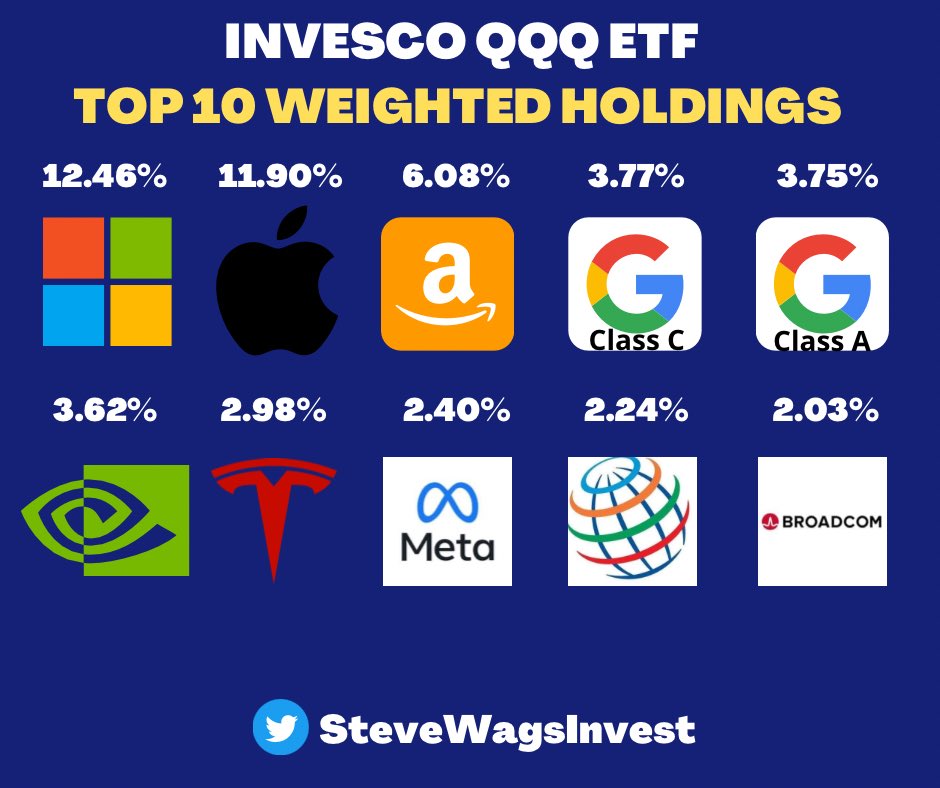
The Consumer Discretionary sector is a massive pillar of QQQ. This includes companies like Amazon and Tesla. While these are often viewed as tech companies, their primary business models involve retail and automotive sales, respectively. Other staples in this category include Starbucks, Booking Holdings, and Airbnb. These companies provide exposure to consumer spending habits and the “experience economy.”
Communication Services is another heavy-hitter, housing Alphabet and Meta Platforms, alongside Netflix and Comcast. This sector captures the shift from traditional media to digital advertising and streaming. If you own QQQ, you are essentially owning the infrastructure of how the world communicates and consumes entertainment.
Healthcare and Biotechnology
One of the more overlooked segments of the QQQ is its exposure to healthcare, specifically biotechnology. Companies like Amgen, Gilead Sciences, and Regeneron Pharmaceuticals are long-standing members of the index. These companies represent the cutting edge of genomic research and drug development. For an investor, this provides a hedge against the cyclicality of tech; healthcare demand remains relatively stable even during economic downturns, providing a layer of “defensive growth” to the portfolio.
Industrials and Other Sectors
The remaining portion of the fund is filled with industrial innovators and retailers. Companies like Honeywell International, which focuses on aerospace and automation, or Costco Wholesale, a retail giant, provide exposure to physical goods and logistics. You will also find names like Monster Beverage and PepsiCo, which add a touch of consumer staples to the mix. This variety ensures that while the fund is growth-heavy, it is not entirely dependent on software and chips.
Performance Analysis: Why the Portfolio Matters
The reason so many investors ask “what companies are in QQQ” is due to the fund’s legendary performance. Over the last decade, QQQ has consistently outperformed the broader S&P 500 index. This outperformance is driven by the specific characteristics of the companies included in the Nasdaq-100.
The Role of Intangible Assets
The companies within QQQ are typically “asset-light.” Unlike traditional industrial companies that require massive factories and physical raw materials, many QQQ companies rely on intellectual property, software code, and brand equity. This allows for much higher profit margins and the ability to scale globally with minimal incremental cost. When you invest in the companies within QQQ, you are primarily investing in human capital and innovation.
Valuation and Interest Rate Sensitivity
Because many companies in QQQ are valued based on their future earnings potential rather than their current book value, the fund is highly sensitive to interest rates. When interest rates rise, the “discount rate” applied to future cash flows increases, which can lead to a contraction in the stock prices of growth companies. Investors must be aware that while the companies in QQQ are high-quality, their stock prices can be more volatile than the average utility or value stock during periods of monetary tightening.
Strategic Implementation: How to Invest in QQQ
Understanding the constituent companies is the first step; the second is knowing how to integrate this information into a personal finance strategy. Because QQQ is so concentrated in large-cap growth, it often serves as a “satellite” holding or a growth engine within a broader diversified portfolio.
QQQ vs. QQQM: Cost Efficiency
For the long-term investor, there is an important distinction to make between the standard QQQ and its newer sibling, QQQM (Invesco NASDAQ 100 ETF). Both funds hold the exact same companies. However, QQQM has a lower expense ratio—the annual fee you pay to the fund manager. While the original QQQ is more liquid and better for active traders and options players, QQQM is often the better choice for buy-and-hold investors looking to keep more of their returns over several decades.
Risk Management through Diversification
Given the heavy weighting of companies like Apple and Microsoft, investors should check their other holdings to avoid “over-concentration.” If you already own a large-cap core fund or significant shares of individual tech stocks, adding QQQ might make your portfolio too dependent on a single sector. Financial advisors often recommend balancing a QQQ position with value-oriented funds, small-cap stocks, or international equities that do not overlap with the Nasdaq-100’s tech-heavy roster.

The Future of the QQQ Portfolio
As we look toward the next decade, the companies in QQQ are likely to be the primary beneficiaries of the “Fourth Industrial Revolution.” The rise of artificial intelligence, renewable energy, and digital finance is already reflected in the index’s shifting weights. Companies that were small players five years ago are now becoming core holdings. By staying invested in QQQ, an investor is essentially outsourcing the research process to the market itself, ensuring that their capital is always flowing toward the companies that are defining the future of the global economy.
aViewFromTheCave is a participant in the Amazon Services LLC Associates Program, an affiliate advertising program designed to provide a means for sites to earn advertising fees by advertising and linking to Amazon.com. Amazon, the Amazon logo, AmazonSupply, and the AmazonSupply logo are trademarks of Amazon.com, Inc. or its affiliates. As an Amazon Associate we earn affiliate commissions from qualifying purchases.