
Understanding the share count of a global behemoth like Apple Inc. (AAPL) is more than just a search for a single number; it is a deep dive into the company’s capital allocation strategy, its valuation mechanics, and its commitment to shareholder value. As of the most recent fiscal filings in early 2024, Apple has approximately 15.33 billion shares outstanding. However, for the serious investor, this number is a moving target that tells a compelling story of financial engineering and corporate discipline.
In the world of finance, shares outstanding represent the total number of shares currently held by all stockholders, including share blocks held by institutional investors and restricted shares owned by the company’s officers and insiders. For Apple, this figure is the denominator in several critical financial ratios, most notably Earnings Per Share (EPS). By examining the trajectory of Apple’s share count, we can uncover how the company has managed to maintain stellar stock performance even during periods of decelerating revenue growth.
The Mechanics of Apple’s Capital Structure
To grasp the significance of Apple’s 15.33 billion shares, one must first distinguish between “authorized,” “issued,” and “outstanding” shares. Authorized shares are the maximum number of shares the company is legally allowed to issue according to its corporate charter. Issued shares are those that have been distributed to investors, while shares outstanding are those issued shares minus any shares held in the company’s treasury.
Basic vs. Diluted Shares Outstanding
When looking at Apple’s quarterly earnings reports (10-Q) or annual reports (10-K), investors will see two different figures: basic and diluted shares outstanding.
-
Basic Shares Outstanding: This includes only the shares currently in the hands of the public and insiders.
-
Diluted Shares Outstanding: This is a more conservative and comprehensive number. It includes basic shares plus all potential shares that could be created through the exercise of employee stock options, restricted stock units (RSUs), and convertible securities.
For Apple, the gap between basic and diluted shares is relatively narrow but significant. When calculating the P/E (Price-to-Earnings) ratio, the market almost exclusively uses the diluted share count to ensure that the valuation accounts for the potential “dilution” of existing ownership.
The Impact of Historical Stock Splits
The current count of 15.33 billion might seem astronomical compared to other “Magnificent Seven” stocks. This is primarily due to Apple’s history of stock splits. Apple has split its stock five times since going public:
-
June 16, 1987 (2-for-1)
-
June 21, 2000 (2-for-1)
-
February 28, 2005 (2-for-1)
-
June 9, 2014 (7-for-1)
-
August 28, 2020 (4-for-1)
Without these splits, a single share of Apple would be worth tens of thousands of dollars, making it inaccessible to most retail investors. The splits increased the number of shares outstanding while lower the price per share proportionally, keeping the total market capitalization the same but increasing liquidity.
The Shrinking Denominator: Apple’s Massive Buyback Program
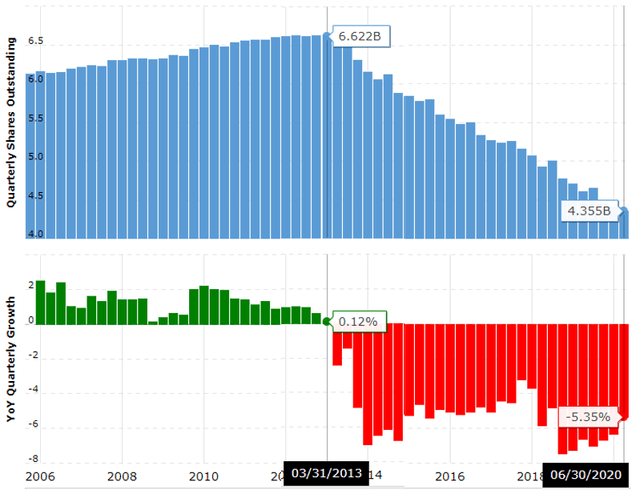
The most fascinating aspect of Apple’s share count is not its current size, but its steady decline. Since 2012, Apple has engaged in one of the most aggressive share repurchase programs in corporate history. This strategy, often referred to as a “buyback,” involves the company using its massive cash reserves to buy its own stock from the open market and effectively retire those shares.
The Math of Accretion
Why does Apple buy back so much of its own stock? The answer lies in the “Money” niche’s most fundamental principle: maximizing shareholder value. When the number of shares outstanding decreases, each remaining share represents a larger percentage of the company’s earnings.
For example, if a company earns $100 and has 100 shares, the EPS is $1.00. If the company buys back 20 shares, leaving only 80 shares outstanding, the same $100 in earnings results in an EPS of $1.25. This 25% increase in EPS occurs without the company actually growing its net income. For Apple, this has been a primary driver of stock price appreciation. By reducing the “denominator” (shares outstanding), they make the “numerator” (net income) work harder for the investor.

The “Net Cash Neutral” Goal
Apple’s management, led by CFO Luca Maestri and CEO Tim Cook, has frequently stated their goal of becoming “net cash neutral.” At its peak, Apple held over $250 billion in cash and marketable securities. Holding too much cash on a balance sheet can actually drag down a company’s Return on Equity (ROE). By returning this cash to shareholders through buybacks and dividends, Apple optimizes its capital structure.
Over the last decade, Apple has spent over $600 billion on share repurchases. To put that in perspective, Apple has spent more on its own shares than the total market capitalization of most companies in the S&P 500. This consistent demand for its own stock provides a “floor” for the share price and signals to the market that management believes the stock is undervalued.
Why Investors Must Track Share Count Diligence
For the individual investor or financial analyst, the share count is the lens through which all other financial metrics are viewed. If you are calculating the intrinsic value of Apple using a Discounted Cash Flow (DCF) model, the final step is dividing the enterprise value by the diluted shares outstanding to arrive at a fair price per share.
Valuation and Market Capitalization
Market capitalization is calculated by multiplying the current share price by the total number of shares outstanding. If Apple is trading at $190 per share with 15.33 billion shares, its market cap is approximately $2.9 trillion.
Investors must watch the share count to ensure that “growth” isn’t being masked by dilution. In many tech companies, high levels of stock-based compensation (SBC) can lead to a rising share count, which dilutes existing shareholders. Apple, however, is a rare case where the buyback program far outpaces the issuance of new shares for employees, leading to a “net reduction” in share count year-over-year.
The Dividend Connection
Apple also pays a quarterly dividend. The total amount of money Apple spends on dividends is directly tied to the number of shares outstanding. As the company retires shares through buybacks, it can actually increase the dividend per share without necessarily increasing the total cash outflow for dividends. This is a powerful “double whammy” for income-focused investors: they own a larger piece of the pie, and each piece pays out more cash, even if the total “pie” of dividend allocation stays the same size.
Comparing Apple’s Strategy to the Broader Market
In the context of business finance, Apple’s management of its shares outstanding serves as a gold standard. While other tech companies have faced criticism for using buybacks to “prope up” share prices during downturns, Apple has utilized them as a consistent, long-term tool for capital efficiency.
Buybacks vs. R&D Investment
A common critique in financial circles is whether companies should spend billions on buybacks instead of Research and Development (R&D). However, a look at Apple’s financial statements reveals that they do both. Apple’s R&D spending has climbed steadily, reaching nearly $30 billion annually. Because Apple generates such immense free cash flow—often exceeding $100 billion a year—it does not have to choose between innovation and share repurchases; it can comfortably afford both.
The Tax Efficiency Perspective
From a “Money” and tax-planning perspective, share buybacks are often seen as more efficient than dividends. When a company pays a dividend, shareholders are immediately taxed on that income. When a company repurchases shares, the value is returned via a higher share price. Investors only pay taxes on those gains when they choose to sell their shares, allowing for long-term capital gains treatment and tax-deferred compounding.
The Investor’s Takeaway: Looking Ahead
As of today, Apple’s 15.33 billion shares outstanding represent a company that is leaner and more financially optimized than it was five years ago. For the investor, monitoring this number is a way to gauge the health of Apple’s “Capital Return Program.”
If the pace of buybacks were to slow down significantly, it might indicate that Apple sees better uses for its cash (such as a massive acquisition) or that it views its stock as currently overvalued. Conversely, a continued reduction in the share count suggests that the board of directors remains confident in the company’s long-term trajectory and its ability to generate excess cash.
In conclusion, the number of shares outstanding is not just a static data point; it is a dynamic reflection of Apple’s dominance in the global markets. By systematically reducing the supply of its shares while the global demand for its ecosystem remains high, Apple has created a powerful mechanism for wealth creation. Whether you are a retail investor holding ten shares or a fund manager holding ten million, the “shrinking denominator” of Apple’s share count remains one of the most important factors in the stock’s long-term performance. Keeping a close eye on the quarterly 10-Q filings will ensure you stay informed on exactly how much of this tech titan you truly own.
aViewFromTheCave is a participant in the Amazon Services LLC Associates Program, an affiliate advertising program designed to provide a means for sites to earn advertising fees by advertising and linking to Amazon.com. Amazon, the Amazon logo, AmazonSupply, and the AmazonSupply logo are trademarks of Amazon.com, Inc. or its affiliates. As an Amazon Associate we earn affiliate commissions from qualifying purchases.