
The traditional financial system relies on central banks to issue currency. Whether it is the Federal Reserve in the United States or the European Central Bank in the EU, money is created through policy decisions, printed physically, or issued digitally into the commercial banking system. Bitcoin, however, operates on a fundamentally different paradigm. It is not “issued” by any central authority; instead, it is “mined” through a decentralized, competitive process that combines advanced cryptography with significant physical infrastructure.
To understand how Bitcoin is made is to understand the intersection of computer science and Austrian economics. It is a process that ensures scarcity, security, and transparency without the need for a middleman. For investors, entrepreneurs, and those interested in personal finance, grasping the mechanics of Bitcoin production is essential for evaluating its value as a long-term asset.
The Economic Engine of Bitcoin Mining
At the heart of Bitcoin’s creation is a process known as mining. While the term evokes images of extracting precious metals from the earth, Bitcoin mining is an entirely digital endeavor. However, the analogy holds some weight: just as gold requires physical effort and resources to extract, Bitcoin requires computational work and energy to produce.
Proof of Work: The Consensus Mechanism
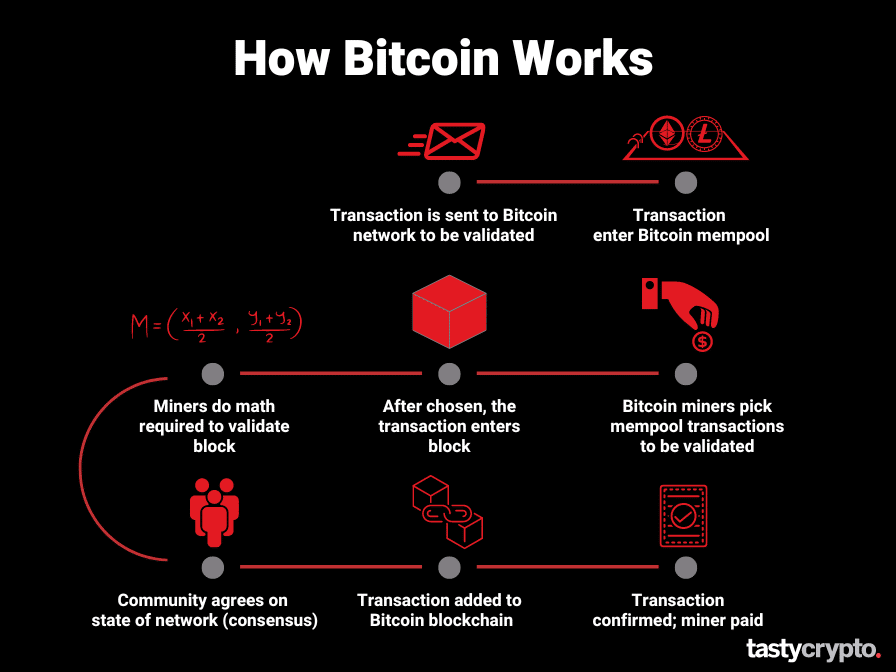
Bitcoin is made through a consensus mechanism called Proof of Work (PoW). This is the protocol that allows the network to agree on which transactions are valid without needing a central bank. In this system, “miners” use powerful computers to solve complex mathematical puzzles. These puzzles are so difficult that they cannot be solved through logic or mathematics alone; they require “brute force”—essentially, trillions of guesses per second.
When a miner successfully finds the solution to a puzzle, they earn the right to add a new “block” of transactions to the blockchain. This process is the only way new Bitcoin enters circulation. It is a competitive race where the winner is rewarded with a specific amount of newly created Bitcoin, known as the “block reward.”
The Role of Miners as Financial Auditors
Beyond merely “making” the currency, miners serve as the decentralized auditors of the network. Every time a block is mined, the miner verifies all the transactions within that block. They ensure that no one is spending Bitcoin they don’t have and that no “double-spending” occurs.
By tying the creation of money to the verification of the ledger, Bitcoin ensures that the people producing the currency are also the ones securing it. This incentive structure is what makes Bitcoin a breakthrough in financial technology. Miners are paid in the very asset they are securing, giving them a direct financial stake in the continued health and integrity of the network.
The Hardware and Infrastructure of Production
In the early days of Bitcoin, anyone with a standard home computer could “make” Bitcoin. You could run the software on a laptop and successfully mine blocks. However, as the network has grown and the value of Bitcoin has increased, the process has become a highly industrial and capital-intensive business.
From CPUs to ASICs: The Evolution of Mining Efficiency
The evolution of Bitcoin mining hardware reflects the professionalization of the industry. Initially, Central Processing Units (CPUs) were sufficient. As competition increased, miners moved to Graphics Processing Units (GPUs), which were much more efficient at the repetitive calculations required for mining.
Today, Bitcoin is made using Application-Specific Integrated Circuits (ASICs). These are machines designed for one purpose and one purpose only: mining Bitcoin. They are thousands of times more efficient than standard computers but come with high price tags and require specialized cooling systems. For the modern investor, the production of Bitcoin is no longer a hobby; it is a sophisticated operation involving warehouses full of high-tech hardware.
Energy Consumption and the Cost of Production
One of the most discussed aspects of how Bitcoin is made is its energy consumption. Because Proof of Work requires massive computational power, it also requires massive amounts of electricity. This energy is the “raw material” of Bitcoin.
From a financial perspective, the cost of electricity is the primary variable in the profitability of making Bitcoin. Miners seek out locations with the cheapest power, often gravitating toward renewable sources like hydroelectric, wind, or geothermal energy. This search for cheap energy has turned Bitcoin miners into global energy arbitrageurs, often utilizing “stranded” energy—power that is produced in remote areas but cannot easily be transported to major cities. Consequently, the production of Bitcoin is intrinsically linked to the global energy market.
The Scarcity Principle: Halving and the 21 Million Cap

Unlike fiat currencies, which can be printed in unlimited quantities, Bitcoin has a hard cap. Only 21 million Bitcoins will ever exist. This digital scarcity is programmed into the code and is enforced by the decentralized network. The way these 21 million coins are released over time is governed by a process called “the halving.”
Understanding the Block Reward
When a miner successfully mines a block, they receive a block reward. In 2009, when Bitcoin first launched, this reward was 50 BTC per block. Approximately every ten minutes, 50 new Bitcoins were “made.” This reward is the primary incentive for miners to contribute their computational power to the network.
However, Bitcoin was designed to be disinflationary. To ensure that the supply does not flood the market and to mimic the increasing difficulty of mining a physical resource like gold, the block reward is programmed to decrease over time.
The Impact of Halving Events on Market Value
Every 210,000 blocks—roughly every four years—the block reward is cut in half. This event is known as “The Halving.” In 2012, the reward dropped to 25 BTC; in 2016, to 12.5 BTC; in 2020, to 6.25 BTC; and in 2024, it dropped to 3.125 BTC.
This halving mechanism is a critical component of Bitcoin’s monetary policy. It reduces the rate at which new Bitcoin is created, effectively tightening the supply. Historically, halving events have been significant catalysts for price appreciation. As the “cost” of making each new Bitcoin increases (because the reward for the same amount of work is halved), the asset becomes scarcer, often leading to increased demand from investors who view it as a hedge against inflation.
Mining as a Business and Investment Strategy
For those looking to “make” Bitcoin today, there are two primary paths: individual mining and mining pools. Given the immense difficulty of the network, the financial strategy behind these paths is vital for anyone considering mining as a side hustle or business venture.
Individual Mining vs. Mining Pools
“Solo mining” is the practice of attempting to mine a block alone. While the potential reward is high (the miner keeps the entire block reward and all transaction fees), the mathematical probability of a single machine solving a block is infinitesimally small. It is essentially a lottery.
To create a more predictable income stream, most miners join “mining pools.” In a pool, thousands of miners combine their computational power to solve blocks collectively. When the pool successfully mines a block, the reward is distributed among all participants based on the amount of work they contributed. For the participant, this turns Bitcoin production into a steadier, more predictable revenue stream, similar to receiving a salary rather than winning a jackpot.
Calculating Profitability and ROI
Making Bitcoin is a game of margins. To determine if mining is a viable financial move, one must calculate the Return on Investment (ROI). The formula includes:
-
Hash Rate: The power of your hardware.
-
Difficulty: A self-adjusting metric that makes mining harder as more miners join the network.
-
Electricity Costs: The price per kilowatt-hour.
-
Hardware Costs: The initial capital expenditure for ASICs.
-
Bitcoin Price: The market value of the coins you produce.
Because the Bitcoin network adjusts its “difficulty” every two weeks, the landscape is constantly shifting. If many miners join the network, the difficulty goes up, making it harder to make Bitcoin. If miners leave, the difficulty goes down. This “difficulty adjustment” ensures that blocks are produced roughly every ten minutes, regardless of how much total power is on the network.
The Future of Bitcoin Issuance and Global Finance
As we approach the final stages of Bitcoin production—the last Bitcoin is expected to be mined around the year 2140—the way Bitcoin is “made” will undergo a significant shift.
Transitioning to a Transaction Fee Economy
When the block reward eventually hits zero, miners will no longer be rewarded with “newly made” Bitcoin. Instead, they will be compensated entirely through transaction fees. Every time someone sends Bitcoin, they pay a small fee to the miner who processes the transaction.
This transition is a crucial part of Bitcoin’s long-term economic sustainability. For Bitcoin to remain secure, the transaction fees must provide enough incentive for miners to continue running their hardware. This shift represents Bitcoin’s maturation from an emerging asset to a fully established global financial layer.

Institutional Adoption and Financial Sovereignty
The production of Bitcoin has moved from the basements of tech enthusiasts to the balance sheets of publicly traded companies. Large-scale mining operations are now listed on the NASDAQ, and institutional investors are increasingly viewing the “making” of Bitcoin as a legitimate industrial process.
By understanding how Bitcoin is made, it becomes clear that it is more than just a digital coin. It is a system designed to provide a predictable, transparent, and unforgeable monetary supply. Whether through direct mining or through strategic investment, the process of Bitcoin creation offers a glimpse into a future where money is governed by mathematics and decentralized competition rather than central policy. For the modern student of finance, Bitcoin represents the ultimate fusion of technology and value, a “hard money” for the digital age.
aViewFromTheCave is a participant in the Amazon Services LLC Associates Program, an affiliate advertising program designed to provide a means for sites to earn advertising fees by advertising and linking to Amazon.com. Amazon, the Amazon logo, AmazonSupply, and the AmazonSupply logo are trademarks of Amazon.com, Inc. or its affiliates. As an Amazon Associate we earn affiliate commissions from qualifying purchases.