
The Dow Jones Industrial Average (DJIA), often referred to simply as “the Dow,” is perhaps the most cited and recognized financial benchmark in the world. When news anchors report that “the market is up,” they are frequently referring to the movement of this specific index. Despite its ubiquity, many investors—from beginners to seasoned professionals—often have a cursory understanding of what actually constitutes the index. It is not a broad representation of the thousands of publicly traded companies in the United States; rather, it is a curated, exclusive club of 30 blue-chip companies that serve as a barometer for the health of the American economy.
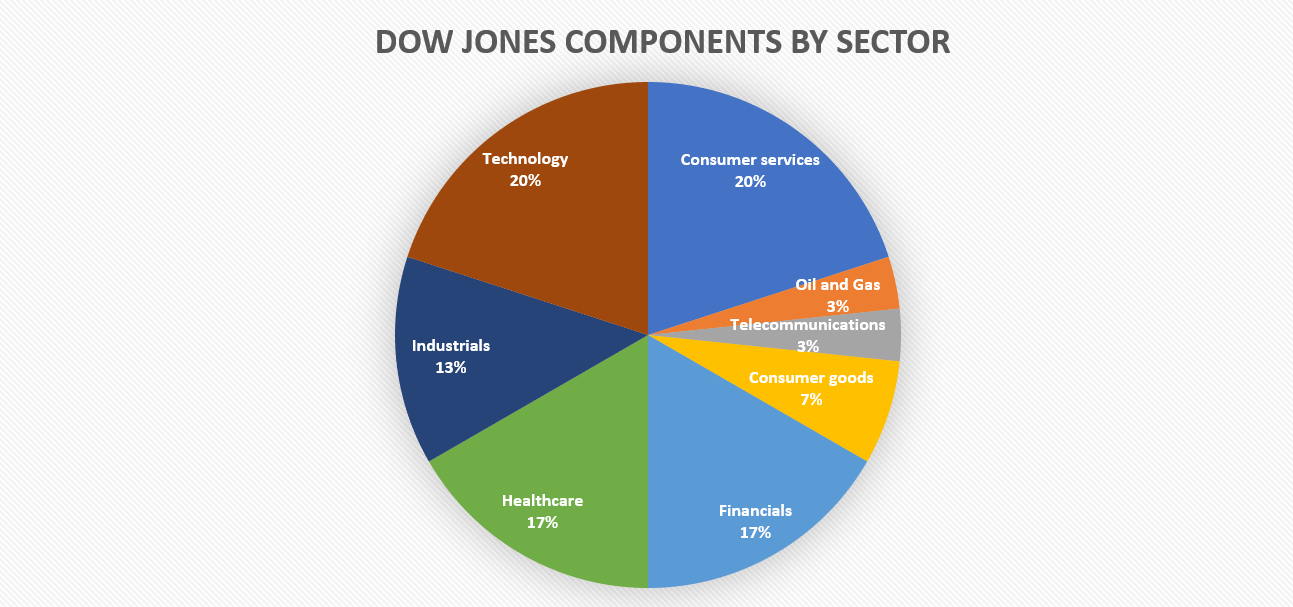
To understand what makes up the Dow Jones, one must look beyond the ticker symbols. The index is a blend of history, unique mathematical weighting, and a rigorous selection process that reflects the shifting landscape of global commerce.
The Structural Blueprint: Understanding the Price-Weighted Model
Unlike the S&P 500 or the Nasdaq Composite, which are market-capitalization-weighted indices, the Dow Jones Industrial Average is a price-weighted index. This distinction is fundamental to how the index is calculated and how it behaves.
The Role of the Dow Divisor
In a market-cap-weighted index, the total value of all outstanding shares determines a company’s influence. In the Dow, however, the price of a single share is the deciding factor. If a company has a share price of $300, it will have a significantly larger impact on the index’s movement than a company with a share price of $50, even if the latter has a larger total market valuation.
To ensure that stock splits, dividends, and other corporate actions do not cause artificial spikes or drops in the index, the Dow uses a mathematical constant known as the “Dow Divisor.” Instead of simply dividing the sum of the 30 stock prices by 30, the sum is divided by this continuously adjusted divisor. As of recent years, the divisor has dropped below 1 (specifically around 0.15), meaning that a $1 move in any single component stock can result in a move of several points in the overall index.
Price vs. Market Capitalization
The price-weighted nature of the Dow has led to unique scenarios in financial history. For instance, a high-priced stock like UnitedHealth Group often carries more weight in the Dow than a tech giant like Apple or Microsoft, simply because its share price is higher, despite Apple and Microsoft having much larger market capitalizations. This methodology is a relic of the late 19th century, designed by Charles Dow to be calculated by hand in an era before high-speed computing. While some critics argue this makes the index less representative of the “true” market, proponents suggest it provides a unique perspective on the performance of the most influential corporate leaders.
The 30 Pillars: Selection Criteria and the Averages Committee
The Dow is not a computer-generated list of the 30 largest companies. Instead, the components are hand-picked by a selection committee. This adds a layer of subjective “prestige” to the index; being “added to the Dow” is often viewed as the ultimate corporate seal of approval.
The Averages Committee
The responsibility for choosing the 30 stocks falls to the Averages Committee, which includes the managing editor of The Wall Street Journal and other representatives from S&P Dow Jones Indices. There are no hard-and-fast quantitative rules for inclusion, such as a minimum market cap requirement. Instead, the committee looks for companies that have an excellent reputation, demonstrate sustained growth, and are of interest to a large number of investors.
Sector Representation and the “Industrial” Misnomer
When the Dow was founded in 1896, it consisted of 12 companies primarily involved in heavy industry—railroads, cotton, gas, and sugar. Today, the word “Industrial” is largely vestigial. The modern Dow represents every major sector of the economy except for transportation and utilities (which have their own specific Dow Jones indices).
The selection committee strives to maintain a balance that reflects the current state of the U.S. economy. This is why, over the decades, heavy manufacturers like Bethlehem Steel and General Motors have been replaced or supplemented by service-oriented firms like Visa, healthcare giants like Amgen, and technology leaders like Salesforce. The goal is to ensure that if the Dow is rising, the “heart” of the American business machine is generally healthy.
Analyzing the Components: A Sector-by-Sector Breakdown

To truly understand what makes up the Dow Jones, one must examine the specific companies that currently hold membership. While the list changes periodically, the components generally fall into several key categories that represent the pillars of the modern economy.
Technology and Communications
In the 21st century, the Dow has leaned heavily into the digital age. Companies like Microsoft and Apple are core components, reflecting the shift from physical manufacturing to software and consumer electronics. The inclusion of Salesforce and Cisco Systems further emphasizes the importance of cloud computing and networking infrastructure. These companies provide the volatility and growth potential that often drive the index’s record-breaking runs.
Financial Services and Insurance
The financial sector is the backbone of the Dow’s stability. With giants like JPMorgan Chase and Goldman Sachs, the index tracks the health of the banking and investment banking sectors. American Express and Visa represent the consumer credit and payment processing side of the economy. These stocks are often sensitive to interest rate changes, making the Dow a sensitive instrument for tracking Federal Reserve policy impacts.
Healthcare and Pharmaceuticals
Healthcare represents a massive portion of U.S. GDP, and the Dow reflects this through components like UnitedHealth Group, Johnson & Johnson, and Merck. These companies offer a defensive element to the index; because people require medical care regardless of economic conditions, these stocks often provide a cushion during market downturns.
Consumer Discretionary and Staples
The American consumer is the engine of the global economy. The Dow captures this through retail powerhouses like Walmart and Home Depot, as well as iconic brands like Coca-Cola and McDonald’s. More recently, the addition of Amazon—replacing Walgreens Boots Alliance—marked a significant milestone, acknowledging the total dominance of e-commerce in the modern retail landscape.
The Evolutionary Process: How the Dow Changes Over Time
The Dow is not a static list. It is a living entity that evolves to remain relevant. The process of adding or removing a company is a major financial event that can trigger billions of dollars in trades as index-tracking funds rebalance their portfolios.
Recent Shifts and Modernization
The removal of General Electric in 2018—the last original member of the index—was a symbolic end to the purely industrial era of the Dow. It was replaced by Walgreens (which has since been replaced by Amazon), signaling a shift toward consumer services and healthcare. These changes are infrequent but necessary. The committee typically waits for a major economic shift or a significant decline in a company’s relevance before making a swap. For example, the inclusion of Intel in the late 90s signaled the arrival of the semiconductor age, while its potential future removal or the addition of an AI-centric firm like Nvidia would signal the next technological frontier.
Why Companies Get Removed
A company is typically removed from the Dow for one of three reasons:
-
Irrelevance: The company no longer represents a major portion of its sector or the economy.
-
Corporate Action: The company is acquired, merged, or undergoes a massive restructuring that changes its core business.
-
Price Irregularity: Because the index is price-weighted, if a stock price falls too low (e.g., under $10 or $20), it loses its ability to influence the index, making its inclusion mathematically redundant. Conversely, if a stock price becomes too high, it might undergo a stock split to remain in the index without overwhelming the other 29 members.
The Dow’s Role in Modern Personal Finance and Investing
For the individual investor, understanding what makes up the Dow Jones is essential for portfolio construction and risk management. While many professionals prefer the S&P 500 for its breadth, the Dow remains a vital tool for several reasons.
The Psychological Benchmark
The Dow is the “mood ring” of the investing public. Because it consists of only 30 well-known household names, it is easier for the general public to grasp. When an investor sees that the Dow is up 500 points, it creates a sense of optimism that filters through the rest of the market. Understanding the components allows an investor to see why the mood is shifting. If the Dow is down but the Nasdaq is up, it usually indicates a rotation out of “value” blue-chip stocks and into “growth” tech stocks.
Investing in the Dow
You cannot “buy” the Dow Jones Industrial Average directly, as it is just a mathematical formula. However, the rise of Exchange-Traded Funds (ETFs) has made it simple for anyone to own a piece of all 30 companies. The SPDR Dow Jones Industrial Average ETF (ticker: DIA), often called “Diamonds,” is one of the most liquid ways to track the index. By holding this ETF, an investor is essentially betting on the continued dominance of the 30 most powerful corporations in America.

The Dividend Advantage
Because the Dow is composed of mature, established “blue-chip” companies, it tends to have a higher dividend yield than more growth-oriented indices. Many of its components, such as Procter & Gamble or 3M, are “Dividend Aristocrats”—companies that have increased their payouts for decades. For the income-focused investor, the Dow represents a collection of the most reliable cash-flow generators in the business world.
In conclusion, the Dow Jones Industrial Average is far more than a simple number on a screen. It is a curated gallery of corporate excellence, a testament to the history of American capitalism, and a sophisticated—albeit idiosyncratic—mathematical model. By understanding the price-weighting mechanics, the rigorous selection by the Averages Committee, and the specific sectors represented, investors can gain a deeper insight into the forces driving the global economy. Whether it is reflecting the rise of the internet or the resilience of the healthcare sector, the Dow remains the definitive shorthand for the “Market” itself.
aViewFromTheCave is a participant in the Amazon Services LLC Associates Program, an affiliate advertising program designed to provide a means for sites to earn advertising fees by advertising and linking to Amazon.com. Amazon, the Amazon logo, AmazonSupply, and the AmazonSupply logo are trademarks of Amazon.com, Inc. or its affiliates. As an Amazon Associate we earn affiliate commissions from qualifying purchases.