
In the vast and intricate landscape of technology, seemingly abstract mathematical concepts often serve as the invisible backbone for groundbreaking innovations. Among these foundational elements are even and odd functions – simple yet profoundly impactful mathematical classifications that describe the symmetry of a function. While originating in pure mathematics, the principles of even and odd functions permeate fields ranging from digital signal processing and image manipulation to algorithm design and the very architecture of artificial intelligence. Understanding these concepts is not merely an academic exercise; for tech professionals, it unlocks a deeper appreciation for the logic underpinning complex systems and provides powerful tools for analysis, optimization, and problem-solving. This article delves into the definitions, properties, and extensive applications of even and odd functions within the technological domain, illuminating their indispensable role in shaping the digital world.
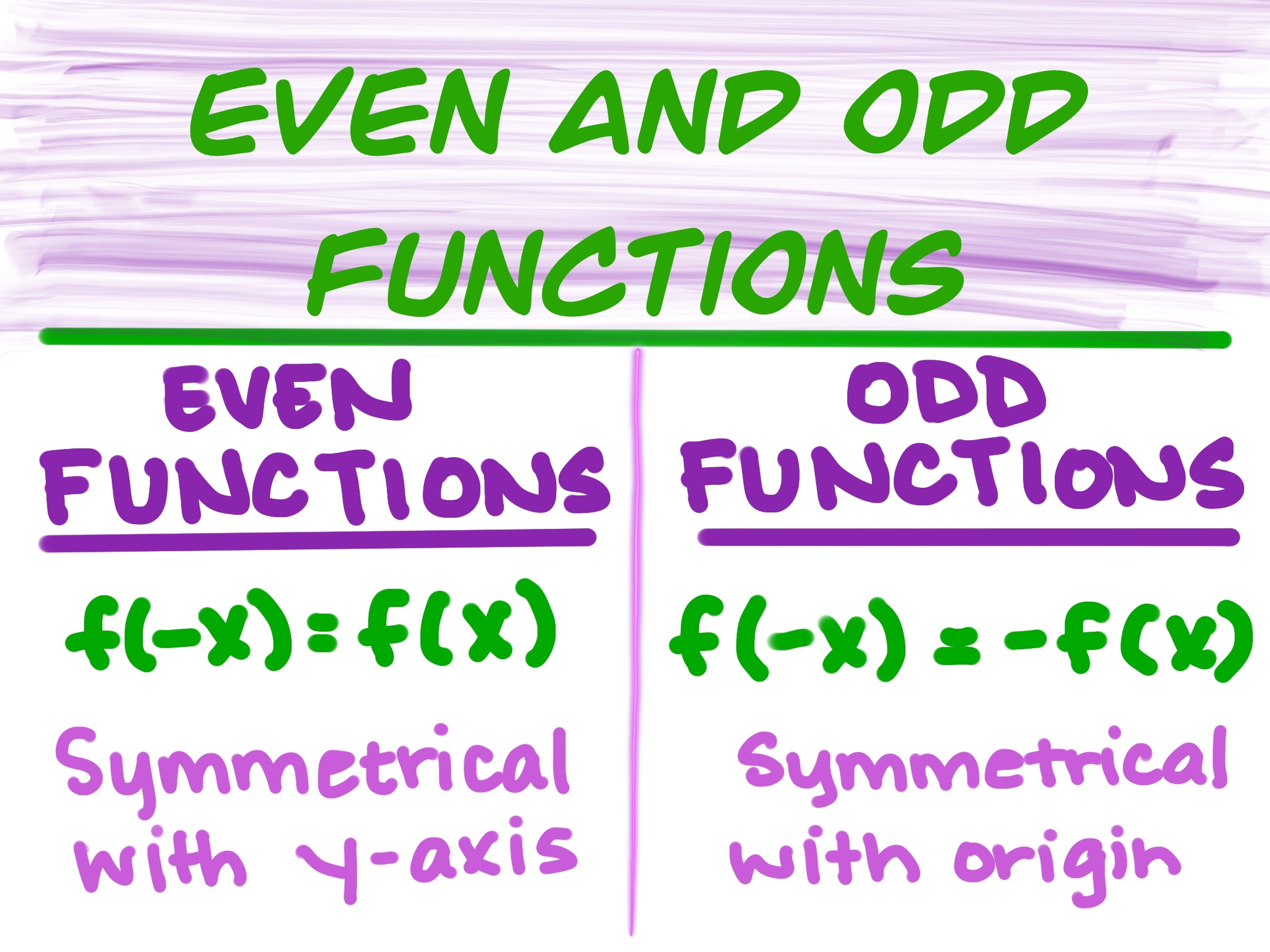
The Mathematical Foundation: Defining Even and Odd Functions
At their core, even and odd functions are characterized by specific types of symmetry with respect to the coordinate axes. These definitions provide a powerful framework for categorizing functions, which in turn offers insights into their behavior and how they interact with various computational processes.
Defining Even Functions (Symmetry about the y-axis)
An even function is formally defined by the property that for every x in its domain, f(x) = f(-x). This means that if you input a positive value x or its negative counterpart -x into the function, the output will be identical. Graphically, this translates to perfect symmetry with respect to the y-axis. If you were to fold the graph along the y-axis, the two halves would perfectly overlap.
Classic examples of even functions include f(x) = x^2, where (-x)^2 = x^2, and the cosine function, f(x) = cos(x), where cos(-x) = cos(x). Constant functions, such as f(x) = c, are also even, as c = c. In the realm of technology, this y-axis symmetry is particularly relevant for analyzing signals or data where the magnitude or intensity is independent of the direction or sign of the input. For instance, in spectral analysis, the magnitude spectrum of a real-valued signal is always an even function, simplifying its representation and processing.
Defining Odd Functions (Symmetry about the Origin)
In contrast, an odd function is defined by the property f(x) = -f(-x) for every x in its domain. This implies that if you input x and -x, their corresponding outputs will have the same magnitude but opposite signs. Graphically, an odd function exhibits rotational symmetry about the origin. If you rotate its graph 180 degrees around the origin, it will appear unchanged.
Prime examples of odd functions include f(x) = x^3, where (-x)^3 = -x^3, and the sine function, f(x) = sin(x), where sin(-x) = -sin(x). This type of symmetry is crucial in applications where the direction or polarity of the input directly influences the sign of the output, such as in certain types of waveform analysis or phase detection. The phase spectrum of a real-valued signal, for instance, is an odd function.
Functions That Are Neither Even Nor Odd
It’s important to recognize that not all functions fit neatly into the “even” or “odd” categories. In fact, the majority of functions encountered in practical applications are neither. A simple example is f(x) = x^2 + x. Here, f(x) = x^2 + x, but f(-x) = (-x)^2 + (-x) = x^2 - x. Since f(x) is not equal to f(-x) (unless x=0), and f(x) is not equal to -f(-x) (unless x=0), this function is neither even nor odd.
However, a remarkable mathematical property states that any function can be uniquely expressed as the sum of an even function and an odd function. This decomposition is incredibly powerful in digital signal processing. If f(x) is a given function, its even component fe(x) can be found using fe(x) = [f(x) + f(-x)] / 2, and its odd component fo(x) using fo(x) = [f(x) - f(-x)] / 2. This ability to decompose complex signals into simpler, symmetrical components greatly simplifies analysis and processing tasks, allowing engineers to address different aspects of a signal independently.
Computational Applications Across Tech Disciplines
The mathematical properties of even and odd functions are not just theoretical curiosities; they are deeply embedded in the algorithms and methodologies that power various technological fields. Their symmetry offers computational advantages, leading to more efficient and effective systems.
Digital Signal Processing (DSP)
In Digital Signal Processing, the concepts of even and odd functions are foundational, particularly in the realm of Fourier analysis. The Fourier Transform, a cornerstone of DSP, decomposes signals into their constituent frequencies. When dealing with real-valued signals, their Fourier Transforms exhibit inherent symmetries related to even and odd functions. Specifically, the real part of the Fourier Transform is an even function, and the imaginary part is an odd function. This understanding allows engineers to simplify calculations, optimize algorithms, and predict signal behavior.
Furthermore, the decomposition of a signal into its even and odd components (as discussed earlier) directly relates to its representation as a sum of cosine and sine waves through Fourier series. Even functions are represented solely by cosine terms, while odd functions are represented solely by sine terms. This simplifies the design of digital filters, the analysis of audio waveforms, and even data compression techniques, where exploiting symmetry can reduce the amount of information needed to represent a signal accurately. For instance, in image and video compression standards like JPEG and MPEG, understanding the spectral symmetry aids in efficient transformation and quantization.
Image Processing and Computer Graphics
Even and odd functions play a subtle yet significant role in image processing and computer graphics. Many image processing operations, such as filtering, convolution, and transformations, implicitly or explicitly leverage these symmetries. For example, some common filters used for edge detection or noise reduction, like Gaussian filters, are often designed with even symmetry to ensure consistent processing regardless of the direction.

In computer graphics, symmetry detection is a common task, whether for object recognition, 3D modeling, or creating realistic visual effects. Algorithms for identifying symmetrical objects or patterns often rely on mathematical descriptions that can be related to even or odd functions. Moreover, transformations like reflections or mirroring, fundamental to graphics applications, directly manifest the principles of even function symmetry. Wavelet transforms, used in image compression and denoising, also utilize basis functions that possess specific symmetry properties, contributing to their efficiency and effectiveness in representing image details across different scales.
Algorithm Design and Optimization
While not always a direct one-to-one application, the underlying principles of symmetry, which even and odd functions embody, are crucial in algorithm design and optimization. For instance, in numerical methods, exploiting the symmetry of a function can significantly reduce the computational cost of integration or differentiation. If an integrand is an odd function over a symmetric interval [-a, a], its integral is zero, eliminating the need for computation. Similarly, for even functions, the integral over [-a, a] can be calculated as twice the integral over [0, a].
More broadly, understanding function properties, including symmetry, helps in designing efficient sorting algorithms, searching algorithms, or even in optimizing the performance of machine learning models. Algorithms that handle data structures with inherent symmetries can be optimized to perform faster by reducing redundant computations. The concept of “balanced trees” in data structures, for example, is about maintaining a form of symmetry to ensure optimal search and insertion times. While not strictly about even/odd functions, it highlights how mathematical properties related to balance and symmetry are leveraged for algorithmic efficiency.
Practical Implications for Software Development and AI
The theoretical underpinnings of even and odd functions translate into tangible benefits and considerations for software developers and AI practitioners, influencing architectural choices and algorithmic performance.
Machine Learning and Deep Learning Architectures
In machine learning, particularly deep learning, the choice and properties of activation functions in neural networks are critical. Some popular activation functions exhibit characteristics related to even and odd functions, which can impact training dynamics and model performance. For instance, the hyperbolic tangent (tanh) activation function is an odd function, centered around zero, which can lead to faster convergence compared to non-centered functions like the sigmoid because it helps normalize the output of each layer. The Rectified Linear Unit (ReLU), widely used today, is neither even nor odd but has a distinct asymmetry that influences how gradients propagate through the network. Understanding these properties helps practitioners make informed decisions about network design and hyperparameter tuning.
Furthermore, leveraging symmetry in data itself can be a powerful strategy for data augmentation. For images, operations like horizontal flipping or rotation (which are forms of symmetry transformation) can effectively multiply the training dataset size, improving model generalization without collecting new data. In feature engineering, identifying and exploiting symmetries in the input data can lead to more robust and meaningful features, simplifying the learning task for the model.
Scientific Computing and Engineering Simulations
Scientific computing and engineering simulations heavily rely on mathematical models that often describe physical phenomena with inherent symmetries. From fluid dynamics to structural analysis, the governing equations frequently possess properties that can be exploited using principles related to even and odd functions. For example, in computational fluid dynamics (CFD) or finite element analysis (FEA), if a physical system (e.g., an airplane wing, a bridge structure) exhibits geometric or material symmetry, the computational domain can often be reduced. Instead of simulating the entire system, engineers might only need to simulate half or a quarter of it, applying appropriate boundary conditions derived from symmetry. This significantly reduces computational load, memory requirements, and simulation time, which are critical in complex, high-fidelity simulations.
Moreover, the numerical solvers used in these simulations often benefit from functions that are even or odd. For instance, in solving partial differential equations, the choice of basis functions in methods like spectral methods or finite element methods can leverage symmetry to simplify matrix operations or ensure the stability of the numerical scheme. This not only speeds up calculations but also contributes to the accuracy and reliability of the simulation results, allowing engineers to design safer and more efficient systems.
Beyond the Basics: Advanced Concepts and Future Trends
The utility of even and odd functions extends beyond conventional applications, influencing advanced mathematical concepts and emerging technological frontiers.
Generalizations and Abstract Algebra
The concepts of even and odd functions find echoes and generalizations in more abstract mathematical fields, particularly in abstract algebra and group theory. Group theory, which studies symmetry, provides a powerful framework for understanding patterns and structures in mathematics and physics. In this context, even and odd functions can be seen as specific instances of functions behaving under certain symmetry operations. This generalization allows mathematicians and computer scientists to develop more sophisticated algorithms for handling complex data structures and cryptographic systems, where understanding fundamental symmetries is paramount. The study of irreducible representations in group theory, for instance, often involves decomposing functions over symmetric domains into components with specific symmetry properties, akin to decomposing a function into its even and odd parts.
Emerging Tech and Research
In the forefront of technological innovation, the principles related to even and odd functions continue to find new applications. In quantum computing, for example, symmetry plays a profound role. Quantum states and operators often exhibit specific symmetries, and leveraging these properties is crucial for designing efficient quantum algorithms and understanding quantum phenomena. The parity of a quantum state (whether it’s even or odd) is a significant quantum number that affects how particles interact. Researchers are exploring how symmetries, including those analogous to even/odd functions, can be used to simplify quantum simulations, optimize quantum circuits, and develop novel quantum error correction codes.
Furthermore, in advanced AI research, particularly in areas like generative models and neural network architectures, understanding and exploiting symmetries in data or model parameters can lead to more robust, efficient, and interpretable AI systems. Efforts to build AI that can generalize better often involve imposing or learning inherent symmetries in the data. As technology continues to evolve, the elegant simplicity and profound utility of even and odd functions will undoubtedly continue to inspire new approaches and solutions across diverse and complex domains.

Conclusion
The distinction between even and odd functions, while seemingly a straightforward mathematical classification, underpins a vast array of technological advancements. From the efficient processing of digital signals and the realistic rendering of computer graphics to the design of sophisticated algorithms and the intricate architectures of deep learning models, the principles of symmetry embodied by these functions are indispensable. For any professional operating within the tech sphere, a grasp of what defines an even or an odd function is not merely academic; it is a fundamental insight that empowers better design, more efficient computation, and a deeper understanding of the systems they build and interact with. As technology continues its relentless march forward, the enduring relevance of these mathematical fundamentals ensures their continued role as vital tools in the innovator’s toolkit.
aViewFromTheCave is a participant in the Amazon Services LLC Associates Program, an affiliate advertising program designed to provide a means for sites to earn advertising fees by advertising and linking to Amazon.com. Amazon, the Amazon logo, AmazonSupply, and the AmazonSupply logo are trademarks of Amazon.com, Inc. or its affiliates. As an Amazon Associate we earn affiliate commissions from qualifying purchases.