
In the modern financial landscape, the barrier to entry for sophisticated investing has never been lower. For decades, retail investors were often sidelined by high brokerage fees and the complexity of picking individual stocks. However, the rise of the Exchange-Traded Fund (ETF) has revolutionized how individuals approach wealth creation. By offering instant diversification, low cost, and transparency, ETFs have become the cornerstone of the modern portfolio.
Selecting the “top” ETFs requires a balanced look at historical performance, expense ratios, and the underlying assets. Whether you are a conservative investor seeking steady dividends or an aggressive growth seeker looking to capitalize on the next wave of innovation, the following five ETFs represent some of the most robust and reliable vehicles for financial growth in the current market.

The Foundation of Passive Investing: Why ETFs Dominate
Before diving into specific picks, it is essential to understand why ETFs have become the preferred tool for both institutional and retail investors. An ETF is a basket of securities—stocks, bonds, or other assets—that trades on an exchange just like an individual stock.
The Power of Diversification
One of the primary rules of investing is to avoid “unsystematic risk,” or the risk associated with a single company. If you invest all your capital into one tech firm and that firm faces a legal crisis, your portfolio suffers immensely. By purchasing an ETF, you are buying a slice of dozens, hundreds, or even thousands of companies simultaneously. This diversification cushions the blow of individual failures while allowing you to capture the general upward trajectory of the market.
Efficiency and Low Expense Ratios
Cost is a silent killer of long-term returns. Traditional mutual funds often come with high management fees and “loads.” In contrast, many of the top-tier ETFs are passively managed, meaning they simply track an index. This lack of active trading results in extremely low expense ratios. Over a 30-year horizon, the difference between a 1% fee and a 0.05% fee can amount to hundreds of thousands of dollars in lost compounded growth.
1. The Core Pillar: Vanguard S&P 500 ETF (VOO)
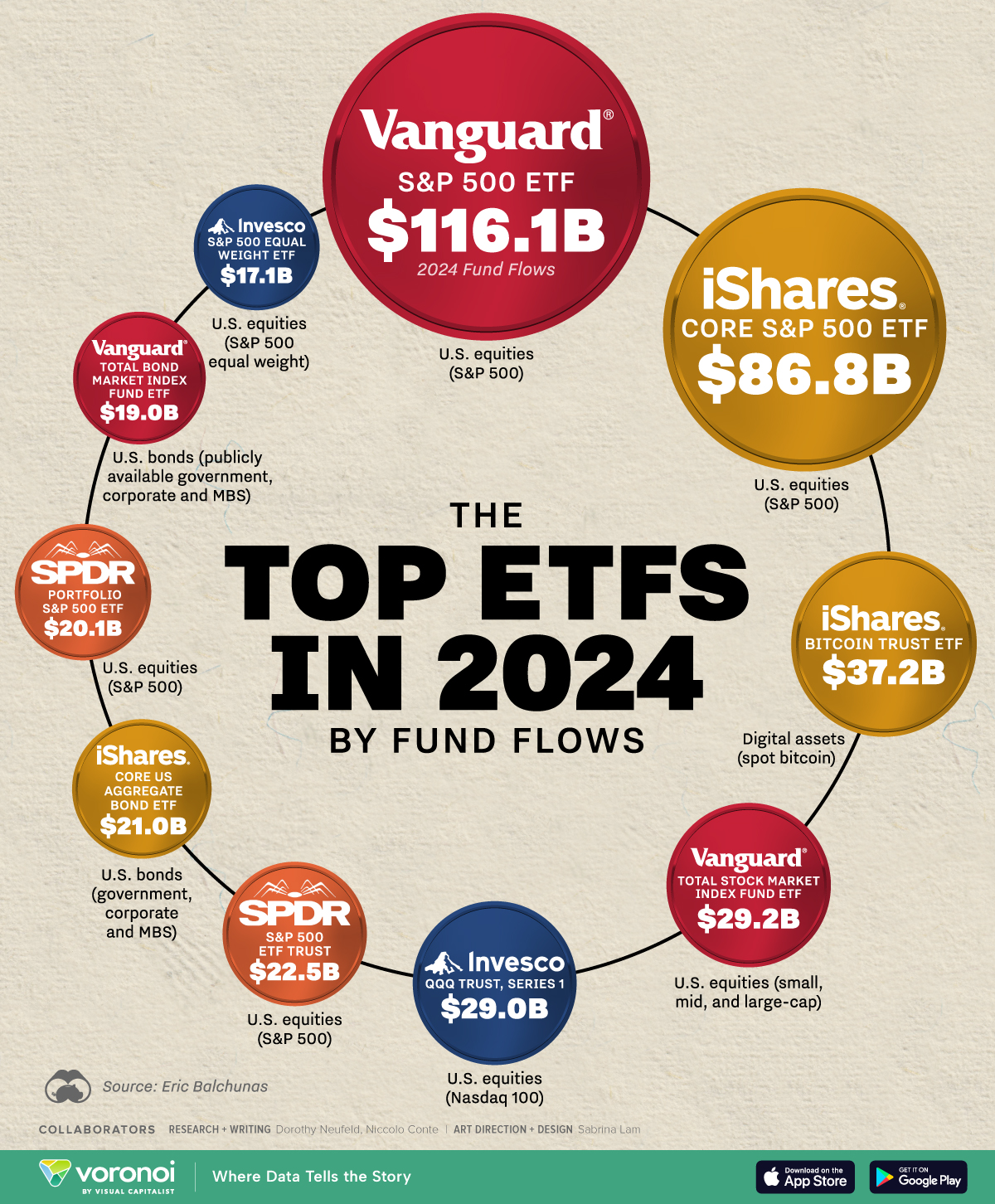
For most investors, the Vanguard S&P 500 ETF (VOO) is the gold standard. This fund seeks to track the performance of the S&P 500 Index, which represents 500 of the largest, most successful U.S. companies.
Why VOO is a Must-Have
VOO offers exposure to approximately 80% of the total U.S. stock market value. When you buy VOO, you are becoming a partial owner of Apple, Microsoft, Amazon, and Berkshire Hathaway. Historically, the S&P 500 has provided an average annual return of roughly 10% before inflation. It is a “bet on America” that has paid off consistently over the decades.
Industry-Leading Low Costs
Vanguard is known for its client-owned structure, which allows it to keep fees at a minimum. VOO boasts an expense ratio of just 0.03%. This means for every $10,000 invested, you pay only $3 per year in management fees. For a long-term “buy and hold” strategy, VOO is virtually unbeatable as a core holding.
2. The Growth Engine: Invesco QQQ Trust (QQQ)
If VOO is the steady engine of a portfolio, the Invesco QQQ Trust is the turbocharger. This ETF tracks the Nasdaq-100 Index, which includes 100 of the largest non-financial companies listed on the Nasdaq Stock Market.
Capitalizing on the Tech Revolution
The QQQ is heavily weighted toward the technology, communication services, and consumer discretionary sectors. It is the go-to vehicle for investors who want concentrated exposure to innovation. Companies like Alphabet (Google), Nvidia, and Meta Platforms (Facebook) dominate this fund. Because it excludes financial institutions, it tends to be more volatile than the S&P 500 but has historically offered significantly higher returns during bull markets driven by technological advancement.
Growth vs. Value Dynamics
Investing in QQQ is a strategic move toward “growth” stocks—companies that reinvest their earnings into expansion rather than paying dividends. While this can lead to sharper drawdowns during interest rate hikes or economic contractions, the long-term trajectory of the Nasdaq-100 has outperformed the broader market over the last 15 years, driven by the digital transformation of the global economy.
3. The Income Generator: Schwab US Dividend Equity ETF (SCHD)
Not all investors are looking for raw price appreciation. Many seek “total return,” which includes the steady cash flow provided by dividends. The Schwab US Dividend Equity ETF (SCHD) is widely considered the premier choice for dividend growth investors.
Quality Over Quantity
Unlike some high-yield funds that chase “yield traps” (companies with high dividends but failing businesses), SCHD focuses on quality. It tracks the Dow Jones U.S. Dividend 100 Index, which selects companies based on fundamental strength, including cash flow to total debt, return on equity, and dividend yield growth. This results in a portfolio of sustainable, blue-chip companies like Home Depot, PepsiCo, and Chevron.
The Power of Compounding Dividends
The true magic of SCHD lies in the growth of its distributions. By reinvesting the dividends paid out by this ETF, investors benefit from the “snowball effect.” SCHD provides a psychological safety net during market downturns; even if the share price remains flat, the investor continues to receive quarterly cash payments, which can be used for living expenses or reinvested to buy more shares at a discount.
4. The Total Market Solution: Vanguard Total Stock Market ETF (VTI)
While the S&P 500 covers the “large-cap” giants, it misses out on the thousands of small and mid-sized companies that could be the giants of tomorrow. The Vanguard Total Stock Market ETF (VTI) provides exposure to the entire investable U.S. equity market.
Capturing Small-Cap Potential
VTI holds over 3,700 stocks. By holding VTI, you own everything from the trillion-dollar behemoths to small, agile companies with market caps under $2 billion. Small-cap stocks often have higher growth potential than large-caps, though they come with higher risk. VTI balances this by weighting the companies by market capitalization, ensuring that the stability of large-caps dominates the fund while the explosive potential of small-caps contributes to the overall return.
Maximum Simplification
For the “lazy investor” who wants the simplest possible strategy, VTI is often the only stock fund they need. It eliminates the need to decide between large-cap, mid-cap, or small-cap allocations. It is the ultimate “set it and forget it” investment, also boasting an incredibly low expense ratio of 0.03%.
5. The Global Diversifier: Vanguard Total International Stock ETF (VXUS)
A common mistake among investors is “home country bias”—the tendency to invest only in companies within one’s own nation. While the U.S. market has performed exceptionally well over the last decade, geographic diversification is vital for a truly resilient portfolio. The Vanguard Total International Stock ETF (VXUS) offers exposure to the rest of the world.
Accessing Emerging and Developed Markets
VXUS covers markets outside of the United States, including developed economies like Japan, the UK, and France, as well as emerging markets like China, India, and Brazil. This exposure ensures that if the U.S. dollar weakens or the U.S. economy enters a period of stagnation (similar to the “lost decade” of the 2000s), your portfolio has other engines of growth.
Valuations and Long-Term Reversion
Historically, international stocks and U.S. stocks trade leadership in cycles. Currently, many international markets trade at lower price-to-earnings (P/E) valuations than the U.S. market. Adding VXUS to a portfolio allows an investor to buy into these cheaper valuations, providing a hedge against a potential correction in highly-valued U.S. tech stocks.
Building Your Portfolio Strategy: Implementation and Risk Management
Identifying the top 5 ETFs is only the first step; the second is determining how to blend them into a coherent strategy that aligns with your financial goals and risk tolerance.
Asset Allocation and Rebalancing
A popular strategy is the “Core and Satellite” approach. An investor might put 60% of their capital into a “core” fund like VOO or VTI for stability. The remaining 40% can be split among “satellites” like QQQ for growth, SCHD for income, and VXUS for international exposure. Over time, some sectors will outperform others, causing your portfolio to become unbalanced. Periodically (e.g., once a year), you should rebalance by selling a portion of the winners and buying more of the laggards to maintain your target allocation.

The Role of Time Horizon and Consistency
Investing in ETFs is not a “get rich quick” scheme. The primary driver of success is time. Through the use of Dollar-Cost Averaging (DCA)—the practice of investing a fixed amount of money at regular intervals regardless of market price—you lower the risk of investing a large sum at a market peak.
In conclusion, while the stock market is inherently unpredictable, these five ETFs—VOO, QQQ, SCHD, VTI, and VXUS—provide the structural integrity needed to navigate various economic climates. By focusing on low costs, broad diversification, and consistent contributions, any investor can harness the power of the global financial markets to build a secure and prosperous future.
aViewFromTheCave is a participant in the Amazon Services LLC Associates Program, an affiliate advertising program designed to provide a means for sites to earn advertising fees by advertising and linking to Amazon.com. Amazon, the Amazon logo, AmazonSupply, and the AmazonSupply logo are trademarks of Amazon.com, Inc. or its affiliates. As an Amazon Associate we earn affiliate commissions from qualifying purchases.