
The Dow Jones Industrial Average (DJIA), often simply referred to as “the Dow,” stands as one of the most iconic and frequently cited stock market indices in the world. Established in 1896 by Charles Dow and Edward Jones, it serves as a price-weighted measurement of 30 prominent, “blue-chip” companies listed on stock exchanges in the United States. For investors, financial analysts, and the general public, the Dow is more than just a list of stocks; it is a barometer for the health of the American economy and a primary indicator of market sentiment.
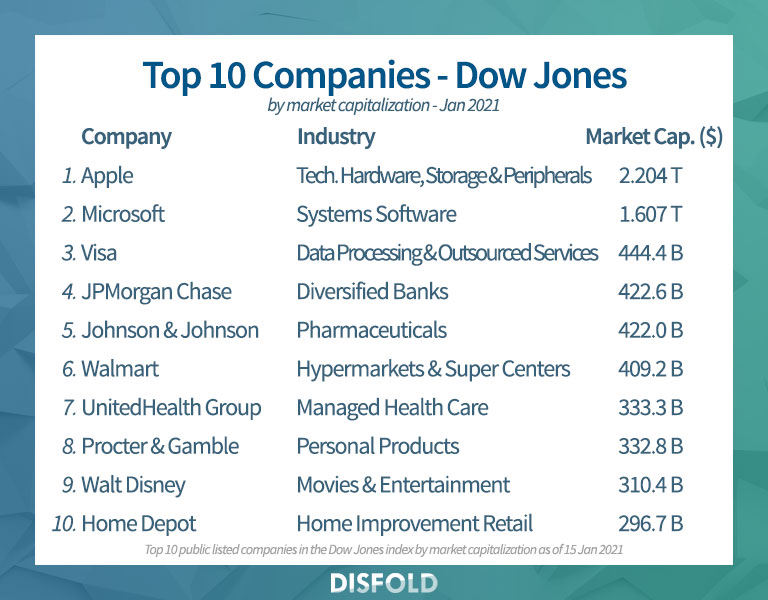
Understanding which companies comprise the Dow 30 is essential for any investor looking to grasp the dynamics of the modern financial landscape. These 30 entities are leaders in their respective industries, representing everything from cutting-edge technology and global finance to consumer staples and industrial manufacturing. Because the index is price-weighted, the movements of higher-priced stocks have a more significant impact on the index’s value, making the composition of the list a subject of intense scrutiny and prestige.
Understanding the Composition and Methodology of the Dow 30
To appreciate the significance of the 30 companies in the Dow, one must first understand how they are selected and how the index functions. Unlike the S&P 500, which uses market capitalization (the total value of all shares), the Dow uses a price-weighting system. This means that a company with a higher stock price—regardless of its total company valuation—influences the index more than a company with a lower stock price.
The Criteria for Inclusion: What Makes a Blue-Chip?
The selection of companies for the Dow Jones Industrial Average is not governed by a rigid quantitative formula. Instead, the index is maintained by a committee at S&P Dow Jones Indices. The committee looks for companies that have an excellent reputation, demonstrate sustained growth, and are of high interest to a large number of investors. Generally, a company must be incorporated and headquartered in the U.S., and a plurality of its revenue should be derived from domestic operations.
These companies are known as “blue-chips,” a term borrowed from poker where blue chips have the highest value. In finance, it signifies a company that is nationally recognized, well-established, and financially sound. These firms typically have a long history of weathering economic downturns and often provide consistent dividends to their shareholders.
The Evolution of the Index: Recent Changes
The Dow is not a static list. To remain a relevant reflection of the U.S. economy, the committee periodically replaces companies that have lost their market dominance with rising industry leaders. For instance, in early 2024, a significant shift occurred when Amazon replaced Walgreens Boots Alliance. This change highlighted the market’s transition away from traditional brick-and-mortar retail toward e-commerce and technology-driven consumer services. Such updates ensure that the “Industrial” in the index’s name is interpreted broadly, encompassing the modern drivers of wealth.
The Price-Weighting Mechanism and the “Dow Divisor”
Because the index is price-weighted, a simple average of the 30 stock prices would be misleading due to stock splits and spin-offs. To account for this, the index uses the “Dow Divisor.” This is a continuously adjusted numerical value used to maintain the continuity of the index. When you see the Dow “up by 200 points,” it is the result of the sum of the 30 stock prices divided by this specialized divisor. This unique mathematical approach makes the Dow a distinct animal compared to broader indices like the Nasdaq or the S&P 500.
A Sector-by-Sector Breakdown of the 30 Dow Companies
The 30 companies within the Dow Jones Industrial Average are selected to represent the broad diversity of the American business world. While the index originally focused on heavy industry—such as railroads and cotton—it now spans across technology, healthcare, finance, and consumer discretionary sectors.
Technology and Communications
Technology has become the dominant force in the global economy, and the Dow reflects this shift. The tech components of the Dow are some of the most influential companies on the planet:
-
Apple (AAPL): A leader in consumer electronics and services.
-
Microsoft (MSFT): A titan in software, cloud computing, and AI.
-
Salesforce (CRM): The pioneer of cloud-based Customer Relationship Management (CRM) software.
-
Cisco Systems (CSCO): A backbone of networking hardware and cybersecurity.
-
Intel (INTC): A primary manufacturer of semiconductor chips (though currently facing intense competition).
-
IBM (IBM): A legacy tech giant focused on hybrid cloud and AI solutions.

In the communication space, Verizon (VZ) represents the telecommunications infrastructure, while The Walt Disney Company (DIS) serves as a powerhouse in media, streaming, and entertainment.
Financials and Professional Services
The financial sector is the engine of the Dow, housing several of the world’s most powerful banks and payment processors:
-
JPMorgan Chase (JPM): The largest bank in the United States.
-
Goldman Sachs (GS): A premier investment banking and securities firm.
-
American Express (AXP): A leader in premium credit cards and travel services.
-
Visa (V): A global giant in digital payment technology.
-
The Travelers Companies (TRV): A leading provider of property and casualty insurance.
Healthcare and Pharmaceuticals
As the U.S. population ages, healthcare has become a critical pillar of the economy. The Dow includes:
-
UnitedHealth Group (UNH): A diversified healthcare and insurance company (and often the highest-weighted stock in the index due to its high share price).
-
Johnson & Johnson (JNJ): A massive healthcare conglomerate (recently spun off its consumer health wing to focus on med-tech and pharma).
-
Merck & Co. (MRK): A global leader in pharmaceuticals and vaccine development.
-
Amgen (AMGN): A pioneer in biotechnology and innovative medicine.
Consumer Goods, Retail, and Industrials
The remaining slots are filled by companies that provide the goods and services Americans use daily:
-
Amazon (AMZN): The world’s largest e-commerce and cloud services provider.
-
Walmart (WMT): The largest physical retailer in the world.
-
Home Depot (HD): The leader in home improvement and construction supplies.
-
McDonald’s (MCD): The global standard-bearer for the fast-food industry.
-
Coca-Cola (KO): An iconic beverage and consumer staples brand.
-
Procter & Gamble (PG): The household goods giant (Tide, Gillette, etc.).
-
Nike (NKE): The world’s leading athletic footwear and apparel brand.
In the industrial and materials sectors, we find:
-
Boeing (BA): The aerospace and defense giant.
-
Caterpillar (CAT): The world’s leading manufacturer of construction and mining equipment.
-
Honeywell (HON): A conglomerate producing everything from aerospace systems to building technologies.
-
3M (MMM): A diversified manufacturer known for innovation in materials and healthcare.
-
Chevron (CVX): The sole energy representative in the current Dow.
-
Dow Inc. (DOW): A major materials science and chemical company (not to be confused with the index itself).
Strategies for Investing in the Dow 30
For the individual investor, the 30 companies in the Dow Jones Industrial Average offer a blueprint for a stable, long-term portfolio. While no investment is without risk, the “blue-chip” nature of these firms provides a level of security that smaller, more volatile companies lack.
The “Dogs of the Dow” Strategy
One popular investment strategy involving the DJIA is known as the “Dogs of the Dow.” This contrarian strategy suggests that investors should buy the ten companies in the Dow with the highest dividend yields at the beginning of each year. The logic is that a high dividend yield often indicates that a stock is temporarily undervalued relative to its fundamentals. By holding these ten stocks for a year and rebalancing annually, investors often aim to outperform the broader index through both capital appreciation and high income.
Investing via Index Funds and ETFs
Most retail investors do not have the capital or the desire to buy individual shares of all 30 companies, especially since some shares (like UnitedHealth) can cost several hundred dollars each. Instead, the most efficient way to gain exposure to the Dow 30 is through an Exchange-Traded Fund (ETF). The most famous of these is the SPDR Dow Jones Industrial Average ETF Trust (ticker: DIA), often called “Diamonds.” By purchasing shares of DIA, an investor owns a proportional slice of all 30 companies, receiving dividends and participating in the overall movement of the index.
The Role of the Dow in a Balanced Portfolio
While the Dow is a prestigious list, financial advisors often recommend using it as a “core” component rather than an entire portfolio. Because it only tracks 30 companies, it lacks the diversification of the S&P 500 (which tracks 500 companies) or the Russell 2000 (which tracks small-cap companies). However, for an investor seeking exposure to large-cap, dividend-paying U.S. stocks with global brand recognition, the Dow 30 remains the ultimate gold standard.

Conclusion: The Enduring Legacy of the Dow 30
The 30 companies in the Dow Jones Industrial Average represent more than just a list of tickers on a screen; they are the corporate titans that define the American economic experience. From the technology in our pockets provided by Apple and Microsoft to the food on our tables from Walmart and Coca-Cola, these companies are woven into the fabric of global commerce.
As an investment tool, the Dow provides a snapshot of the market’s highest tier. While its price-weighting methodology may be seen by some as an antiquated relic of the late 19th century, its ability to capture the movement of the world’s most influential brands remains unparalleled. Whether you are a seasoned investor or a beginner looking to make your first trade, understanding the 30 companies of the Dow is a fundamental step in mastering the world of finance. By tracking these 30 giants, you aren’t just watching the stock market—you are watching the history of the global economy in real-time.
aViewFromTheCave is a participant in the Amazon Services LLC Associates Program, an affiliate advertising program designed to provide a means for sites to earn advertising fees by advertising and linking to Amazon.com. Amazon, the Amazon logo, AmazonSupply, and the AmazonSupply logo are trademarks of Amazon.com, Inc. or its affiliates. As an Amazon Associate we earn affiliate commissions from qualifying purchases.