
For individual investors and seasoned traders alike, understanding the operational hours of the futures markets is not merely a matter of convenience; it is a critical component of a well-informed trading strategy. Unlike traditional stock markets with their relatively constrained trading windows, futures markets often boast extended, near 24-hour cycles, reflecting the global and continuous nature of the underlying assets. This comprehensive guide will demystify the complex tapestry of futures market hours, equipping you with the knowledge to optimize your trading decisions.
The world of derivatives, particularly futures contracts, operates on a different rhythm than the conventional 9-to-5 of equities. Futures, which are agreements to buy or sell an asset at a predetermined price on a specified future date, span a vast array of underlying instruments—from commodities like crude oil and gold to financial indices, currencies, and interest rates. Each of these assets trades on various exchanges around the globe, creating an interconnected web of liquidity that rarely sleeps.

Navigating this continuous environment requires precision. Missing a critical market opening or being caught off-guard by a closure can have significant implications for a portfolio. Price discovery, volatility, and liquidity can all shift dramatically depending on which global market centers are active. By dissecting the typical trading schedules, identifying key global exchanges, and understanding the nuances of various asset classes, traders can gain a crucial edge. This knowledge empowers participants to manage risk more effectively, capitalize on emerging opportunities, and ensure their strategies are aligned with the pulse of the global economy.
Understanding the Global Nature of Futures Trading
The defining characteristic of futures markets, particularly compared to traditional equity markets, is their near-continuous operation. This global reach is a direct consequence of the underlying assets they represent and the worldwide demand for hedging and speculation across multiple time zones.
The 24/5 Trading Cycle
Most major futures markets operate on an almost 24-hour basis, five days a week, typically from Sunday evening through Friday afternoon in U.S. time. This extended schedule facilitates continuous price discovery and allows participants from different geographical regions to trade during their local business hours. For instance, while North American traders are active during their daytime, Asian and European traders are managing their positions during what would be North American night hours.
This seamless handover from one trading session to another creates a dynamic environment where global events can instantaneously impact prices. A news announcement from Asia can ripple through European markets and then influence North American openings, without significant gaps in trading activity. This continuous flow offers both opportunities and challenges: greater flexibility for position management but also the need for constant vigilance. The “closing” often refers to a brief daily maintenance period for the exchange or a halt over the weekend, rather than a full cessation of trading for many hours as seen in stock markets.
Key Global Exchanges and Their Overlap
Futures trading is dominated by a few major exchanges that serve as hubs for specific asset classes. Understanding their operating hours and how they overlap is crucial for a global perspective.
-
CME Group (Chicago Mercantile Exchange, Chicago Board of Trade, NYMEX, COMEX): This is by far the largest and most diverse derivatives exchange globally, offering futures across equity indices (e.g., E-mini S&P 500, Nasdaq 100), commodities (crude oil, natural gas, gold, silver, agricultural products), currencies, and interest rates. CME’s electronic trading platform, Globex, facilitates nearly 24-hour trading for most of its products, typically opening Sunday evening (5:00 PM CT) and closing Friday afternoon (4:00 PM CT), with brief daily maintenance breaks.
-
Intercontinental Exchange (ICE): A major competitor to CME, ICE offers a wide range of futures, particularly strong in energy (Brent crude, natural gas), soft commodities (coffee, sugar, cocoa), and financial futures. ICE also utilizes electronic platforms for extensive trading hours that mirror the continuous nature of global markets.
-
Eurex (European Exchange): Based in Frankfurt, Eurex is a leading European derivatives exchange, known for its equity index futures (e.g., DAX, Euro Stoxx 50) and interest rate derivatives. Its hours are primarily aligned with European business hours but extend electronically to accommodate international participants.
-
Asia-Pacific Exchanges (e.g., SGX, HKEX, TOCOM): Exchanges like the Singapore Exchange (SGX), Hong Kong Exchanges and Clearing (HKEX), and Tokyo Commodity Exchange (TOCOM) provide access to Asian equity indices, regional commodities, and currencies. Their trading hours are critical for price discovery during the Asian trading session, often overlapping with the start of European trading and the close of the previous day’s U.S. session.
The overlap between these exchanges creates periods of heightened liquidity and price action. For instance, when European markets open while Asian markets are still active, or when U.S. markets open while European markets are still trading, global market sentiment and news can rapidly disseminate and be priced in.
Specific Market Openings and Closings by Asset Class
While the 24/5 cycle is a general rule, specific asset classes within the futures market have nuanced schedules and particular considerations.
Equity Index Futures (e.g., S&P 500, Nasdaq)
Equity index futures, such as the popular E-mini S&P 500 and E-mini Nasdaq 100 traded on the CME Globex platform, are among the most actively traded 24-hour futures contracts. Their electronic trading generally runs from Sunday 5:00 PM CT to Friday 4:00 PM CT, with a daily break from 3:15 PM CT to 3:30 PM CT. This continuous trading allows market participants to react to macroeconomic data, corporate earnings, and geopolitical events released at any time globally, providing a robust hedging and speculative tool for equity market exposure.
Commodity Futures (e.g., Crude Oil, Gold, Agricultural Products)
Commodities exhibit significant variation in their trading hours, often reflecting the physical market operations and global supply chains.
-
Energy Futures (Crude Oil, Natural Gas): WTI Crude Oil futures (NYMEX) and Brent Crude Oil futures (ICE) trade nearly 24 hours, Sunday evening through Friday afternoon, similar to equity index futures. Their liquidity is global, reflecting the continuous production and consumption of energy worldwide.
-
Precious Metals (Gold, Silver): Gold and silver futures (COMEX) also boast extensive electronic trading hours, typically mirroring the CME Globex schedule. These assets are considered global safe havens and are sensitive to international monetary policy and geopolitical developments, necessitating continuous access.
-
Agricultural Products (Corn, Soybeans, Wheat): Futures for agricultural commodities (CBOT) have more distinct trading sessions. While they do have electronic trading overnight, there are often specific “pit” or open outcry sessions, alongside a more defined electronic schedule, usually with a longer daily break. For example, grain futures might trade electronically from Sunday evening through late morning U.S. time, close for several hours, and then reopen for an afternoon electronic session. This often aligns with the typical daylight hours for agricultural operations and data releases.
Currency Futures (Forex)
Currency futures, traded on exchanges like CME, largely follow the 24/5 model, reflecting the underlying spot forex market which is the largest and most liquid financial market in the world, operating around the clock. Trading typically begins Sunday evening and concludes Friday afternoon, with brief daily breaks. The continuous nature allows traders to react to central bank announcements, economic indicators, and political developments from any major global economy as they occur.
Interest Rate Futures
Interest rate futures, such as those tied to U.S. Treasuries (e.g., 2-Year T-Note, 10-Year T-Note) and Eurodollars (CME), also trade nearly 24 hours, five days a week. These highly sensitive instruments react to economic data, central bank statements, and shifts in monetary policy, making continuous trading essential for global bond market participants to manage risk and express views on future interest rate movements.
Factors Influencing Futures Market Hours
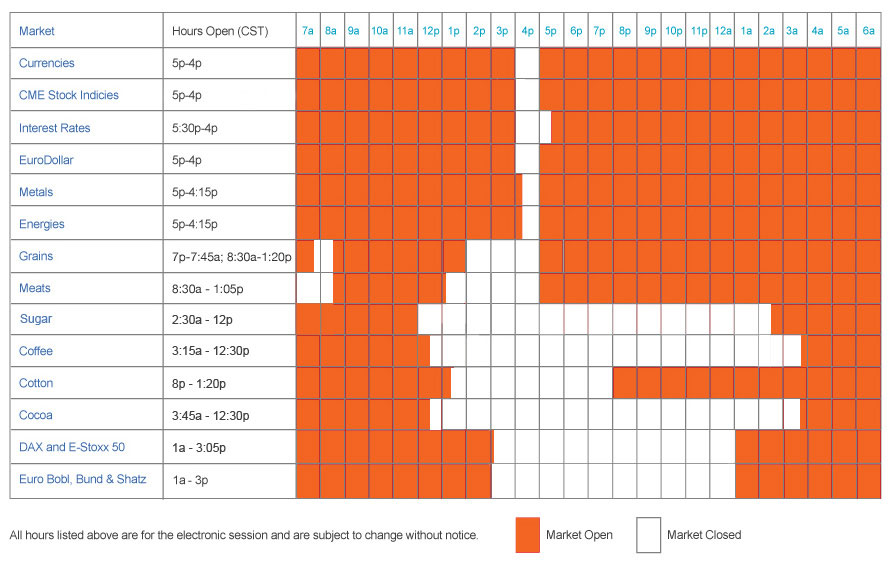
Beyond the standard trading cycles, several other factors can influence when futures markets are open and active.
Exchange Operating Schedules
Each exchange sets its own specific operating hours, which can include varying open and close times, daily maintenance windows, and holiday schedules. While electronic trading platforms like CME Globex offer extended hours for many products, some contracts or specific trading methods (like expiring contracts) might have slightly different or more constrained schedules. It’s crucial for traders to refer directly to the official exchange websites for the most accurate and up-to-date information, as these schedules are subject to change.
Holiday Closures and Early Finishes
Futures markets, despite their global nature, observe national holidays of the countries where their primary exchanges are located. For instance, U.S.-based futures exchanges will close for federal holidays like Christmas Day, New Year’s Day, and Thanksgiving. However, the exact holiday schedule can vary by exchange and sometimes even by contract. Some holidays might entail a full closure, while others might result in an early finish or reduced trading hours. International traders must be aware of these local holidays to avoid unexpected market closures or thin trading conditions.
Rollover Periods and Contract Expiration
Futures contracts have finite lifespans and expire on specific dates. As a contract approaches its expiration, trading activity often shifts to the next available contract month, a process known as “rollover.” During this period, liquidity in the expiring contract can diminish, while the new front-month contract sees increased volume. The final trading day for an expiring contract also typically has specific, often shortened, trading hours, and can experience heightened volatility as positions are closed or rolled over. Traders must be acutely aware of these expiration dates and the associated trading schedule adjustments to avoid holding contracts past their expiry or trading illiquid contracts.
The Strategic Importance of Knowing Trading Hours
For any participant in the futures market, a deep understanding of trading hours is not a trivial detail; it’s a strategic imperative that directly impacts risk management, profit potential, and overall trading success.
Managing Risk and Volatility
Certain times of the day are inherently more volatile than others. For example, the open of a major trading session (e.g., London open for European markets, New York open for U.S. markets) often brings a surge of new information and order flow, leading to increased volatility and wider price swings. Knowing when these periods occur allows traders to adjust their risk exposure, place protective stops strategically, or even choose to avoid trading during times of extreme uncertainty. Conversely, during periods of thin trading (e.g., late night in certain regions or during holidays), liquidity can dry up, making it harder to enter or exit positions at favorable prices and potentially leading to larger price gaps.
Optimizing Entry and Exit Points
The ebb and flow of liquidity and volatility throughout the 24-hour cycle present opportunities to optimize trade entry and exit points. A trader might prefer to enter a position during a less volatile period to get a better fill, or conversely, choose to exit a position during a high-volume period to ensure quick execution. Understanding which global markets are active can help traders align their strategies with prevailing market dynamics. For instance, an Asian-focused strategy might thrive during the Asian trading session, while a U.S. economic data-driven strategy would be best executed during the U.S. market hours.
Accessing Liquidity and Tight Spreads
Liquidity is paramount in futures trading. High liquidity ensures that orders can be executed quickly and with minimal impact on price. Spreads (the difference between the bid and ask price) are typically tighter during periods of high liquidity. Knowing when the major global market centers overlap and are most active helps traders identify the peak liquidity periods for their chosen contracts. Trading during these times generally results in better execution prices and lower transaction costs. Conversely, trading during low-liquidity hours can lead to wider spreads and slippage, eroding potential profits.
Avoiding Off-Hours Gaps
While futures markets are nearly 24/5, there are still brief periods of closure (e.g., daily maintenance or weekend breaks). Significant news or events that occur during these off-hours can lead to “gaps” in price when the market reopens. A gap occurs when the opening price is significantly different from the previous closing price, without any trading activity in between. Traders holding positions overnight or over the weekend must be aware of this gap risk, as it can result in losses that exceed initial stop-loss orders if the market gaps unfavorably. Understanding market hours helps in making informed decisions about holding positions during these vulnerable periods.
Tools and Resources for Tracking Futures Market Hours
Given the complexity and dynamic nature of futures trading hours, relying on reliable sources is essential. Fortunately, a variety of tools and resources are available to help traders stay informed.
Exchange Websites and Official Calendars
The most authoritative source for futures market hours is always the official website of the respective exchange. CME Group, ICE, Eurex, and other major exchanges maintain detailed trading calendars, holiday schedules, and product specifications that clearly outline the open, close, and daily break times for each contract. These sites are regularly updated with any changes, such as adjustments for daylight saving time transitions or emergency closures. Traders should bookmark these pages and consult them frequently, especially when planning trades around holidays or contract rollovers.
Trading Platforms and Brokerage Tools
Most reputable futures trading platforms and online brokerage accounts integrate market hours directly into their interface. These platforms often display the current status of a market (open, closed, pre-market) and provide countdown timers to the next open or close. Many also offer customizable alerts for specific market events, including opening and closing bells. While convenient, it’s still advisable to cross-reference this information with official exchange sources, particularly for less common contracts or during unusual market conditions. Brokerage firms also frequently publish their own calendars of trading hours, focusing on the contracts they offer access to.
Financial News Services and Market Data Providers
Leading financial news services (e.g., Bloomberg, Reuters, Wall Street Journal) and specialized market data providers (e.g., Investing.com, Barchart, TradingView) offer comprehensive market hour information, often presented in an easy-to-digest format. These services typically provide global market calendars, highlight upcoming holidays, and detail the trading hours for various asset classes across different exchanges. They can be particularly useful for gaining a quick overview of multiple markets simultaneously and for understanding how different global time zones align. However, always verify critical information against the primary source—the exchange itself—before making trading decisions.
In conclusion, the question “when are the futures markets open” reveals a dynamic, global ecosystem where continuous trading is the norm. Mastering the intricacies of these hours—from the 24/5 cycle to specific asset class nuances, holiday impacts, and rollover considerations—is not just an administrative task but a cornerstone of strategic futures trading. By leveraging reliable resources and understanding the implications of different trading periods on liquidity, volatility, and risk, traders can enhance their decision-making process, optimize their entries and exits, and ultimately navigate the complex world of derivatives with greater confidence and precision.
aViewFromTheCave is a participant in the Amazon Services LLC Associates Program, an affiliate advertising program designed to provide a means for sites to earn advertising fees by advertising and linking to Amazon.com. Amazon, the Amazon logo, AmazonSupply, and the AmazonSupply logo are trademarks of Amazon.com, Inc. or its affiliates. As an Amazon Associate we earn affiliate commissions from qualifying purchases.