
Securing a mortgage is arguably the most significant financial commitment the average individual will make in their lifetime. For most, the difference of even half a percentage point in an interest rate can equate to tens of thousands of dollars over the life of a loan. However, comparing mortgage offers is not as simple as looking at the lowest interest rate listed on a lender’s website. To make a truly informed decision, a borrower must look beneath the surface, analyzing the interplay between interest rates, closing costs, loan structures, and long-term financial goals.
The modern mortgage market is filled with various products, from traditional fixed-rate loans to complex adjustable-rate instruments. Because each lender structures their fees and incentives differently, comparing these offers requires a systematic approach. This guide provides a deep dive into the mechanics of mortgage comparison, ensuring you select the product that best aligns with your financial future.

Deciphering the Loan Estimate: The Foundation of Comparison
The most critical tool in your arsenal is the Loan Estimate (LE). Following the implementation of the TILA-RESPA Integrated Disclosure (TRID) rules, lenders are required to provide a standardized three-page document within three business days of receiving your application. Because this document is standardized across the industry, it allows for a direct “apples-to-apples” comparison between different institutions.
Page One: The High-Level Summary
The first page of the Loan Estimate provides the most immediate data points: the loan amount, the interest rate, and the projected monthly payment. While these figures are eye-catching, they are only the starting point. Pay close attention to whether the interest rate is “locked.” A low rate on paper means little if it fluctuates before you reach the closing table. Furthermore, check for “Prepayment Penalties” or “Balloon Payments.” In the modern market, these are rare for conventional loans but can still appear in specialized products; they represent significant financial risks that should generally be avoided.
Page Two: Closing Cost Details
This section is where the true cost of the loan is revealed. Closing costs are divided into “Loan Costs” and “Other Costs.”
-
A. Origination Charges: These are fees the lender charges for making the loan. This includes processing fees, underwriting fees, and, most importantly, “points.” Discount points are essentially prepaid interest; you pay more upfront to secure a lower rate.
-
B. Services You Cannot Shop For: These are third-party fees dictated by the lender, such as appraisal fees and credit report fees.
-
C. Services You Can Shop For: This includes title insurance and survey fees. When comparing offers, if one lender estimates significantly lower title fees than another, it may simply be an unrealistic estimate rather than a true saving, as you will ultimately choose the title company yourself.
Page Three: The Comparisons Table
The third page of the LE is specifically designed to help you compare. It features a “5-Year Cost” calculation, which shows the total amount of principal, interest, mortgage insurance, and loan costs you will have paid after sixty months. This is perhaps the most useful metric for a buyer who plans to move or refinance within a few years. It also lists the “Total Interest Percentage” (TIP), which tells you how much interest you will pay over the life of the loan as a percentage of your loan amount.
Interest Rate vs. APR: Knowing the Real Cost
One of the most common mistakes borrowers make is focusing exclusively on the interest rate while ignoring the Annual Percentage Rate (APR). While the interest rate determines your monthly principal and interest payment, the APR reflects the total cost of borrowing.
The Components of APR
The APR includes the interest rate plus other costs such as points, mortgage broker fees, and other charges you pay to get the loan. Because the APR spreads these upfront costs over the life of the loan, it serves as a more accurate barometer of the loan’s cost. If two lenders offer the same 6.5% interest rate, but one has an APR of 6.6% and the other has an APR of 6.8%, the latter is charging significantly higher upfront fees.
When APR Can Be Misleading
While APR is a powerful tool, it assumes you will keep the loan for its entire term (usually 30 years). If you plan to sell the home or refinance in five years, a loan with a lower interest rate but higher upfront costs (resulting in a higher APR) might actually be more expensive than a loan with a slightly higher rate and no upfront fees. To compare effectively, you must calculate the “break-even point”—the moment where the monthly savings from a lower interest rate finally offset the higher upfront costs of the loan.
Evaluating Points and Lender Credits
In a volatile interest rate environment, lenders often use “points” and “credits” to customize a loan’s pricing. Understanding the trade-off between the two is essential for optimizing your cash flow.
Buying Down the Rate (Discount Points)
One point is equal to 1% of the loan amount. By paying points at closing, you “buy down” the interest rate. This is a long-term strategy. For example, on a $400,000 mortgage, one point costs $4,000. If that point lowers your monthly payment by $50, it would take 80 months (over 6.5 years) to break even. If you plan to stay in the home for twenty years, paying points is a wise financial move. If you are a “starter home” buyer, keep your cash in the bank instead.
Utilizing Lender Credits
Lender credits work in the opposite direction. The lender agrees to pay some or all of your closing costs in exchange for a slightly higher interest rate. This is often referred to as a “no-cost mortgage.” While your monthly payment will be higher, this strategy can be highly effective for buyers with limited liquid assets or those who believe interest rates will drop in the near future, allowing them to refinance before the higher rate becomes a long-term burden.
Comparing Loan Structures and Long-Term Implications
The type of loan you choose is just as important as the lender you choose. When comparing offers, ensure you are not just comparing lenders, but also comparing the long-term utility of different loan structures.
Fixed-Rate vs. Adjustable-Rate Mortgages (ARMs)
A fixed-rate mortgage offers stability; your principal and interest payment will never change. An ARM, conversely, offers a lower initial rate for a set period (e.g., 5, 7, or 10 years), after which the rate adjusts based on market indices. When comparing an ARM offer to a fixed-rate offer, look closely at the “caps”—the limits on how much the rate can increase per adjustment and over the lifetime of the loan. In a rising-rate environment, the “teaser” rate of an ARM can be a trap; in a falling-rate environment, it can be a savvy shortcut to lower payments.
15-Year vs. 30-Year Terms
Lenders will often present a 15-year option as a way to save on interest. The interest rates on 15-year mortgages are almost always lower than those on 30-year mortgages. However, the monthly payment is significantly higher because you are amortizing the debt over half the time. From a personal finance perspective, the 30-year mortgage offers more flexibility. You can always pay extra on a 30-year loan to retire the debt in 15 years, but you cannot “pay less” on a 15-year loan if you hit a financial rough patch.
Government-Backed vs. Conventional
If you are comparing an FHA loan to a Conventional loan, pay close attention to Mortgage Insurance (MI). On an FHA loan, Mortgage Insurance Premium (MIP) is typically required for the life of the loan if you put down less than 10%. On a Conventional loan, Private Mortgage Insurance (PMI) can be cancelled once you reach 20% equity. Even if the FHA interest rate is lower, the persistence of MIP might make the Conventional loan cheaper over a ten-year horizon.
The Strategy of Shopping: Timing and Negotiation
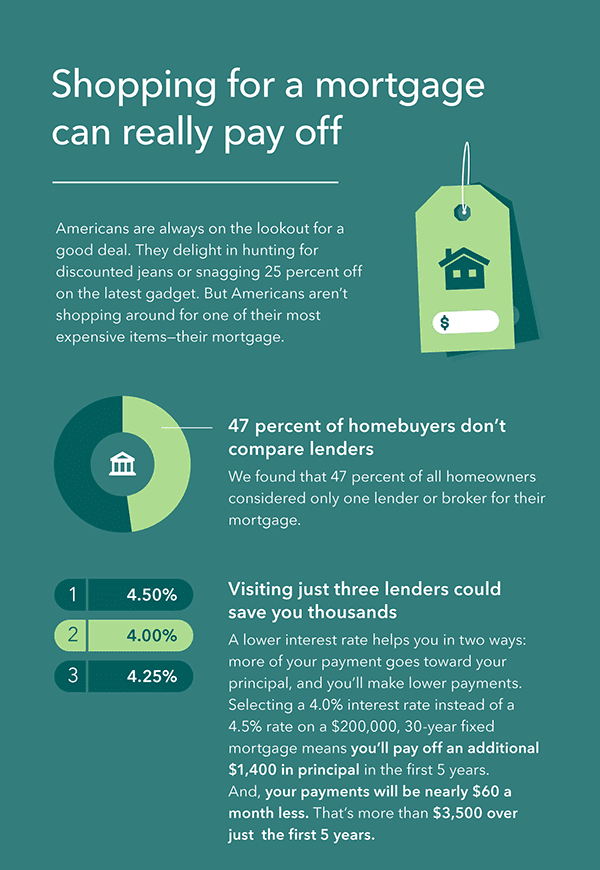
The final stage of comparing mortgage offers is the tactical execution of the “shop.” Most borrowers stop after checking with their primary bank, but data from the Consumer Financial Protection Bureau (CFPB) suggests that consumers who get at least three quotes save an average of $3,500 in the first few years of the loan.
The “Shopping Window” for Credit Scores
Many borrowers fear that multiple credit inquiries will tank their credit score. However, credit scoring models (FICO and VantageScore) recognize mortgage shopping. As long as all mortgage-related credit pulls occur within a 14-to-45-day window, they are typically treated as a single inquiry for scoring purposes. This allows you to shop aggressively without fear of long-term credit damage.
Leveraging Offers for Negotiation
Lenders are often willing to negotiate their origination fees or match a competitor’s interest rate to earn your business. Once you have received multiple Loan Estimates, identify the one with the lowest “Section A” fees and the one with the lowest interest rate. Contact your preferred lender and ask them if they can match the terms. Often, a lender will waive a processing fee or drop a rate by an eighth of a percentage point rather than lose a qualified borrower to a competitor.

Considering the Servicing and Experience
While the numbers are paramount, the “soft” side of the mortgage offer matters. Does the lender have a reputation for closing on time? If a lender offers a rate that is 0.1% lower but has a history of missing closing dates, you could lose your earnest money or your contract on the house entirely. Furthermore, ask if the lender “services” their own loans. If they sell your loan immediately after closing, you may end up dealing with a customer service department that is difficult to reach.
Comparing mortgage offers is an exercise in both mathematical precision and strategic foresight. By looking beyond the monthly payment and deconstructing the Loan Estimate, analyzing the APR, and weighing the cost of points against your expected tenure in the home, you can transform a complex financial hurdle into a calculated investment. The effort put into this comparison phase is perhaps the highest-earning “hourly rate” work you will ever perform, resulting in a mortgage that supports, rather than hinders, your long-term wealth accumulation.
aViewFromTheCave is a participant in the Amazon Services LLC Associates Program, an affiliate advertising program designed to provide a means for sites to earn advertising fees by advertising and linking to Amazon.com. Amazon, the Amazon logo, AmazonSupply, and the AmazonSupply logo are trademarks of Amazon.com, Inc. or its affiliates. As an Amazon Associate we earn affiliate commissions from qualifying purchases.