
For millions of investors entering the cryptocurrency market, Coinbase serves as the primary gateway. Its user-friendly interface, robust security measures, and regulatory compliance make it a preferred choice for both institutional players and retail beginners. However, the convenience of the platform comes at a cost. Understanding exactly what a “Coinbase fee” entails is critical for any investor looking to maximize their returns and minimize unnecessary expenses. In the world of digital assets, fees are not just a minor annoyance; they are a variable that can significantly impact the long-term profitability of a portfolio.

Coinbase does not utilize a single, flat fee for every transaction. Instead, it employs a dynamic and often complex pricing structure that varies based on the size of the transaction, the payment method used, the geographical location of the user, and the specific platform interface being utilized. To navigate these costs effectively, one must look beyond the “buy” button and understand the mechanics of spreads, transaction commissions, and network costs.
The Dual Nature of Coinbase’s Pricing Model
At its core, Coinbase operates two primary transaction environments: the standard “Simple” interface and “Coinbase Advanced.” Each has a distinct philosophy regarding how it charges users. The Simple interface is designed for ease of use, where the complexity of the market is hidden behind a streamlined process. For this convenience, users generally pay a premium.
Understanding the Spread
The most overlooked component of a Coinbase fee is the “spread.” When you use the simple buy or sell feature, Coinbase adds a margin—or spread—to the market price of the cryptocurrency. This spread typically hovers around 0.50% to 1.00%, though it can fluctuate based on market volatility.
For example, if Bitcoin is trading at $50,000 on the open market, Coinbase might quote you a price of $50,250. That $250 difference is not explicitly labeled as a “fee” in the same way a transaction commission is, but it is a direct cost to the investor. This spread ensures that Coinbase can fulfill your order immediately at a guaranteed price, protecting the platform from price swings during the few seconds it takes to process the trade.
Transaction Fees for Small vs. Large Orders
In addition to the spread, Coinbase applies a transaction fee. For many years, Coinbase used a fixed-fee schedule for smaller transactions: $0.99 for trades under $10, $1.46 for trades between $10 and $25, and so on. Recently, the platform has transitioned toward a more dynamic “variable fee” model.
In this model, the fee is calculated at the time the order is placed and is influenced by the size of the order and the current market conditions. Generally, as the dollar amount of your purchase increases, the fee as a percentage of the total transaction tends to decrease. However, for the casual investor buying $20 worth of Ethereum every week, these small, recurring fees can eat away 5% to 7% of the total investment before the asset even has a chance to appreciate.
Payment Methods and Their Financial Impact
How you fund your account is just as important as what you buy. Coinbase supports a variety of payment methods, each carrying its own fee implications. Investors who prioritize speed often find themselves paying the highest premiums, while those who can afford to wait a few days for funds to clear can save significantly.
ACH Transfers and Wire Services
For users in the United States, the Automated Clearing House (ACH) transfer is usually the most cost-effective way to move money into the platform. Coinbase typically does not charge a separate fee for depositing via ACH, though the standard transaction fees and spreads still apply when you eventually buy crypto with those funds.
Wire transfers, on the other hand, often carry a flat fee—usually around $10 for incoming and $25 for outgoing. This makes wire transfers inefficient for small amounts but potentially more economical for very large institutional-grade movements where the flat fee is a negligible percentage of the total capital.
Credit and Debit Card Premiums
Using a debit card or integrated mobile payment systems like Apple Pay or Google Pay offers near-instantaneous access to funds. However, this convenience carries the highest price tag on the platform. Coinbase often charges a fee of approximately 3.99% for these transactions.
When you combine a 3.99% payment fee with a 1.00% spread and the standard transaction commission, an investor can lose nearly 5-6% of their purchasing power instantly. From a personal finance perspective, this is a significant hurdle to overcome. If your investment needs to grow by 6% just to break even, you are starting your journey at a disadvantage. Consequently, savvy investors almost exclusively use ACH transfers or pre-funded cash balances to execute their trades.
Transitioning to Coinbase Advanced for Lower Costs
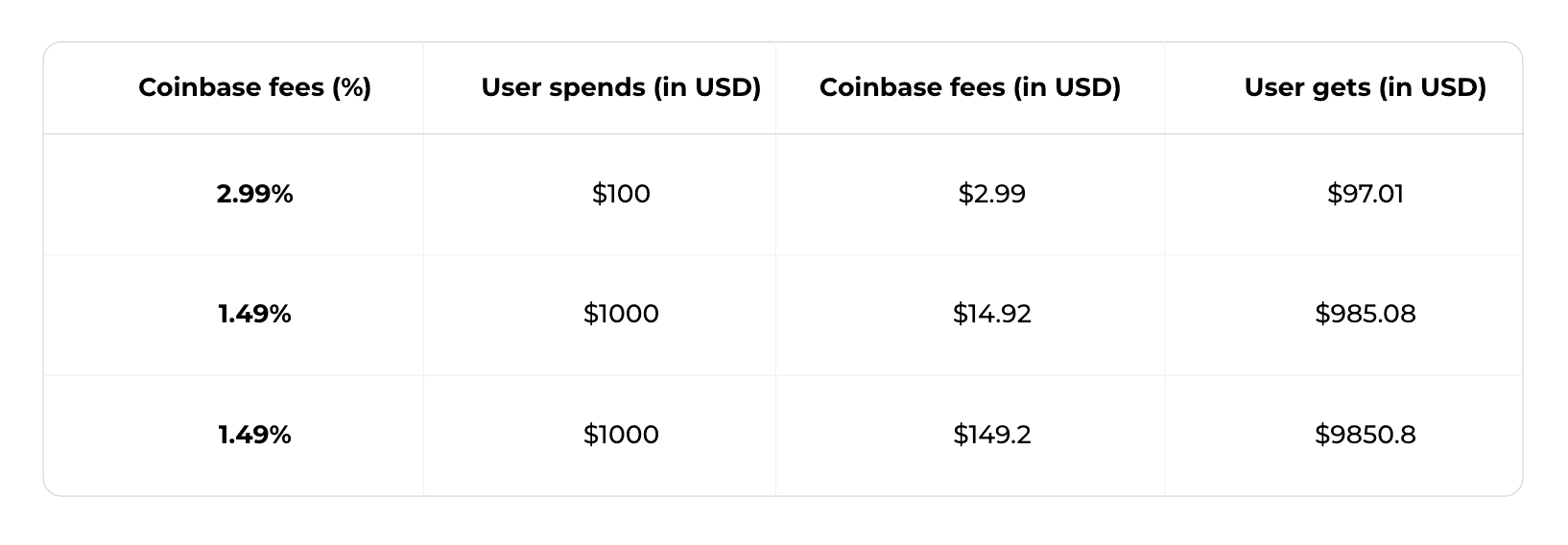
For those who find the standard fees too high, Coinbase offers a more sophisticated platform known as “Coinbase Advanced.” Formerly known as Coinbase Pro, this interface is designed for more frequent traders and provides access to order books, limit orders, and, most importantly, a much lower fee schedule.
The Maker-Taker Fee Schedule
Coinbase Advanced uses a tiered “Maker-Taker” model. This is standard practice in the financial world and rewards users who provide liquidity to the market.
-
Taker Fees: These are charged when you place an order that is executed immediately against an existing order on the order book. Because you are “taking” liquidity away, the fee is slightly higher.
-
Maker Fees: These are charged when you place an order that does not match immediately (like a limit order). Your order stays on the book, “making” liquidity for others to use later.
As of current standards, Maker/Taker fees on Coinbase Advanced often start around 0.40% to 0.60% for the lowest volume tier. This is a massive reduction compared to the 1.5% to 4% often seen on the simple interface.
Volume-Based Discounts
The Advanced platform also rewards high-volume traders. Coinbase calculates your trailing 30-day trading volume and places you in a specific tier. As your volume increases, your fee percentage decreases. For institutional traders moving millions of dollars per month, the fees can drop to as low as 0.00% for makers and 0.05% for takers. While these tiers are out of reach for the average retail investor, even the base tier of Coinbase Advanced offers a superior value proposition compared to the standard “Simple” buy feature.
Ancillary Fees: Staking, Conversions, and Withdrawals
Beyond the act of buying and selling, there are several other scenarios where Coinbase applies charges. Understanding these is vital for anyone using Coinbase as a full-service financial tool.
The Cost of Staking Rewards
Staking has become a popular way for investors to earn “interest” on their proof-of-stake assets like Ethereum, Solana, and Cardano. Coinbase facilitates this by handling the technical aspects of running a validator node. In exchange for this service, Coinbase takes a commission on the rewards earned.
This commission is typically around 25% to 35% of the yield. For instance, if the network provides a 5% annual staking reward, Coinbase may take a portion of that, resulting in a net yield of approximately 3.25% to 3.75% for the user. While this is a steep price compared to staking independently through a hardware wallet, many users accept it for the simplicity of earning rewards with a single click.
Crypto-to-Crypto Conversion Fees
Coinbase allows users to “convert” one cryptocurrency directly into another—for example, swapping Bitcoin for Solana. While Coinbase advertises these conversions as having a “0% fee,” this is somewhat misleading. While there is no explicit transaction commission, Coinbase charges a spread of up to 2.00% on these swaps. For large portfolios, these “free” conversions can result in substantial losses in asset value.
Network and Withdrawal Fees
When you move your cryptocurrency off Coinbase and into a private wallet or another exchange, you encounter “network fees” (often called gas fees on the Ethereum network). It is important to note that these fees do not go to Coinbase; they go to the miners and validators who secure the blockchain. However, Coinbase may add a small administrative fee or estimate the network fee on your behalf. These costs fluctuate wildly based on network congestion, sometimes costing a few cents and other times costing $50 or more during peak bull market activity.

Actionable Strategies to Reduce Your Coinbase Expenses
Understanding fees is only the first step; the second is actively working to minimize them. To protect your capital, consider the following strategies:
-
Use Coinbase Advanced: Regardless of your experience level, the Advanced interface is accessible to anyone with a Coinbase account. By simply using “Limit Orders” on the Advanced tab, you can cut your fees by more than half compared to the standard “Buy” button.
-
Avoid Convenience Deposits: Stop using debit cards or Apple Pay for purchases. Plan your trades in advance, deposit USD via ACH, wait for the funds to clear, and then execute your trades.
-
Consolidate Your Trades: Because of the way variable fees work on small orders, it is often cheaper to make one $500 purchase a month than to make five $100 purchases.
-
Monitor the Spread: Before finalizing any “Simple” trade, compare the quoted price on Coinbase to the actual market price on a site like CoinMarketCap. If the spread is wider than 1%, consider waiting for lower volatility or using the Advanced interface.
-
Be Wary of “Free” Services: Always remember that in the world of finance, “free” usually means the cost is hidden in the spread or the currency conversion rate.
Coinbase provides an invaluable service by bridging the gap between traditional banking and the decentralized future. However, that bridge has a toll. By understanding the nuances of Coinbase fees—from the hidden spreads to the advantages of Maker-Taker models—investors can ensure that more of their money stays in their portfolio and less of it goes toward the exchange’s bottom line. In an asset class as volatile as cryptocurrency, controlling the variables you can manage, like transaction costs, is the hallmark of a disciplined and successful investor.
aViewFromTheCave is a participant in the Amazon Services LLC Associates Program, an affiliate advertising program designed to provide a means for sites to earn advertising fees by advertising and linking to Amazon.com. Amazon, the Amazon logo, AmazonSupply, and the AmazonSupply logo are trademarks of Amazon.com, Inc. or its affiliates. As an Amazon Associate we earn affiliate commissions from qualifying purchases.