
Determining how much you can afford for a car loan is one of the most significant financial decisions a household can make. For many, a vehicle is the second-largest purchase they will ever navigate, trailing only a primary residence. However, the complexity of modern automotive financing—characterized by fluctuating interest rates, extended loan terms, and rising vehicle prices—often leads consumers to focus on the wrong metrics.
Too often, buyers fall into the trap of “payment shopping,” where the only concern is whether the monthly installment fits within their current cash flow. This narrow focus ignores the broader impact on long-term wealth, debt-to-income ratios, and the total cost of ownership. To truly understand car affordability, one must look beyond the sticker price and the monthly check, employing rigorous financial frameworks to ensure the purchase enhances rather than hinders their financial freedom.
The Foundation of Affordability: The 20/4/10 Rule
In the world of personal finance, the “20/4/10 rule” serves as the gold standard for vehicle budgeting. While it may seem conservative in an era of 84-month loans and zero-down offers, it is designed to protect the buyer from “underwater” loans and excessive interest expenses.
The 20% Down Payment
The first pillar of this rule is a 20% down payment. Modern vehicles are depreciating assets that lose a significant portion of their value the moment they are driven off the lot. By putting 20% down, you create a “buffer” of equity. This prevents a situation known as being “upside down” or having “negative equity,” where you owe the lender more than the car is worth. If you need to sell the vehicle unexpectedly or if it is totaled in an accident, having that 20% equity ensures you aren’t writing a check to the bank to settle the balance of a car you no longer own.
The 4-Year Loan Term
While many dealerships now push 72-month or even 84-month terms to make expensive SUVs feel “affordable,” these long-dated loans are a primary driver of financial instability. A 48-month (four-year) term is the ideal balance. It ensures that the loan is paid off while the vehicle still has significant residual value and is likely still under some form of manufacturer warranty. Furthermore, shorter terms almost always command lower interest rates, saving you thousands of dollars in interest over the life of the loan.
The 10% Income Limit
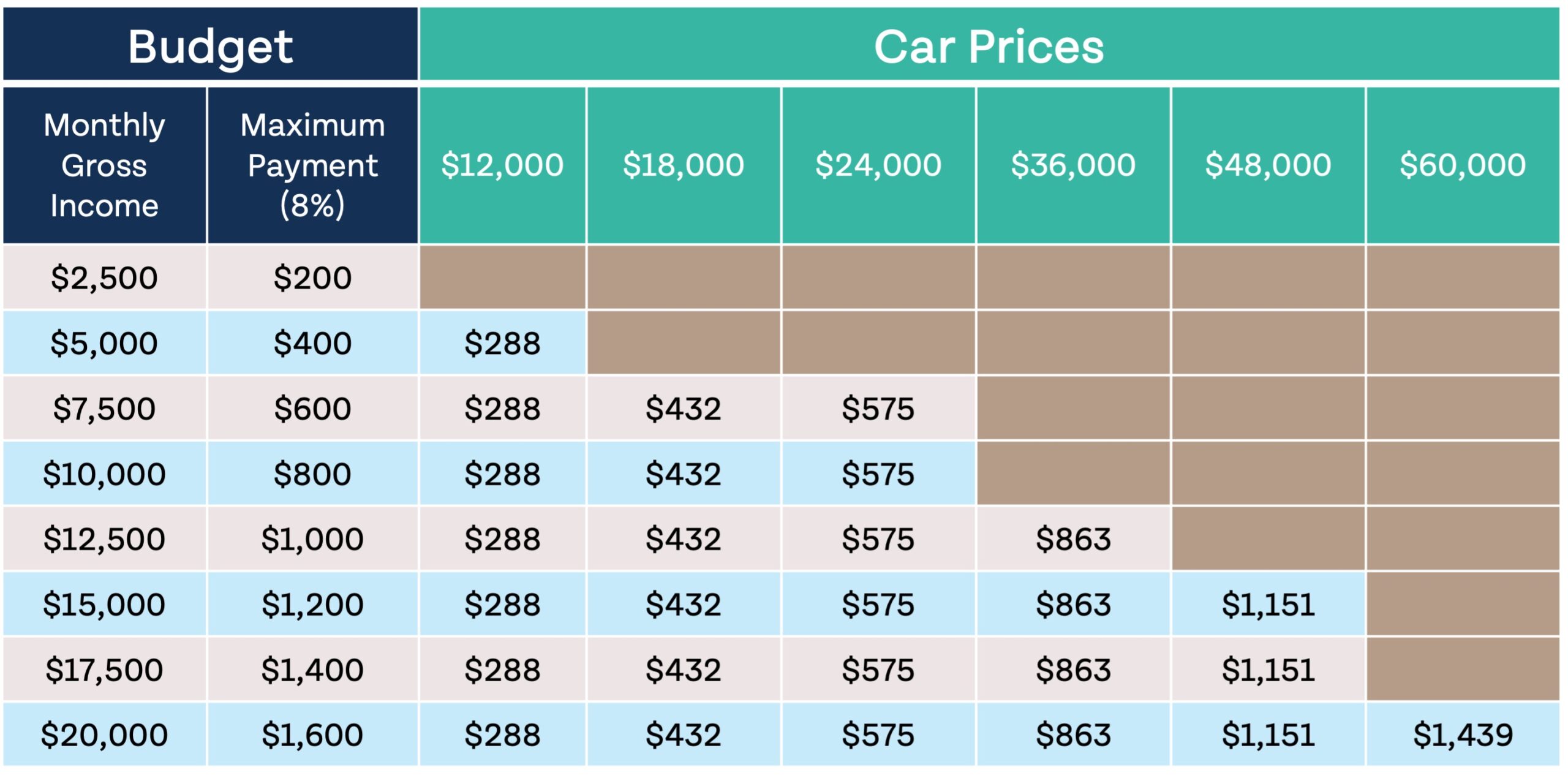
The final pillar dictates that your total transportation costs—including the loan payment, insurance, and fuel—should not exceed 10% of your gross monthly income. If you earn $6,000 a month, your entire automotive footprint should stay under $600. This conservative approach ensures that your car doesn’t cannibalize your ability to save for retirement, build an emergency fund, or invest in other appreciating assets.
Analyzing Your Debt-to-Income Ratio
Beyond the 20/4/10 rule, lenders will evaluate your Debt-to-Income (DTI) ratio to determine your borrowing power. This is the percentage of your gross monthly income that goes toward paying debts.
The Back-End Ratio
Lenders typically look at your “back-end ratio,” which includes your mortgage or rent, student loans, credit card minimums, and your proposed car payment. Most conventional lenders prefer this ratio to be below 36%, though some may stretch to 43% for borrowers with high credit scores.
If your current housing costs and existing debts already consume 30% of your income, a car loan that takes up another 10% would push you into a high-risk category. In this scenario, even if you can technically “afford” the payment, a lender might charge a higher interest rate to compensate for the perceived risk, or your overall financial flexibility will be severely compromised.
The Impact of Other Financial Goals
Affordability is subjective and must be viewed through the lens of your personal balance sheet. If you are currently aggressive in paying down high-interest credit card debt or if you are behind on retirement savings, your “affordable” car loan might be significantly lower than what a bank is willing to lend you. It is a fundamental truth of personal finance that what a bank says you can borrow is rarely what you should borrow.
The Total Cost of Ownership (TCO) Equation

The monthly loan payment is merely the “admission fee” to car ownership. To determine true affordability, you must calculate the Total Cost of Ownership (TCO). This encompasses several variables that can vary wildly depending on the make and model of the vehicle.
Insurance Premiums
Insurance costs have surged in recent years due to rising repair costs and the complexity of modern vehicle sensors. Before signing a loan agreement, obtain an insurance quote for the specific VIN or model. A “budget-friendly” used luxury sedan might have a lower monthly loan payment than a new economy hatchback, but its insurance premiums could be double, effectively neutralizing the savings.
Maintenance and Repairs
Maintenance is a predictable expense, whereas repairs are volatile. When calculating affordability, you must account for the “luxury tax” associated with certain brands. High-performance or European vehicles often require specialized labor and expensive synthetic oils, which add hundreds of dollars to the annual operating cost. A robust affordability plan includes setting aside a “sinking fund” for tires, brakes, and unexpected mechanical failures.
Fuel and Energy Costs
Whether you are buying a gas-powered vehicle, a hybrid, or an EV, energy costs must be factored into the 10% income limit. With fluctuating gas prices, a fuel-inefficient vehicle can quickly become a burden on a tight budget. Conversely, while an EV may have a higher initial purchase price (and a larger loan), the significantly lower “fuel” and maintenance costs might allow for a slightly larger monthly payment while remaining within the same total budget.
How Interest Rates and Credit Scores Dictate Your Purchasing Power
Your credit score is the single most influential factor in determining how much car you can afford. This is because interest rates (APR) directly impact the size of your monthly payment and the total amount you will pay over the life of the loan.
The Cost of a Lower Credit Score
Consider two borrowers purchasing a $30,000 vehicle with a 60-month term.
-
Borrower A has a “Prime” score (750+) and secures a 5% APR. Their monthly payment is roughly $566, and they pay $3,960 in total interest.
-
Borrower B has a “Subprime” score (600) and is offered a 14% APR. Their monthly payment for the exact same car jumps to $698, and they pay $11,880 in total interest.
The difference in credit scores costs Borrower B nearly $8,000 more for the same asset. In this context, “affordability” isn’t just about the car; it’s about the cost of the money used to buy it. If your credit score is currently in the subprime range, the most effective way to increase your car affordability is to spend six months to a year improving your credit profile before applying for a loan.
Pre-Approval: The Buyer’s Best Tool
To truly know what you can afford, you should seek pre-approval from a credit union or bank before visiting a dealership. This provides you with a firm interest rate and a maximum loan amount, effectively turning you into a “cash buyer” in the eyes of the salesperson. It also prevents the dealership from marking up the interest rate—a common practice where the dealer acts as a middleman and adds 1–2% to the rate offered by the lender as a “commission.”
Strategic Financial Planning for Your Next Purchase
If the numbers suggest that your dream car is currently out of reach, there are several strategic levers you can pull to bridge the gap without compromising your financial health.
The “Test Drive” Budgeting Method
Before committing to a loan, spend three to six months “paying” your projected car payment and insurance increase into a dedicated savings account. If your current car is paid off and you are eyeing a $500 monthly payment, move that $500 into savings every month. This does two things: it proves that your budget can handle the new expense without strain, and it simultaneously builds a larger down payment, which will reduce the loan amount and interest costs when you finally make the purchase.
Depreciation Awareness
The most affordable car is often the one that has already experienced its steepest depreciation curve. A two-to-three-year-old certified pre-owned (CPO) vehicle can often be purchased for 30-40% less than its original MSRP, while still offering modern safety features and a manufacturer-backed warranty. By lowering the principal amount of the loan, you naturally lower the monthly payment and the interest paid, making the vehicle much more affordable in the long run.
Opportunity Cost
Finally, consider the opportunity cost. Every dollar sent to a car lender is a dollar that isn’t being invested in the stock market or a high-yield savings account. Over a five-year loan term, a $600 monthly payment represents $36,000 in principal alone. If that money were invested at a 7% annual return instead, it would grow significantly over time. While most people need a vehicle to function in society, keeping the loan as small and short as possible allows you to redirect your wealth-building power toward assets that go up in value, rather than down.
In conclusion, determining how much car loan you can afford is a mathematical exercise that requires discipline and a long-term perspective. By adhering to the 20/4/10 rule, understanding your DTI, accounting for the total cost of ownership, and optimizing your credit score, you can drive a vehicle that fits your lifestyle without stalling your financial progress. Affordability is not about the maximum amount a bank will let you borrow; it is about the maximum amount you can spend while still reaching your other financial goals.
aViewFromTheCave is a participant in the Amazon Services LLC Associates Program, an affiliate advertising program designed to provide a means for sites to earn advertising fees by advertising and linking to Amazon.com. Amazon, the Amazon logo, AmazonSupply, and the AmazonSupply logo are trademarks of Amazon.com, Inc. or its affiliates. As an Amazon Associate we earn affiliate commissions from qualifying purchases.