
Determining whether you are legally required to file a federal income tax return is one of the most fundamental steps in managing your personal finances. For many, the answer is straightforward, but for those with fluctuating incomes, side hustles, or unique filing statuses, the requirements can become complex. The Internal Revenue Service (IRS) sets specific gross income thresholds each year that dictate who must file. These thresholds are primarily tied to the standard deduction, meaning that if you earn less than the standard deduction for your filing status, you generally do not owe federal income tax and may not be required to file.
However, the “requirement” to file is only one part of the equation. Understanding the nuances of tax law can reveal instances where filing a return is not only beneficial but essential for recovering overpaid taxes or claiming valuable credits. To navigate this financial landscape effectively, you must look at your filing status, your age, and the nature of your income.
Understanding the Federal Filing Thresholds
The primary factor determining your filing requirement is your gross income. Gross income includes all income you receive in the form of money, goods, property, and services that isn’t exempt from tax. This includes wages, interest, dividends, business income, and even some portions of social security benefits.
The IRS adjusts filing thresholds annually to account for inflation. These thresholds are aligned with the standard deduction, which is the portion of income not subject to tax that reduces your taxable income.
Filing Status and Income Limits
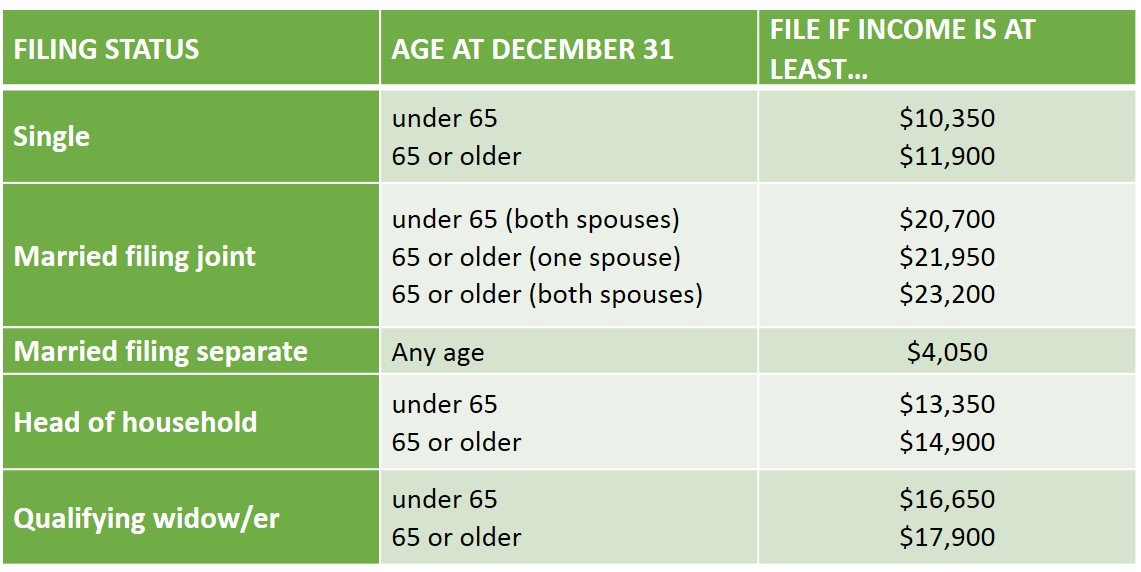
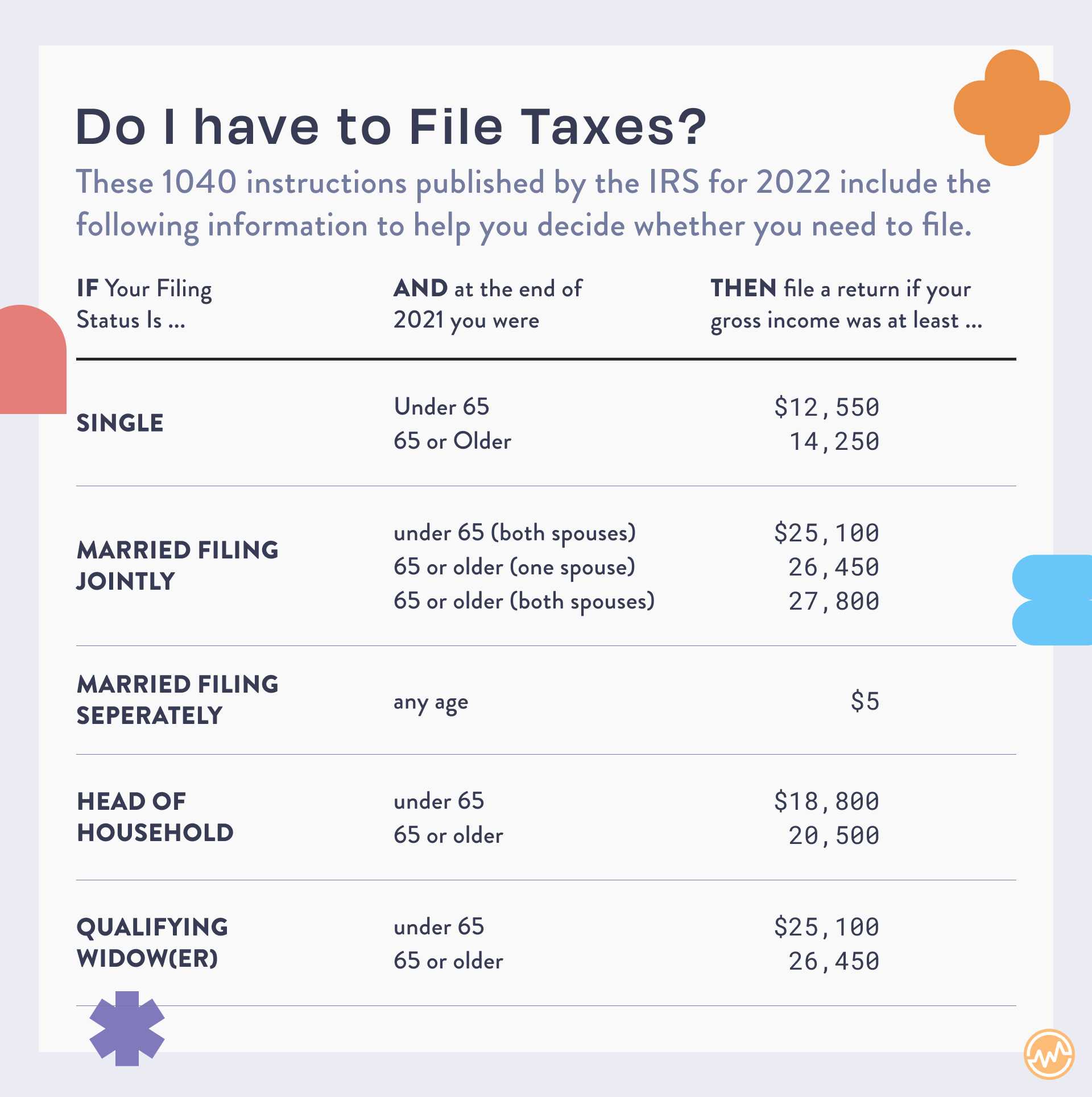
Your filing status is a major determinant of your threshold. For the 2023 tax year (filed in 2024), the thresholds for most taxpayers under age 65 are as follows:
-
Single: $13,850
-
Married Filing Jointly: $27,700
-
Married Filing Separately: $5 (This is a unique rule; if you are married but file separately, and your spouse itemizes deductions, your threshold drops to nearly zero).
-
Head of Household: $20,800
-
Qualifying Surviving Spouse: $27,700
If your gross income exceeds these amounts, you are legally obligated to file a return. If it falls below, you may be exempt, though there are significant exceptions to this rule.
The Impact of Age on Filing Requirements
The IRS provides a slightly higher standard deduction for individuals who are 65 or older. This is because the tax code recognizes that many seniors live on fixed incomes. For a single person age 65 or older, the filing threshold increases to $15,700. For a married couple filing jointly where both spouses are 65 or older, the threshold rises to $30,700. If only one spouse is 65 or older, the threshold is $29,200. This increased buffer ensures that seniors can earn a bit more without the administrative burden of filing, provided their income remains within these bounds.
Special Rules for the Self-Employed and Gig Workers
The rise of the “gig economy”—including freelance work, ride-sharing, and independent consulting—has changed the tax landscape for millions. If you earn income as an independent contractor or run your own small business, the standard filing thresholds do not apply to you in the same way they apply to W-2 employees.
The $400 Self-Employment Threshold
The most critical number for anyone with a side hustle is $400. If your net earnings from self-employment are $400 or more, you must file a federal income tax return, regardless of your total gross income. This is because self-employed individuals are responsible for paying self-employment taxes, which cover Social Security and Medicare.
While a W-2 employee has these taxes automatically withheld from their paycheck by their employer, an independent contractor does not. Even if your total annual income is only $5,000—well below the $13,850 threshold for a single filer—if that $5,000 came from freelance work, you owe self-employment tax and must file.
Net Earnings vs. Gross Income
It is important to distinguish between gross receipts and net earnings. Gross receipts are the total amount of money your business took in. Net earnings are your receipts minus “ordinary and necessary” business expenses. If you made $1,000 selling handmade crafts but spent $700 on materials and shipping, your net earnings are $300. In this specific scenario, you would not hit the $400 threshold for self-employment filing, provided you had no other income that pushed you over the standard thresholds.
Dependent Filing Requirements
The rules change significantly if someone else, such as a parent or guardian, can claim you as a dependent on their tax return. This most commonly applies to students and children with part-time jobs or investment accounts. Dependents must file a return if their income exceeds certain limits, which are divided into two categories: earned and unearned income.
Earned vs. Unearned Income
-
Earned Income: This includes wages, salaries, tips, and professional fees. For a dependent, the threshold to file is generally $13,850.
-
Unearned Income: This includes interest, dividends, and capital gains. The threshold for unearned income is much lower, typically around $1,250. If a child has a brokerage account that generated $1,300 in dividends, they must file a return, even if they have no other job.
The Hybrid Scenario
If a dependent has both earned and unearned income, the rules become a “greater of” calculation. Usually, a dependent must file if their gross income is more than the larger of $1,250 or their earned income (up to $13,450) plus $400. This complexity is designed to prevent high-income individuals from shifting large amounts of investment assets to their children to avoid taxes, a concept often referred to as the “Kiddie Tax.”
Strategic Reasons to File When Not Required
Even if your income falls below the legal filing threshold, there are several scenarios where filing a tax return is a wise financial move. In these cases, filing is not a burden but an opportunity to recover money.
Recovery of Withheld Taxes
If you worked a part-time job or a seasonal position, your employer likely withheld federal income tax from your paychecks based on the assumption that you would earn more over the course of the year. If your total year-end income is below the filing threshold, you don’t actually owe those taxes. However, the IRS will not automatically send that money back to you. The only way to receive a refund of the federal tax withheld is to file a return.
Claiming Refundable Tax Credits
The U.S. tax code includes several “refundable” credits. Unlike a non-refundable credit, which can only reduce your tax bill to zero, a refundable credit can result in the government sending you a check for the excess amount.
-
Earned Income Tax Credit (EITC): This is a credit for low-to-moderate-income working individuals and couples, particularly those with children. Even if you owe zero taxes, you could receive thousands of dollars back through the EITC.
-
Child Tax Credit (CTC): While parts of this credit are non-refundable, the “Additional Child Tax Credit” portion can be refunded to taxpayers who earned at least $2,500.
-
American Opportunity Tax Credit (AOTC): This credit helps students and parents pay for the first four years of post-secondary education. Up to 40% of the credit (maximum $1,000) is refundable.
Establishing a Financial Record
Filing a tax return creates an official record of your income. This can be vital for several reasons:
-
Loan Applications: If you plan to apply for a mortgage, car loan, or business loan, lenders almost always require the last two years of tax returns to verify your income.
-
Financial Aid: Students applying for federal student aid through the FAFSA must provide tax information. Having a return on file simplifies this process.
-
Social Security Credits: Filing ensures that your earnings are properly credited toward your future Social Security benefits.
Navigating Documentation and Deadlines
Regardless of whether you are required to file or choosing to file for a refund, the process requires organized financial documentation. Keeping track of your income throughout the year is essential for an accurate return.
Key Documents to Gather
-
W-2 Forms: Provided by employers for salaried or hourly work.
-
1099-NEC/K: Provided for independent contractor work or payments received via third-party processors.
-
1099-INT/DIV: Provided by banks and brokerages for interest and dividends.
-
Receipts: Crucial for self-employed individuals to justify business deductions.

Deadlines and Extensions
The standard deadline for filing federal income tax returns is April 15th. If you cannot meet this deadline, you can request an automatic six-month extension, pushing the deadline to October 15th. However, it is vital to remember that an extension to file is not an extension to pay. If you owe taxes, you must estimate the amount and pay it by the April deadline to avoid interest and penalties.
For those who are not required to file but are doing so to claim a refund, the stakes are lower. You generally have a three-year window from the original deadline to file a return and claim your refund. After three years, the money becomes the property of the U.S. Treasury.
Ultimately, knowing how much income you need to file taxes is about more than just compliance; it is about financial literacy. By understanding these thresholds and the benefits of filing, you can ensure that you meet your legal obligations while making the most of the credits and refunds available to you.
aViewFromTheCave is a participant in the Amazon Services LLC Associates Program, an affiliate advertising program designed to provide a means for sites to earn advertising fees by advertising and linking to Amazon.com. Amazon, the Amazon logo, AmazonSupply, and the AmazonSupply logo are trademarks of Amazon.com, Inc. or its affiliates. As an Amazon Associate we earn affiliate commissions from qualifying purchases.