
Student loan debt is more than just a balance on a ledger; for millions of graduates, it represents a significant hurdle to achieving major life milestones, from purchasing a first home to investing for retirement. Navigating the complex landscape of federal and private loans requires more than just making monthly payments. It demands a strategic approach that balances immediate financial stability with long-term wealth creation. Whether you are a recent graduate entering your grace period or a mid-career professional looking to eliminate the final remnants of your education debt, understanding the mechanics of repayment is the first step toward financial sovereignty.

Mapping Your Debt Landscape: Understanding Loan Types and Terms
Before selecting a repayment strategy, you must conduct a thorough audit of your current debt profile. Not all student loans are created equal, and the rules governing them vary significantly based on whether they are federal or private.
Federal vs. Private Loans
Federal loans, managed by the Department of Education, offer a suite of protections and flexibility that private loans lack. These include income-driven repayment (IDR) plans, loan forgiveness programs, and generous deferment or forbearance options during times of economic hardship. Private loans, issued by banks, credit unions, or online lenders, are primarily driven by the terms of the individual contract. They often lack the safety nets of federal debt but may offer lower interest rates for borrowers with excellent credit scores.
The Impact of Interest Rates and Capitalization
Understanding how interest accrues is vital. Most student loans use simple daily interest, but “capitalization” is the silent killer of repayment progress. This occurs when unpaid interest is added to the principal balance, causing future interest to be calculated on a larger amount. This typically happens after grace periods, deferments, or transitions between repayment plans. By making interest-only payments during these periods, you can prevent your balance from ballooning before you even begin standard repayment.
Identifying Your Servicer
Your loan servicer is the company that handles the billing and administrative aspects of your loan. It is not uncommon for loans to be sold or transferred between servicers. Keeping an updated account on the Federal Student Aid (FSA) website is the only way to ensure you are tracking all federal obligations accurately. For private loans, checking your credit report annually is the most reliable way to identify every outstanding balance and its respective lender.
Strategic Repayment Frameworks: Avalanche vs. Snowball
Once you have a clear picture of what you owe, you must decide on a methodology for tackling the debt. Two primary schools of thought dominate the personal finance space: the Debt Avalanche and the Debt Snowball.
The Debt Avalanche Method
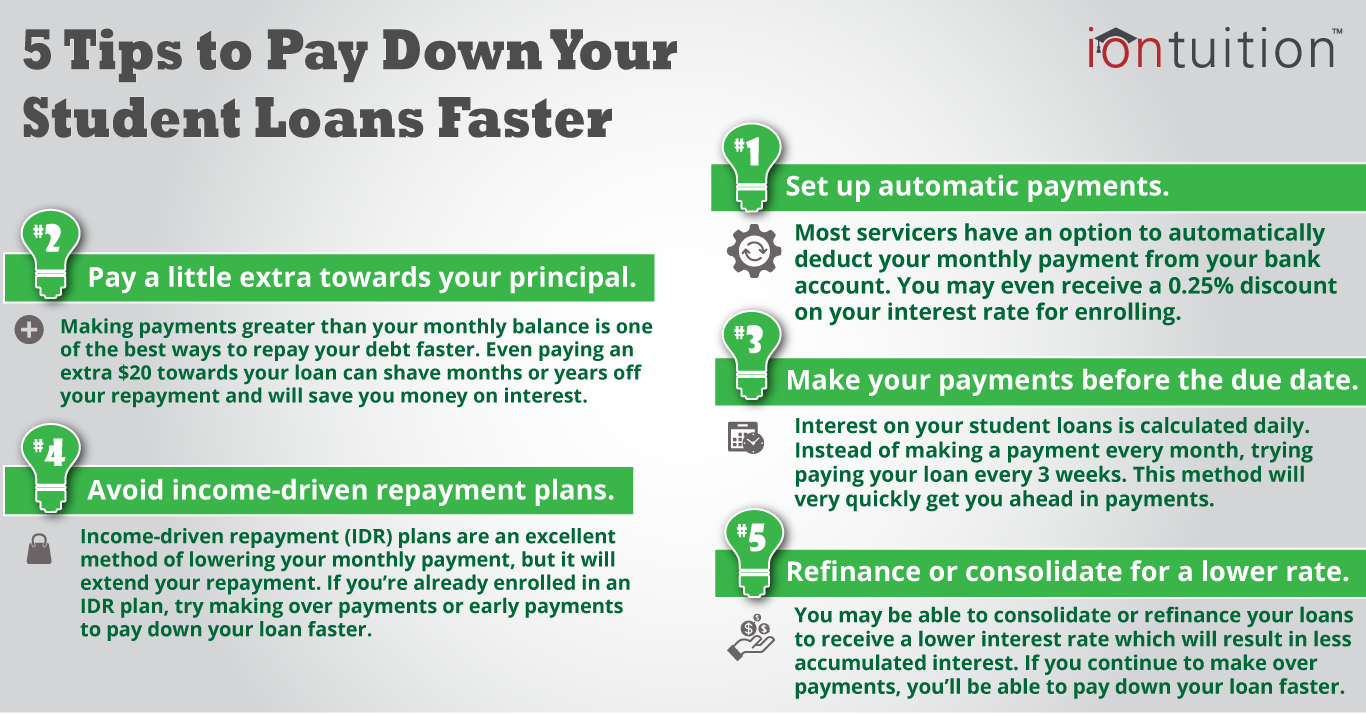
The Debt Avalanche is the mathematically optimal choice. In this strategy, you list all your loans in order of interest rate, from highest to lowest. You make the minimum payments on all loans but direct every extra dollar of your budget toward the loan with the highest interest rate. Once that is paid off, you “avalanche” that payment amount into the next highest interest rate loan. This method minimizes the total interest paid over the life of the loans and shortens the repayment period the most effectively.
The Debt Snowball Method
The Debt Snowball prioritizes psychological wins over mathematical efficiency. Here, you list your loans by total balance, from smallest to largest. You focus all extra funds on the smallest balance first. The logic is that by eliminating a small debt quickly, you gain a sense of momentum and accomplishment that fuels your motivation to tackle larger balances. For borrowers who feel overwhelmed by the sheer number of individual loans, the snowball method provides the behavioral reinforcement needed to stay the course.
The Bi-Weekly Payment Hack
A simple yet effective tactic to accelerate any repayment plan is switching from monthly to bi-weekly payments. By paying half of your monthly obligation every two weeks, you end up making 26 half-payments in a year. This equates to 13 full monthly payments instead of 12. This extra payment, applied directly to the principal, can shave months—or even years—off your repayment timeline without requiring a massive shift in your monthly budget.
Maximizing Federal Protections and Forgiveness Programs
For those with federal debt, the Department of Education provides several pathways that can lower monthly burdens or even result in total debt discharge after a set period.
Income-Driven Repayment (IDR) and the SAVE Plan
The Saving on a Valuable Education (SAVE) plan represents one of the most significant shifts in federal student loan policy. IDR plans calculate your monthly payment based on your discretionary income and family size rather than your total balance. Under the SAVE plan, many borrowers see their monthly payments drop to zero, and perhaps more importantly, the government waives any interest that exceeds the monthly payment. This prevents the balance from growing while the borrower is in a low-income bracket. After 20 or 25 years of qualifying payments, any remaining balance is forgiven.
Public Service Loan Forgiveness (PSLF)
PSLF remains the “gold standard” for debt relief for those working in the public sector. If you work full-time for a government agency (federal, state, local, or tribal) or a 501(c)(3) non-profit organization, you may be eligible for total forgiveness of your Direct Loans after making 120 qualifying monthly payments under an IDR plan. The key to PSLF is meticulous record-keeping; you must certify your employment annually and ensure your loans are consolidated into the Direct Loan program if they were originally FFEL or Perkins loans.
Employer Student Loan Contributions
A growing trend in corporate benefits is the student loan repayment assistance program. Under Section 127 of the Internal Revenue Code, employers can provide up to $5,250 per year in tax-free student loan repayment assistance to employees. This is essentially “free money” that functions much like a 401(k) match. If your employer offers this benefit, it should be your primary tool for aggressive repayment, as it allows you to pay down the principal with pre-tax dollars.
Refinancing: When to Move to Private Lenders
Refinancing involves taking out a new loan with a private lender to pay off your existing federal or private loans. This is a powerful tool, but it is a one-way street that should be navigated with caution.
The Case for Refinancing
The primary reason to refinance is to secure a lower interest rate. If your credit score has improved significantly since you graduated, or if market rates have dropped, you could potentially save thousands of dollars. Refinancing also allows you to consolidate multiple monthly payments into a single one, simplifying your financial life. This is particularly beneficial for high-income earners with private student loans that carry double-digit interest rates.
The Risks of Refinancing Federal Loans
The most critical caveat in student loan management is that refinancing federal loans into a private loan permanently strips away all federal protections. You will lose access to IDR plans, PSLF eligibility, and federal discharge options in the event of disability or death. Before refinancing federal debt, ask yourself if your job security is high enough and your emergency fund robust enough to forgo the safety net provided by the Department of Education. For most, the best strategy is to refinance existing private loans while leaving federal loans within the government system.
Accelerating the Timeline: Income Generation and Lifestyle Design
While structural strategies and government programs are essential, the speed of your debt repayment is ultimately determined by the gap between your income and your expenses.
Leveraging Windfalls and Side Hustles
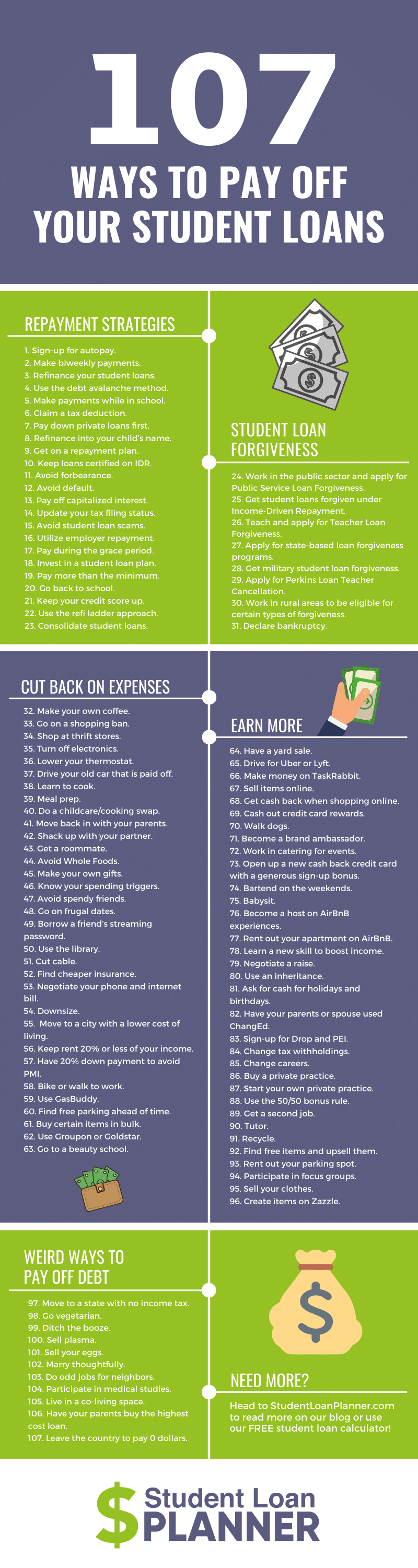
To make a dent in large principal balances, you must look beyond your primary salary. Tax refunds, performance bonuses, and inheritance money should be treated as “accelerant funds.” Rather than absorbing these into your lifestyle, apply them directly to your highest-interest loan. Additionally, the rise of the gig economy provides opportunities to generate “debt-specific” income. Whether it is freelance consulting, tutoring, or e-commerce, directing 100% of side-hustle earnings toward student loans can drastically alter your financial trajectory.
The 0.25% Autopay Discount
Almost every loan servicer, both federal and private, offers a 0.25% interest rate reduction if you sign up for automatic debit payments. While a quarter of a percent may seem negligible, on a $50,000 balance over a 10-year term, it adds up to hundreds of dollars in savings. More importantly, it ensures you never miss a payment, protecting your credit score and keeping you on track for any forgiveness timelines.
Budgeting for Aggressive Repayment
Living like a student after you have graduated is the most effective way to eliminate debt. By maintaining a modest lifestyle for the first three to five years of your career, you can allocate “lifestyle creep” raises toward your debt instead of a more expensive apartment or vehicle. Use budgeting tools to track your “burn rate” and identify “leaky” expenses that can be redirected toward your loans. Every dollar you pay toward the principal today is a dollar that won’t be generating interest against you tomorrow.
Paying for student loans is a marathon, not a sprint. It requires a blend of tactical knowledge, disciplined execution, and occasional pivoting as your career and life circumstances evolve. By understanding your options—from IDR plans to the debt avalanche—you move from being a victim of your debt to a manager of your wealth. Freedom from student loans is not just about reaching a zero balance; it is about reclaiming your future earnings to build the life you envisioned when you first stepped onto campus.
aViewFromTheCave is a participant in the Amazon Services LLC Associates Program, an affiliate advertising program designed to provide a means for sites to earn advertising fees by advertising and linking to Amazon.com. Amazon, the Amazon logo, AmazonSupply, and the AmazonSupply logo are trademarks of Amazon.com, Inc. or its affiliates. As an Amazon Associate we earn affiliate commissions from qualifying purchases.