
In the high-stakes world of real estate investing and personal finance, information is the primary currency. The Multiple Listing Service (MLS) stands as the definitive repository of real estate data, a comprehensive database utilized by brokers to share information about properties for sale. For the serious investor or the financially savvy homeowner, gaining access to this data is not merely a matter of curiosity; it is a strategic necessity. Understanding how to navigate the barriers to entry for the MLS can be the difference between a high-yield acquisition and a missed opportunity.
The Economic Logic of Direct MLS Access
To understand why access to the MLS is so coveted, one must first understand the financial concept of information asymmetry. In any market, the party with the most accurate, real-time data holds the leverage. While public-facing platforms have democratized property searches to an extent, they remain secondary sources that often lag behind the primary data stream.
The Information Asymmetry Advantage
The MLS provides more than just listing prices and photographs. It offers a wealth of granular data that is often stripped away by the time it reaches consumer websites like Zillow or Realtor.com. For a financial analyst or a real estate investor, the most valuable data points are found in the “private remarks” and historical transaction logs. These sections often contain critical information regarding seller motivation, specific closing instructions, or known structural issues that are not publicized to the general market.
By accessing the MLS directly, an individual can see the exact moment a property’s status changes from “active” to “under contract,” or more importantly, when it returns to the market after a failed inspection. This real-time visibility allows for a faster capital allocation strategy, ensuring that you are making offers while your competitors are still waiting for their third-party apps to update.
Why Third-Party Aggregators Fail High-Stakes Investors
The financial risk of relying on third-party aggregators lies in data latency and incompleteness. These platforms pull data via Internet Data Exchange (IDX) feeds, which are simplified versions of the MLS. In a fast-moving market, a delay of even 24 hours can result in a lost deal. Furthermore, many aggregators do not display “expired” or “withdrawn” listings. For a savvy investor, an expired listing represents a prime opportunity for a direct-to-seller negotiation, potentially bypassing commission costs and securing a better purchase price. Without direct MLS access, these opportunities remain invisible, representing a significant opportunity cost.
The Professional Path: Licensing as a Business Investment
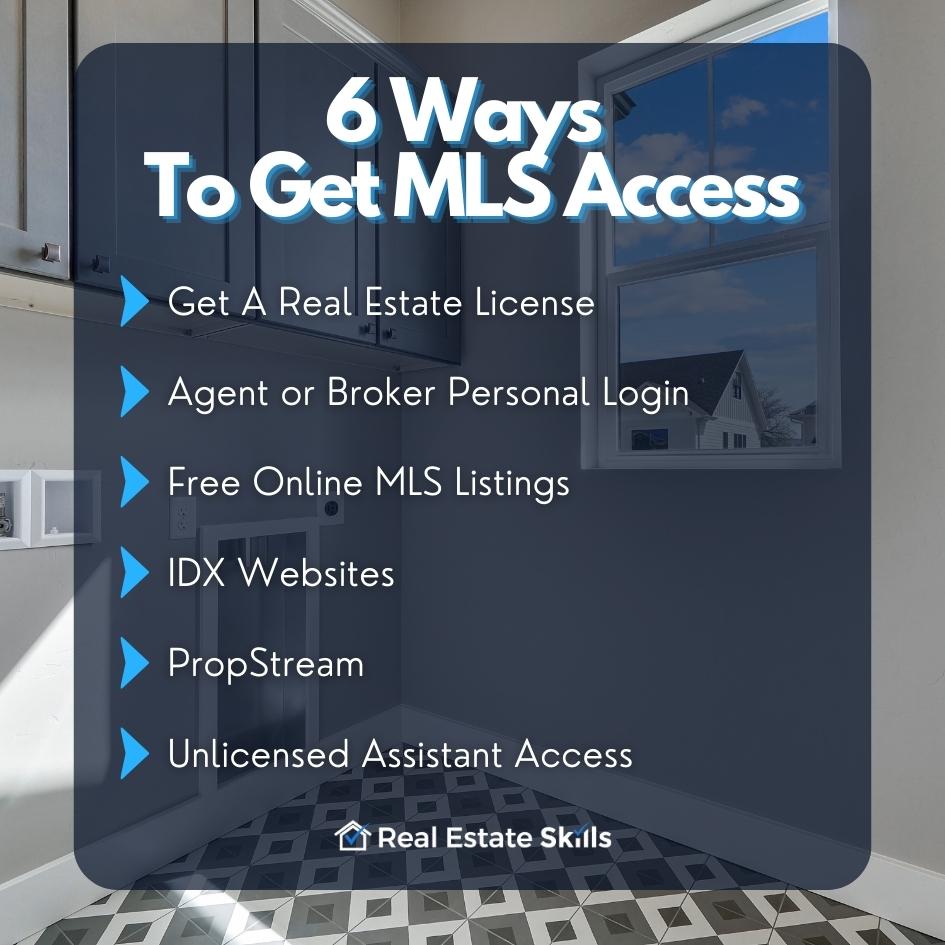
The most direct way to gain unrestricted access to the MLS is to become a licensed real estate professional. While this requires a commitment of time and capital, it should be viewed as a business investment rather than a mere regulatory hurdle.
The Cost-Benefit Analysis of Real Estate Licensure
Becoming a licensed agent involves several financial layers: pre-licensing education, examination fees, and background checks. Depending on the jurisdiction, this initial investment can range from $500 to $1,500. For an individual managing a personal portfolio of multi-family units or conducting multiple flips per year, this cost is easily recouped.
Beyond the data access, being licensed allows an investor to claim the “agent” portion of the commission on their own purchases. On a $500,000 property, a 2.5% to 3% buyer’s agent commission equates to $12,500 to $15,000. This immediate return on investment dwarfs the initial licensing costs. However, one must also account for the professional liability insurance (E&O insurance) and the ongoing continuing education requirements, which are necessary to maintain the license in good standing.
Navigating Board Dues and Maintenance Fees
Gaining a license is only the first step. To access the actual MLS software, one must typically join the National Association of Realtors (NAR) and a local board of realtors. This involves annual dues and quarterly MLS subscription fees. These costs can total between $1,000 and $2,500 per year.
From a business finance perspective, these are fixed operating expenses. If your investment strategy involves high-frequency trading of properties or if you are managing a large-scale rental portfolio, the ability to pull your own “comps” (comparable sales data) without waiting for an external agent provides a level of agility that justifies these recurring costs. The depth of the data—including tax records, zoning information, and historical price fluctuations—allows for more sophisticated financial modeling and risk assessment.
Alternative Strategies for the Financial Opportunist
For those who do not wish to maintain a professional license, there are alternative methods to tap into the MLS data stream. These methods require a blend of networking and the strategic use of financial technology.
Forming Strategic Partnerships with Licensees
One of the most cost-effective ways to access MLS listings is through a symbiotic relationship with an active broker. Many investors hire “bird dogs” or junior agents to set up automated MLS alerts. Unlike the alerts found on consumer websites, these are professional-grade “auto-emails” that can be customized with highly specific criteria—such as price per square foot, specific neighborhoods, or keywords in the private remarks like “cash only” or “motivated seller.”
In this scenario, the investor provides the capital and the deal flow, while the agent provides the data access and handles the paperwork. Financially, this is a “no-fee” way to get the data, though it usually implies that the agent will be the one collecting the commission on any resulting transaction. For the investor, this preserves liquidity by avoiding the upfront costs of licensing and dues while still benefiting from the speed of the professional database.
Leveraging Virtual Office Websites (VOW) for Granular Data
A “Virtual Office Website” (VOW) is a category of website that provides a more comprehensive look at MLS data than standard IDX sites. To access a VOW, a user must typically create an account and establish a “broker-consumer relationship” digitally. Once registered, these sites can legally display more data than a public search engine—such as the sales price history of a home and the original listing price.
While not a full MLS login, a VOW is a powerful tool for the budget-conscious investor. It allows for a deeper dive into market trends and property valuations without the overhead of a license. Using these tools, an investor can perform a preliminary financial audit on a property before even reaching out to an agent, streamlining the due diligence process and saving valuable time.
Data-Driven Investing: Maximizing the Value of Listing Access
Once access is secured, the focus shifts from “how to get in” to “how to use the data to generate wealth.” The MLS is not just a list of houses; it is a financial analytical tool that, when used correctly, can identify market inefficiencies.
Analyzing Comp Data for Accurate Valuation
The “CMA” (Comparative Market Analysis) tool within the MLS is the gold standard for determining a property’s After Repair Value (ARV). By looking at “sold” listings within a tight radius over the last 90 to 180 days, an investor can calculate the exact market ceiling.
A sophisticated approach involves filtering for properties with similar finishes and square footage to create a weighted average of sale prices. This prevents over-leveraging and ensures that the acquisition price leaves enough margin for renovation costs and the desired profit. In the world of business finance, this is essentially a “mark-to-market” valuation, providing a realistic snapshot of an asset’s liquidity.
Identifying Off-Market Opportunities and Expired Listings
The MLS is also a historical archive. Investors often search for properties that have been on the market for an unusually long time (high Days on Market, or DOM) or those that have “expired” without a sale. A property that has been sitting for 100 days is a liability for the seller, often leading to a price reduction or a willingness to entertain creative financing options, such as seller carrying a note.
By identifying these “stale” listings, an investor can target properties where the seller is under financial duress or simply tired of the process. Negotiating a deal on an expired listing can lead to significant equity capture on day one, as these properties are often sold below their true market value due to poor initial marketing or unrealistic pricing that has since been corrected by the market’s silence.
The Future of Real Estate Data and Capital Allocation
The landscape of MLS access is currently undergoing significant shifts due to legal and technological changes. As an investor or a person concerned with personal finance, staying ahead of these trends is crucial for long-term wealth preservation.
The Impact of Commission Structure Changes on Access
Recent legal settlements regarding how real estate commissions are structured and advertised are likely to change the way MLS data is utilized. Historically, the MLS was the primary place to see the “cooperative compensation” offered to buyer’s agents. As these rules change, the way investors calculate their transaction costs will evolve.
Accessing the MLS will become even more critical as “off-MLS” or “pocket listings” may become more common in certain niche markets. Being “in the system” allows an investor to see the broader market trends that will dictate whether a private deal is actually a bargain or an overpriced asset.
Scaling Your Portfolio with Real-Time Market Intelligence
Ultimately, getting access to MLS listings is about scaling your financial operations. Whether you are a first-time homebuyer looking to save money or a seasoned developer looking for your next million-dollar project, the data contained within the MLS is the foundation of sound financial decision-making.
By treating MLS access as a key component of your business infrastructure—whether through professional licensing, technological tools, or strategic partnerships—you position yourself to act with confidence in a volatile market. In the intersection of real estate and finance, the fastest and most accurate data always wins. Direct access to the source is not just a convenience; it is a fundamental pillar of modern wealth building.
aViewFromTheCave is a participant in the Amazon Services LLC Associates Program, an affiliate advertising program designed to provide a means for sites to earn advertising fees by advertising and linking to Amazon.com. Amazon, the Amazon logo, AmazonSupply, and the AmazonSupply logo are trademarks of Amazon.com, Inc. or its affiliates. As an Amazon Associate we earn affiliate commissions from qualifying purchases.