
In the intricate world of finance, numbers tell a story. But raw figures, while essential, often lack the comparative power needed for true insight. This is where percentages step in, transforming isolated data points into meaningful metrics that drive informed decisions. Understanding “how to find a number is what percent of another” isn’t just about solving a math problem; it’s about unlocking a fundamental language of money. From personal budgeting and investment analysis to strategic business planning, mastering this calculation is the bedrock of financial literacy and a catalyst for greater economic control. It empowers individuals and organizations alike to contextualize financial information, make astute comparisons, and forecast future trends with greater precision.
The Core Concept: Understanding Percentages in Finance
At its heart, a percentage is a way to express a part of a whole as a fraction of 100. It provides a standardized method for comparison, making complex financial data digestible and actionable. While seemingly simple, its pervasive use across all facets of finance underscores its critical importance.
What Exactly is a Percentage?
A percentage, denoted by the symbol ‘%’, literally means “per hundred.” It’s a ratio or a fraction where the denominator is 100. For instance, 25% means 25 out of 100, or 25/100, which can also be expressed as the decimal 0.25. This universal language allows us to easily compare quantities even when their total amounts differ significantly. In financial terms, whether you’re looking at an interest rate, a discount, or a profit margin, the percentage offers immediate context and comparability.
Why Percentages Matter More Than Raw Numbers
Raw numbers can be deceptive without context. Is a $1,000 increase in revenue good? It depends. If total revenue was $10,000, that’s a 10% increase, which is significant. If total revenue was $1,000,000, it’s a negligible 0.1% increase. Percentages provide this crucial context, standardizing comparisons regardless of the scale of the underlying figures. They allow for easy evaluation of performance over time, against benchmarks, or between different financial entities, making them indispensable for analysis in budgeting, investing, and business operations.
The Fundamental Formula Unveiled
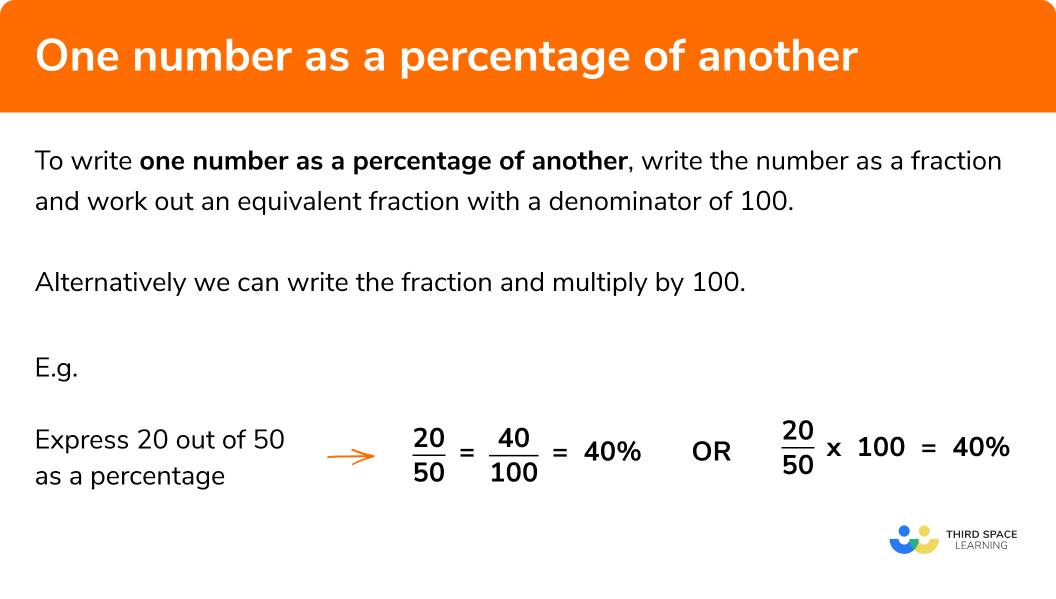
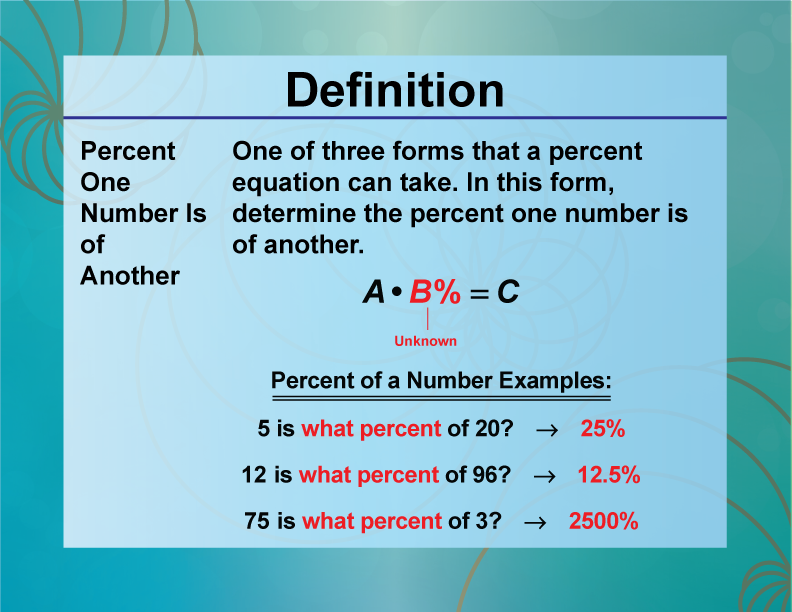
The core calculation for determining what percent one number is of another is straightforward:
($text{Part} div text{Whole}) times 100 = text{Percentage}$
Here:
-
Part: This is the specific number or amount you are trying to express as a percentage. For example, the amount of interest paid, the discount received, or a particular expense category.
-
Whole: This is the total or original amount against which the “part” is being compared. This could be your total income, the original price of an item, the principal loan amount, or a company’s total revenue.
-
100: Multiplying by 100 converts the resulting decimal fraction into a percentage, making it easier to read and understand.
Understanding each component of this formula is key to applying it correctly across diverse financial scenarios.
Practical Applications in Personal Finance
For individuals, mastering percentage calculations is not just about academic knowledge; it’s about gaining control over one’s financial destiny. From daily spending to long-term savings, percentages empower smarter decisions.
Budgeting and Expense Tracking
One of the most immediate applications of percentages in personal finance is budgeting. By calculating what percentage of your income goes to housing, food, transportation, or entertainment, you gain a clear picture of your spending habits. For instance, if your rent is $1,500 and your net monthly income is $5,000, your housing costs represent ($1,500 / $5,000) * 100 = 30% of your income. This allows you to compare your spending to financial guidelines (e.g., the 50/30/20 rule) and identify areas where you might be overspending or could allocate more towards savings.
Understanding Loans, Interest, and Debt
Percentages are fundamental to comprehending debt. Interest rates on credit cards, mortgages, and personal loans are always expressed as percentages (Annual Percentage Rate, or APR). Calculating the interest paid as a percentage of the principal loan amount helps you understand the true cost of borrowing. For example, if you pay $50 in interest on a $1,000 balance, you’ve paid 5% interest for that period. Understanding your debt-to-income ratio (total monthly debt payments as a percentage of gross monthly income) is also crucial for assessing your financial health and qualifying for new loans.
Navigating Discounts, Sales, and Taxes
Every time you shop, percentages are at play. A “20% off” sale means you’re saving a fifth of the original price. To calculate the actual savings, you’d multiply the original price by 20%. Similarly, sales tax, income tax brackets, and property taxes are all percentage-based. Knowing how to calculate these helps you determine the final cost of an item or understand your take-home pay after deductions, ensuring you’re a savvy consumer and taxpayer.
Measuring Savings and Retirement Growth
For long-term financial goals, percentages are indispensable. Your savings rate (the percentage of your income you save) is a critical indicator of your progress toward financial independence. Investment accounts grow (or sometimes shrink) by a certain percentage each year, known as the annual growth rate or return on investment (ROI). Understanding these percentages allows you to project how much your money will grow over time, assess if you’re on track for retirement, and make informed decisions about your investment contributions.
Strategic Uses in Investing and Wealth Building
In the realm of investments, percentages transition from merely useful to absolutely critical. They are the language of performance, risk, and portfolio health.
Analyzing Investment Returns and Performance
When evaluating investments, the absolute dollar gain is less informative than the percentage return. If an investment gained $1,000, that sounds good. But if it was on a $100,000 investment, it’s only a 1% return. If it was on a $5,000 investment, it’s a 20% return. Calculating the Return on Investment (ROI) – (Current Value – Original Value) / Original Value * 100 – provides a standardized metric to compare different investment opportunities, regardless of their initial cost, allowing investors to truly gauge performance over time.
Deciphering Portfolio Allocation and Diversification
A well-diversified investment portfolio spreads risk across different asset classes, industries, and geographies. This diversification is managed and measured through percentages. For example, an investor might aim for a portfolio composed of 60% stocks, 30% bonds, and 10% cash. Calculating the current percentage of each asset in your portfolio helps you understand your risk exposure, rebalance as needed, and ensure your allocation aligns with your financial goals and risk tolerance.
Understanding Fees and Their Impact
Investment fees, often expressed as percentages, can significantly erode long-term returns. Expense ratios on mutual funds and ETFs, management fees charged by financial advisors, and transaction fees are all percentage-based. Even a seemingly small 1% annual fee can compound over decades, costing an investor thousands, or even hundreds of thousands, of dollars. Calculating what these fees represent as a percentage of your total assets helps you understand their true cost and choose more cost-effective investment vehicles.
Dividend Yields and Income Generation
For income-focused investors, dividend yield is a key metric. This is calculated as the annual dividend per share divided by the stock’s current share price, expressed as a percentage. A stock with a $1 annual dividend trading at $50 per share has a 2% dividend yield ($1/$50 * 100). This percentage helps investors compare the income-generating potential of different stocks or funds, playing a vital role in constructing portfolios designed for passive income.
Business Finance and Entrepreneurship through the Percentage Lens
For businesses, percentages are the lifeblood of performance analysis, strategic planning, and operational efficiency. They transform raw accounting data into actionable insights for growth and profitability.
Key Performance Indicators (KPIs) and Growth Metrics
Businesses rely heavily on percentage-based KPIs to monitor health and performance. Revenue growth percentage (current revenue vs. previous period), profit margins (gross, operating, net profit as a percentage of revenue), and market share (a company’s sales as a percentage of total market sales) are critical. These percentages allow managers to set targets, measure progress, and compare their company’s performance against competitors or industry benchmarks, signaling areas of strength or concern.
Pricing Strategies and Profitability
Percentages are central to setting prices and understanding profitability. Markups, for example, are a percentage added to the cost of a product to determine its selling price. Gross profit margin, calculated as (Revenue – Cost of Goods Sold) / Revenue * 100, indicates the percentage of revenue left after accounting for direct production costs. Net profit margin, which considers all expenses, shows the ultimate profitability of each dollar of sales. These percentages are vital for ensuring a business is priced competitively and generating sufficient returns.
Cost Analysis and Efficiency Improvements
Managing costs is crucial for business success, and percentages offer the clearest view. Calculating the cost of goods sold (COGS) as a percentage of revenue, or specific operational expenses (e.g., marketing spend, administrative costs) as a percentage of total expenses, helps identify areas of inefficiency. If a particular cost category represents an unusually high percentage, it flags an area for potential optimization, allowing businesses to streamline operations and improve their bottom line.
Financial Ratios for Business Health
Many critical financial ratios that assess a company’s liquidity, solvency, efficiency, and profitability are inherently percentage-based or derived from comparisons that percentages clarify. Ratios like debt-to-equity (total debt as a percentage of shareholder equity), current ratio (current assets / current liabilities), or return on assets (net income as a percentage of total assets) provide a comprehensive snapshot of a business’s financial standing, informing investors, lenders, and management alike.
Tools and Tips for Accurate Percentage Calculations
While the formula is simple, consistent accuracy in financial percentage calculations benefits from the right tools and a disciplined approach.
Everyday Calculators and Spreadsheets
For quick, simple calculations, any basic calculator will suffice. For more complex or recurring financial tasks, spreadsheet software like Microsoft Excel or Google Sheets is invaluable. They allow you to set up formulas once and apply them across numerous data points, automating calculations for budgets, investment tracking, and business reports. Functions like =(A1/B1)*100 are the digital equivalent of the fundamental percentage formula, making large datasets manageable.
Online Financial Calculators and Apps
The internet abounds with specialized financial calculators and mobile apps designed for specific percentage-based computations. Mortgage calculators, loan amortization schedules, retirement planners, and investment growth projectors often leverage complex percentage formulas to provide instant insights. These tools simplify intricate calculations, allowing users to focus on understanding the implications of the percentages rather than just the mechanics of finding them.
Common Mistakes to Avoid
Even seasoned professionals can make simple errors. The most common mistake is mixing up the “part” and the “whole,” leading to an inverted or incorrect percentage. Another is forgetting to multiply by 100 at the end if you want the result in percentage format rather than a decimal. Rounding errors can also accumulate, so pay attention to decimal places, especially in high-stakes financial scenarios. Always double-check your inputs and ensure the result makes logical sense within the financial context.
Developing Your Financial Intuition
Beyond rote calculation, developing a financial intuition for percentages is a powerful skill. This means being able to quickly estimate percentages in your head (e.g., “10% of $500 is $50”) and having a general understanding of what constitutes a ‘good’ or ‘bad’ percentage in different financial contexts. For instance, knowing that a 20% credit card APR is high or that a 7% annual investment return is generally strong helps you make faster, more confident financial decisions without always needing a calculator for every single scenario.

Conclusion
The seemingly simple act of figuring out “how to find a number is what percent of another” transcends basic arithmetic; it’s a cornerstone of financial intelligence. From meticulously managing personal budgets and strategically growing investments to steering the profitability of a business, percentages provide the context, clarity, and comparability essential for sound decision-making. Mastering this fundamental calculation empowers individuals and organizations to translate raw financial data into meaningful insights, identify trends, assess risk, and ultimately, build a more secure and prosperous financial future. Embrace the power of percentages, and unlock a clearer path to financial mastery.
aViewFromTheCave is a participant in the Amazon Services LLC Associates Program, an affiliate advertising program designed to provide a means for sites to earn advertising fees by advertising and linking to Amazon.com. Amazon, the Amazon logo, AmazonSupply, and the AmazonSupply logo are trademarks of Amazon.com, Inc. or its affiliates. As an Amazon Associate we earn affiliate commissions from qualifying purchases.