
Understanding how to calculate the percentage increase between two numbers is a foundational skill in personal and business finance. Whether you’re tracking the growth of your investments, analyzing year-over-year revenue spikes, or monitoring the rise in your living expenses, this calculation provides a clear, standardized metric for assessing change. It allows for meaningful comparisons and informed decision-making, moving beyond raw numerical differences to reveal the true scale of expansion or appreciation.
Understanding the Core Concept
At its heart, percentage increase quantifies how much a value has grown relative to its starting point. It transforms an absolute change into a proportional change, making it universally applicable across various financial scenarios, regardless of the initial magnitudes.
What is Percentage Increase?
Percentage increase measures the proportional growth of a value from an initial state to a final state. Instead of just stating that something went up by X dollars or units, it expresses that increase as a percentage of the original amount. This is crucial because a $100 increase on a $1,000 investment is far more significant than a $100 increase on a $100,000 investment, and percentage increase clearly illustrates this difference (10% vs. 0.1%).
Why it Matters in Finance
In the financial world, raw numbers alone often tell an incomplete story. A company reporting a $1 million increase in profits sounds impressive, but if their initial profits were $5 million, that’s a 20% growth. If their initial profits were $100 million, it’s only a 1% growth. Percentage increase provides the context necessary for accurate financial analysis.
For individuals, it helps in:
-
Evaluating Investment Returns: Comparing the performance of different assets (stocks, bonds, real estate) over various periods.
-
Tracking Income Growth: Understanding the real impact of salary raises or side hustle earnings.
-
Analyzing Expense Inflation: Monitoring how much costs like groceries, rent, or utilities are increasing over time.
For businesses, it’s vital for:
-
Performance Measurement: Assessing revenue growth, profit margin expansion, or customer acquisition rates.
-
Strategic Planning: Setting realistic growth targets and evaluating the effectiveness of business initiatives.
-
Benchmarking: Comparing performance against industry averages or competitors.
Without the ability to calculate and interpret percentage increase, financial decisions would be based on incomplete data, potentially leading to misjudgments in investment, budgeting, or business strategy.
The Step-by-Step Calculation Method
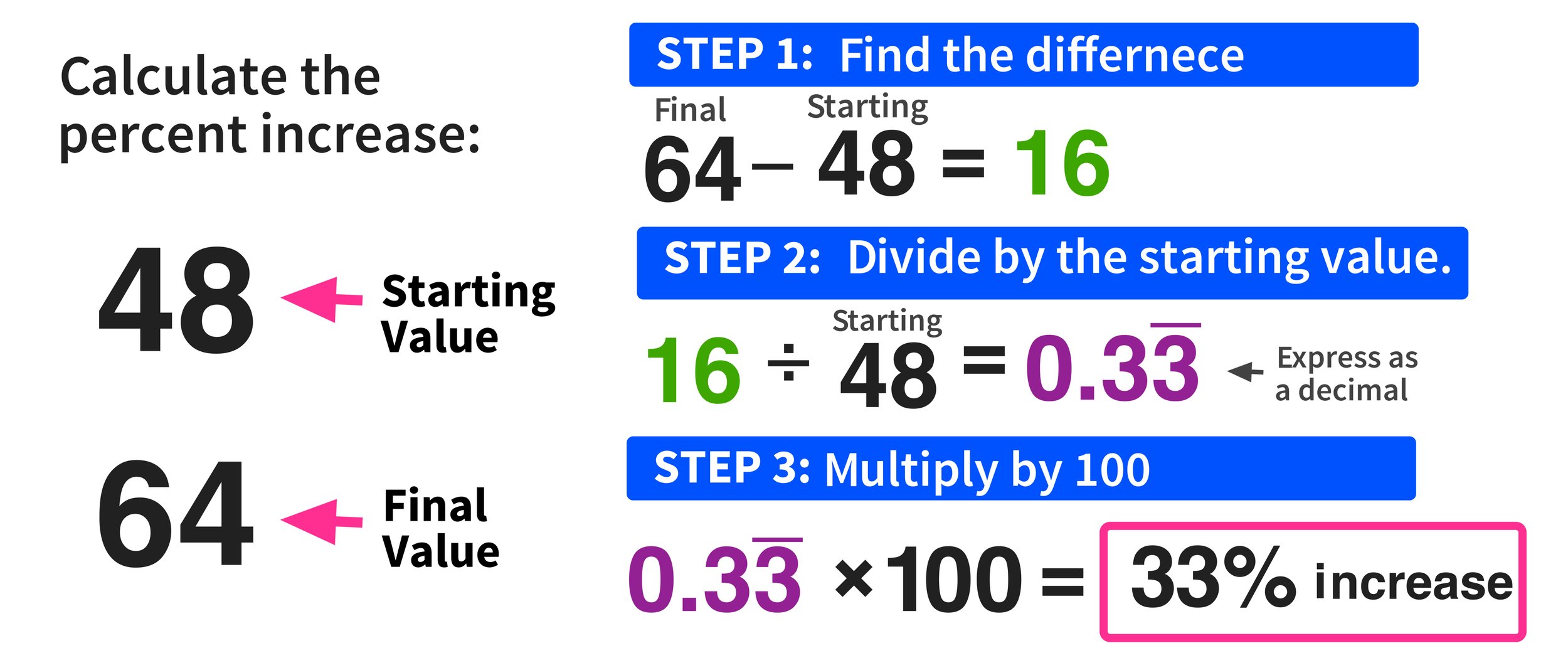
Calculating percentage increase is a straightforward process involving just a few steps. The formula is intuitive and can be applied to any two numbers where the second number is greater than the first.
The general formula for percentage increase is:
$$ text{Percentage Increase} = frac{text{Final Value} – text{Initial Value}}{text{Initial Value}} times 100% $$
Let’s break down each component with practical financial examples.
Identifying Your Starting and Ending Values
The first crucial step is to correctly identify the “Initial Value” (also known as the original value or old value) and the “Final Value” (also known as the new value or current value). The initial value is the point from which you are measuring growth, and the final value is the point to which you are measuring.
Example: You bought shares in a company for $50 per share (Initial Value). A year later, the shares are trading at $65 per share (Final Value).
-
Initial Value = $50
-
Final Value = $65
Calculating the Absolute Change
The absolute change represents the raw numerical difference between the final and initial values. It tells you how much the value has increased in absolute terms. To find this, simply subtract the initial value from the final value.
Formula: Absolute Change = Final Value – Initial Value
Example (continuing from above):
- Absolute Change = $65 (Final Value) – $50 (Initial Value) = $15
This means your shares increased in value by $15 per share.
Dividing by the Original Value
This step is critical because it contextualizes the absolute change. By dividing the absolute change by the initial value, you determine the increase as a proportion or a decimal fraction of the starting point. This ratio is the core of the percentage calculation.
Formula: Ratio = Absolute Change / Initial Value
Example (continuing):
- Ratio = $15 (Absolute Change) / $50 (Initial Value) = 0.30
This means the increase is 0.30 times the original value.
Converting to a Percentage
The final step is to convert the decimal ratio into a percentage. This is done by multiplying the ratio by 100. The result will have a percent sign (%) appended to it, clearly indicating a proportional increase.
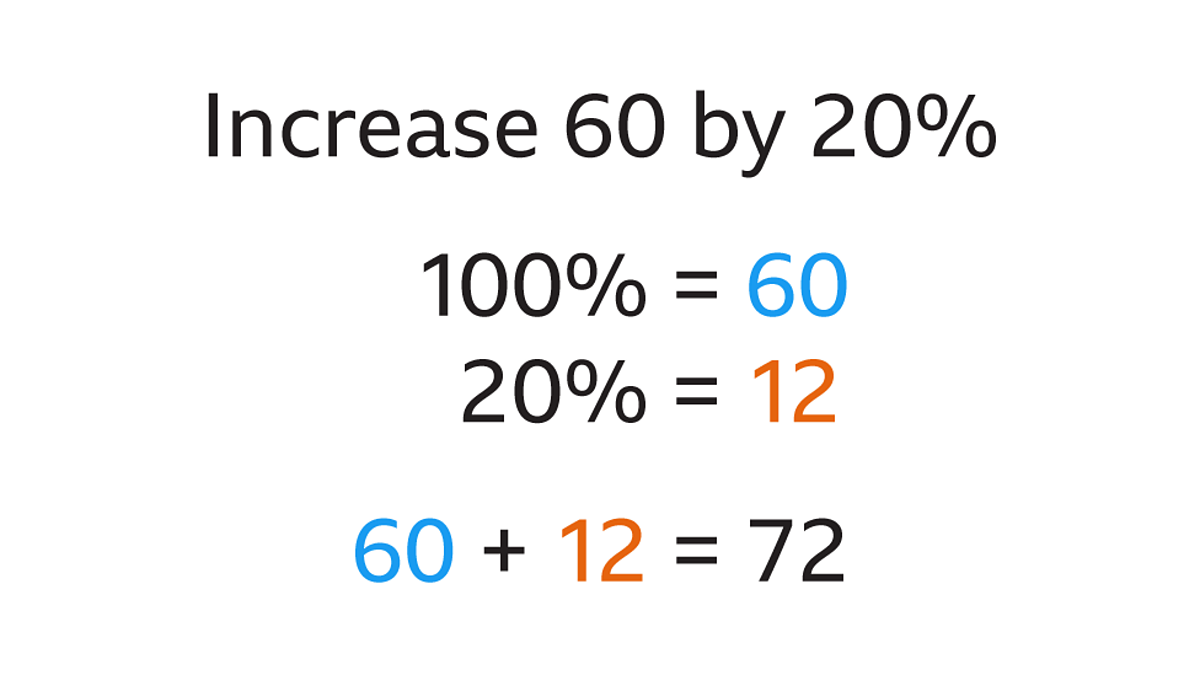
Formula: Percentage Increase = Ratio × 100%
Example (final step):
- Percentage Increase = 0.30 (Ratio) × 100% = 30%
So, your shares increased by 30%.
Let’s consider another financial example:
You started a side hustle that generated $800 in revenue last month (Initial Value). This month, it generated $1,200 (Final Value).
-
Absolute Change: $1,200 – $800 = $400
-
Divide by Original Value: $400 / $800 = 0.50
-
Convert to Percentage: 0.50 × 100% = 50%
Your side hustle revenue increased by 50% this month.
Real-World Financial Applications
The ability to calculate percentage increase is not just an academic exercise; it’s a practical tool with widespread applications across various financial domains.
Investment Portfolio Growth
One of the most common uses of percentage increase is to measure the performance of investments. Investors constantly need to know how much their stocks, bonds, mutual funds, or real estate holdings have appreciated.
-
Scenario: You invested $10,000 in a mutual fund. After three years, your investment is worth $12,500.
-
Increase = ($12,500 – $10,000) / $10,000 = $2,500 / $10,000 = 0.25
-
Percentage Increase = 0.25 * 100% = 25%
-
This 25% tells you the overall growth of your investment, allowing you to compare it against other investment opportunities or inflation rates.
Business Revenue and Profit Analysis
Businesses rely heavily on percentage increases to evaluate their financial health and growth trajectories. They track revenue, gross profit, net profit, and customer base growth using this metric.
-
Scenario: A small business generated $500,000 in revenue last fiscal year and $625,000 this fiscal year.
-
Increase = ($625,000 – $500,000) / $500,000 = $125,000 / $500,000 = 0.25
-
Percentage Increase = 0.25 * 100% = 25%
-
A 25% year-over-year revenue increase is a strong indicator of business expansion and effective strategy. Conversely, if profits only grew by 2%, it might signal efficiency issues even with revenue growth.
Personal Finance Tracking (Salaries, Savings)
For personal financial management, percentage increase helps individuals monitor their economic progress and plan effectively.
-
Salary Increases: If your annual salary was $60,000 last year and increased to $63,000 this year.
-
Increase = ($63,000 – $60,000) / $60,000 = $3,000 / $60,000 = 0.05
-
Percentage Increase = 0.05 * 100% = 5%
-
Knowing your salary increased by 5% allows you to assess if it’s keeping pace with inflation or improving your purchasing power.
- Savings Growth: Tracking how much your savings account balance has grown due to interest or regular contributions. If your savings went from $5,000 to $5,300 in a year, that’s a 6% increase, which helps you visualize progress toward financial goals.
Understanding Inflation and Cost Increases
Inflation erodes purchasing power, and understanding its impact often involves percentage increase calculations.
-
Scenario: The average cost of a basket of goods was $200 last year and is now $208.
-
Increase = ($208 – $200) / $200 = $8 / $200 = 0.04
-
Percentage Increase = 0.04 * 100% = 4%
-
This 4% represents the inflation rate for those goods, indicating how much more expensive everyday items have become and why your money buys less. Similarly, budgeting for rising housing costs or utility bills relies on understanding these percentage changes.
Common Pitfalls and Considerations
While the calculation is straightforward, there are important nuances and potential pitfalls to consider to ensure accurate and meaningful financial analysis.
The Importance of the Starting Value
The choice of the “Initial Value” is paramount. The percentage increase is always calculated relative to this starting point. Using the wrong initial value will yield an incorrect and misleading percentage. For instance, if you want to calculate the percentage increase from Q1 to Q2, Q1’s value must be the initial value. If you mistakenly used Q2’s value, you would be calculating a percentage decrease from Q2 to Q1 in reverse. Always double-check that your denominator is the true original figure you intend to measure growth from.
Handling Negative Values (Percentage Decrease)
Sometimes, financial figures go down instead of up. While the core formula remains largely the same, when the final value is less than the initial value, the result will be a negative percentage, indicating a decrease.
-
Scenario: An investment dropped from $1,000 (Initial Value) to $800 (Final Value).
-
Calculation: ($800 – $1,000) / $1,000 = -$200 / $1,000 = -0.20
-
Percentage Change = -0.20 * 100% = -20%
-
This clearly indicates a 20% decrease. Often, for clarity, analysts might calculate percentage decrease separately, using a formula like: $(text{Initial Value} – text{Final Value}) / text{Initial Value} times 100%$. Both methods yield the same magnitude but help avoid confusion about positive/negative signs. The important thing is to understand what the sign implies.
Annualized vs. Cumulative Growth
When dealing with growth over multiple periods, it’s essential to distinguish between cumulative growth and annualized growth.
-
Cumulative Growth: This is the total percentage increase over the entire period, irrespective of how long it took. Our standard formula calculates cumulative growth between two points in time. For example, an investment grew 50% over 5 years.
-
Annualized Growth: This expresses the average annual rate of growth over multiple periods. It’s more complex to calculate (often involving compound annual growth rate – CAGR) and provides a better basis for comparing investments with different time horizons. A 50% growth over 5 years is a different annualized rate than 50% growth over 2 years. While the basic percentage increase calculation provides the cumulative figure, understanding the timeframe is crucial for proper interpretation, especially in investment analysis.
Leveraging Financial Tools for Efficiency
While manual calculation is fundamental, financial professionals and savvy individuals often use digital tools to quickly and accurately calculate percentage increases, especially when dealing with large datasets or complex scenarios.
Spreadsheet Software (Excel, Google Sheets)
Spreadsheets are perhaps the most powerful and versatile tools for financial calculations. They allow you to automate percentage increase calculations for numerous data points.
-
Basic Formula: If your Initial Value is in cell A1 and your Final Value is in cell B1, the formula for percentage increase would be
=(B1-A1)/A1. To display it as a percentage, simply format the cell to “Percentage” and adjust decimal places as needed. -
Mass Calculations: You can drag this formula down a column to instantly calculate the percentage increase for hundreds or thousands of rows of data, such as monthly revenue figures, stock price changes, or expense categories. This drastically reduces manual effort and error.
-
Scenario Analysis: Spreadsheets also enable dynamic “what-if” analysis. By changing initial or final values, you can immediately see the impact on the percentage increase, aiding in forecasting and budgeting.

Online Calculators and Financial Apps
For quick, one-off calculations or on-the-go analysis, numerous online percentage calculators and financial apps are available.
-
Simplicity: These tools typically provide a user-friendly interface where you simply input the initial and final values, and they instantly display the percentage increase (or decrease).
-
Accessibility: They are easily accessible via web browsers or smartphone apps, making them convenient for quick checks during meetings, while shopping, or reviewing financial statements.
-
Specialized Calculators: Some apps or websites offer specialized financial calculators that incorporate percentage increase as part of broader functions, such as ROI calculators, compound interest calculators, or inflation trackers. While they perform the calculation for you, understanding the underlying steps ensures you can interpret their results accurately and identify any potential input errors.
Mastering the calculation of percentage increase, whether manually or with digital tools, is an indispensable skill that empowers better financial analysis, planning, and decision-making for both individuals and businesses.
aViewFromTheCave is a participant in the Amazon Services LLC Associates Program, an affiliate advertising program designed to provide a means for sites to earn advertising fees by advertising and linking to Amazon.com. Amazon, the Amazon logo, AmazonSupply, and the AmazonSupply logo are trademarks of Amazon.com, Inc. or its affiliates. As an Amazon Associate we earn affiliate commissions from qualifying purchases.