
For the financially astute student, leveraging every available discount and perk is not just a luxury—it’s a necessity. Among the myriad of student-centric offers, Amazon Prime Student stands out as a powerful tool for optimizing personal finances while accessing a suite of invaluable services. This isn’t merely about convenience; it’s about smart budgeting, cost reduction, and maximizing the return on a minimal investment. This guide delves into the specifics of signing up for Amazon Prime Student, framed through the lens of financial strategy and prudent spending, ensuring you understand not just how to enroll, but why it’s a strategically wise move for your wallet.

Unlocking Financial Value: Why Student Prime is a Smart Move for Your Wallet
In the often-tight financial landscape of higher education, every dollar saved or strategically spent contributes significantly to a student’s overall financial well-being. Amazon Prime Student isn’t just a perk; it’s a significant financial tool designed to reduce common student expenditures and enhance fiscal efficiency.
The Core Financial Benefit: Discounted Access
The most immediate and compelling financial advantage of Amazon Prime Student is the substantial discount on the standard Amazon Prime membership fee. Students typically qualify for 50% off the regular price, an immediate and tangible saving that frees up funds for other essential expenses like textbooks, tuition, or even a well-deserved treat. Furthermore, many students are eligible for an extended free trial period—often six months—which provides a significant window to experience the full suite of Prime benefits without any upfront cost. This initial free period serves as a risk-free financial experiment, allowing students to accurately assess the membership’s value against their personal spending habits before committing a single dime. It’s an opportunity to calculate a personal return on investment (ROI) by tracking how much they save on shipping, entertainment, and exclusive deals during this trial. The financial insight gained during this phase is invaluable, teaching prudent consumption and subscription management.
Beyond Savings: Hidden Value in Everyday Student Life
While the membership fee discount is the headline, the broader financial implications of Prime Student extend far beyond. Consider the daily expenditures and logistical challenges students face. The cost of transportation to brick-and-mortar stores, often involving gas or public transit fares, adds up. The temptation of impulse purchases when shopping in person can derail a carefully crafted budget. Prime’s free, fast shipping mitigates these costs and risks. For essential items, from dorm room necessities to academic supplies, ordering online through Prime can be significantly more cost-effective and time-efficient. Furthermore, the included access to Prime Video and Amazon Music can replace separate streaming subscriptions, consolidate entertainment budgets, and provide a comprehensive media library that helps students avoid paying for multiple services. For many, these benefits alone can easily offset the discounted annual fee, effectively making the financial outlay for Prime a net zero or even a net gain. It’s about more than just convenience; it’s about making smarter purchasing decisions that align with a tight student budget.
Calculating Your ROI: When the Free Trial Pays Off
Understanding the true financial benefit of Prime Student requires a personal assessment of its utility. The initial free trial period is a golden opportunity for this calculation. During these months, consciously track your savings:
-
Shipping Costs Avoided: Estimate how much you would have paid for shipping on orders without Prime.
-
Entertainment Savings: If Prime Video or Music replaces a separate streaming service (e.g., Netflix, Spotify), quantify that monthly saving.
-
Exclusive Deals: Take advantage of any student-exclusive discounts on Amazon products and services, noting the price difference.
-
Time Value: While harder to quantify directly in dollars, consider the time saved by not traveling to stores, which can be reinvested in study or income-generating activities.
By the end of the trial, compare these cumulative savings and benefits against the discounted annual membership fee. For the vast majority of students, the tangible and intangible financial advantages of Prime Student will far outweigh its cost, proving it to be a sound financial investment in their student life. This proactive approach to evaluating subscriptions is a crucial lesson in personal finance that extends far beyond Amazon Prime.
Navigating the Enrollment Process: A Step-by-Step Financial Guide
Signing up for Amazon Prime Student isn’t just about clicking a few buttons; it’s about successfully securing a financial concession based on your student status. Understanding the requirements and the process ensures you unlock this valuable discount without hitches.
Eligibility Requirements: Proving Your Student Status (and Why It Matters Financially)
The core principle behind Prime Student’s existence is to offer a financial break to those actively pursuing higher education. Consequently, proving your student status is the most critical step. Amazon typically requires you to be enrolled in at least one course at a college or university located in an eligible country. This isn’t an arbitrary hurdle; it’s Amazon’s mechanism for ensuring that the discounted financial terms are extended only to the intended demographic.
You’ll generally need to provide proof of enrollment, which can include:
-
A valid
.eduemail address (the quickest verification method). -
A student ID card with an expiration date.
-
An official transcript or enrollment verification letter from your institution.
-
Your tuition bill.
The financial implication here is significant: incorrect or insufficient documentation means you won’t qualify for the reduced price, forcing you to either pay the full Prime membership fee or forgo the benefits entirely. Ensuring your documentation is current and easily accessible is paramount to securing this important financial advantage. Proactively gathering these documents before beginning the signup process can save time and prevent potential financial delays or missed opportunities.
The Sign-Up Walkthrough: Securing Your Discount
Once you have your eligibility proof ready, the actual sign-up process is straightforward, designed to quickly bring you into the fold of discounted services.
-
Visit the Amazon Prime Student Page: Start by navigating directly to the dedicated Amazon Prime Student page on the Amazon website. This ensures you’re accessing the specific offer rather than the general Prime membership.
-
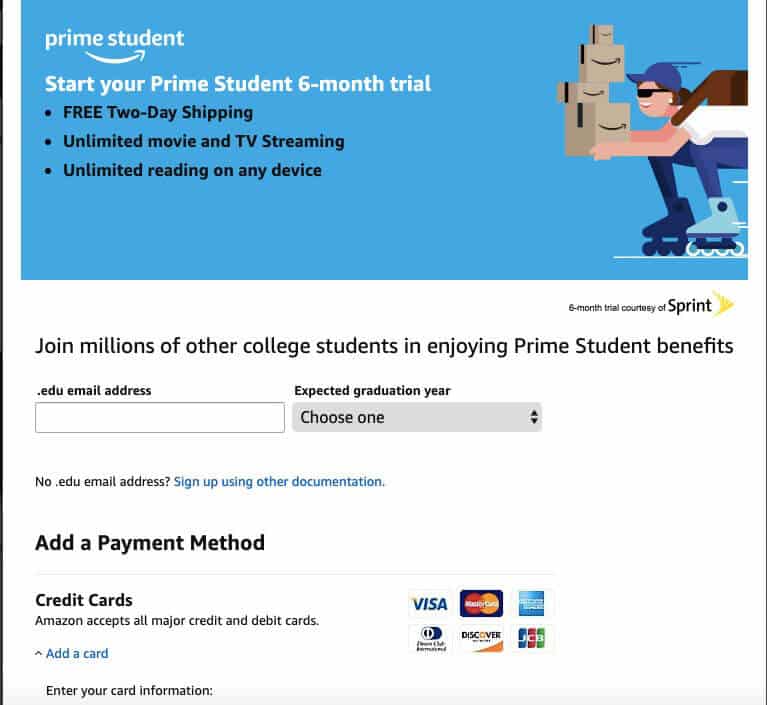
Initiate the Free Trial: Look for the option to “Try Prime Student” or “Start your 6-month free trial.” This is where your financial journey with Prime Student typically begins, offering that risk-free assessment period.
-
Enter Your Information: You’ll be prompted to provide basic personal details, including your name, email address (preferably your
.eduemail if you have one), and a payment method. While the trial is free, a payment method is required to seamlessly transition to the paid membership if you choose to continue. -
Verify Student Status: This is the crucial step for securing your financial discount.
-
.eduEmail Verification: If you provided an.eduemail, Amazon will send a verification link to that address. Clicking this link is often all that’s needed. -
Manual Verification: If you don’t have an
.eduemail or if it’s not immediately verified, you’ll be directed to upload documentation (student ID, transcript, etc.). Amazon’s team will then manually review your proof, which might take a few business days.
-
-
Confirm Membership: Once your student status is verified, your Prime Student membership (or free trial) officially begins, granting you immediate access to all the discounted perks.
This methodical approach ensures that your financial eligibility is confirmed, paving the way for sustained savings.
Payment Methods and Managing Your Subscription Budget
Even though the initial period might be free, considering how you’ll manage the paid subscription is a vital part of your financial planning.
-
Payment Method Selection: Amazon accepts various payment methods, including credit cards, debit cards, and Amazon gift cards. For students, using a debit card linked to a dedicated “fun money” or “discretionary spending” portion of their budget can be a good way to control this expense. Alternatively, some students might leverage a credit card for the rewards, but only if they commit to paying the balance in full each month to avoid interest charges—a fundamental principle of sound personal finance.
-
Budgeting for Renewal: Set a reminder for when your free trial is nearing its end. If you decide to continue, ensure you’ve allocated the discounted annual fee in your personal budget. This foresight prevents unexpected charges and helps maintain financial control.
-
Cancellation Policy: Understand Amazon’s cancellation policy. If at any point the financial value no longer aligns with your needs, or if your student status changes, knowing how to cancel avoids unnecessary future charges. This flexibility is another layer of financial control built into the service.
Effective management of your subscription, from payment method to renewal reminders, transforms Prime Student from a simple service into a well-integrated component of your personal financial strategy.
Maximizing Your Membership: Turning Perks into Practical Savings
Signing up for Prime Student is just the first step; the real financial advantage comes from actively leveraging its myriad perks to generate tangible savings and streamline your expenses. Each feature, when viewed through a financial lens, offers an opportunity to optimize your budget.
Free Two-Day Shipping: Eliminating Hidden Costs
The cornerstone of Amazon Prime, free two-day (and often same-day or one-day) shipping, is a potent financial tool for students. Beyond the obvious avoidance of shipping fees (which can quickly add up for frequent online shoppers), this service eliminates several hidden costs:
-
Transportation Expenses: No need to drive to multiple stores, saving on gas, parking fees, or public transport fares. For students without cars, this is a significant logistical and financial relief.
-
Time is Money: The time saved by not physically shopping can be redirected towards studying, working a part-time job, or engaging in other income-generating activities.
-
Reduced Impulse Buying: Online shopping, especially when focused on specific needs, can reduce the temptation for impulse purchases often triggered by browsing store aisles. This discipline directly translates to budget adherence.
By consciously consolidating your purchases and utilizing the fast, free shipping, you turn a core Prime feature into a powerful mechanism for cost avoidance and efficient resource allocation.
Prime Video & Music: Cutting Entertainment Expenses
Entertainment is a significant budget category for many students. Prime Video and Amazon Music are not just diversions; they are robust financial alternatives to separate, costly streaming subscriptions.
-
Consolidation of Services: If you’re paying for Netflix, Hulu, Spotify, or Apple Music separately, Prime Video and Amazon Music Unlimited (often available at a student discount on top of Prime) can potentially replace one or more of these. This consolidation directly reduces your monthly entertainment outflow.
-
Access to Extensive Libraries: Both services offer vast libraries of content, from popular movies and TV shows to millions of ad-free songs, ensuring your entertainment needs are met without needing to subscribe elsewhere.
-
Budget-Friendly Leisure: Having readily available, diverse entertainment options discourages expensive outings solely for leisure, such as frequent movie tickets or concert attendance, thus keeping your discretionary spending in check.
Leveraging these services strategically allows students to maintain a rich entertainment life without overspending, proving that enjoyment doesn’t have to come at a high financial cost.
Exclusive Student Deals & Discounts: Leveraging Additional Opportunities
Beyond the core Prime benefits, Amazon Prime Student members gain access to exclusive promotions and discounts tailored specifically for students. These can range from temporary price drops on electronics and academic supplies to special offers on services.
-
Savvy Shopping: Regularly check the “Prime Student” section of Amazon or your email for these targeted deals. Proactively seeking these discounts ensures you capitalize on every opportunity to save.
-
Textbook Rentals & Purchases: Prime Student often includes discounts on textbook rentals or purchases, a notorious expense for students. This can significantly reduce the financial burden of academic materials.
-
Future Savings on Amazon Services: Keep an eye out for discounts on Amazon services like Audible or Kindle Unlimited, which might periodically be offered to Prime Student members, further extending your savings potential across various digital media.
By staying informed about and utilizing these exclusive offers, students can continuously extract additional financial value from their membership, turning it into a dynamic savings platform.
Textbook Savings with Prime Reading/Rental
One of the most significant financial burdens for college students often comes from textbooks. Amazon Prime, through its Prime Reading feature and discounted textbook services, offers substantial relief. Prime Reading includes a rotating selection of free eBooks and eMagazines, which can sometimes include required or supplementary readings, directly reducing textbook procurement costs. Furthermore, Amazon’s textbook rental program, often enhanced for Prime members, allows students to rent textbooks for a fraction of the purchase price. This direct attack on a major student expense makes Prime Student an indispensable financial tool for academic success, ensuring that educational costs are kept as low as possible.
Beyond the Discount: Strategic Financial Planning with Student Prime
While the immediate savings and perks of Amazon Prime Student are undeniably attractive, integrating this membership into a broader financial strategy is key to long-term fiscal health. It’s not just about spending less now, but about cultivating smart financial habits for the future.
Budgeting for Your Subscription: A Minor Expense, Major Returns
For many students, the discounted annual fee for Prime Student might seem like just another expense. However, savvy financial planning views it as a strategic investment. Integrate this fee into your annual or semesterly budget, allocating funds just as you would for tuition, housing, or groceries. The key is to see it as a recurring fixed cost that, when fully leveraged, yields returns far greater than its outlay.
-
Proactive Allocation: Don’t let the renewal come as a surprise. Mark the renewal date on your calendar and ensure the funds are available.
-
Cost-Benefit Analysis: Periodically reassess the value. Are you still actively using the shipping, streaming, and exclusive deals? If the answer is yes, the minor expense is generating major returns in savings and convenience, making it a budget-justified expenditure.
-
Financial Discipline: Treating the Prime Student fee as a necessary budget line item helps instill financial discipline, a skill invaluable for post-graduation life.
Avoiding Unnecessary Spending: The Paradox of Convenience
The convenience of Amazon Prime can sometimes lead to what’s known as the “Prime effect”—the temptation to buy more because shipping is “free” or because items are easily accessible. While Prime aims to save you money, it’s crucial to employ financial discipline to prevent overspending.
-
Needs vs. Wants: Before adding an item to your cart, especially for non-essentials, take a moment to differentiate between a genuine need and an impulse want.
-
Budget Adherence: Stick to your pre-defined budget. Prime should facilitate more cost-effective purchases within your budget, not encourage spending beyond it.
-
Comparison Shopping: Even with Prime, it’s wise to occasionally compare prices with other retailers. While Prime offers convenience, it’s not always the absolute cheapest option for every single item. A quick check can ensure you’re truly getting the best financial deal.
By exercising mindful consumption, students can harness Prime’s convenience without falling into the trap of unnecessary spending, turning a potential pitfall into a testament to financial control.
Transitioning Post-Graduation: Preparing for the Full Price
Amazon Prime Student is a temporary financial benefit, typically lasting for up to four years or until graduation, whichever comes first. Strategic financial planning requires students to anticipate this transition.
-
Future Budget Adjustments: As your student Prime membership nears its end, begin to factor the full Prime membership price into your post-graduation budget. This avoids a sudden, unexpected increase in your annual expenses.
-
Re-evaluating Value: Post-graduation, your lifestyle and financial situation will change. Re-evaluate if the full-price Prime membership still offers the same compelling financial value for your new life stage. Perhaps you’ll no longer need as much shipping, or your entertainment needs will shift.
-
Exploring Alternatives: Be open to exploring alternative services or memberships if the full Prime price no longer aligns with your financial priorities. This continuous evaluation of subscription services is a hallmark of intelligent personal finance management.
By planning for this transition, students can smoothly navigate the shift from discounted services to full-price options, maintaining their financial equilibrium and demonstrating a sophisticated approach to managing their long-term financial commitments. Amazon Prime Student is more than just a membership; it’s a valuable chapter in a student’s ongoing journey of financial literacy and responsible money management.
aViewFromTheCave is a participant in the Amazon Services LLC Associates Program, an affiliate advertising program designed to provide a means for sites to earn advertising fees by advertising and linking to Amazon.com. Amazon, the Amazon logo, AmazonSupply, and the AmazonSupply logo are trademarks of Amazon.com, Inc. or its affiliates. As an Amazon Associate we earn affiliate commissions from qualifying purchases.