
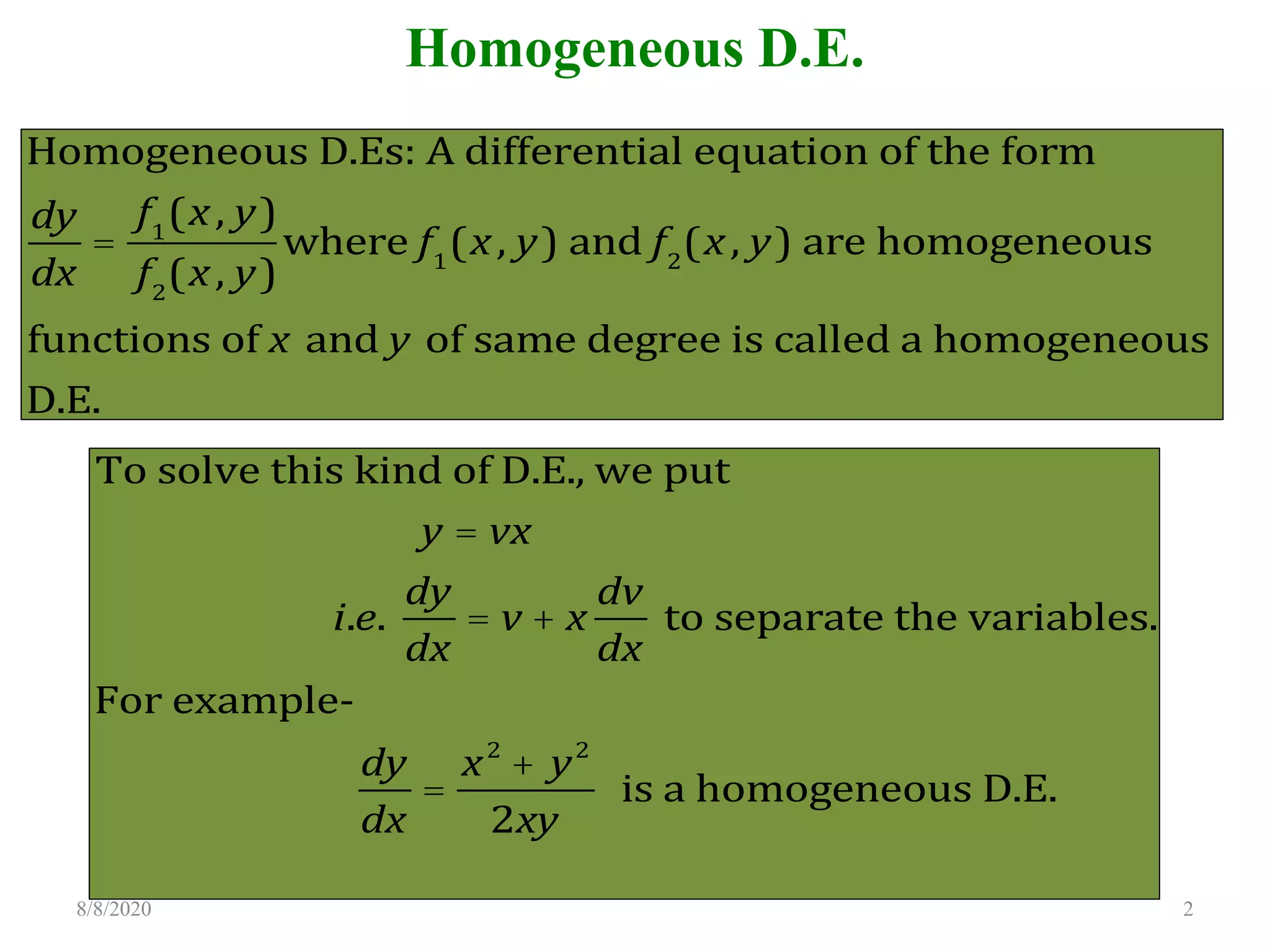
In the rapidly evolving landscape of software engineering, artificial intelligence, and high-performance computing, the term “homogeneous equation” frequently bridges the gap between abstract mathematics and practical digital application. While a student might first encounter the concept in a differential equations or linear algebra course, a technology professional views the homogeneous equation as a foundational tool for scaling algorithms, rendering 3D environments, and optimizing machine learning models. At its core, a homogeneous equation is one where all terms are of the same degree, or more specifically, an equation where the function remains invariant or scales predictably when its variables are multiplied by a constant.
In the context of modern technology, homogeneity represents symmetry and scalability. Whether you are developing a physics engine for a triple-A video game or architecting a neural network, understanding the mechanics of these equations is essential for managing complex systems with efficiency and precision.
The Mathematical Backbone of Modern Software
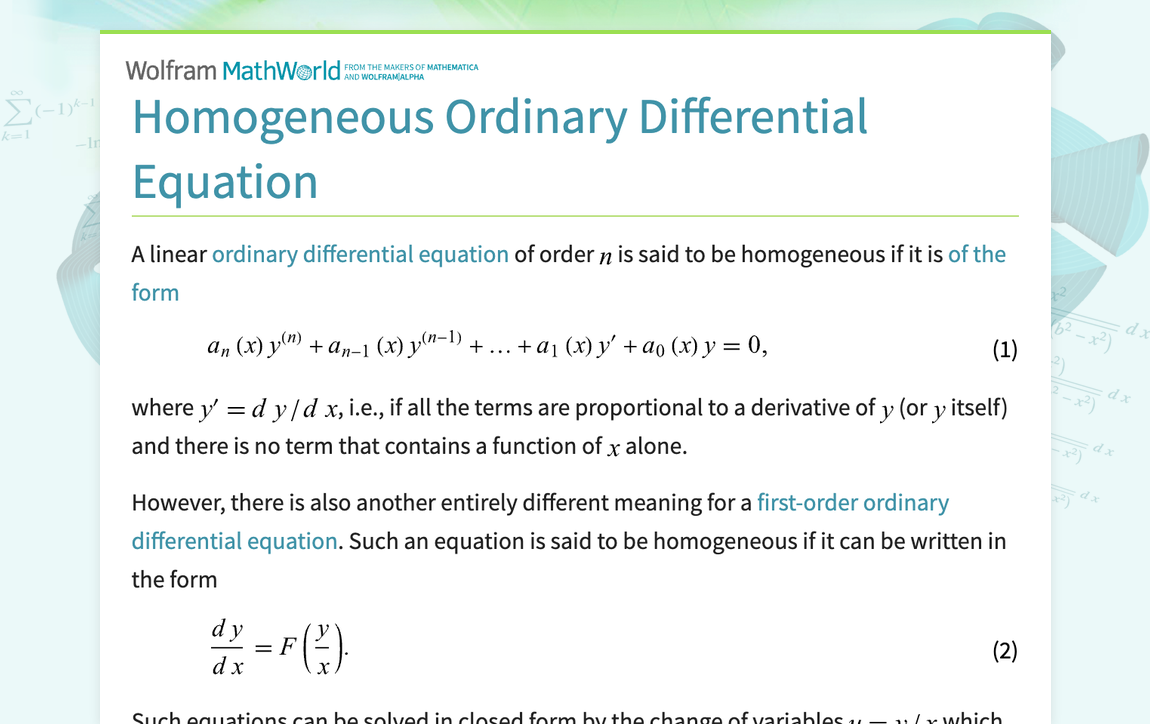
To understand why homogeneous equations are vital to technology, one must first grasp their mathematical structure. In linear algebra, a system of equations is considered homogeneous if it takes the form $Ax = 0$, where $A$ is a matrix and $0$ is the zero vector. This implies that the system always has at least one solution—the trivial solution where all variables are zero. In the world of software development, this represents a “null state” or a baseline from which more complex behaviors are derived.
Properties of Scaling and Degree
In a broader algebraic sense, a function $f(x, y)$ is homogeneous of degree $n$ if, for any constant $k$, $f(kx, ky) = k^n f(x, y)$. This property of “scaling” is the secret sauce behind many of the technologies we take for granted today. When a software developer builds a responsive web interface or a vector-based graphic, they are essentially leveraging the principles of homogeneity to ensure that as inputs (screen size or resolution) scale, the output (the visual representation) maintains its structural integrity.
Efficiency in Algorithmic Complexity
From a computational perspective, homogeneous equations allow for the simplification of complex problems. By reducing a non-homogeneous system to its homogeneous counterpart, engineers can solve for the general behavior of a system before adding specific constraints. This “divide and conquer” approach is a staple in algorithmic design, particularly in Big O analysis and the optimization of recursive functions.
Homogeneous Coordinates in Computer Graphics and Vision
Perhaps the most visible application of homogeneous equations in technology is in the field of computer graphics. If you have ever played a high-definition video game or used CAD software, you have witnessed the power of homogeneous coordinates in real-time.
The 4D Solution to a 3D Problem
Standard 3D Cartesian coordinates $(x, y, z)$ are remarkably limited when it comes to certain geometric transformations—specifically translations. In a standard 3D matrix, you can easily handle rotation and scaling through multiplication, but translation requires addition. This inconsistency is a nightmare for GPU (Graphics Processing Unit) optimization.
By introducing a fourth dimension—the homogeneous coordinate $w$—engineers can represent 3D points as $(x, y, z, w)$. This allows all transformations, including translation, to be performed using a single 4×4 matrix multiplication. This is a quintessential example of how a mathematical “homogeneous” trick streamlines hardware performance, allowing GPUs to process billions of polygons per second with uniform logic.
Ray Tracing and Projection
In the realm of modern rendering techniques like Ray Tracing, homogeneous equations are used to calculate the intersection of light rays with surfaces. Because projective geometry relies on the fact that any point $(x, y, z, w)$ is equivalent to $(kx, ky, kz, kw)$, developers can project 3D scenes onto 2D screens while maintaining perfect perspective. Without the mathematical symmetry provided by these equations, the visual fidelity of modern augmented reality (AR) and virtual reality (VR) would be impossible to achieve.
Homogeneity in Artificial Intelligence and Machine Learning
As we move deeper into the era of AI, the importance of homogeneous systems has shifted from graphics to data processing. Neural networks are essentially massive systems of linear and non-linear equations, and the way data flows through these layers often depends on the properties of homogeneity.
Weight Initialization and Normalization
In deep learning, “Batch Normalization” and “Layer Normalization” are techniques used to ensure that the inputs to each layer of a neural network are scaled consistently. This relates back to the concept of homogeneous functions. If a network’s activation functions are homogeneous (such as the Rectified Linear Unit, or ReLU), the model becomes more robust to changes in the scale of input data. A ReLU function, $f(x) = max(0, x)$, is technically homogeneous of degree one, meaning that if you double the input, the output also doubles (for positive values). This property helps in maintaining gradient stability during the training of massive models like LLMs (Large Language Models).
Optimization Algorithms
The process of training an AI involves minimizing a loss function. Many of the most efficient optimization algorithms, such as those involving Hessian matrices or second-order derivatives, rely on the assumption that the local geometry of the error surface can be modeled by homogeneous or quasi-homogeneous equations. Understanding the degree of homogeneity in a loss landscape allows researchers to tune “learning rates” more effectively, preventing the model from crashing or overshooting its target.
Digital Security and Cryptographic Systems
The utility of homogeneous equations extends even into the shadowy world of cybersecurity and cryptography. Modern encryption relies on the difficulty of solving certain mathematical problems, and homogeneous systems play a recurring role in both the creation and the breaking of these codes.
Elliptic Curve Cryptography (ECC)
ECC is a cornerstone of modern digital security, powering everything from HTTPS to blockchain transactions. The equations defining these curves are often expressed in “Projective Homogeneous Coordinates.” By using the homogeneous form, cryptographers avoid the computationally expensive division operations required by standard coordinates. This makes encryption faster and more energy-efficient, which is critical for mobile devices and IoT (Internet of Things) gadgets with limited battery life.
Cryptanalysis and Linear Systems
On the flip side, security researchers use homogeneous systems to test the strength of encryption algorithms. “Algebraic attacks” involve representing a cipher as a system of multivariate equations. If these equations can be simplified into a homogeneous form, it often becomes significantly easier to find the “null space” or the secret key. The constant battle between code-makers and code-breakers is, in many ways, a battle over the control and manipulation of these mathematical structures.
Why Technical Professionals Must Master the Concept
In a world where “Software is eating the world,” the underlying mathematics of that software determines who leads the market. The transition from a “coder” to a “software architect” or “AI researcher” often requires a move away from simple logic and toward the structural beauty of equations.
Optimization of Resource Consumption
As cloud computing costs rise, the ability to write mathematically optimized code is a competitive advantage. Using homogeneous properties to simplify calculations means fewer CPU cycles, less RAM usage, and lower electricity bills for data centers. For a tech startup, the difference between a homogeneous approach to data processing and a brute-force approach can be the difference between a scalable product and a financial drain.
Cross-Disciplinary Innovation
The principles of homogeneity are not confined to one niche. A developer who understands homogeneous coordinates in graphics can easily transition into robotics, where those same equations govern the movement of robotic arms (kinematics). A data scientist who understands homogeneous loss functions can pivot into financial modeling or quantitative trading. Mastering this concept provides a universal toolkit for solving high-stakes problems across the entire tech sector.

The Future: Quantum Computing and Beyond
As we look toward the future of technology, homogeneous equations are finding new life in quantum computing. Quantum states are represented by vectors in Hilbert space, and the evolution of these states is governed by linear, homogeneous operators. The “Schrödinger Equation,” the heart of quantum mechanics, is itself a linear homogeneous differential equation.
For the next generation of tech tools—from quantum-resistant encryption to molecular simulation—the ability to manipulate these equations will be the primary driver of innovation. We are moving away from an era of simple “if-then” logic and into an era of “continuous mathematics,” where the symmetry, scaling, and balance of homogeneous equations define the limits of what is possible.
In conclusion, “What is a homogeneous equation?” is not just a question for the classroom. It is a fundamental inquiry into the logic of our digital reality. From the way a light beam reflects off a digital surface to the way a neural network learns to speak, homogeneity provides the structural integrity that allows technology to scale, perform, and secure our modern world. For any tech professional looking to stay ahead of the curve, these equations are not just math—they are the source code of the future.
aViewFromTheCave is a participant in the Amazon Services LLC Associates Program, an affiliate advertising program designed to provide a means for sites to earn advertising fees by advertising and linking to Amazon.com. Amazon, the Amazon logo, AmazonSupply, and the AmazonSupply logo are trademarks of Amazon.com, Inc. or its affiliates. As an Amazon Associate we earn affiliate commissions from qualifying purchases.