
In the landscape of modern technology, particularly within the realms of cybersecurity and data encryption, certain mathematical concepts serve as the invisible scaffolding for our digital lives. One of the most critical, yet frequently misunderstood, concepts is that of numbers being “relatively prime.” While it may sound like an abstract term from a high school number theory class, the concept of coprimality is the engine driving the algorithms that protect everything from your private text messages to multi-billion-dollar corporate bank transfers.
To understand what “relatively prime” means in a technological context, we must first look at its simple mathematical definition and then explore how this property is leveraged to create unbreakable codes and secure digital architectures.

Decoding the Concept: What Does Relatively Prime Mean in a Digital World?
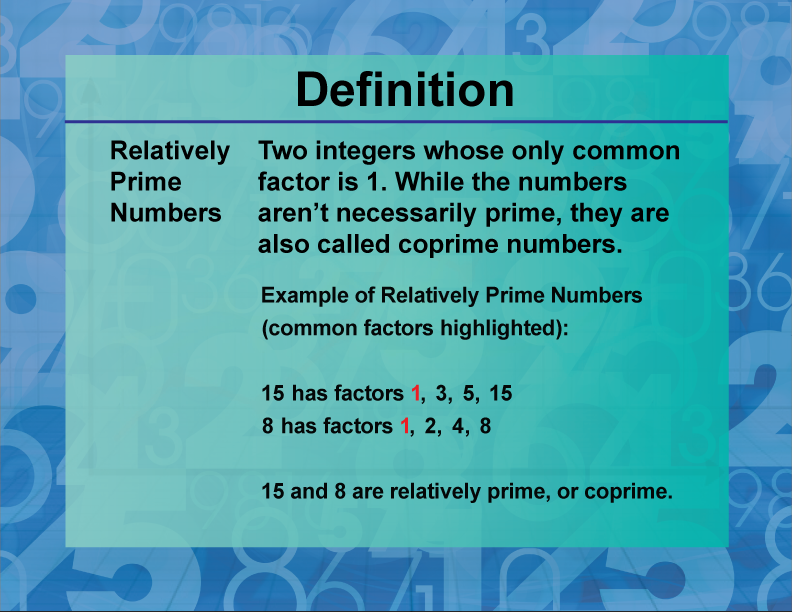
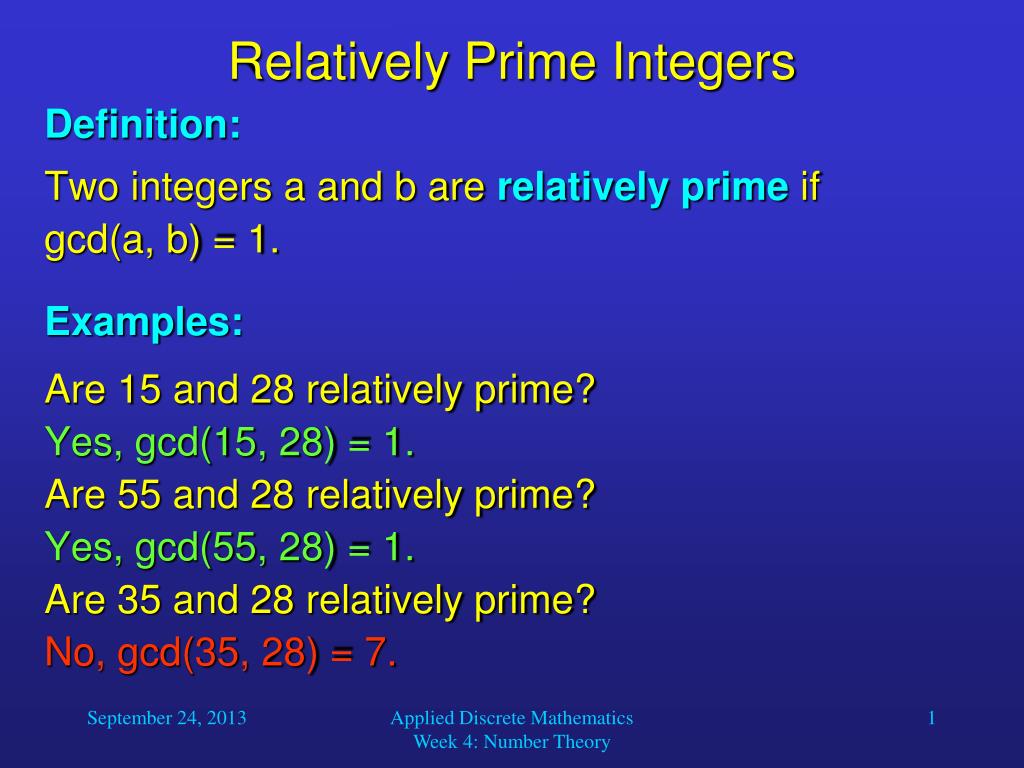
At its core, two integers are said to be relatively prime—also known as coprime or mutually prime—if the only positive integer that divides both of them is 1. In other words, their greatest common divisor (GCD) is 1. For example, 8 and 15 are relatively prime. Although 8 is divisible by 2 and 4, and 15 is divisible by 3 and 5, they share no common factors other than 1. Conversely, 8 and 12 are not relatively prime because they share a common factor of 4.
In the tech sector, this relationship is far more than a numerical curiosity. It is a fundamental requirement for the functioning of modular arithmetic, which is the logic system used in digital clocks, computer memory addressing, and, most importantly, cryptography.
The Logic of Modular Arithmetic
In computing, we often work with “wraparound” numbers, known as modular arithmetic. If you think of a clock, after 12 comes 1. In computer science, we use this to ensure that data stays within certain bounds. For many of these operations to be reversible—a necessity for encryption and decryption—the numbers involved must be relatively prime to the “modulus” (the number at which the system wraps around). If they are not, the mathematical “keys” used to lock and unlock data may fail, leading to data collisions or security vulnerabilities.
Coprimality in Algorithm Efficiency
Software engineers utilize the concept of relatively prime numbers to optimize performance in various algorithms. For instance, in hash table implementations, choosing a table size that is relatively prime to the patterns in the data can significantly reduce “collisions,” where two different pieces of information try to occupy the same storage slot. This mathematical foresight ensures that software runs faster, consumes less memory, and scales more effectively under heavy loads.
Cryptography and the Power of Coprimality
The most significant application of relatively prime numbers in technology is found in the RSA (Rivest–Shamir–Adleman) encryption algorithm. As one of the first practicable public-key cryptosystems, RSA is used globally to secure sensitive data transmission. Its security relies heavily on the properties of prime numbers and the difficulty of factoring the product of two large primes.
The RSA Mechanism and Coprimality
To understand the role of relatively prime numbers here, we must look at how an RSA key pair is generated. The process involves selecting two very large prime numbers, $p$ and $q$. These are multiplied to create $n$, which becomes the modulus for both the public and private keys.
The next step involves a value called Euler’s totient function, $phi(n)$, which represents the count of numbers up to $n$ that are relatively prime to $n$. A public exponent, $e$, is then chosen. For the encryption to be mathematically sound and secure, $e$ must be relatively prime to $phi(n)$. This specific requirement—that $e$ and $phi(n)$ share no factors—is what allows for the calculation of the private key, $d$. Without this “relatively prime” relationship, the mathematical inverse would not exist, and the message could never be decrypted.
Why “Relative” Matters More Than “Absolute”
While prime numbers themselves are the stars of the show, the “relative” relationship is the director. You do not always need two prime numbers to achieve secure logic; you need two numbers that don’t “interfere” with each other’s factors. This interference—or lack thereof—is what allows digital systems to create “one-way functions.” These are mathematical operations that are easy to perform in one direction but nearly impossible to reverse without a specific piece of information (the private key).
Digital Security Architecture and Prime Logic
Beyond the specific mechanics of RSA, the concept of relatively prime numbers permeates broader digital security architecture, influencing how we generate random numbers and how we verify the integrity of data.
Pseudo-Random Number Generation (PRNG)
In technology, true randomness is surprisingly hard to achieve. Most “random” numbers generated by computers are actually pseudo-random, created by complex formulas. One of the most common methods is the Linear Congruential Generator (LCG). For an LCG to produce a sequence that is as long as possible before repeating, the “increment” used in the formula must be relatively prime to the “modulus.”
If these values were not relatively prime, the sequence would repeat very quickly, making the “randomness” predictable. In a security context, predictable random numbers are a catastrophe. They allow hackers to guess session tokens, encryption keys, and password reset links. By ensuring coprimality, developers ensure that the digital keys protecting our information are as unpredictable as possible.
Data Integrity and Hashing
When you download a software update, your computer often checks a “hash” to ensure the file hasn’t been tampered with. Hashing algorithms often rely on prime numbers and relatively prime constants to distribute data uniformly. This ensures that even a tiny change in the input (like a single bit of malicious code) results in a completely different hash value. This sensitivity is anchored in the way relatively prime numbers interact within the algebraic structures of the hashing functions.
The Future of Encryption: Beyond Standard Coprimality
As we move toward the era of quantum computing, the reliance on traditional prime-based encryption is being challenged. Quantum computers, using Shor’s algorithm, could theoretically factor the large numbers used in RSA much faster than any classical computer, effectively breaking the “relatively prime” security model we currently rely on.
Post-Quantum Cryptography
Tech innovators and security agencies are currently developing “post-quantum” cryptographic standards. While these move away from simple integer factorization, the underlying principles of number theory and relatively prime relationships remain relevant. New methods, such as lattice-based cryptography, still utilize the concepts of “unshared factors” and “modular independence” to create security barriers that even quantum bits (qubits) would struggle to bypass.
The Persistence of Discrete Mathematics
The transition to newer technologies does not make the concept of being relatively prime obsolete. Instead, it shifts the context. In distributed ledger technologies (like blockchain) and advanced AI model security, the need for unique, non-overlapping mathematical identifiers is growing. The logic of “relatively prime” continues to provide a blueprint for how to create distinct, secure pathways in an increasingly interconnected digital ecosystem.
Practical Applications for Developers and Tech Enthusiasts
Understanding what it means to be relatively prime isn’t just for cryptographers; it has practical implications for general software development and systems design.
Optimizing Database Sharding
In large-scale cloud applications, databases are often “sharded,” meaning they are split into smaller pieces across multiple servers. To ensure that data is distributed evenly and to avoid “hotspots” (where one server is overloaded while others are idle), engineers often use a modulus that is relatively prime to the number of expected data entries. This ensures a more uniform distribution, directly impacting the speed and reliability of the app.
Networking and Cycle Timing
In network protocols, particularly those involving “retries” when a packet is lost, developers use relatively prime intervals. If two devices on a network both try to reconnect at intervals that share a common factor, they might continue to collide indefinitely (a phenomenon known as network resonance). By using intervals that are relatively prime, engineers ensure that the devices eventually “de-sync” and find a clear window to communicate, maintaining the stability of the internet’s infrastructure.
Digital Signal Processing
In the world of audio and video tech, relatively prime numbers are used in the design of anti-aliasing filters and in the sampling of signals. By ensuring that sampling rates and signal frequencies maintain certain coprime relationships, engineers can prevent “ghost” frequencies (artifacts) from ruining the quality of digital media.
The concept of being relatively prime is a silent guardian of the digital age. It is the mathematical principle that ensures our keys are unique, our random numbers are unpredictable, and our data is distributed efficiently. Whether you are browsing the web, securing a corporate network, or developing the next generation of AI tools, the simple truth that two numbers share no common factors remains one of the most powerful tools in the technologist’s arsenal.
aViewFromTheCave is a participant in the Amazon Services LLC Associates Program, an affiliate advertising program designed to provide a means for sites to earn advertising fees by advertising and linking to Amazon.com. Amazon, the Amazon logo, AmazonSupply, and the AmazonSupply logo are trademarks of Amazon.com, Inc. or its affiliates. As an Amazon Associate we earn affiliate commissions from qualifying purchases.