
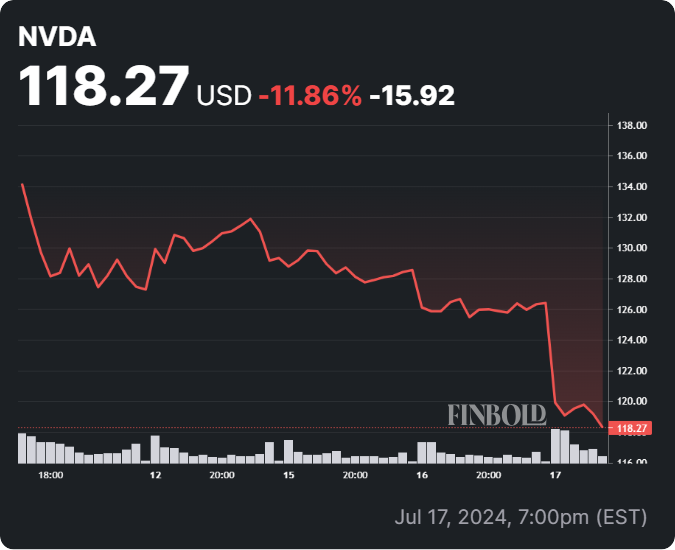
NVIDIA (NVDA) has long been a darling of the stock market, revered for its pioneering work in graphics processing units (GPUs) and its crucial role in the burgeoning fields of artificial intelligence, data centers, and high-performance computing. For years, its stock performance seemed unstoppable, fueled by relentless innovation and expanding market opportunities. However, even the most robust companies experience periods of correction, and when a high-flying stock like NVDA takes a tumble, it invariably raises questions among investors, analysts, and market observers. A dip in NVDA’s stock price is rarely attributable to a single factor but rather a complex interplay of macroeconomic forces, company-specific developments, evolving market sentiment, and technical trading dynamics. Understanding these multifarious pressures is critical for any investor seeking to navigate the often-turbulent waters of the financial markets. This article delves into the various reasons that could lead to a downturn in NVIDIA’s stock, exploring both broad market trends and granular company-centric issues that collectively influence its valuation.
Broader Market Headwinds Affecting Growth Stocks
Even a titan like NVIDIA is not immune to the gravitational pull of the wider economic and financial landscape. Macroeconomic shifts and sector-wide sentiment can significantly impact how investors value high-growth companies. When the tide of the broader market recedes, even the strongest ships can find themselves in shallower waters.
Macroeconomic Concerns and Monetary Policy
One of the most potent forces influencing stock valuations is the prevailing macroeconomic environment. Periods of high inflation often prompt central banks, such as the U.S. Federal Reserve, to increase interest rates. Higher interest rates have a twofold negative effect on growth stocks like NVIDIA. Firstly, they increase the cost of borrowing for companies, potentially slowing down expansion plans that rely on debt. Secondly, and more critically for valuation, higher rates reduce the present value of future earnings. Growth stocks derive a significant portion of their valuation from projected earnings many years into the future. When discount rates rise, those future earnings are worth less today, leading to a downward revision of stock prices. Fears of a looming recession—whether due to inflation, geopolitical events, or other economic stressors—also cause investors to become more risk-averse, prompting a flight from speculative growth assets to safer, more stable investments or even cash. This broader shift in capital allocation can put considerable pressure on high-valuation stocks regardless of their individual performance.
Sector-Wide Corrections and Investment Rotation
The technology and semiconductor sectors, where NVIDIA is a dominant player, are inherently cyclical and prone to significant swings. Periods of explosive growth are often followed by consolidations or corrections as the market recalibrates expectations. A “tech correction” or a “semiconductor downturn” can drag down even fundamentally strong companies. This often occurs when investors decide to rotate out of growth stocks, which have typically outperformed during periods of low interest rates and high liquidity, into “value” stocks or sectors perceived as more resilient during economic slowdowns. This rotation can be triggered by a change in economic outlook, a shift in market sentiment, or simply profit-taking after an extended bull run in a particular sector. Furthermore, supply chain issues, which have plagued the semiconductor industry for several years, can create sector-wide uncertainty regarding production capacity, inventory levels, and demand forecasting, contributing to investor apprehension across the board.
Geopolitical Tensions and Trade Policies
NVIDIA operates on a global stage, with complex supply chains stretching across continents and significant market exposure in various regions. Geopolitical tensions, particularly those involving major economic powers like the United States and China, can introduce substantial risk. For instance, trade disputes, tariffs, and export controls on advanced technology (such as specific AI chips) can directly impact NVIDIA’s ability to sell its products in crucial markets or source components efficiently. Government policies aimed at fostering domestic semiconductor production or restricting technological transfers can force NVIDIA to re-evaluate its manufacturing strategies, potentially incurring higher costs or limiting market access. Such uncertainties create an unpredictable operating environment, which investors often discount by assigning a lower valuation to the company’s stock, leading to a decline in price.
Company-Specific Catalysts and Valuation Reassessment
While external forces play a significant role, internal company dynamics, specific product cycles, and how the market perceives NVIDIA’s intrinsic value also contribute substantially to its stock performance. A reassessment of these factors can trigger a localized downturn.
Profit-Taking After Significant Gains
NVIDIA has experienced a phenomenal growth trajectory over the past decade, delivering extraordinary returns for its shareholders. However, after such an extended period of upward movement, it is natural for investors to engage in profit-taking. This phenomenon occurs when investors, particularly institutional ones, sell off a portion of their holdings to lock in gains, especially after the stock has reached new all-time highs or significant psychological price points. This selling pressure, while not indicative of any fundamental weakness in the company, can lead to a temporary or even sustained dip in the stock price as supply outstrips demand. Large-scale profit-taking often exacerbates any underlying negative sentiment or technical weakness, causing a domino effect.
Evolving Competitive Landscape and Market Dynamics
Although NVIDIA remains a dominant force, particularly in high-end GPUs and AI accelerators, the competitive landscape is constantly evolving. Rival companies like Advanced Micro Devices (AMD) continue to innovate and gain market share in various segments, from gaming to data centers. New entrants in specialized AI hardware, custom silicon development by hyperscalers (e.g., Google’s TPUs, Amazon’s Inferentia), and open-source initiatives could all potentially chip away at NVIDIA’s competitive moat. While NVIDIA has a robust ecosystem, any perceived threat to its leadership position or concerns about a slowdown in its core market segments—like gaming or professional visualization—can spook investors. For instance, a temporary decline in demand for GPUs from the cryptocurrency mining sector, which historically provided a boost, or a slowdown in enterprise data center spending could also impact revenue projections and subsequently the stock price.
Valuation Concerns and Analyst Revisions
NVIDIA’s stock often trades at a premium valuation, reflecting its strong growth prospects and market leadership. However, such high valuations make the stock particularly sensitive to any perceived slowdown in growth or a change in future earnings expectations. If the company’s quarterly earnings report falls short of analyst consensus, or if management provides a cautious outlook for future quarters, investors may reassess whether the current valuation is justified. Analysts, in response, might revise their price targets downwards or downgrade their recommendations, triggering a wave of selling. Concerns about a slowdown in specific segments (e.g., lower gaming demand post-pandemic boom, slower adoption of new data center technologies) or increased research and development costs without immediate returns can also lead to a re-evaluation of its earnings multiple, causing the stock to decline.
Regulatory Scrutiny and Policy Challenges
The increasing geopolitical importance of semiconductor technology means that companies like NVIDIA are subject to heightened regulatory scrutiny and the impact of national and international policy decisions. These external governmental pressures can create substantial financial headwinds.
Antitrust Investigations and Merger Obstacles

As a major player in a critical industry, NVIDIA is frequently under the microscope of antitrust regulators worldwide. The most prominent example was its attempted acquisition of Arm Holdings, which ultimately collapsed due to significant regulatory hurdles and opposition from key customers. Such failed mergers, or ongoing investigations into market dominance, create uncertainty for investors. They can signal limitations on future growth through acquisition, force companies to divest assets, or impose operational restrictions that impact profitability. The financial costs of pursuing large-scale mergers—even unsuccessful ones—can be substantial, diverting resources and attention from core business operations. Concerns about potential future antitrust actions, whether explicit or implicit, can weigh on a stock’s valuation as investors factor in the risks of regulatory intervention.
Export Controls and Trade Restrictions
Governments worldwide are increasingly using export controls and trade restrictions as tools of foreign policy and national security, particularly concerning advanced technology. For NVIDIA, which designs leading-edge AI chips and data center solutions, these policies can have a direct and significant impact. Restrictions on selling certain high-performance GPUs to specific countries or entities, for example, can immediately cut off substantial revenue streams. The need to redesign products to comply with export regulations, or to navigate complex licensing requirements, can add significant costs, delays, and uncertainty to NVIDIA’s operations. These policy-driven market access challenges not only affect current sales but also cast a shadow over future growth projections, as they limit the total addressable market for some of its most advanced and lucrative products. Investors often react negatively to such news, anticipating a direct hit to the company’s top and bottom lines.
Investor Sentiment and Technical Trading Factors
Beyond fundamentals and macroeconomics, the often-irrational ebb and flow of investor sentiment and the technical dynamics of stock trading can play a crucial role in short-term price movements, amplifying downturns.
Fear, Uncertainty, and Doubt (FUD)
Market psychology is a powerful force. When a high-profile stock like NVIDIA starts to decline, it can trigger a wave of fear, uncertainty, and doubt (FUD) among investors. Negative news—whether a slight earnings miss, a rumor, or a broader market sell-off—can be amplified by social media and financial news cycles. This FUD can lead to panic selling, where investors sell their holdings not based on a change in the company’s fundamentals, but rather on the fear of further losses. Such emotional trading can disconnect a stock’s price from its intrinsic value in the short to medium term, creating a self-fulfilling prophecy of downward momentum, especially for stocks with high public visibility and retail investor interest.
Technical Breakdowns and Algorithmic Trading
In modern markets, technical analysis and algorithmic trading play a significant role in price movements. When a stock breaks below key support levels (e.g., a 50-day or 200-day moving average), it can trigger automated selling programs deployed by institutional investors and hedge funds. These algorithms are designed to execute trades based on predefined technical indicators, often accelerating downward trends once certain thresholds are breached. Furthermore, stop-loss orders placed by individual investors can be triggered, adding to selling pressure. This technical selling, decoupled from fundamental news, can exacerbate a downturn, pushing the stock price lower than what its fundamentals might suggest, until new support levels are found or investor sentiment shifts.
Options Market Dynamics
The derivatives market, particularly stock options, can also influence a stock’s spot price. Large positions in put options (bets that a stock will fall) can create downward pressure. Market makers who sell put options often hedge their positions by short-selling the underlying stock, especially as the stock approaches the strike price of those puts. This dynamic can create a “gamma squeeze” in reverse, where declining stock prices trigger more hedging-related selling, pushing the price further down. Conversely, large investors unwinding call option positions (bets that a stock will rise) can also lead to selling pressure on the underlying stock. The interplay between the options market and the underlying equity can amplify volatility and contribute to significant price movements, both up and down.
What a Downturn Means for NVIDIA’s Future and Investors
While a stock downturn can be alarming, it’s crucial for investors to differentiate between temporary market noise and genuine fundamental weakness. For a company as strong and innovative as NVIDIA, a dip often represents a recalibration rather than a systemic failure.
Differentiating Volatility from Fundamental Weakness
A decline in NVDA’s stock price doesn’t automatically signal a terminal problem for the company. Volatility is an inherent characteristic of the stock market, particularly for high-growth, high-valuation stocks that are sensitive to both macroeconomic shifts and technological cycles. A fundamental weakness would be indicated by a sustained deterioration in core business metrics—such as declining revenue, eroding profit margins, loss of market share to competitors, or a significant slowdown in innovation. Often, a stock dip is a reflection of profit-taking, broader market sentiment, or a temporary re-evaluation of future growth expectations rather than a fundamental flaw in the company’s business model or technological leadership. Investors should scrutinize whether the reasons for the downturn are structural or cyclical, and if they permanently impair NVIDIA’s long-term competitive advantages.
Opportunity for Long-Term Investors
For long-term investors who have conviction in NVIDIA’s technological prowess, market leadership, and the enduring trends it serves (AI, data centers, metaverse, autonomous vehicles), a significant downturn can be viewed as a buying opportunity. Corrections allow investors to acquire shares of a high-quality company at a more attractive valuation, potentially leading to higher returns over an extended horizon. The underlying drivers of NVIDIA’s business—the insatiable demand for computing power, the pervasive integration of AI across industries, and the continuous innovation in graphics and parallel processing—remain robust. Patient investors often use these periods of market fear to accumulate positions in companies they believe will continue to thrive in the long run, leveraging short-term price fluctuations to their advantage.
Focus on Innovation and Market Leadership
NVIDIA’s strength lies in its relentless focus on innovation and its dominant position across multiple high-growth markets. Its CUDA platform, vast developer ecosystem, and comprehensive hardware-software stack create powerful network effects and significant barriers to entry for competitors. Even during a stock downturn, the company continues to invest heavily in R&D, push the boundaries of AI, expand its data center footprint, and explore new frontiers like the metaverse and industrial digitalization. These core strengths, coupled with a healthy balance sheet and strong cash flow generation, suggest that NVIDIA is well-positioned to weather market storms and emerge stronger. For investors, understanding these enduring fundamentals is key to maintaining perspective during periods of price volatility.
Conclusion
The question “why NVDA is down” elicits a complex answer, reflecting the multifaceted nature of financial markets. It is rarely a single catastrophic event but rather a confluence of macroeconomic pressures such as rising interest rates and inflation concerns, sector-specific corrections driven by profit-taking and investment rotations, and company-specific valuation concerns. Furthermore, geopolitical tensions, regulatory scrutiny, and the powerful, sometimes irrational, forces of investor sentiment and technical trading dynamics all contribute to the stock’s performance.
For a company like NVIDIA, a leader in critical and rapidly evolving technological fields, a stock downturn often represents a recalibration of market expectations or a reaction to broader market forces rather than a fundamental breakdown of its business. While alarming in the short term, such corrections are a normal part of market cycles. Astute investors understand that differentiating between temporary volatility and genuine fundamental weakness is paramount. A dip can provide a valuable opportunity for those with a long-term perspective to invest in a company that continues to be a driving force in global technology and innovation, underscoring the importance of informed analysis over reactive panic.
aViewFromTheCave is a participant in the Amazon Services LLC Associates Program, an affiliate advertising program designed to provide a means for sites to earn advertising fees by advertising and linking to Amazon.com. Amazon, the Amazon logo, AmazonSupply, and the AmazonSupply logo are trademarks of Amazon.com, Inc. or its affiliates. As an Amazon Associate we earn affiliate commissions from qualifying purchases.