
In the landscape of global technology, few narratives are as compelling as the resurgence of Microsoft. Once viewed as a legacy software provider tethered to the desktop era, the company has undergone a radical transformation into a cloud-first, AI-driven powerhouse. To understand “Why Microsoft” is the primary question for modern enterprises and individual power users alike, one must look beyond the ubiquity of Windows. The answer lies in a deeply integrated ecosystem that spans from the silicon layer of global data centers to the generative AI assistants sitting on every employee’s taskbar.
The contemporary Microsoft value proposition is built on the concept of a “unified stack.” While competitors often offer fragmented solutions—best-of-breed tools that require complex integration—Microsoft has pivoted toward a seamless fabric where identity, security, data, and productivity applications communicate natively. This cohesion has made them the default choice for the digital transformation of the modern economy.
The AI Revolution: Azure and the Copilot Era
At the heart of Microsoft’s current technological dominance is its aggressive and early bet on artificial intelligence. By forming a multi-billion dollar partnership with OpenAI and building the specialized infrastructure required to train large language models (LLMs), Microsoft positioned itself at the epicenter of the generative AI boom.
Integrating Generative AI across the Stack
The “Copilot” branding is more than just a marketing slogan; it represents a fundamental shift in how users interact with software. By embedding GPT-4 and subsequent models directly into the Microsoft 365 suite, the company has solved the “blank page” problem for millions of workers. In Word, AI drafts documents; in Excel, it performs complex data analysis through natural language queries; and in Outlook, it prioritizes and summarizes communications.
This integration is powerful because it leverages the Microsoft Graph—the gateway to data and intelligence in Microsoft 365. Unlike standalone AI tools that lack context, Microsoft’s AI understands the user’s specific organizational environment, including their emails, meetings, and file history, all while maintaining strict enterprise data boundaries. This contextual awareness is the differentiator that makes Microsoft’s AI implementation superior for professional use.
The Infrastructure of Tomorrow: Azure’s Global Reach
Underpinning the AI revolution is Microsoft Azure, a cloud platform that has evolved into a global supercomputer. Azure is no longer just about virtual machines and storage; it is the platform for the “Intelligent Cloud and Intelligent Edge.” With over 60 data center regions worldwide—more than any other provider—Azure offers the low-latency and high-availability infrastructure required for global scale.
For developers and enterprises, “Why Microsoft” in the cloud context comes down to the Azure OpenAI Service. It allows businesses to build their own proprietary AI applications using the same models that power ChatGPT, but within a private, secure, and compliant environment. This bridge between cutting-edge research and enterprise-grade reliability has made Azure the preferred destination for high-stakes AI deployment.
The Modern Workspace: Beyond Windows and Office
The traditional view of Microsoft was centered on the operating system. Today, Microsoft has decoupled its core value from the local hardware, creating a fluid digital workspace that follows the user across devices, whether they are on a PC, a Mac, or a mobile device.
Microsoft 365: The Operating System of Business
Microsoft 365 (formerly Office 365) has transitioned from a collection of productivity apps into a comprehensive service platform. The move to a subscription-based model was not just a financial shift but a technical one. It allowed for continuous updates, ensuring that every user has access to the latest security patches and features without the friction of “version jumping.”
The real power of M365 lies in SharePoint and OneDrive. These aren’t merely storage solutions; they are the collaborative backbone of the enterprise. Real-time co-authoring, version history, and integrated permissions mean that the “finalv2edit.docx” email chain is a thing of the past. The ecosystem facilitates a “single source of truth” for data, which is essential for organizational agility.
Teams as a Central Nervous System
Perhaps the most significant development in the Microsoft ecosystem over the last five years is the rise of Microsoft Teams. More than just a chat or video conferencing tool, Teams has become a “platform within a platform.” By integrating third-party apps, custom-built Power Apps, and the entire M365 suite into a single interface, Microsoft has created a digital headquarters.

For many professionals, the workday begins and ends within Teams. It serves as the hub for voice, video, document collaboration, and project management. This consolidation reduces “toggle tax”—the loss of productivity that occurs when workers switch between disparate applications. By keeping the workflow centralized, Microsoft captures the entirety of the user’s focus, reinforcing the “Why Microsoft” choice through sheer convenience and efficiency.
Developer Empowerment: The GitHub and VS Code Synergy
A critical component of Microsoft’s tech strategy has been winning back the hearts and minds of developers. After years of friction with the open-source community, the “new” Microsoft has become one of the largest contributors to open-source projects globally.
Democratizing Development with Open Source
The acquisition of GitHub was a watershed moment. By owning the world’s most popular code repository and community, Microsoft positioned itself at the start of the software development lifecycle. However, they did not stop at hosting code. Visual Studio Code (VS Code) has become the most widely used integrated development environment (IDE) in the world, praised for its extensibility and lightweight performance.
The synergy between GitHub and Azure is profound. With GitHub Actions, developers can automate their CI/CD (Continuous Integration/Continuous Deployment) pipelines directly into the Azure cloud. Furthermore, GitHub Copilot—the AI pair programmer—has fundamentally changed software engineering, allowing developers to generate boilerplate code and troubleshoot bugs in real-time. This end-to-end developer experience makes Microsoft the most attractive stack for building modern software.
Low-Code/No-Code Solutions through Power Platform
Microsoft has also addressed the “citizen developer” through the Power Platform (Power BI, Power Apps, Power Automate). As the demand for custom software outstrips the supply of professional developers, these low-code tools allow business users to build their own automation workflows and data dashboards. By connecting these tools to the rest of the Microsoft stack via “Dataverse,” the company ensures that even simple business automations remain within the managed, secure corporate environment.
Security and Compliance in an Era of Perimeterless Work
As work moved out of the traditional office and into the cloud, the security perimeter vanished. Microsoft recognized this early, pivoting its security strategy toward “Zero Trust”—the philosophy of “never trust, always verify.”
The Zero Trust Architecture
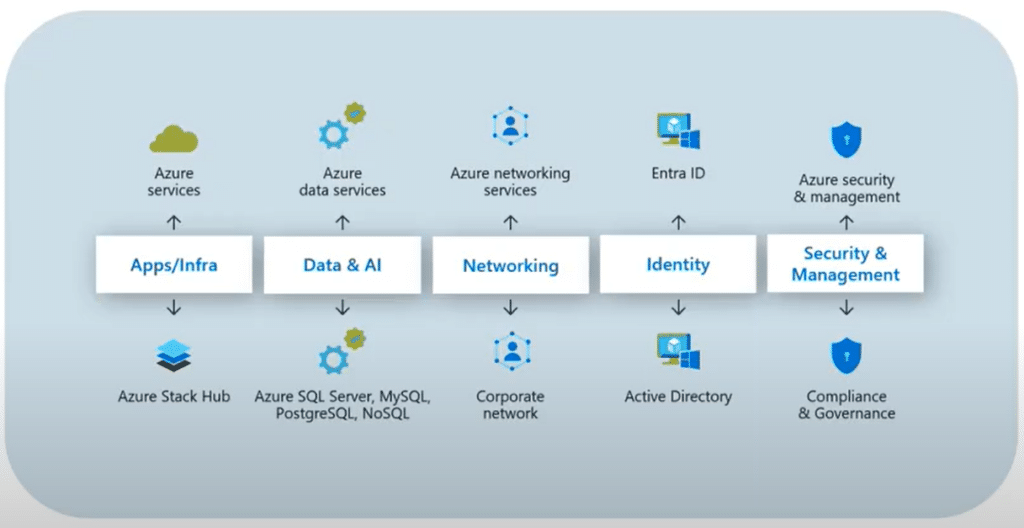
Microsoft is now one of the world’s largest security companies, though it is rarely categorized as such by the general public. Microsoft Entra ID (formerly Azure AD) is the gold standard for identity management, providing the foundation for secure access across thousands of applications. By managing identity, Microsoft can enforce conditional access policies, ensuring that only the right person, on a compliant device, can access sensitive data.
The integration of security across the stack is a major technical advantage. Microsoft Defender provides endpoint protection, while Microsoft Sentinel acts as a cloud-native SIEM (Security Information and Event Management) system. Because Microsoft sees trillions of signals across its global network every day—from Windows updates to Xbox logins—it can use AI to identify and neutralize threats before they reach an individual customer’s network.
Integrated Security Intelligence
The true value for a Chief Information Officer (CIO) choosing Microsoft is “XDR” (Extended Detection and Response). Instead of managing twenty different security vendors, an organization can use the Microsoft Defender suite to protect email, identities, cloud apps, and devices in a unified way. This visibility is impossible to achieve with a fragmented security posture. In an age of sophisticated ransomware and state-sponsored cyberattacks, the depth of Microsoft’s security telemetry is a compelling reason to stay within their ecosystem.
The Strategic Conclusion
“Why Microsoft” is a question with a multi-layered answer. For the IT administrator, it is about ease of management and the robustness of the Azure cloud. For the developer, it is about the world-class tools provided by GitHub and VS Code. For the end-user, it is about the productivity gains realized through Copilot and the familiar, yet modernized, interface of Microsoft 365.
Microsoft has successfully transitioned from being a provider of software “products” to a provider of a cohesive “platform.” This platform is built on the pillars of cloud scalability, AI-driven intelligence, and a rigorous commitment to security. By consistently innovating and integrating their offerings, Microsoft has ensured that they are not just a part of the technology conversation, but the foundation upon which the modern digital world is built. In the competition for the future of work and computing, the Microsoft ecosystem offers a level of synergy and scale that remains unmatched in the industry.
aViewFromTheCave is a participant in the Amazon Services LLC Associates Program, an affiliate advertising program designed to provide a means for sites to earn advertising fees by advertising and linking to Amazon.com. Amazon, the Amazon logo, AmazonSupply, and the AmazonSupply logo are trademarks of Amazon.com, Inc. or its affiliates. As an Amazon Associate we earn affiliate commissions from qualifying purchases.