
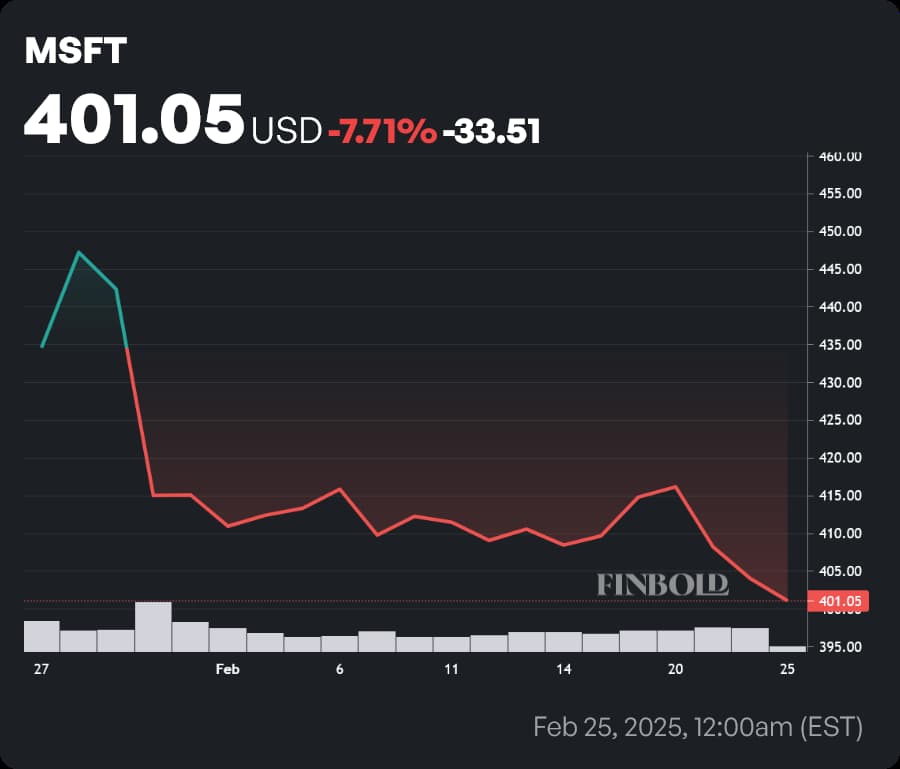
Microsoft, a titan of the technology world, has long been a bedrock for many investment portfolios. Its diverse portfolio spanning cloud computing, enterprise software, gaming, and personal computing has historically offered stability and growth. However, even the most formidable companies experience periods of underperformance. When a stock like Microsoft, renowned for its consistent growth and strong market position, experiences a downturn, it prompts investors to closely examine the underlying causes. This analysis delves into the multifaceted factors contributing to Microsoft stock’s recent struggles, viewed strictly through the lens of financial markets, investor sentiment, and business fundamentals.
Macroeconomic Headwinds and Broader Market Sentiment
No single company, not even one as diversified as Microsoft, operates in a vacuum. The broader economic environment plays a significant role in determining investor appetite and stock valuations. Recent periods have seen a confluence of challenging macroeconomic conditions that have disproportionately affected growth stocks, including tech giants.
Inflation, Interest Rates, and Economic Slowdown
A primary driver of recent market volatility has been persistent global inflation. Central banks worldwide, particularly the U.S. Federal Reserve, have responded with aggressive interest rate hikes aimed at cooling economies and taming rising prices. Higher interest rates typically translate into a higher cost of capital for businesses and make future earnings streams, particularly those of growth-oriented companies like Microsoft, less attractive when discounted back to present value. This “discount rate effect” puts downward pressure on stock valuations.
Moreover, the prospect of an economic slowdown or even a recession dampens corporate earnings expectations across the board. Companies anticipating lower consumer spending and reduced business investment often project more conservative revenue and profit growth. For a company as deeply embedded in both consumer and enterprise markets as Microsoft, an economic contraction poses a direct threat to its revenue streams from software licenses, cloud services, and hardware sales. Investors, in turn, price in these lower expectations, leading to stock depreciation.
Broad Tech Sector Correction
Beyond company-specific issues, Microsoft has also been swept up in a broader correction within the technology sector. After years of phenomenal growth, fueled by low interest rates and accelerated digital transformation during the pandemic, tech stocks in general have faced a reckoning. Valuations that once seemed justifiable based on hyper-growth narratives have come under intense scrutiny in a higher-rate environment. Investors are shifting from prioritizing growth at any cost to demanding profitability and strong free cash flow, especially from mature tech companies.
This re-evaluation has led to a sector-wide de-rating, where even fundamentally strong companies like Microsoft find their price-to-earnings (P/E) multiples compressing. When the entire tide is going out, even the biggest ships can find themselves lower in the water, irrespective of their individual seaworthiness. Microsoft’s stock, despite its relative resilience compared to some speculative tech plays, has not been immune to this macro-driven recalibration of tech valuations.
Specific Business Segment Performance Concerns
While macroeconomic factors set the stage, specific performance within Microsoft’s diverse business segments often provides more granular reasons for investor apprehension. Even minor slowdowns in key growth drivers can spook a market accustomed to consistent, strong results.
Deceleration in Azure Cloud Growth
Microsoft’s Intelligent Cloud segment, particularly Azure, has been the primary growth engine for the company for years. Azure’s robust expansion has fueled investor optimism and justified its premium valuation. However, recent earnings reports have shown a deceleration in Azure’s growth rate. While still expanding at a healthy pace, the percentage growth figures have begun to taper off.
This slowdown can be attributed to several factors: enterprises optimizing their cloud spending amidst economic uncertainty, a natural maturation of the cloud market as it scales, and intense competition from Amazon Web Services (AWS) and Google Cloud Platform (GCP). Investors watch Azure’s trajectory closely, as it represents Microsoft’s future profitability and market leadership in a critical technological domain. Any perceived weakening in its growth outlook can trigger a reassessment of Microsoft’s long-term earnings potential, impacting its stock price.
Weakness in Personal Computing (Windows, Devices)
The Personal Computing segment, encompassing Windows, Surface devices, Xbox gaming, and search advertising, has also faced its share of challenges. The PC market, which experienced a boom during the pandemic as remote work and learning became prevalent, has seen a significant contraction. Global PC shipments have declined year-over-year, impacting Windows OEM revenue. Consumers and businesses are extending refresh cycles, and economic belt-tightening means fewer new purchases.
Similarly, demand for Microsoft’s Surface devices can be cyclical and susceptible to discretionary spending cuts. While Windows remains a dominant operating system, its growth is tied to hardware sales, making it vulnerable to PC market downturns. Any sustained weakness in this segment puts pressure on Microsoft’s overall revenue, signaling a potential drag on the company’s more profitable cloud and enterprise offerings.
Gaming Division Volatility (Xbox, Activision Blizzard Acquisition Nuances)
Microsoft’s gaming division, primarily Xbox, has seen mixed results. While Game Pass subscriptions continue to grow, hardware sales can be lumpy, and content development costs are substantial. More significantly, the protracted regulatory battles surrounding Microsoft’s proposed acquisition of Activision Blizzard have introduced a layer of uncertainty. While many investors view the acquisition as a strategic long-term play to bolster its gaming content and position in the metaverse, the ongoing scrutiny from antitrust regulators in various jurisdictions (e.g., the FTC in the U.S., CMA in the UK, European Commission) creates an overhang.
The possibility of the deal being blocked, or significantly modified, generates investor anxiety. Capital committed to the acquisition, the potential synergies, and the strategic direction of Microsoft’s gaming segment are all tied to its outcome. Delays and regulatory hurdles introduce risk and can contribute to stock underperformance as the market dislikes uncertainty.
Valuation Challenges and Investor Expectations

At its core, stock price reflects the market’s collective assessment of a company’s future earnings power, discounted by its inherent risks. For Microsoft, a company that has enjoyed premium valuations for years, any shift in this assessment can have a profound impact.
Premium Valuation Under Scrutiny
For an extended period, Microsoft traded at a premium valuation compared to the broader market and even some of its tech peers. This premium was justified by its consistent double-digit revenue growth, expanding profit margins, massive free cash flow generation, and strong competitive moats (especially in enterprise software and cloud). However, in an environment of rising interest rates and decelerating growth for some segments, investors become far less willing to pay such elevated multiples.
The “growth stock” narrative becomes harder to maintain when growth rates begin to temper, even slightly. Investors may start to question if the premium is still warranted, particularly if economic headwinds persist. This re-evaluation of valuation multiples, even without a significant change in the company’s fundamentals, can lead to a substantial drop in stock price. The market may decide that a lower P/E ratio is more appropriate for a company of Microsoft’s size and maturity in the current economic climate.
Impact of Future Growth Projections
Investor expectations are a powerful force in the stock market. Microsoft has consistently met or exceeded market expectations for revenue and earnings for many quarters. However, as the company scales to ever-larger revenue bases, maintaining high percentage growth becomes increasingly challenging. When management provides future guidance that is perceived as conservative, or when analysts revise down their long-term growth projections, it directly impacts the stock.
Markets are forward-looking. A significant portion of Microsoft’s current stock price is predicated on its ability to generate substantial future profits from areas like AI integration, cloud expansion, and new services. If there are any indications that these future growth avenues might be less robust or come online slower than previously anticipated, investors will adjust their models and, consequently, the stock price. Even a slight miss on guidance or a perceived softening of the long-term outlook can trigger selling pressure.
Competitive Pressures and Regulatory Scrutiny
Even established leaders like Microsoft are not immune to intense competition and the ever-watchful eye of regulators. These external forces can introduce risks and cost pressures that impact investor confidence.
Intensifying Cloud Competition
While Azure remains a formidable player, the cloud computing market is fiercely competitive. Amazon Web Services (AWS) continues to be the market leader, and Google Cloud Platform (GCP) is making significant strides. Each player is aggressively pursuing market share, often leading to price wars, increased innovation spend, and the need to offer highly specialized services. This intense competition can compress profit margins for cloud providers, even as the market itself continues to grow.
Microsoft must continually invest massive resources in infrastructure, R&D, and sales to maintain its competitive edge in Azure. Any perceived weakening of its competitive position, or a significant gain by a rival, can cause investors to question Azure’s long-term profitability and its ability to sustain its growth trajectory, thereby impacting the stock.
Antitrust and Data Privacy Concerns
Large technology companies, including Microsoft, are under increasing scrutiny from antitrust regulators globally. Concerns about market dominance, potential anti-competitive practices (especially regarding bundling services or leveraging ecosystem advantages), and data privacy issues are growing. This regulatory oversight can lead to costly investigations, fines, and even forced changes to business models.
For instance, potential regulatory actions concerning its dominance in operating systems, enterprise software, or even the integration of its services (like Teams with Office) could impose restrictions that impact Microsoft’s profitability or strategic flexibility. The ongoing challenges with the Activision Blizzard acquisition highlight the regulatory headwinds facing large-scale mergers in the tech sector. These risks, while often diffuse, create an element of uncertainty that can weigh on a stock’s valuation, as investors factor in the potential for future regulatory constraints or litigation.
Strategic Outlook and Long-Term Investment Thesis
Despite the headwinds, it’s crucial for investors to maintain perspective on Microsoft’s long-term investment thesis. A temporary downturn does not necessarily invalidate the company’s fundamental strengths or its strategic positioning for future growth.
AI Integration and Future Growth Drivers
Microsoft is strategically positioned at the forefront of the artificial intelligence revolution. Its substantial investments in OpenAI, its integration of AI capabilities (like ChatGPT and DALL-E) across its product suite (Office 365, Azure, GitHub Co-pilot), and its commitment to developing advanced AI infrastructure represent significant future growth drivers. The promise of AI to enhance productivity, drive new software functionalities, and create entirely new revenue streams is immense. As these AI-powered features roll out and achieve broader adoption, they could reignite growth in various segments and improve profitability. Investors are keenly watching how effectively Microsoft can monetize its AI leadership.
Resilient Business Model and Strong Cash Flow
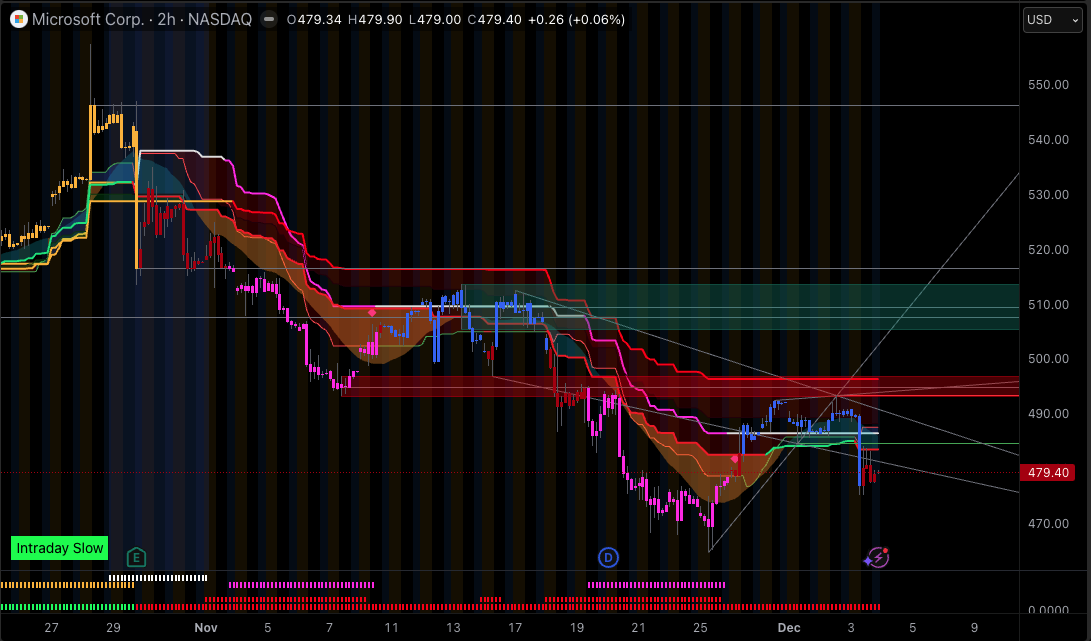
Beneath the short-term stock fluctuations, Microsoft possesses an extraordinarily resilient business model characterized by high recurring revenue (subscriptions for Office 365, Azure, LinkedIn), strong customer lock-in (especially in enterprise), and diversified revenue streams. The company consistently generates massive amounts of free cash flow, which provides flexibility for strategic investments, share buybacks, and dividend payments, returning value to shareholders.
This financial strength allows Microsoft to weather economic downturns, continue investing in R&D, and pursue strategic acquisitions that bolster its long-term competitive position. While the stock may face temporary pressure from market conditions or specific segment performance, Microsoft’s underlying financial health and strategic vision for areas like cloud computing, AI, and enterprise solutions suggest that it remains a powerful player with significant long-term value potential for investors.
In conclusion, the recent underperformance of Microsoft stock is a complex interplay of macroeconomic pressures, a broader tech sector re-rating, specific growth decelerations in key business segments like Azure and Personal Computing, ongoing regulatory scrutiny, and a re-evaluation of premium valuations. However, investors often look beyond these short-term challenges to the company’s robust fundamentals, strategic investments in future technologies like AI, and its proven ability to adapt and innovate, which together form the bedrock of its long-term investment appeal.
aViewFromTheCave is a participant in the Amazon Services LLC Associates Program, an affiliate advertising program designed to provide a means for sites to earn advertising fees by advertising and linking to Amazon.com. Amazon, the Amazon logo, AmazonSupply, and the AmazonSupply logo are trademarks of Amazon.com, Inc. or its affiliates. As an Amazon Associate we earn affiliate commissions from qualifying purchases.