
For many investors, opening a brokerage app to see a sea of red can be a jarring experience. The question “Why is the market down today?” is one of the most frequently searched queries in the financial world, reflecting the inherent anxiety that comes with capital risk. However, market downturns are rarely the result of a single, isolated event. Instead, they are usually the product of a complex interplay between macroeconomic data, geopolitical shifts, corporate performance, and investor psychology.
Understanding these drivers is essential for any disciplined investor. Rather than reacting with panic, a professional approach involves dissecting the “why” to determine if a market dip is a temporary correction, a healthy consolidation, or the beginning of a fundamental shift in the economic cycle.
Macroeconomic Pressures and Monetary Policy
The most significant driver of broad market movement is the macroeconomic environment, specifically the actions of central banks like the Federal Reserve. Markets do not operate in a vacuum; they are highly sensitive to the cost of borrowing and the value of currency.
Interest Rates and the Federal Reserve’s Stance
In the modern financial era, the Federal Reserve is arguably the most influential entity in the global markets. When the market is down, the culprit is often a “hawkish” shift in monetary policy. If the Fed signals that interest rates will remain “higher for longer,” or if they implement a surprise rate hike, stocks generally sell off.
Higher interest rates increase the cost of capital for businesses, which can squeeze profit margins. More importantly, higher rates increase the “discount rate” used by analysts to value future cash flows. For high-growth companies, particularly in the tech and speculative sectors, a higher discount rate significantly lowers their present value, leading to immediate price drops.
Inflationary Pressures and CPI Data
Inflation is the silent killer of market returns. When the Consumer Price Index (CPI) or Personal Consumption Expenditures (PCE) data comes in higher than expected, the market reacts negatively. High inflation suggests that the Federal Reserve will have to be more aggressive in raising rates to cool the economy. Additionally, persistent inflation erodes consumer purchasing power, leading to fears of a slowdown in consumer spending—the primary engine of the U.S. economy. When investors see “hot” inflation data, they often “price in” a more difficult economic environment, leading to a downward trend in equity prices.
Corporate Earnings and Fundamental Shifts
While macroeconomics sets the stage, individual company performance and sector health provide the specific script. The stock market is, at its core, a collection of businesses. If the collective outlook for these businesses dims, the market follows suit.
The Impact of Guidance and Growth Projections
Four times a year, during earnings season, companies report their financial health. Often, a company may report record profits and still see its stock price tumble. This happens when the company’s “guidance”—its projection for future quarters—is weak.
Investors are forward-looking. They do not buy a stock for what it did yesterday; they buy it for what it will do tomorrow. If major market leaders (such as the “Magnificent Seven” or bellwether industrial stocks) suggest that demand is waning, inventory is piling up, or costs are rising, it can trigger a sector-wide or market-wide sell-off. A single disappointing outlook from a major semiconductor or retail giant can act as a canary in the coal mine, causing investors to de-risk across the board.
Sector-Specific Slumps and Contagion
Sometimes the market is down because of a specific crisis in one sector that threatens to spill over into others. We see this frequently in the financial sector; if a regional bank faces liquidity issues, it can trigger a “contagion” effect where investors fear a systemic failure, leading them to sell off all financial stocks. Similarly, a crash in energy prices might drag down the entire S&P 500 energy sector, which has a weighted impact on the broader indices. When a heavy-weight sector undergoes a fundamental shift, the “headline” index numbers will inevitably reflect that pain.
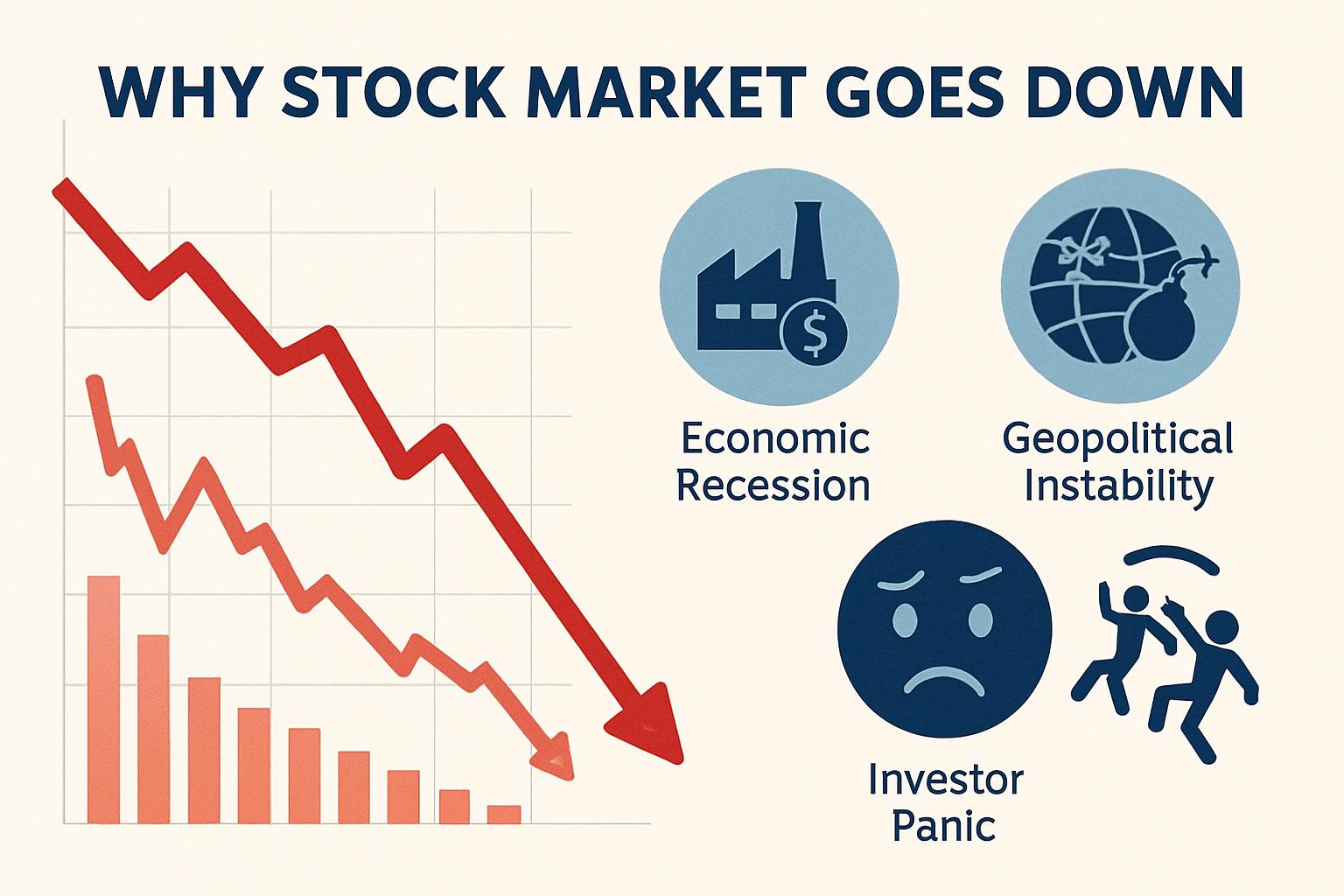
Geopolitical Uncertainty and Global Supply Chains
The global economy is deeply interconnected. Events happening thousands of miles away can have an immediate impact on a domestic brokerage account. Markets hate uncertainty, and geopolitics is the ultimate source of it.
Regional Conflicts and Energy Prices
Wars and regional instability are primary drivers of market volatility. When conflict arises in oil-producing regions or critical trade corridors, the immediate concern is the supply of energy and raw materials. A spike in oil prices acts as a de facto tax on both businesses and consumers, increasing transportation costs and reducing discretionary income. If the market is down today, it may be due to escalating tensions that threaten global stability, causing investors to flee “risk-on” assets like stocks in favor of “safe havens” like gold or government bonds.
Trade Policies and International Relations
Trade wars, tariffs, and diplomatic friction between major economies (such as the U.S. and China) create a volatile environment for multinational corporations. If a new trade restriction is announced, it can disrupt supply chains that have been optimized over decades. This uncertainty makes it difficult for companies to forecast costs and revenues, leading to a “sell first, ask questions later” mentality among institutional investors. Any disruption to the free flow of goods and services is generally viewed as a negative for global equity markets.
Investor Sentiment and Technical Factors
Not all market moves are based on hard data or news events. Sometimes, the market is down simply because of the way it is structured and the way humans (and algorithms) react to price movement.
The Role of Algorithmic and High-Frequency Trading
In the modern era, a significant portion of daily trading volume is executed by algorithms. These programs are often set to trigger sell orders when certain technical levels are broken. For example, if the S&P 500 falls below its “200-day moving average,” it can trigger a cascade of automated selling. This creates a feedback loop where the price drop triggers more selling, which drops the price further. This “technical selling” can cause the market to be down significantly even in the absence of a major news headline.
Market Psychology: Fear and the VIX Index
The “Fear Gauge,” or the VIX (CBOE Volatility Index), measures the market’s expectation of 30-day volatility. When the VIX spikes, it indicates that investors are buying “put options” to protect their portfolios, signaling fear. Human psychology plays a massive role in market downturns. “Loss aversion” is a documented psychological phenomenon where the pain of losing money is twice as powerful as the joy of gaining it. When the market starts to dip, fear can become infectious, leading to “panic selling” where investors exit positions regardless of the long-term fundamentals of the companies they own.
Strategies for the Disciplined Investor
When the market is down, the most important thing an investor can do is maintain a sense of perspective. Volatility is not a flaw in the system; it is a feature of the system.
Portfolio Rebalancing and Diversification
A downward market is an excellent time to review one’s asset allocation. Diversification is the only “free lunch” in investing. If your portfolio is down more than the broader market, it may be a sign that you are over-exposed to a specific sector or risk factor. Professional investors use these periods to “rebalance”—selling assets that have held their value to buy assets that are now trading at a discount. This disciplined approach ensures that you are buying low and selling high, rather than the opposite.
Long-term Vision vs. Short-term Noise
History shows that the stock market has an upward bias over long periods. Every “market down” day in history has eventually been followed by a recovery and new all-time highs. For the long-term investor, daily fluctuations are mostly “noise.”
Strategies such as Dollar-Cost Averaging (DCA) allow investors to take advantage of market downturns by purchasing more shares when prices are low. By focusing on the underlying value of businesses rather than the flickering red numbers on a screen, investors can navigate today’s downturn with the confidence that they are building wealth for the future.
In conclusion, when the market is down, it is usually a symphony of factors: a hawkish Federal Reserve, a disappointing earnings report, a geopolitical flare-up, or a technical break in price action. By identifying which of these factors is at play, you can transition from a reactive trader to an informed, strategic investor. Navigating the “down” days is what ultimately defines success in the “up” years.
aViewFromTheCave is a participant in the Amazon Services LLC Associates Program, an affiliate advertising program designed to provide a means for sites to earn advertising fees by advertising and linking to Amazon.com. Amazon, the Amazon logo, AmazonSupply, and the AmazonSupply logo are trademarks of Amazon.com, Inc. or its affiliates. As an Amazon Associate we earn affiliate commissions from qualifying purchases.