
In the volatile world of digital assets, few cryptocurrencies have experienced as much scrutiny and turbulence as XRP. As the native token of the XRP Ledger, designed by Ripple Labs to facilitate lightning-fast cross-border payments, XRP has long been a top-ten cryptocurrency by market capitalization. However, investors and market observers frequently find themselves asking a frustrating question: why is XRP going down?
Price fluctuations in the cryptocurrency market are rarely the result of a single factor. Instead, they are the culmination of macroeconomic shifts, regulatory developments, and internal market dynamics. For the savvy investor, understanding the “why” behind a price dip is essential for navigating the complexities of personal finance and strategic investing. This article explores the primary drivers currently exerting downward pressure on XRP’s valuation.

1. Macroeconomic Pressures and Global Market Trends
The cryptocurrency market does not exist in a vacuum. Despite the early narrative that digital assets would serve as a “hedge” against traditional market failures, history has shown that tokens like XRP are highly sensitive to broader economic conditions. When global markets face headwinds, speculative assets are often the first to be liquidated.
The Impact of Monetary Policy and Interest Rates
Central bank policies, particularly those of the U.S. Federal Reserve, play a pivotal role in XRP’s price action. In an era of fluctuating interest rates and persistent inflation, the “risk-off” sentiment becomes dominant. When interest rates are high, traditional investments like Treasury bonds become more attractive because they offer guaranteed returns with virtually zero risk.
As a result, liquidity is pulled out of “risk-on” assets, including technology stocks and cryptocurrencies. For XRP, this means a reduction in the capital inflow necessary to sustain or increase its price. When institutional and retail investors tighten their belts, the selling pressure often outweighs the buying demand, leading to a downward trend.
Correlation with Bitcoin and the Broader Crypto Market
While Ripple focuses on enterprise utility, XRP’s price remains tethered to the movement of Bitcoin (BTC). As the market leader, Bitcoin sets the tone for the entire industry. When Bitcoin experiences a correction or a period of stagnation, altcoins—including XRP—typically follow suit, often with higher volatility.
If the broader market sentiment is bearish due to global instability or regulatory fears in other sectors, XRP will likely struggle to maintain an independent upward trajectory. Investors often trade XRP in “pairs” against BTC or ETH, meaning that a decline in the value of the leading assets can trigger automated sell-offs across the board.
2. The Regulatory Landscape and the SEC Legal Saga
Perhaps the most significant weight on XRP’s price over the last several years has been the legal battle between Ripple Labs and the U.S. Securities and Exchange Commission (SEC). While a landmark ruling in 2023 provided some clarity, the legal overhang continues to create a “shadow of doubt” that prevents a full price recovery.
The Exhaustion of the “Legal Win” Momentum
In July 2023, a federal judge ruled that XRP is not, in and of itself, a security when sold to the general public on exchanges. This led to a massive, immediate price surge. However, in the months following, the price retraced most of those gains. This is a classic “sell the news” event in the world of investing.
Once the initial euphoria subsided, investors were forced to confront the reality that the legal process is far from over. Appeals, potential fines, and ongoing debates regarding “institutional sales” mean that Ripple is still operating under a cloud of litigation. For large-scale institutional investors, this lingering uncertainty is a deterrent. Until the legal status is settled with absolute finality, many “big money” players prefer to sit on the sidelines, leading to a lack of the massive buying pressure required to break through resistance levels.
Regulatory Hostility in Key Markets
Beyond the SEC, the global regulatory environment for cryptocurrencies is increasingly stringent. Various jurisdictions are implementing stricter Anti-Money Laundering (AML) and Know Your Customer (KYC) requirements. While XRP’s design is more “compliant-friendly” than many anonymous tokens, the administrative burden on exchanges and financial institutions can slow down the adoption of the XRP Ledger. Whenever a new restrictive policy is announced in a major market like the EU or Asia, it can trigger a speculative sell-off as traders fear reduced liquidity.
3. Technical Market Analysis and On-Chain Metrics
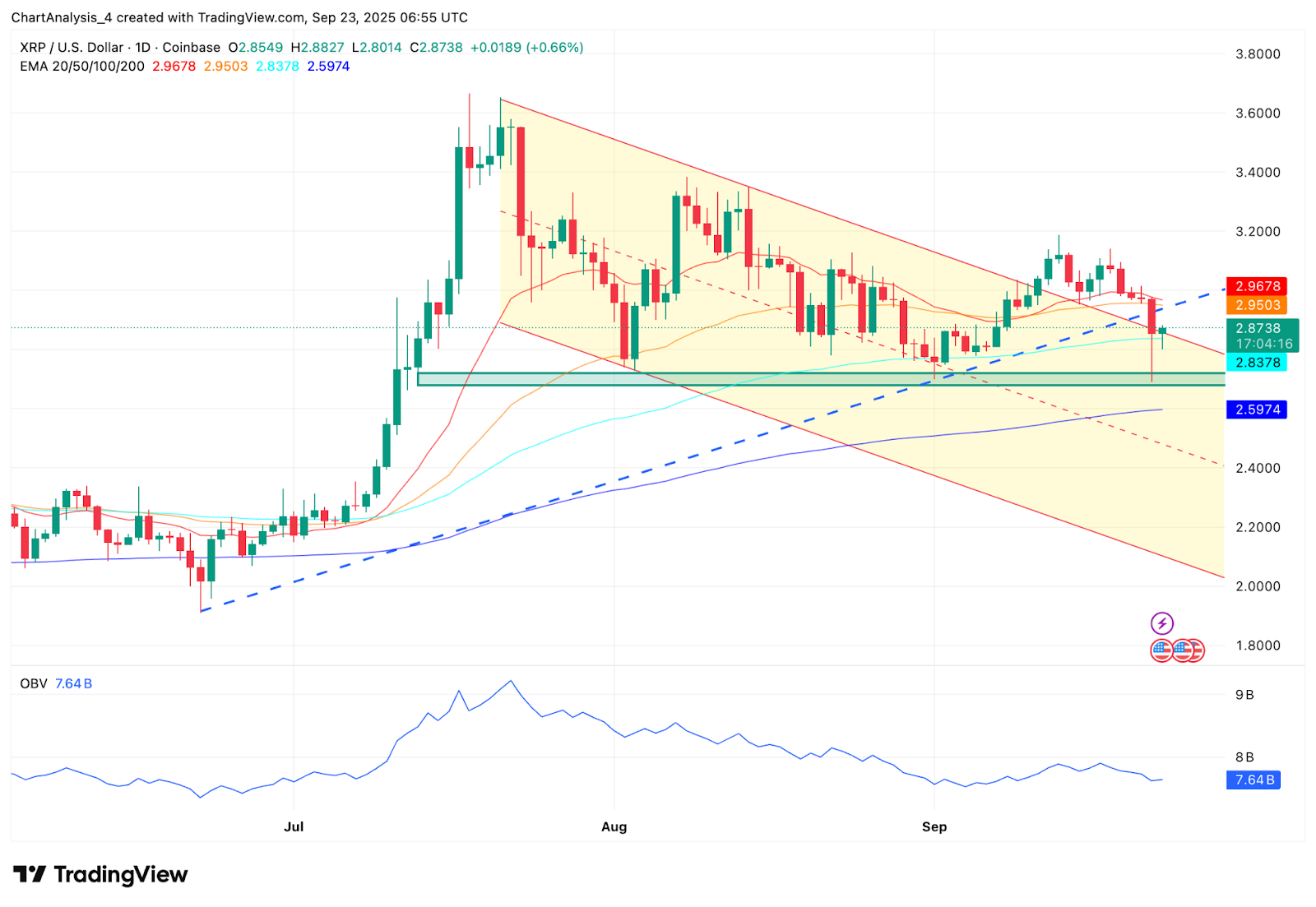
To understand why XRP is going down, one must look at the data on the blockchain and the patterns on the charts. Price action is often a reflection of supply-and-demand mechanics and the behavior of large-scale holders.
Resistance Levels and Profit-Taking
From a technical analysis perspective, XRP frequently hits “psychological resistance” levels. For instance, whenever the price nears the $0.70 or $1.00 mark, a significant number of long-term holders choose to take profits. This creates a “supply wall.”
Many investors bought XRP at significantly lower prices or are “underwater” from the 2017-2018 peak. When the price rallies slightly, these individuals sell to break even or lock in modest gains, which creates downward pressure. Without a massive catalyst to push the price through these resistance zones, the asset tends to drift back toward support levels.
Whale Movements and Exchange Inflows
“Whales”—investors who hold massive amounts of a specific cryptocurrency—have a disproportionate impact on the market. On-chain data often shows significant transfers of XRP from private wallets to exchanges. Typically, when a large amount of a token is moved onto an exchange, it signals an intention to sell.
If several whales decide to liquidate portions of their holdings simultaneously, the market becomes oversold. Furthermore, the XRP Ledger’s escrow system, where Ripple releases a set amount of XRP into the market each month, adds to the circulating supply. While most of this is usually re-escrowed, the constant presence of new supply can dampen price appreciation if demand does not grow at a commensurate rate.
4. Competitive Dynamics and the Evolution of Payment Tech
XRP’s primary value proposition is its utility as a bridge currency for international settlements. However, the landscape of financial technology is evolving rapidly, and XRP faces stiffer competition than it did five years ago.
The Rise of CBDCs and Stablecoin Rivals
When Ripple first emerged, the idea of a digital asset for banks was revolutionary. Today, many central banks are developing their own Central Bank Digital Currencies (CBDCs). Additionally, highly liquid stablecoins like USDC and USDT are being used for cross-border settlements.
If a major financial institution decides to use a proprietary stablecoin or a government-backed CBDC instead of XRP, it reduces the perceived “necessity” of the XRP token. The market reacts to this competition by devaluing XRP, as investors question whether it will remain the “gold standard” for institutional liquidity.
Network Utility vs. Speculative Value
A recurring issue for XRP is the gap between the success of Ripple (the company) and the price of XRP (the token). Ripple continues to sign partnerships with banks worldwide, yet these partnerships do not always require the use of the XRP token for liquidity. Some institutions use Ripple’s software (like xCurrent) without ever touching XRP.
When news breaks of a new Ripple partnership that doesn’t involve the XRP token, it can lead to investor disappointment and a subsequent price drop. The market is increasingly demanding proof of actual “burn” and utility-driven demand rather than just speculative interest based on corporate news.
Conclusion: A Multi-Faceted Decline
When asking “why is XRP going down,” it is clear that there is no singular culprit. The decline is a cocktail of macroeconomic “risk-off” sentiment, a protracted legal battle that has exhausted market patience, and a technical environment characterized by heavy profit-taking and supply influxes. Furthermore, the burgeoning competition in the digital payment space forces XRP to constantly re-justify its value proposition.
For the disciplined investor, these periods of downward movement are a reminder of the inherent risks in the cryptocurrency market. While XRP maintains a loyal community and a functional use case that many other tokens lack, it is not immune to the gravity of financial reality. Navigating XRP’s price action requires a balance of monitoring high-level legal developments, global economic health, and the evolving competitive landscape of fintech. Understanding these drivers is the first step toward making informed decisions in an unpredictable financial frontier.
aViewFromTheCave is a participant in the Amazon Services LLC Associates Program, an affiliate advertising program designed to provide a means for sites to earn advertising fees by advertising and linking to Amazon.com. Amazon, the Amazon logo, AmazonSupply, and the AmazonSupply logo are trademarks of Amazon.com, Inc. or its affiliates. As an Amazon Associate we earn affiliate commissions from qualifying purchases.