
Tesla (TSLA) has long been the lightning rod of the equity markets, a stock that defies traditional valuation metrics and commands a premium based on its potential to revolutionize multiple industries simultaneously. However, when the “T” in the Magnificent Seven experiences a downward trajectory, it often leaves investors scrambling to decipher whether the dip is a temporary correction or a fundamental shift in the company’s growth narrative. Understanding why TSLA is down requires a multi-faceted analysis of macroeconomic pressures, industry-specific headwinds, and the idiosyncratic risks associated with its leadership and strategic pivot toward artificial intelligence.
In the world of high-stakes investing, Tesla is rarely just a “car company.” It is viewed as an energy firm, an AI powerhouse, and a robotics pioneer. Consequently, its stock price is sensitive to a broad array of stimuli, from Federal Reserve interest rate decisions to the nuances of battery supply chains in Southeast Asia. To understand the current downward pressure on the stock, we must examine the convergence of these factors and how they are impacting investor sentiment in the short and long term.
Macroeconomic Headwinds and the Cost of Capital
One of the primary reasons for downward pressure on TSLA is the broader macroeconomic environment, specifically the persistence of elevated interest rates. For a growth-oriented company like Tesla, the cost of capital is a critical component of its valuation. When interest rates remain high, the “discount rate” applied to future earnings increases. Since a significant portion of Tesla’s valuation is derived from cash flows expected five to ten years in the future—through Full Self-Driving (FSD) software, the Optimus robot, and energy storage—higher rates disproportionately lower the present value of those future profits.
The Impact of High Rates on Consumer Demand
Beyond valuation models, interest rates have a visceral impact on Tesla’s bottom line: car loans. Most consumers do not buy Teslas with cash; they finance them. As the Federal Reserve maintains a restrictive monetary policy to combat inflation, the monthly payment for a Model 3 or Model Y becomes significantly more expensive for the average buyer. This forces Tesla into a difficult position: either accept lower sales volumes or slash prices to keep monthly payments affordable. Over the past year, Tesla has chosen the latter, sacrificing its once-enviable gross margins to maintain market share. Investors, who once prized Tesla for its “software-like” margins, are now reassessing the stock as it begins to look more like a traditional, capital-intensive automotive manufacturer.
The “Magnificent Seven” De-correlation
There is also the factor of institutional rotation. For much of the last decade, Tesla was the undisputed leader of the EV revolution. However, as the focus of the market shifted toward generative AI, capital began flowing more aggressively into companies like NVIDIA and Microsoft. When investors rebalance their portfolios, Tesla often faces selling pressure if it is perceived to be lagging behind its peers in the “Magnificent Seven” in terms of immediate revenue growth or earnings beats. This de-correlation means that even when the S&P 500 is up, TSLA can be down if the market sees better “risk-reward” opportunities elsewhere in the tech sector.
Fundamental Pressures: Margins, Deliveries, and Global Competition
While macro factors set the stage, Tesla’s internal fundamentals are the primary drivers of its daily price action. The narrative surrounding Tesla has shifted from “unlimited demand” to “competitive saturation.” For the first time in its history, Tesla is facing legitimate, high-volume competition on a global scale, and the financial markets are reacting to the resulting “margin compression.”
The China Challenge and BYD
China remains the most important market for Tesla’s growth, but it has also become its most challenging. Domestic Chinese automakers, most notably BYD, have achieved a scale and vertical integration that allows them to produce high-quality EVs at price points Tesla struggles to match. When news breaks regarding cooling demand in China or further price cuts at the Giga Shanghai factory, TSLA stock often reacts negatively. Investors fear that Tesla may be losing its “moat” in the world’s largest EV market, forcing it into a perpetual price war that erodes profitability.
Delivery Misses and Inventory Build-up
The quarterly delivery report is perhaps the most significant catalyst for TSLA stock. When deliveries fall short of analyst expectations, it signals a potential slowdown in the company’s 50% compound annual growth rate (CAGR) target. Recent quarters have shown a widening gap between production and deliveries, leading to concerns about inventory build-up. An increasing “days of supply” figure suggests that the market for EVs may be reaching a point of temporary saturation, at least at current price points. For a stock trading at a high Price-to-Earnings (P/E) multiple, any hint of a growth slowdown is a recipe for a sell-off.

The Gross Margin Erosion
Historically, Tesla boasted automotive gross margins exceeding 25%, a figure that dwarfed legacy automakers like Ford or GM. However, the aggressive price cuts implemented to stimulate demand have pulled these margins down toward the high teens. While Elon Musk has argued that the company can afford to sell cars at lower margins today to build an installed base for future high-margin software (FSD) sales, the “buy-side” of Wall Street is often more focused on current earnings quality. Until margins stabilize, the stock will likely face continued volatility.
The Leadership Factor and Strategic Pivots
Tesla is inextricably linked to its CEO, Elon Musk. While his visionary leadership is responsible for much of the company’s $500B+ valuation, his extracurricular activities and unconventional management style introduce a unique layer of “key man risk.”
Governance and Compensation Uncertainty
Recent legal battles over Musk’s multi-billion dollar compensation package have created a cloud of corporate governance uncertainty. When a Delaware court voided his pay deal, it raised questions about his long-term commitment to the company and his desire to move AI development to other entities like xAI if he does not reach a 25% voting stake in Tesla. For institutional investors, this kind of drama is a deterrent. Uncertainty is the enemy of a high stock price, and the ongoing saga regarding Musk’s control over the company’s AI future creates a “distraction discount.”
The Pivot to AI and Robotaxis
Tesla is currently in a transitional phase. It is moving away from being seen as a “volume car company” toward becoming an “AI and robotics company.” The announcement of the dedicated Robotaxi and the heavy investment in the Dojo supercomputer are central to this shift. However, this transition is fraught with execution risk. If investors believe the Robotaxi timeline is too optimistic or that the regulatory hurdles for Full Self-Driving are insurmountable in the near term, they may sell the stock in favor of companies with more immediate AI monetization, such as semiconductor manufacturers. When TSLA is down today, it is often because a specific headline has cast doubt on the viability or timing of these futuristic AI ventures.
Institutional Sentiment and Technical Analysis
Finally, we must consider the mechanics of the market itself. Stock prices are not just reflections of company value; they are the result of supply and demand for shares.
Technical Support Levels
From a technical analysis perspective, TSLA often trades within specific price channels. If the stock breaks below a key “support level”—such as the 200-day moving average—it can trigger automated selling by algorithmic trading platforms. This creates a feedback loop: as the price drops, more sell orders are triggered, causing the price to drop further. Investors watching the “charts” might see a “head and shoulders” pattern or a “death cross,” leading to a sentiment shift that has little to do with the day’s news and everything to do with momentum.
The Shift in Retail vs. Institutional Ownership
Tesla has one of the most loyal retail investor bases in history. However, for the stock to sustain a long-term rally, it needs the support of “big money”—pension funds, mutual funds, and insurance companies. If institutional investors feel that the risk-reward profile of Tesla is becoming too skewed toward the “risk” side due to volatility or lack of clear guidance from management, they may trim their positions. A “down day” for TSLA is often characterized by high-volume selling that suggests institutional de-risking.
Conclusion: Navigating the Tesla Volatility
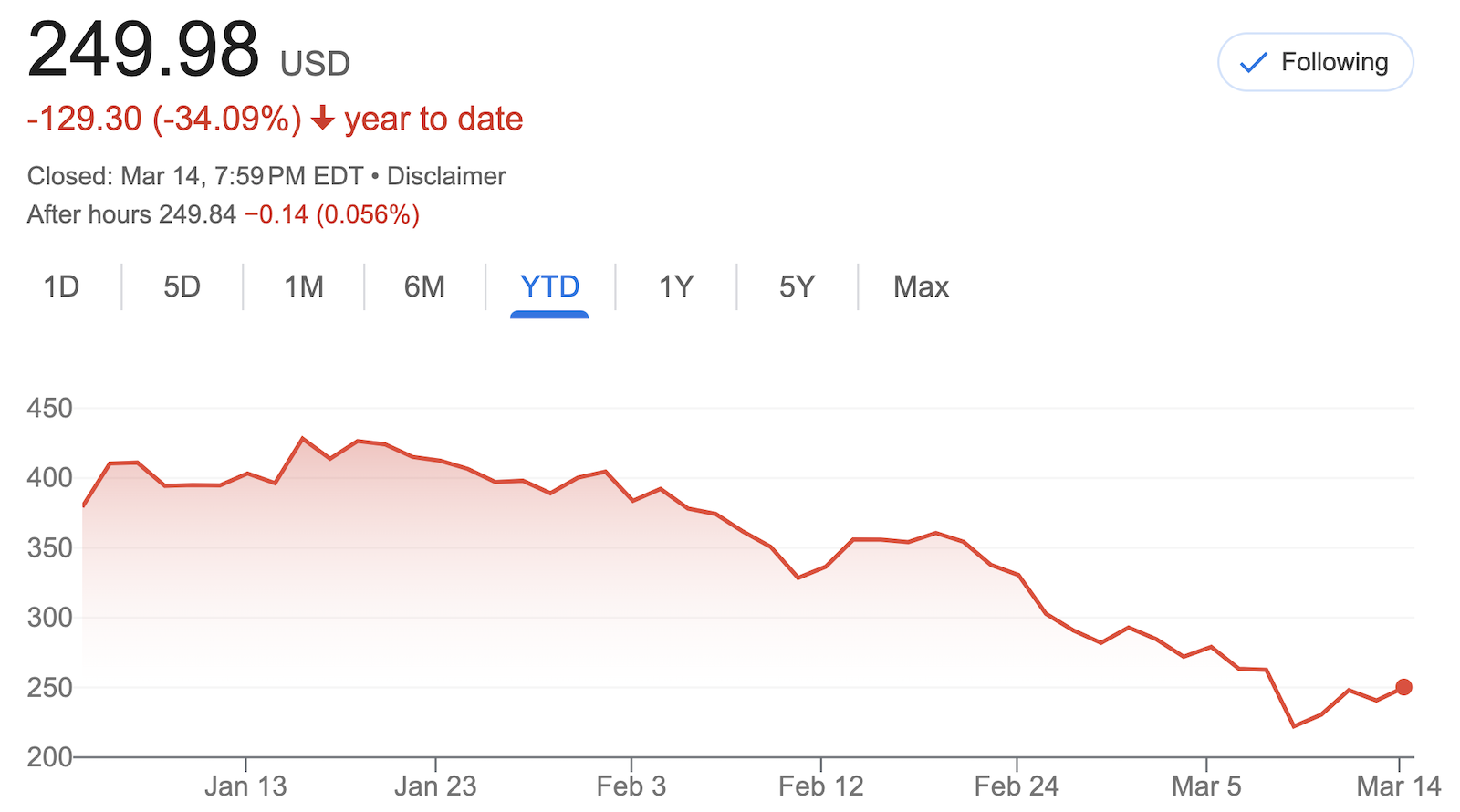
Tesla remains one of the most complex and debated stocks in the financial world. When TSLA is down today, it is rarely due to a single event. Instead, it is typically the result of a “perfect storm” of high interest rates, intensifying global competition, and a high-stakes strategic pivot toward AI that is testing the patience of even the most bullish investors.
For the disciplined investor, these downturns represent a moment to reassess the long-term thesis. Is Tesla still the leader in EV technology? Can they successfully monetize autonomous driving? Will the energy storage business eventually rival the automotive side? If the answers to these questions remain positive, then the “noise” of a single day’s trading is merely a byproduct of the stock’s inherent volatility. However, if the fundamental data—margins, delivery growth, and technological milestones—continues to move in the wrong direction, then “down days” may become a more frequent feature of the Tesla investment landscape. In the world of finance, the only certainty with Tesla is that the journey will be anything but a straight line.
aViewFromTheCave is a participant in the Amazon Services LLC Associates Program, an affiliate advertising program designed to provide a means for sites to earn advertising fees by advertising and linking to Amazon.com. Amazon, the Amazon logo, AmazonSupply, and the AmazonSupply logo are trademarks of Amazon.com, Inc. or its affiliates. As an Amazon Associate we earn affiliate commissions from qualifying purchases.