
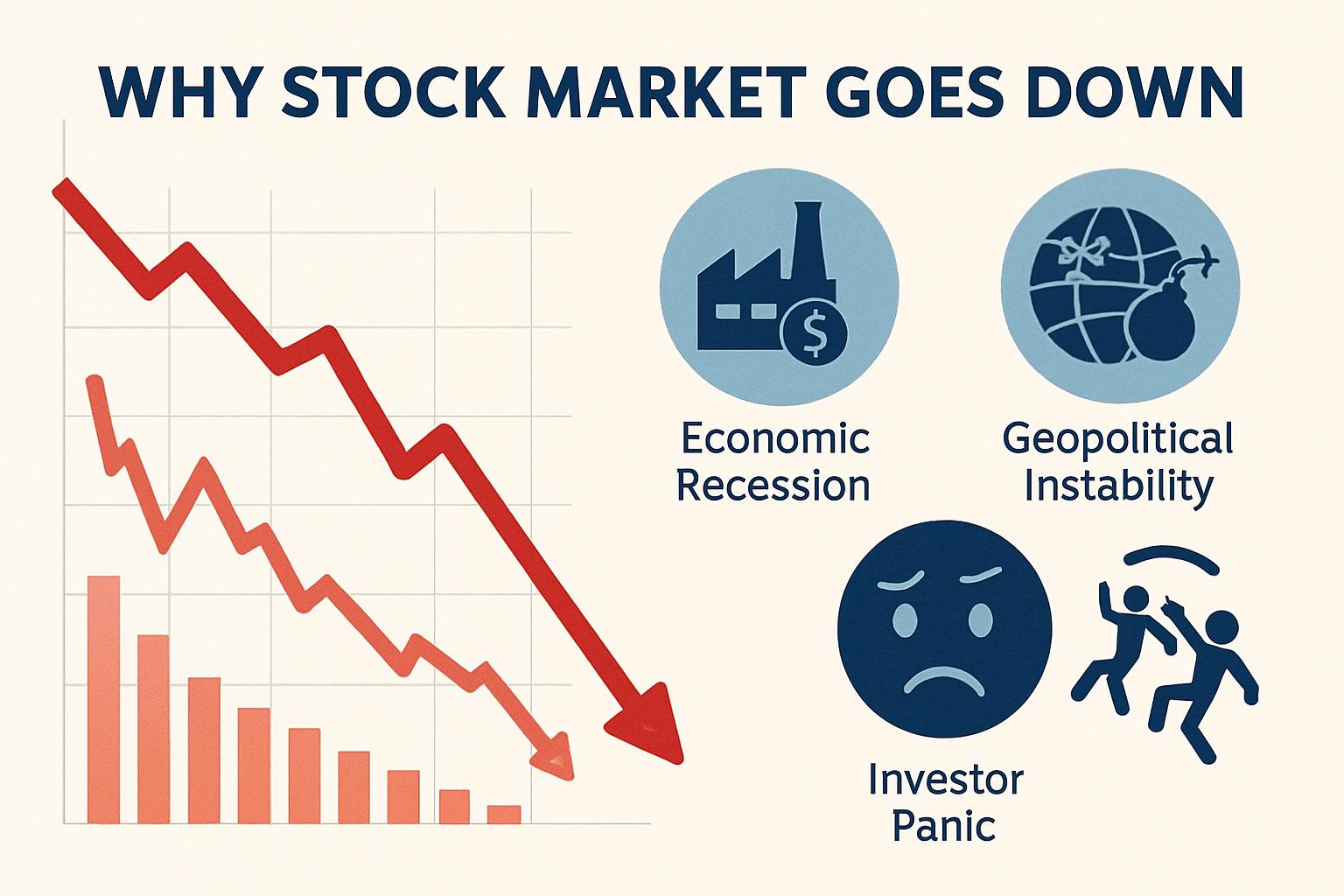
Market volatility is an inherent part of the investing experience, yet when the “sea of red” appears on trading screens, it triggers a visceral reaction for both seasoned investors and newcomers alike. Understanding why the stock market is crashing today requires a multidimensional look at the intersection of economic policy, corporate performance, and human psychology. While the headlines often point to a single catalyst, market downturns are usually the result of a confluence of factors that reach a breaking point.
In this analysis, we will deconstruct the primary drivers behind significant market sell-offs, examining how macroeconomic shifts, geopolitical tensions, and investor sentiment converge to create the downward pressure we see in the financial markets today.

1. Macroeconomic Catalysts: The Federal Reserve and Inflationary Pressures
At the heart of almost every major market correction lies the cost of money. The stock market does not operate in a vacuum; it is tethered to the broader economy by interest rates and the purchasing power of the consumer.
The Role of Interest Rates and Central Bank Policy
The Federal Reserve (and other central banks globally) acts as the primary thermostat for the economy. When inflation rises above the target 2% threshold, the Fed raises interest rates to cool the economy. Higher interest rates make borrowing more expensive for corporations, which can eat into profit margins and stifle expansion plans.
From an investor’s perspective, higher rates increase the “discount rate” used to value future cash flows. This is particularly punishing for growth stocks, where much of the value is predicated on earnings far in the future. When the market anticipates that the Fed will remain “higher for longer,” stock valuations often undergo a painful recalibration, leading to the selling pressure we see today.
Inflation and the Squeeze on Consumer Spending
Inflation acts as a silent tax on both businesses and households. When the cost of raw materials, energy, and labor increases, companies must either raise prices or accept lower margins. If they raise prices too much, consumer demand drops.
A market crash often signals a collective fear that the consumer—the backbone of the global economy—is finally tapped out. When retail sales data or consumer confidence indices miss expectations, the market views it as a harbinger of a looming recession. This fear triggers a flight to safety, moving capital out of equities and into more stable assets like Treasury bonds or gold.
2. Corporate Earnings and the Valuation Realignments
While the “macro” environment sets the stage, the “micro” performance of individual companies often provides the final push. Stock prices are, ultimately, a reflection of expected future earnings. When those expectations are dashed, the market reacts swiftly.
The Disconnect Between Price and Value
Bull markets are often characterized by “multiple expansion,” where investors are willing to pay more for every dollar of a company’s earnings. However, this can lead to a bubble where stock prices outpace the underlying fundamentals of the business.
A market crash is often a “reversion to the mean.” If stocks have been trading at historically high Price-to-Earnings (P/E) ratios, even a minor disappointment in growth can cause a massive sell-off as the market attempts to find a more sustainable valuation floor. Today’s crash may simply be the market’s way of correcting the excesses of previous months, ensuring that prices once again align with realistic earnings potential.
Quarterly Guidance and the “Whisper Number”
It isn’t just about what a company earned in the last three months; it is about what they say regarding the future. If major bellwether companies—the titans of industry that lead the indices—issue “weak guidance,” it sends a shiver through the entire market.
Investors look for signals regarding supply chain health, inventory levels, and labor costs. When several sector leaders simultaneously warn of a “challenging environment,” it confirms the market’s worst fears. The resulting sell-off is often a pre-emptive strike by investors who would rather sit on the sidelines in cash than risk holding shares through a period of declining profitability.
3. Geopolitical Tensions and Global Stability
The stock market thrives on certainty and loathes the unknown. Geopolitical instability is perhaps the most significant source of “un-priceable” risk, creating sudden shocks that the market struggle to digest.
Energy Markets and Supply Chain Fragility
Modern economies run on energy and global trade. Any conflict or diplomatic breakdown in regions critical to oil production or semiconductor manufacturing can have immediate repercussions on the stock market. For example, a spike in crude oil prices acts as an immediate headwind for the transportation and manufacturing sectors, while simultaneously fueling inflation.
When global supply chains are threatened by trade wars, tariffs, or regional conflicts, the “just-in-time” efficiency that many corporations rely on breaks down. This leads to increased costs and delayed revenue, both of which are kryptonite for stock prices. Today’s market decline may be reflecting a sudden escalation in global tensions that threatens the free flow of goods and services.
Policy Shifts in Major Economies
We live in an interconnected financial world. A regulatory crackdown in a major economy like China or a change in fiscal policy in the European Union can ripple through the U.S. markets. Large-cap companies often derive a significant portion of their revenue from international markets. Therefore, political instability abroad isn’t just a foreign news story—it is a direct threat to the bottom line of domestic corporations. When investors see policy risks increasing, they often choose to de-risk their portfolios across the board.
4. Psychological Factors and Market Sentiment
Financial markets are driven by numbers, but they are governed by human emotion. The transition from a “bull market” (optimism) to a “bear market” (pessimism) can happen with breathtaking speed, fueled by the psychological phenomenon of herd mentality.
The Role of Panic Selling and Algorithmic Trading
In the modern era, the market is not just people; it is also machines. High-frequency trading (HFT) and algorithmic models are programmed to respond to specific technical triggers. If a major index breaks below a certain moving average or a key support level, these algorithms can trigger massive sell orders in milliseconds.
This creates a “waterfall effect” where price drops trigger more selling, which in turn triggers even more automated sell orders. For the individual investor, this can look like a blind panic, but it is often a mechanical reaction to shifting data points. Once the momentum turns negative, it takes a significant amount of positive news to arrest the slide.
Behavioral Finance: Fear vs. Greed
The “Fear & Greed Index” is a common tool used by analysts to gauge the market’s temperature. When greed is high, investors overlook risks. When fear takes over, they overlook opportunities.
A “crash” today might be the result of “capitulation”—the moment when the last remaining optimists give up and sell their positions. Paradoxically, this high-volume selling often marks the beginning of a market bottom, but the journey to that point is marked by extreme volatility and emotional distress for those watching their portfolio balances decline.
5. Navigating the Volatility: Strategies for the Disciplined Investor
While the reasons for a market crash are complex, the strategy for dealing with one remains rooted in classic financial principles. For the long-term investor, a crash is not just a period of loss, but a period of realignment and potential opportunity.
Portfolio Diversification and Risk Management
The most effective defense against a market crash is a well-structured portfolio built before the volatility begins. Diversification across different asset classes—such as bonds, real estate, and international equities—can help buffer the blow of a domestic stock market decline.
Investors who utilize “stop-loss” orders or maintain a healthy allocation of cash are better positioned to weather the storm. The goal of risk management is not to avoid every dip, but to ensure that no single market event can derail your long-term financial goals.
The Power of Dollar-Cost Averaging
For those with a long time horizon, a market crash is effectively a “sale” on high-quality companies. Dollar-cost averaging (DCA)—the practice of investing a fixed amount of money at regular intervals regardless of price—is a powerful tool during a downturn.
By continuing to buy when prices are low, you lower your average cost per share. When the market eventually recovers—as it historically always has—the shares purchased during the “crash” contribute significantly to long-term wealth accumulation. The key is to remain disciplined and avoid the temptation to “time the market,” which often results in missing the eventual rebound.

Conclusion: Maintaining a Long-Term Perspective
The question of “why is the stock market crashing today” usually has several answers: it is a mix of rising interest rates, cooling earnings, geopolitical fear, and the inevitable cycle of human emotion. While the short-term noise is deafening, it is important to remember that markets have survived every crisis they have ever faced.
By focusing on fundamentals, maintaining a diversified portfolio, and keeping an eye on the long-term horizon, investors can transform a day of market chaos into a stepping stone for future financial success. In the world of finance, the most valuable asset isn’t just capital—it’s the temperament to stay the course when everyone else is running for the exits.
aViewFromTheCave is a participant in the Amazon Services LLC Associates Program, an affiliate advertising program designed to provide a means for sites to earn advertising fees by advertising and linking to Amazon.com. Amazon, the Amazon logo, AmazonSupply, and the AmazonSupply logo are trademarks of Amazon.com, Inc. or its affiliates. As an Amazon Associate we earn affiliate commissions from qualifying purchases.