
For investors and market observers, Tesla (TSLA) is more than just a car company; it is a barometer for retail investor sentiment, growth-stock valuation, and the future of the green economy. However, the volatility that once propelled the company to trillion-dollar heights often acts as a double-edged sword. When Tesla’s stock price slides, the reasons are rarely singular. Instead, a downward move is usually the result of a complex interplay between macroeconomic shifts, fundamental performance metrics, and the nuanced psychology of the options market.
To understand why Tesla is down today, one must look past the headlines and examine the underlying financial mechanics that drive the world’s most watched equity.
Macroeconomic Factors and Interest Rate Pressures
The most pervasive influence on Tesla’s stock price often has nothing to do with the cars themselves and everything to do with the cost of capital. Tesla is categorized as a “growth stock,” a designation that means a significant portion of its valuation is derived from projected future earnings rather than current cash flow.
The Impact of “Higher for Longer” Fed Policies
When the Federal Reserve maintains high interest rates, the “discount rate” applied to future earnings increases. In financial modeling, particularly Discounted Cash Flow (DCF) analysis, higher rates make a dollar earned ten years from now worth significantly less today. Consequently, growth stocks like Tesla often see their valuations compressed even if their business operations remain stable.
Furthermore, Tesla is a capital-intensive business that relies on consumer credit. Most vehicles are purchased via financing. As interest rates rise, the monthly payment for a Model 3 or Model Y increases, even if the sticker price remains the same. This creates a ceiling on demand, forcing Tesla to choose between maintaining high prices with lower volume or cutting prices to sustain volume—a dilemma that directly impacts the bottom line.
Shifting Capital from Growth to Value Stocks
In periods of market uncertainty, institutional investors often rotate their portfolios. This “risk-off” sentiment involves moving capital out of high-beta stocks (those that move more aggressively than the broader market) and into defensive sectors like utilities, healthcare, or consumer staples. Because Tesla carries a high beta, it is often among the first to be sold off when the market anticipates an economic slowdown or a period of stagnating growth. Today’s dip may simply be a reflection of a broader sector rotation where “smart money” is seeking safety over speculation.
Fundamental Performance and Margin Compression
While macro trends set the stage, Tesla’s specific financial performance provides the script. For years, Tesla enjoyed industry-leading gross margins that made traditional automakers envious. However, that narrative has shifted as the electric vehicle (EV) market matures.
Quarterly Delivery Misses and Revenue Stagnation
Wall Street is obsessed with delivery numbers. For Tesla, these figures serve as a proxy for revenue growth. When the company reports delivery numbers that fall short of analyst expectations, or when “whisper numbers” suggest a pending miss, the stock reacts violently.
Investors are currently hypersensitive to the “law of large numbers.” As Tesla grows, maintaining a 50% year-over-year growth rate becomes mathematically more difficult. Any sign that the company is transitioning from an era of hyper-growth to one of steady, moderate growth requires a complete recalibration of the stock’s Price-to-Earnings (P/E) multiple, often leading to a sharp price correction.
The Global EV Price War and Margin Erosion
One of the primary drivers of Tesla’s recent downward pressure is the ongoing price war initiated by the company itself to maintain market share. While price cuts help move inventory, they are a direct hit to gross margins.
In the financial world, “margin” is a synonym for “quality.” When Tesla’s automotive gross margins (excluding regulatory credits) began to slip toward the levels of legacy automakers like Ford or GM, the “tech premium” that investors were willing to pay for the stock began to evaporate. Furthermore, the rise of domestic competitors in China—most notably BYD—has created a pricing environment where Tesla no longer dictates the terms of the market. Investors today are questioning whether Tesla can ever return to its 25%+ margin glory days.
Valuation Concerns and Institutional Sentiment
Tesla remains one of the most expensive stocks in the S&P 500 when measured by traditional valuation metrics. This premium is built on the assumption that Tesla is not an auto company, but an AI, robotics, and energy firm. When the market begins to doubt this “multiversal” identity, the stock price suffers.
Is the P/E Ratio Sustainable in a Slower Growth Environment?
Even after various pullbacks, Tesla’s P/E ratio often remains multiples higher than that of Toyota or Volkswagen. This valuation suggests that investors expect Tesla to eventually dominate not just the EV market, but also the autonomous driving and energy storage sectors.
However, if the market perceives a delay in these secondary business lines, the “valuation gap” becomes a liability. Today’s decline might be a “reversion to the mean,” where the stock price is forced to align more closely with its actual earnings power rather than its theoretical potential. If the growth in earnings per share (EPS) does not keep pace with the stock’s price, institutional investors will trim their positions to manage risk.
Institutional De-risking and Technical Resistance Levels
The movement of Tesla’s stock is heavily influenced by large institutional holders and algorithmic trading. From a technical analysis perspective, stocks often trade within certain “channels.” If Tesla breaks below a key support level—such as the 50-day or 200-day moving average—it can trigger automated sell orders.
Additionally, Tesla is a favorite of the options market. Large volumes of “put” options can create “gamma flips,” where market makers are forced to sell the underlying stock to hedge their positions, accelerating a downward move. Today’s drop might be less about a specific news event and more about a technical breakdown that gained momentum as key financial thresholds were crossed.
Strategic Shifts: From Automotive Sales to AI and Robotics
Finally, Tesla is currently in the midst of a massive strategic pivot. The company is shifting its primary focus from selling mass-market electric cars to developing “Robotaxis” and the “Optimus” humanoid robot. While this holds immense long-term potential, it introduces a high degree of execution risk.
The Monetization Timeline for Robotaxis and FSD
Investors are increasingly asking: “Show me the money.” While Full Self-Driving (FSD) software is a high-margin product, its widespread adoption and regulatory approval remain elusive. The market has priced in a significant “AI premium” for Tesla, but as other tech giants like Nvidia or Alphabet show more immediate AI-driven revenue, capital may flow out of Tesla and into companies with clearer short-term monetization paths.
If there is a delay in a product launch or a regulatory setback regarding autonomous driving, Tesla’s stock often bears the brunt of the frustration. For a “Money” focused investor, the uncertainty regarding the timeline of these innovations makes it difficult to value the company accurately, leading to volatility.
Investor Fatigue Regarding Future Promises
There is a concept in finance known as “investor fatigue.” For years, Tesla has traded on “the next big thing.” However, as the Cybertruck rollout continues to be a niche endeavor and the “Model 2” (a cheaper $25,000 car) remains a subject of speculation rather than a production reality, some investors are losing patience.
When a company’s valuation is built on future promises, any lack of clarity regarding the execution of those promises leads to a sell-off. Today’s downward movement could be a reflection of the market demanding more “concrete” financial results and fewer “aspirational” projections.
Conclusion: The Cost of Being a Disruptor
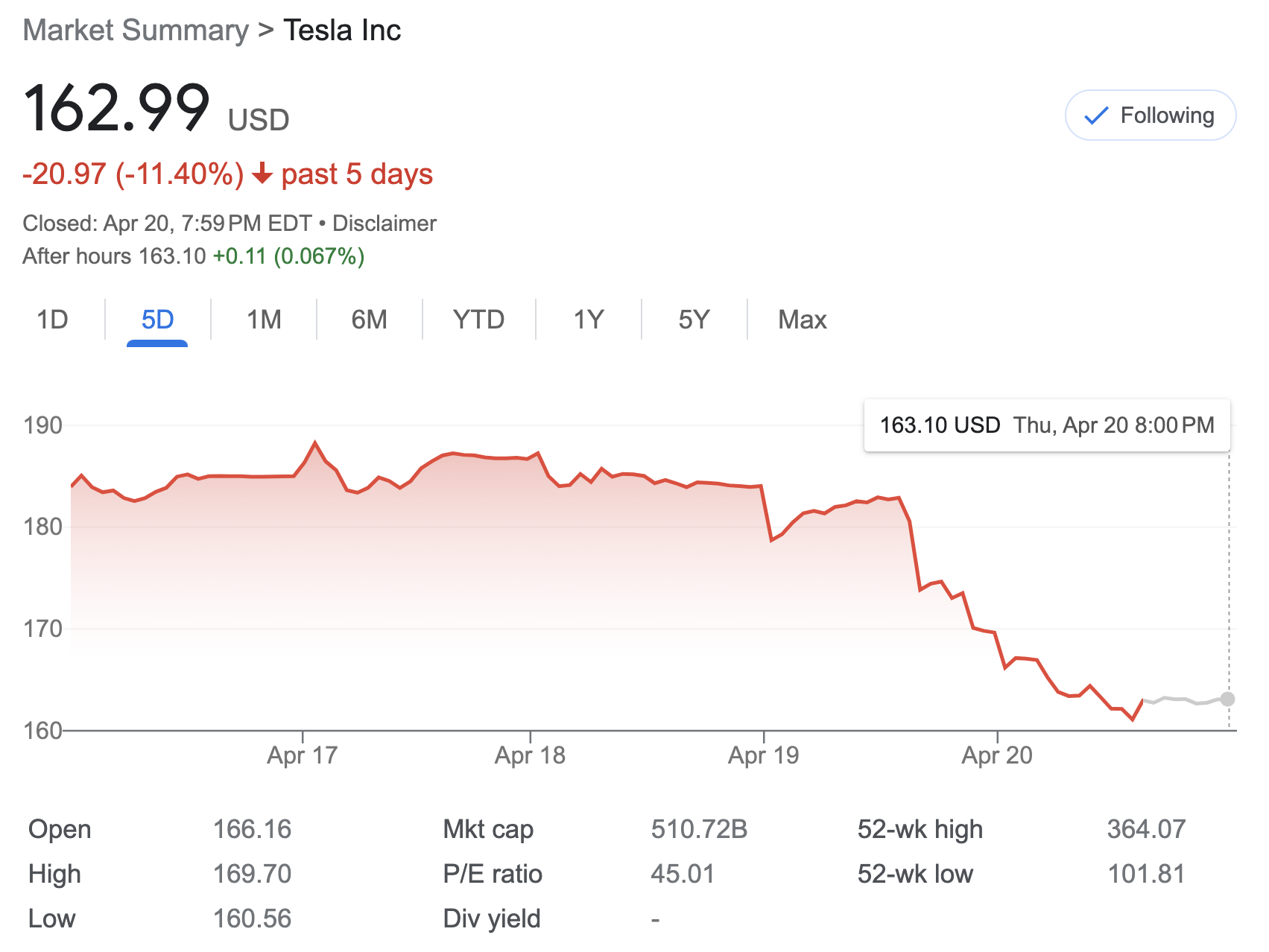
In summary, Tesla is down today because it sits at the intersection of several unfavorable financial trends. High interest rates are making its products more expensive and its future cash flows less valuable. Ongoing price wars in the global market are eating into the margins that once justified its sky-high valuation. Meanwhile, the transition from a hardware-focused car company to a software-focused AI powerhouse is fraught with uncertainty.
For the disciplined investor, these periods of “down days” are a reminder that even the most innovative companies are not immune to the laws of finance. Tesla continues to be a high-risk, high-reward equity, and its current price action is a reflection of the market’s ongoing struggle to find the “fair value” for a company that defies traditional categorization. Whether this is a buying opportunity or a warning sign depends entirely on one’s conviction in Tesla’s ability to convert its technological roadmap into sustainable, high-margin cash flow.
aViewFromTheCave is a participant in the Amazon Services LLC Associates Program, an affiliate advertising program designed to provide a means for sites to earn advertising fees by advertising and linking to Amazon.com. Amazon, the Amazon logo, AmazonSupply, and the AmazonSupply logo are trademarks of Amazon.com, Inc. or its affiliates. As an Amazon Associate we earn affiliate commissions from qualifying purchases.