
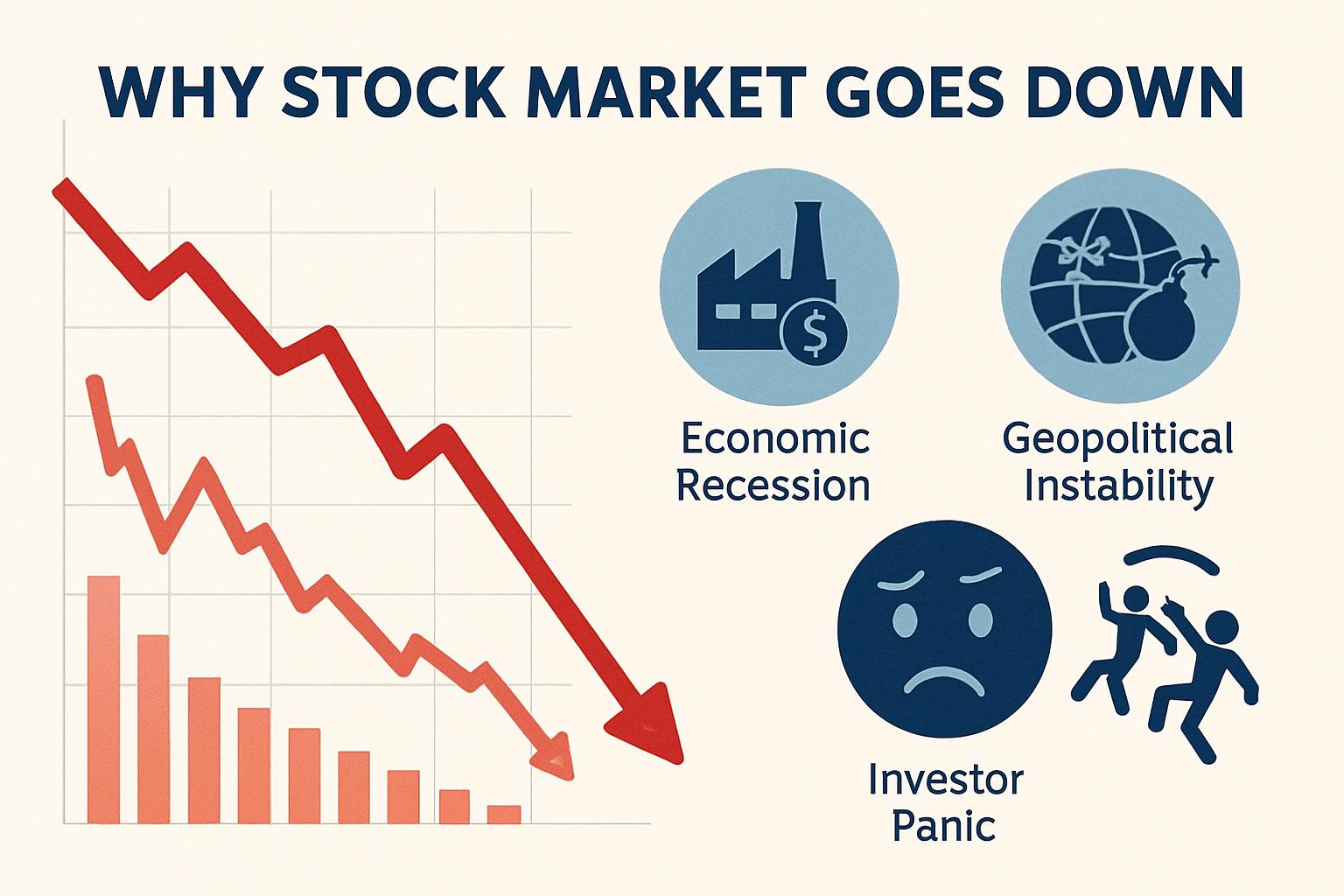
The stock market, an intricate barometer of economic health and corporate prospects, is inherently susceptible to periods of decline. These downturns, often characterized by widespread sell-offs and heightened volatility, are rarely attributable to a single factor. Instead, they typically stem from a confluence of macroeconomic shifts, geopolitical events, corporate performance issues, and evolving investor sentiment. Understanding these underlying causes is crucial for investors seeking to navigate challenging market conditions.
Macroeconomic Headwinds and Monetary Policy Shifts
One of the most potent drivers of stock market drops is a challenging macroeconomic environment, particularly when central banks adjust monetary policy in response.
Inflationary Pressures and Interest Rate Hikes
Persistent and elevated inflation stands as a significant threat to corporate profitability and consumer purchasing power. When the cost of goods and services rises rapidly, businesses face increased input costs, which can squeeze profit margins if they cannot fully pass these costs onto consumers. Consumers, in turn, find their disposable income eroded, leading to reduced spending on discretionary items.
Central banks, mandated to maintain price stability, typically respond to high inflation by raising benchmark interest rates. Higher interest rates make borrowing more expensive for both businesses and consumers, cooling economic activity. For companies, increased borrowing costs can hinder expansion plans and reduce profitability. For consumers, higher rates on mortgages, car loans, and credit cards reduce their capacity for spending, further dampening demand. From an investor’s perspective, higher interest rates also make future corporate earnings less valuable in present terms, as the discount rate used in valuation models increases, often leading to a downward revaluation of stocks, particularly those of growth companies.
Economic Slowdown or Recession Fears
The specter of an economic slowdown or outright recession frequently triggers market declines. Investors constantly monitor economic indicators for signs of weakening growth. Declining GDP growth, rising unemployment rates, and contraction in manufacturing or services indices are all red flags. A particularly strong signal often watched by market participants is an inverted yield curve, where short-term government bonds yield more than long-term ones, historically a reliable precursor to recessions.
During an economic contraction, corporate earnings typically suffer across a broad spectrum of industries. Reduced consumer and business spending translates to lower revenues and profits. Faced with diminished earnings prospects and heightened uncertainty, investors often opt to sell equities and move into safer assets, accelerating the market’s decline. The fear of a prolonged downturn can create a self-fulfilling prophecy, as reduced investment and spending further weigh on economic activity.
Supply Chain Disruptions
Modern globalized economies are highly interdependent. Disruptions to supply chains, whether caused by geopolitical events, natural disasters, or health crises, can have far-reaching effects on the stock market. When factories cannot obtain necessary components, or goods cannot be transported efficiently, production slows, costs rise, and delivery times lengthen. This can lead to inventory shortages, lost sales, and increased operational expenses for businesses, ultimately impacting their bottom line and stock performance. While some disruptions are temporary, persistent issues can embed higher costs into the economic system, contributing to inflationary pressures and reducing corporate profitability for extended periods.
Geopolitical Instability and Global Events
Beyond pure economic indicators, external shocks from geopolitical events and global crises frequently destabilize markets.
International Conflicts and Trade Tensions
Geopolitical conflicts, regional skirmishes, and broader international tensions introduce significant uncertainty into global markets. Such events can disrupt trade routes, impose sanctions that alter economic relationships, and create volatility in commodity markets, particularly oil and gas. For instance, a conflict in a major oil-producing region can send energy prices skyrocketing, acting as a tax on global consumers and businesses, fueling inflation, and eroding profit margins. Trade wars, characterized by tariffs and protectionist policies, can stifle international commerce, reduce corporate sales, and make supply chains less efficient, all of which weigh heavily on corporate earnings and investor confidence. The unpredictability of these events makes risk assessment challenging, often leading investors to reduce exposure to equities.
Energy Price Volatility
Energy markets play a pivotal role in the global economy. Sudden and sharp fluctuations in the price of crude oil, natural gas, and other energy commodities can have profound impacts on stock markets. A rapid increase in energy prices boosts transportation costs for businesses, increases utility bills for consumers, and drives up the cost of producing goods that rely on energy-intensive processes. This acts as a significant drag on economic growth and can exacerbate inflationary pressures, prompting central banks to tighten monetary policy. Conversely, a sharp drop in energy prices can sometimes signal weakening global demand, which itself can be a cause for concern regarding an economic slowdown. Both extremes of volatility can create instability and contribute to market drops.
Lingering Effects of Global Health Crises
While immediate panic surrounding global health crises might subside, their lingering effects can continue to influence stock market performance. This includes persistent labor shortages, changes in consumer behavior (e.g., shifts from services to goods, or reluctance to return to pre-crisis activities), and long-term impacts on specific industries such as travel, hospitality, or healthcare. Government responses to such crises, including increased debt burdens and changes in fiscal policy, can also create long-term economic headwinds that affect corporate profitability and investor outlook.
Corporate Earnings, Valuations, and Sector-Specific Concerns
The fundamental performance and perceived value of individual companies and sectors are always critical factors in market movements.
Disappointing Earnings Reports and Future Guidance

At the micro-level, the collective performance of publicly traded companies is a direct driver of stock market trends. When a significant number of companies report earnings that fall short of analyst expectations, or when they issue weak future guidance, it signals potential headwinds for corporate profitability. Disappointing earnings indicate that the economic environment is tougher than anticipated, or that individual companies are struggling with competition, operational inefficiencies, or declining demand. Weak guidance, which provides a forward-looking perspective on expected revenues and profits, often signals that management anticipates slower growth or challenges ahead. These revelations can trigger widespread selling as investors re-evaluate their positions and adjust future earnings forecasts, which are key to stock valuations.
Overvalued Markets and Valuation Corrections
Periods of sustained bull markets can lead to elevated stock valuations, where stock prices grow faster than the underlying earnings or intrinsic value of companies. Metrics such as high price-to-earnings (P/E) ratios, price-to-sales ratios, or market capitalization relative to GDP can indicate that a market has become “overvalued.” When valuations stretch to extreme levels, the market becomes more vulnerable to a correction. Any negative catalyst – be it rising interest rates, an economic slowdown, or unexpected geopolitical news – can pop the “bubble,” leading to a sharp and rapid decline as investors adjust their expectations for future growth and risk. Such corrections are often seen as a necessary recalibration, bringing stock prices back in line with more realistic future earnings potential.
Sector-Specific Challenges
While macroeconomic forces affect the entire market, specific sectors can experience unique challenges that contribute to broader market weakness or lead to targeted downturns. For instance, the technology sector, often valued on high growth expectations, can be particularly sensitive to rising interest rates, which reduce the present value of future earnings. A downturn in the housing market can severely impact construction companies, material suppliers, and financial institutions heavily invested in mortgages. Regulatory changes, disruptive technologies, or shifts in consumer preferences can also create significant headwinds for specific industries, leading to poor stock performance for companies within those sectors, even if the broader economy is relatively stable.
Investor Sentiment and Market Psychology
Beyond the tangible economic and corporate fundamentals, the psychological aspects of investing play a crucial role in market movements, often amplifying both rallies and drops.
Fear, Uncertainty, and Doubt (FUD)
Markets are not purely rational. Investor sentiment, driven by emotions such as fear, uncertainty, and doubt (FUD), can significantly influence trading behavior. Negative news cycles, widespread pessimism on social media, or sensationalized media coverage can create a contagion of fear. When fear dominates, investors may engage in panic selling, offloading assets irrespective of underlying fundamentals, simply to avoid further losses. This herd behavior can accelerate market declines, pushing prices down rapidly, even for fundamentally strong companies. Uncertainty about the future, whether economic, political, or social, also encourages a “wait-and-see” approach, reducing buying activity and making markets more susceptible to downward pressure.
Liquidity Concerns and Margin Calls
During sharp market downturns, liquidity can quickly dry up. This means there are fewer buyers willing to purchase assets, making it harder for sellers to find a counterparty without significantly lowering their price. A lack of liquidity exacerbates price declines. Furthermore, investors who trade on margin (using borrowed money to buy securities) can face margin calls if the value of their portfolio falls below a certain threshold. To meet these calls, investors are often forced to sell assets, irrespective of their long-term conviction, which adds further selling pressure to the market. This forced selling can create a downward spiral, where declining prices trigger more margin calls, leading to more selling.
The Role of Algorithmic Trading
Modern financial markets are heavily influenced by algorithmic trading, where computer programs execute trades based on predefined rules and market conditions. While these algorithms enhance efficiency, during periods of high volatility, they can also amplify market movements. If an algorithm is programmed to sell when certain market indicators hit a threshold, a widespread cascade of such sales across multiple algorithms can lead to flash crashes or rapid, steep declines that may not be directly tied to new fundamental information. The speed and volume of algorithmic trading can contribute to sudden market shifts, making it challenging for human investors to react in real-time.
Navigating Volatility: A Long-Term Perspective
While market drops are an inevitable part of investing, adopting a disciplined, long-term approach can help mitigate their impact and even position investors for future gains.
The Importance of Diversification
Diversification remains a cornerstone of prudent investing. Spreading investments across various asset classes (equities, bonds, real estate), different sectors, and diverse geographical regions helps to reduce overall portfolio risk. When one part of the portfolio is underperforming, other parts might be stable or even gaining, cushioning the overall impact of a market downturn. A well-diversified portfolio is less susceptible to the specific challenges faced by any single company, industry, or region.
Dollar-Cost Averaging
Dollar-cost averaging involves investing a fixed amount of money at regular intervals, regardless of market fluctuations. When stock prices are high, a fixed dollar amount buys fewer shares; when prices are low, it buys more. This strategy helps to average out the purchase price over time, reducing the risk of making a large investment at a market peak. During a market drop, dollar-cost averaging allows investors to acquire more shares at lower prices, which can significantly boost returns when the market eventually recovers.
Rebalancing and Strategic Asset Allocation
Periodically rebalancing a portfolio means adjusting asset allocations back to their target percentages. For example, if equities have performed well and now represent a larger portion of the portfolio than desired, rebalancing might involve selling some equities and buying bonds. Conversely, after a market drop, rebalancing might mean buying more equities at lower prices to restore the target allocation. This systematic approach helps maintain the desired risk profile and encourages investors to “buy low and sell high” in a disciplined manner, rather than reacting emotionally to market swings.

Focus on Fundamentals
During periods of market turmoil, it’s easy to get caught up in the daily noise and short-term price movements. However, focusing on the long-term fundamentals of companies and the broader economic outlook is crucial. Understanding why a market is dropping involves analyzing the underlying economic conditions, corporate earnings, and geopolitical landscape, rather than merely reacting to price charts. Investors who focus on the intrinsic value of their investments and their long-term potential are often better positioned to weather downturns and benefit from eventual recoveries.
aViewFromTheCave is a participant in the Amazon Services LLC Associates Program, an affiliate advertising program designed to provide a means for sites to earn advertising fees by advertising and linking to Amazon.com. Amazon, the Amazon logo, AmazonSupply, and the AmazonSupply logo are trademarks of Amazon.com, Inc. or its affiliates. As an Amazon Associate we earn affiliate commissions from qualifying purchases.