
In the contemporary financial landscape, few tickers command as much attention as NVIDIA Corporation (NVDA). As the standard-bearer for the artificial intelligence revolution and a cornerstone of the modern semiconductor industry, Nvidia’s stock performance often serves as a barometer for the broader technology sector and investor appetite for risk. However, even the most meteoric ascents are punctuated by periods of correction and consolidation. When investors ask “why is Nvidia down today,” the answer is rarely found in a single news headline, but rather in a complex tapestry of macroeconomic shifts, valuation mechanics, and sector-specific rotation.
Understanding the downward movement of Nvidia requires a deep dive into the mechanics of the stock market, the psychology of institutional investors, and the fiscal environment that governs high-growth assets.
Macroeconomic Headwinds and the “Risk-Off” Sentiment
The primary driver behind short-term dips in high-valuation stocks like Nvidia is often found in the broader macroeconomic environment rather than the company’s internal operations. As a growth-oriented asset, Nvidia is hypersensitive to shifts in monetary policy and treasury yields.
The Impact of Interest Rates on Growth Stock Valuation
In financial modeling, the value of a company like Nvidia is largely derived from its projected future cash flows. These future earnings are “discounted” back to their present value using a discount rate, which is heavily influenced by the prevailing interest rates set by central banks. When the Federal Reserve signals a “higher for longer” stance on interest rates, the discount rate increases, which mathematically lowers the present value of those future earnings. Consequently, when bond yields rise, high-growth tech stocks often face immediate selling pressure as investors recalibrate their valuation models.
Systematic Market De-risking
Broad market sentiment plays a crucial role in Nvidia’s daily price action. During periods of geopolitical instability or disappointing economic data—such as consumer price index (CPI) reports showing persistent inflation—investors often pivot to a “risk-off” posture. In this scenario, institutional funds may trim their most profitable positions to raise cash or move into defensive sectors like utilities or consumer staples. Because Nvidia has seen such significant gains over the past year, it is often the first “piggy bank” investors tap into when they need to lock in profits or mitigate portfolio risk.
Valuation Reality Checks and the Cycle of Profit-Taking
Nvidia’s journey to becoming one of the most valuable companies in the world has been characterized by staggering price-to-earnings (P/E) ratios and intense speculative fervor. While the company’s fundamentals are robust, the stock’s price often moves faster than its actual earnings growth, leading to periods where the market must pause to catch its breath.
The Phenomenon of “Sell on the News”
Often, Nvidia’s stock may decline even after positive news or an earnings beat. This is known in the financial world as a “sell on the news” event. Traders and hedge funds often “buy the rumor” leading up to a major catalyst—such as a product launch or a quarterly report—driving the price up in anticipation. Once the event occurs, the upside is considered “priced in,” and institutional players sell their shares to realize gains, causing the price to drop despite the underlying news being objectively good.
Technical Corrections and Mean Reversion
From a technical analysis perspective, stocks rarely move in a straight line. When Nvidia’s stock price deviates too far from its moving averages (such as the 50-day or 200-day moving average), it is considered “overextended.” Technical indicators like the Relative Strength Index (RSI) can signal that a stock is “overbought.” When these levels are reached, algorithmic trading platforms and technical traders often trigger sell orders, leading to a healthy, albeit painful, mean reversion where the stock price pulls back to more sustainable levels.
Sector-Specific Cooling: The AI Capex Debate
Nvidia’s dominance is inextricably linked to the massive capital expenditure (Capex) of “Hyperscalers”—companies like Microsoft, Alphabet, and Meta. Recently, a narrative has emerged among financial analysts questioning the sustainability of this spending, which directly impacts Nvidia’s revenue projections.
Questioning the Return on Investment (ROI) for Generative AI
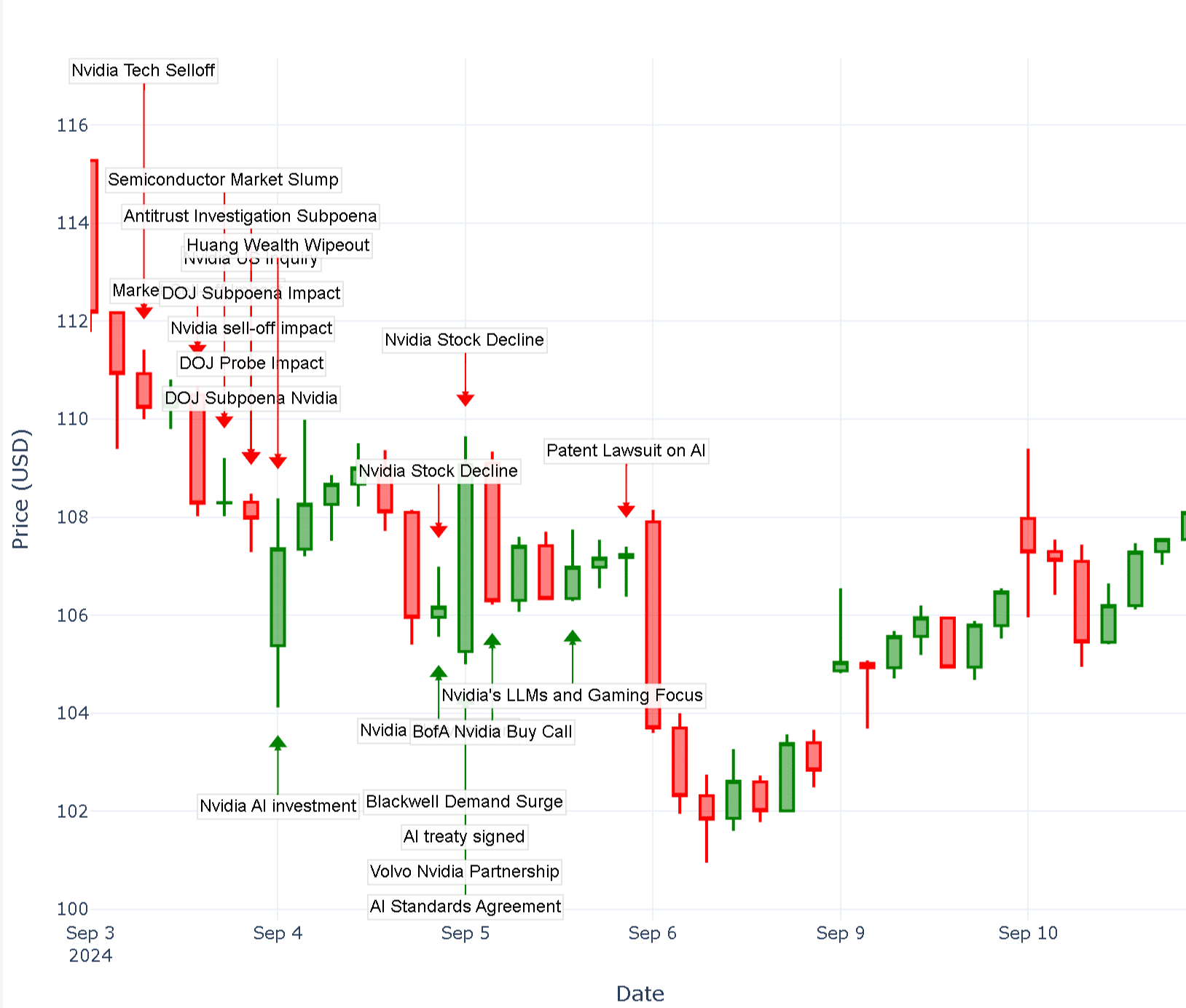
Wall Street is beginning to demand proof of profitability from the companies buying Nvidia’s H100 and Blackwell chips. If investors perceive that the “AI bubble” is shifting from an infrastructure-build phase to a “show me the money” phase, they may become skeptical of Nvidia’s ability to maintain its triple-digit revenue growth. Any hint that major tech firms are slowing their data center investments or finding ways to optimize existing hardware can lead to a sharp decline in Nvidia’s stock as analysts downwardly revise their future growth estimates.
Inventory Normalization and Lead Times
In the heat of the AI boom, Nvidia chips were subject to extreme scarcity, leading to a “double-ordering” phenomenon where customers ordered more than they needed to ensure they received at least some supply. As supply chain constraints ease and Nvidia increases its manufacturing capacity, lead times for their products have shortened. While this is good for the industry, the “Money” side of the house often views shorter lead times as a sign of waning demand. This perception, whether accurate or not, can trigger a sell-off as investors fear the peak of the hardware cycle has passed.
Geopolitical Tensions and Regulatory Hurdles
As a titan of the semiconductor industry, Nvidia is a frequent casualty of the “Chip Wars” and international trade disputes. Because a significant portion of Nvidia’s revenue comes from international markets, particularly China, any shift in trade policy creates immediate financial volatility.
Impact of Export Restrictions
The U.S. Department of Commerce has frequently updated its export controls to limit the sale of advanced AI chips to certain regions for national security reasons. Every time a new regulation is rumored or announced, Nvidia’s stock typically takes a hit. Investors calculate the potential lost revenue from these restricted markets and adjust the stock’s price accordingly. Even if Nvidia develops “compliance-friendly” versions of its chips, the market remains wary of the reduced margins and lower performance tiers these products might offer.
Concentrated Manufacturing Risk
The financial community is also acutely aware of Nvidia’s reliance on Taiwan Semiconductor Manufacturing Company (TSMC) for its chip fabrication. Geopolitical tensions in the Taiwan Strait represent a “black swan” risk that is perpetually factored into Nvidia’s risk premium. Any escalation in rhetoric or military exercises in the region can cause institutional investors to reduce their exposure to the entire semiconductor sector, with Nvidia—the largest player—seeing the most significant dollar-volume outflows.
The Role of Derivatives and Options Market Dynamics
In the modern market, the tail often wags the dog. Nvidia is one of the most heavily traded stocks in the options market, and the behavior of options traders can significantly influence the “spot” price of the stock through a process known as “gamma hedging.”
Gamma Squeezes and Unwinding
When retail and institutional investors buy large amounts of “call options” (bets that the stock will go up), market makers who sell those options must buy the underlying Nvidia stock to hedge their risk. This creates upward pressure. Conversely, if investors begin buying “put options” (bets that the stock will fall) or if call options expire without being renewed, market makers will sell the underlying stock to remain “delta neutral.” This mechanical selling can accelerate a downward move, turning a small dip into a significant intraday slide.
Institutional Rebalancing
At the end of quarters or months, large mutual funds and ETFs often engage in “rebalancing.” If Nvidia has outperformed the rest of a fund’s portfolio, the fund manager is required by their charter to sell some Nvidia shares and buy underperforming assets to maintain their target allocation percentages. This non-fundamental selling is a common reason for price dips in high-performing stocks like Nvidia, regardless of the company’s actual business health.
Conclusion: Perspective in a Volatile Market
For the disciplined investor, a “down day” for Nvidia is rarely a sign of corporate failure, but rather a reflection of the intricate machinery of the global financial markets. Whether driven by rising interest rates, profit-taking after a historic rally, or the complex ebb and flow of the options market, volatility is the price of admission for participating in high-growth technology investing.
While the headlines may focus on the immediate loss of market cap, the “Money” perspective requires looking beyond the daily fluctuations to the long-term earnings power and the structural role Nvidia plays in the global economy. Understanding these financial levers allows investors to distinguish between a fundamental breakdown in a company’s story and the routine, often healthy, corrections that characterize a functioning market. As long as Nvidia remains the primary engine of the AI era, its stock will continue to be a site of intense financial tug-of-war, where every dip is analyzed through the lens of risk, reward, and the relentless search for valuation equilibrium.
aViewFromTheCave is a participant in the Amazon Services LLC Associates Program, an affiliate advertising program designed to provide a means for sites to earn advertising fees by advertising and linking to Amazon.com. Amazon, the Amazon logo, AmazonSupply, and the AmazonSupply logo are trademarks of Amazon.com, Inc. or its affiliates. As an Amazon Associate we earn affiliate commissions from qualifying purchases.