
MicroStrategy (MSTR) has evolved from a traditional enterprise software firm into a unique financial instrument—a high-beta, levered play on Bitcoin. Because of this transformation, the stock rarely moves in isolation. When investors ask why MicroStrategy is down on any given day, the answer typically lies at the intersection of cryptocurrency price action, corporate debt mechanics, and the fluctuating premium the market is willing to pay for its Bitcoin holdings.
Understanding the downward pressure on MSTR requires a deep dive into the company’s capital structure and its role as a “Bitcoin Treasury” company. Unlike a standard tech stock, MicroStrategy’s valuation is driven more by the assets on its balance sheet than the cash flow from its software business.

The Inextricable Link: Bitcoin Volatility and MSTR Performance
The most immediate and obvious reason for a decline in MicroStrategy’s share price is a downward move in the price of Bitcoin. Since Michael Saylor, the company’s founder and Executive Chairman, initiated the Bitcoin treasury strategy in August 2020, MSTR has maintained a correlation with the digital asset that often exceeds 0.80. However, the stock does not move in a 1:1 ratio with Bitcoin; it acts as a levered proxy.
Understanding the Correlation and Beta
MicroStrategy is essentially a “leveraged bet” on Bitcoin. Because the company uses debt—specifically convertible senior notes—to acquire more Bitcoin, its equity value is hypersensitive to price swings in the underlying asset. In financial terms, MSTR often exhibits a high “beta” relative to Bitcoin. If Bitcoin drops by 5%, it is not uncommon to see MicroStrategy drop by 10% or more. This volatility is a double-edged sword; while it provides outsized gains during bull runs, it leads to aggressive liquidations and stop-loss triggers during market pullbacks.
The Impact of Bitcoin Spot ETFs
Historically, MicroStrategy was one of the few ways institutional investors could gain exposure to Bitcoin within a traditional brokerage account. With the approval and launch of several Bitcoin Spot ETFs (Exchange Traded Funds), the competitive landscape has changed. On days when MicroStrategy is down, it may be due to “capital migration.” If investors feel the premium on MSTR is too high compared to the zero-to-low management fees of a Spot ETF, they may sell their MSTR positions to reallocate into a cleaner, non-leveraged Bitcoin product. This shift in institutional demand can create significant downward pressure on the stock’s price.
Capital Structure and the “Bitcoin Flywheel” Risks
MicroStrategy’s strategy involves what many call a “Bitcoin Flywheel”: issuing cheap debt or new equity to buy Bitcoin, which increases the Bitcoin per share, which in turn (ideally) drives the stock price higher, allowing for more debt issuance. However, when the market turns bearish, this flywheel can appear to move in reverse.
Convertible Debt and Interest Rate Sensitivity
The company has billions of dollars in convertible debt. While much of this debt carries low interest rates, the market’s perception of this leverage changes based on the broader macroeconomic environment. If the Federal Reserve signals that interest rates will remain “higher for longer,” the cost of future refinancing increases. Furthermore, as the stock price drops, the “conversion” feature of these notes becomes less attractive to bondholders. If the stock falls toward the “strike price” of these notes, it can create a technical “gamma” effect where market makers hedge their positions, further depressing the stock price.
Share Issuance and Dilution
MicroStrategy frequently uses “at-the-market” (ATM) equity offerings to raise capital for further Bitcoin purchases. While this strategy is designed to be “accretive” (meaning it increases the amount of Bitcoin held per share), the immediate effect of an equity offering is dilution. If the company announces or is suspected of selling new shares to the market, the increased supply of stock can cause a short-term price drop. Investors often sell in anticipation of this dilution, especially if they believe the company is buying Bitcoin at a local “top.”
Valuation Premium: Is the Gap Closing?
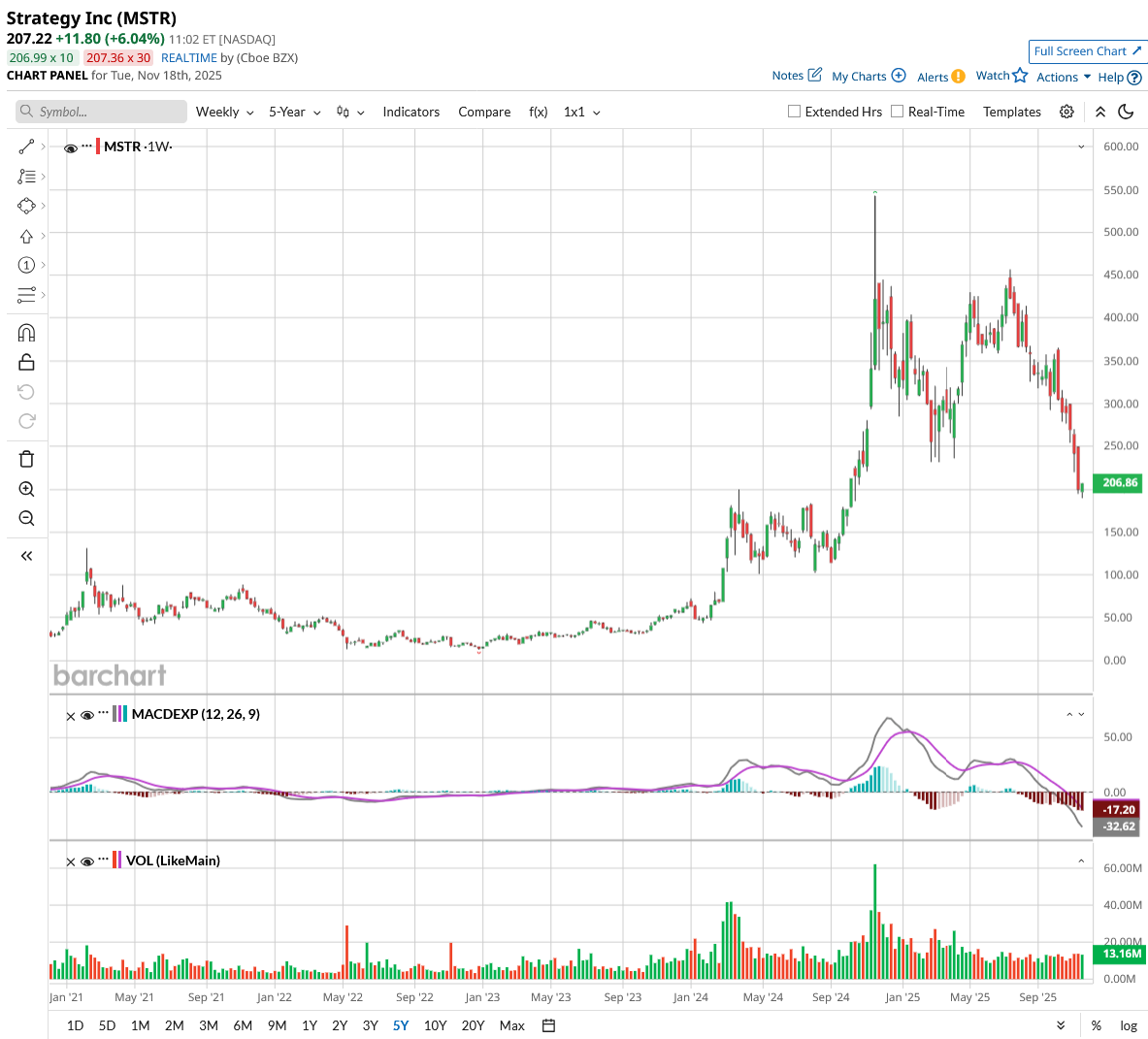
One of the most complex aspects of MicroStrategy’s stock price is the “Premium to NAV” (Net Asset Value). MicroStrategy often trades at a market capitalization significantly higher than the total value of the Bitcoin it holds. When MSTR is down while Bitcoin is sideways or only slightly down, it is usually because this premium is shrinking.
The NAV Multiple Explained
Investors pay a premium for MicroStrategy for several reasons: the ability to trade it on margin, its inclusion in major indices like the MSCI World, and the fact that it is a productive company that can generate its own capital to buy more assets. At times, this premium has reached 2x or even 3x the value of its Bitcoin holdings. However, premiums are mean-reverting. If the market determines that a 2.5x multiple is unsustainable, the stock will sell off until the multiple reaches a more “reasonable” historical level (often between 1.3x and 1.8x). A “down day” for MSTR is frequently just a “multiple compression” day.
Institutional De-risking and Profit Taking
Because MicroStrategy is a high-performing asset, it is often a prime candidate for profit-taking. Large hedge funds and institutional holders that have seen 100% or 200% returns in a short period may sell MSTR to lock in gains or to cover losses in other parts of their portfolio. This “de-risking” behavior often happens during periods of geopolitical uncertainty or ahead of major economic data releases (like CPI or jobs reports). When the “smart money” exits, the lack of immediate liquidity can cause the stock to tumble.
The Role of the Software Business and Fundamentals
While the Bitcoin treasury strategy dominates the headlines, MicroStrategy remains a functioning enterprise software company. It specializes in business intelligence (BI), analytics, and cloud-based software services. While this segment is small compared to the Bitcoin holdings, it cannot be entirely ignored.
Legacy Analytics vs. Cloud Transition
MicroStrategy is currently in the middle of transitioning its legacy on-premise customers to a cloud-based subscription model. This transition can be “lumpy” for financial statements. If the company releases an earnings report or an interim update showing a decline in total software revenue or a struggle to compete with AI-driven analytics competitors (like Microsoft’s Power BI or Tableau), the stock may suffer. Even though most investors buy MSTR for the Bitcoin, a failing software business reduces the company’s ability to service its debt, which adds a layer of fundamental risk.
Operational Cash Flow
The software business provides the cash flow necessary to pay the interest on the company’s debt. If operational margins shrink, the market may worry that the company will be forced to sell some of its Bitcoin to cover obligations—something Michael Saylor has vowed not to do. Any perception that the “safety net” of the software business is weakening can trigger a sell-off from more conservative institutional investors.
Macroeconomic Pressures and the Risk-Off Environment
Finally, MicroStrategy is a “risk-on” asset. It thrives in an environment of high liquidity, low interest rates, and a weakening US dollar. When the global macro environment shifts to “risk-off,” MSTR is often among the first stocks to be sold.
Fed Policy and Liquidity Trends
The price of Bitcoin—and by extension, MicroStrategy—is highly sensitive to global M2 money supply growth. When the Federal Reserve tightens liquidity (Quantitative Tightening), there is less “excess” cash flowing into speculative or high-growth assets. On days when the US Dollar Index (DXY) is strong, MSTR is typically weak. A strong dollar makes dollar-denominated assets like Bitcoin less attractive, and the resulting sell-off in the crypto market is amplified in MicroStrategy’s stock price.
Market Sentiment and Short Interest
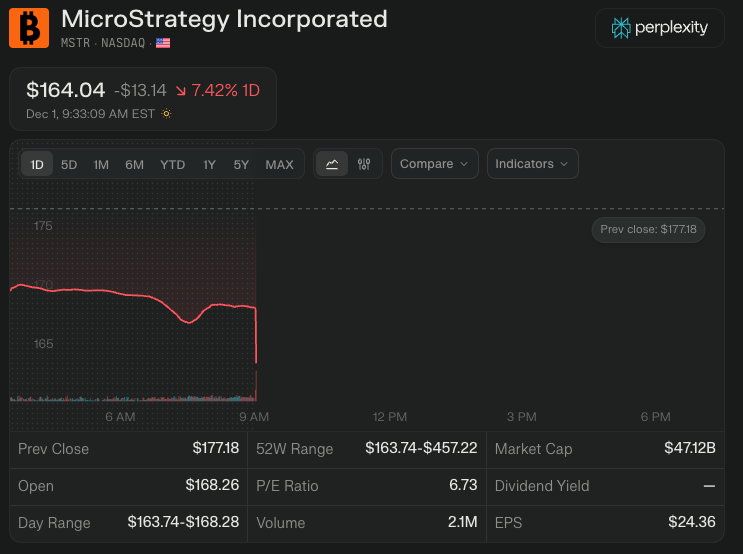
MicroStrategy is one of the most heavily shorted stocks in the technology sector. Short sellers bet against the stock, often arguing that the premium to NAV is unjustifiable. This high short interest creates a volatile environment. While it can lead to “short squeezes” on the way up, it also means that any downward momentum is exacerbated as short sellers press their advantage. If a major support level is broken, the combination of “long” liquidations and “short” selling can create a cascading effect, leading to a deep red day for the stock.
In summary, when MicroStrategy is down, it is rarely due to a single factor. It is usually a combination of a dip in Bitcoin’s price, a narrowing of the valuation premium, and broader macroeconomic shifts that favor safety over high-leverage growth. For the disciplined investor, these downturns are a feature—not a bug—of a stock that has positioned itself as the most aggressive corporate experiment in the modern financial world.
aViewFromTheCave is a participant in the Amazon Services LLC Associates Program, an affiliate advertising program designed to provide a means for sites to earn advertising fees by advertising and linking to Amazon.com. Amazon, the Amazon logo, AmazonSupply, and the AmazonSupply logo are trademarks of Amazon.com, Inc. or its affiliates. As an Amazon Associate we earn affiliate commissions from qualifying purchases.