
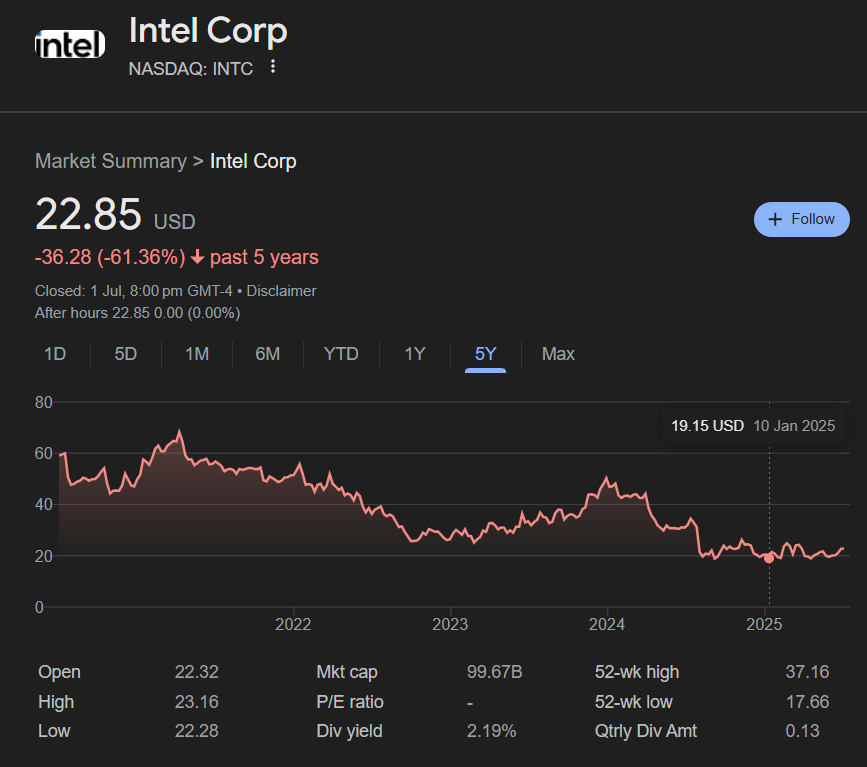
For decades, Intel Corporation (INTC) was the undisputed sovereign of the semiconductor world. As a cornerstone of the “Wintel” duopoly that powered the personal computing revolution, Intel was the quintessential “blue chip” stock—a reliable generator of dividends, growth, and market stability. However, the last several years have painted a starkly different financial portrait. While the broader semiconductor index (SOX) and rivals like Nvidia and AMD have reached record valuations, Intel’s stock has languished, frequently hitting multi-year lows and decoupling from the high-flying tech rally.
To understand why Intel stock is so low, one must look past the ticker symbol and examine a complex intersection of capital allocation shifts, competitive displacement, and a fundamental transition in the company’s business model. From an investor’s perspective, Intel is currently caught in a “perfect storm” where massive capital requirements meet shrinking market share.

The Financial Burden of the IDM 2.0 Strategy
Under the leadership of CEO Pat Gelsinger, Intel has pivoted toward a strategy known as IDM 2.0 (Integrated Device Manufacturing). While strategically ambitious, this move has created significant short-term downward pressure on the stock price due to the sheer volume of capital expenditure (CapEx) required.
The Foundry Gamble: Investing Billions in Infrastructure
Unlike “fabless” competitors like Nvidia or AMD, which design chips but outsource the expensive manufacturing to TSMC, Intel is doubling down on building its own factories (fabs). The company is investing upwards of $100 billion in new manufacturing sites across Ohio, Arizona, and Germany. From a balance sheet perspective, this is an enormous drain on cash. Investors typically reward “asset-light” models that offer high margins; Intel, conversely, is becoming “asset-heavy.” The market is currently discounting the stock because these investments will take years, if not a decade, to generate a positive return on invested capital (ROIC).
Margin Compression: The Cost of Playing Catch-up
For years, Intel enjoyed gross margins in the 60% range. Today, those margins have compressed significantly, often dipping into the 40s. The financial logic is simple: manufacturing chips at the leading edge (18A and 20A nodes) is exponentially more expensive than older processes. As Intel races to regain process leadership from TSMC, it is sacrificing current profitability for the hope of future dominance. For institutional investors who prioritize quarterly earnings per share (EPS), this transition creates a period of “dead money” where the risks of construction delays or yield issues outweigh the potential for growth.
Competitive Displacement and the Erosion of Market Share
A stock’s value is largely a reflection of a company’s competitive moat. For Intel, that moat has been breached on two primary fronts: the data center and the consumer PC market.
The Rise of AMD and the Loss of Data Center Dominance
In the world of business finance, the data center is the “high-margin” crown jewel. Historically, Intel controlled over 90% of this market. However, AMD’s EPYC processors have systematically chipped away at this lead by offering better performance-per-watt and lower total cost of ownership (TCO). When Intel loses a percentage point of data center market share, it isn’t just losing revenue; it is losing its most profitable revenue. The stock reflects this “leakage,” as investors worry that Intel may never recover the near-monopoly status that once fueled its massive buybacks and dividends.
The AI Gold Rush: Why Investors Are Favoring GPU Over CPU
The current macro-trend in investing is centered entirely on Artificial Intelligence. The financial markets have undergone a structural shift where capital is flowing out of General Purpose Computing (CPUs) and into Accelerated Computing (GPUs). Because Intel’s legacy is built on the x86 CPU architecture, it has been largely sidelined during the initial AI explosion led by Nvidia. Even though Intel is developing its Gaudi AI accelerators, the market views them as a distant third behind Nvidia and even AMD’s MI300 series. This “AI gap” has led to a valuation discount, as Intel is seen as a “legacy tech” play in a world obsessed with next-generation AI infrastructure.
Financial Performance and Investor Sentiment

Stock prices are ultimately driven by the relationship between expectation and reality. For Intel, a series of earnings misses and slashed guidance has severely damaged investor confidence, leading to a “show-me” story where the market refuses to bid up the price until results are proven.
Dividend Cuts and Cash Flow Volatility
One of the primary reasons income-oriented investors held Intel was its reliable dividend. In early 2023, Intel made the difficult financial decision to cut its dividend by over 60% to preserve cash for its fab construction. While fiscally responsible from a long-term survival standpoint, this move triggered a mass exodus of “dividend aristocrat” funds and retail investors who relied on that yield. When a stock loses its identity as an income play but hasn’t yet proven itself as a growth play, it falls into a valuation “no man’s land,” contributing to the low share price.
Growth vs. Value: The Crisis of Identity
Intel currently trades at a price-to-book (P/B) ratio and price-to-earnings (P/E) multiple that look more like a struggling industrial company than a high-growth tech firm. The market is struggling to categorize Intel. Is it a turnaround value play? Or is it a “value trap” where the price is low because the business is in a permanent state of decline? This uncertainty creates volatility. Until Intel can show consistent sequential revenue growth and stabilizing margins, the “Money” side of the equation—the institutional buyers—will likely remain on the sidelines.
Geopolitical Factors and Government Subsidies
In the modern financial landscape, government policy plays a massive role in a company’s valuation, especially in the semiconductor sector. Intel has become a central figure in the West’s attempt to “re-shore” chip manufacturing.
The CHIPS Act: A Lifeline or a Distraction?
Intel is a primary beneficiary of the U.S. CHIPS and Science Act, receiving billions in grants and loans. While this is a net positive for the balance sheet, the financial markets are wary of “subsidized growth.” There are strings attached to government money, including restrictions on stock buybacks and expansion in certain foreign territories. Investors often prefer organic, market-driven growth over government-mandated infrastructure. There is also the concern that the political process is slower than the technology cycle, meaning the financial relief may arrive too late to help Intel maintain its competitive edge against TSMC’s expansion in Arizona.
Global Supply Chain Diversification
From an investment risk perspective, Intel’s heavy concentration in Western manufacturing is both a strength and a weakness. While it mitigates some “Taiwan risk” (geopolitical tension between China and Taiwan), it also exposes the company to the higher labor and environmental costs of operating in the U.S. and Europe. The market is currently weighing these geopolitical protections against the higher operational expenditures (OpEx) required to run these facilities, and so far, the higher costs are winning the argument in the eyes of analysts.
The Road to Recovery: Valuation and Long-Term Outlook
Despite the low stock price, some contrarian investors view Intel’s current valuation as a generational entry point. However, several financial milestones must be met before the stock can sustain a meaningful recovery.
Is Intel Currently Undervalued or a Falling Knife?
At current levels, Intel’s market capitalization is a fraction of Nvidia’s and significantly lower than its own historical peaks. From a technical analysis standpoint, the stock has found “floors” only to break through them when earnings reports highlight further margin contraction. For the stock to be considered “undervalued,” Intel must prove that its Foundry Services (IFS) can win major external customers. If Intel can sign a “whale” client—such as Apple, Nvidia, or Qualcomm—to use its manufacturing nodes, the financial narrative would shift from “spending money” to “earning high-margin service revenue.”
Key Milestones for an Investor Turnaround
To see the stock price rise, investors are looking for three specific signals:
- Positive Free Cash Flow: Moving from burning cash on construction to generating cash from operations.
- Node Parity: Successfully launching the 18A process on time in 2025 to prove they have caught up to TSMC.
- AI Execution: Demonstrating that the Gaudi line of chips can capture even 5–10% of the AI accelerator market.
In conclusion, Intel stock is low because the company is currently in the “valley of death” of a massive corporate transformation. It is spending like a startup while defending its territory like a legacy incumbent. For the patient investor, the low price represents the cost of uncertainty; for the skeptic, it represents a fundamental shift in the chip industry where the former king has been permanently dethroned. The next 24 months will be the most critical in Intel’s financial history as it attempts to prove that its multi-billion dollar gamble will eventually pay dividends—both literally and figuratively.
aViewFromTheCave is a participant in the Amazon Services LLC Associates Program, an affiliate advertising program designed to provide a means for sites to earn advertising fees by advertising and linking to Amazon.com. Amazon, the Amazon logo, AmazonSupply, and the AmazonSupply logo are trademarks of Amazon.com, Inc. or its affiliates. As an Amazon Associate we earn affiliate commissions from qualifying purchases.