
For many investors, opening a brokerage app to see a sea of red can be a jarring experience. Whether it is a minor pullback or a significant correction, the immediate question is always the same: Why did the stock market go down today?
The stock market is a complex, living ecosystem influenced by millions of participants, global events, and mathematical algorithms. While it often feels like a singular entity, the market is actually a “voting machine” in the short term, reflecting the collective emotions and expectations of investors. In the long term, it acts as a “weighing machine,” reflecting the actual value of companies. When the market drops, it is usually the result of a shift in one of several core pillars: macroeconomic data, corporate health, geopolitical stability, or investor psychology.
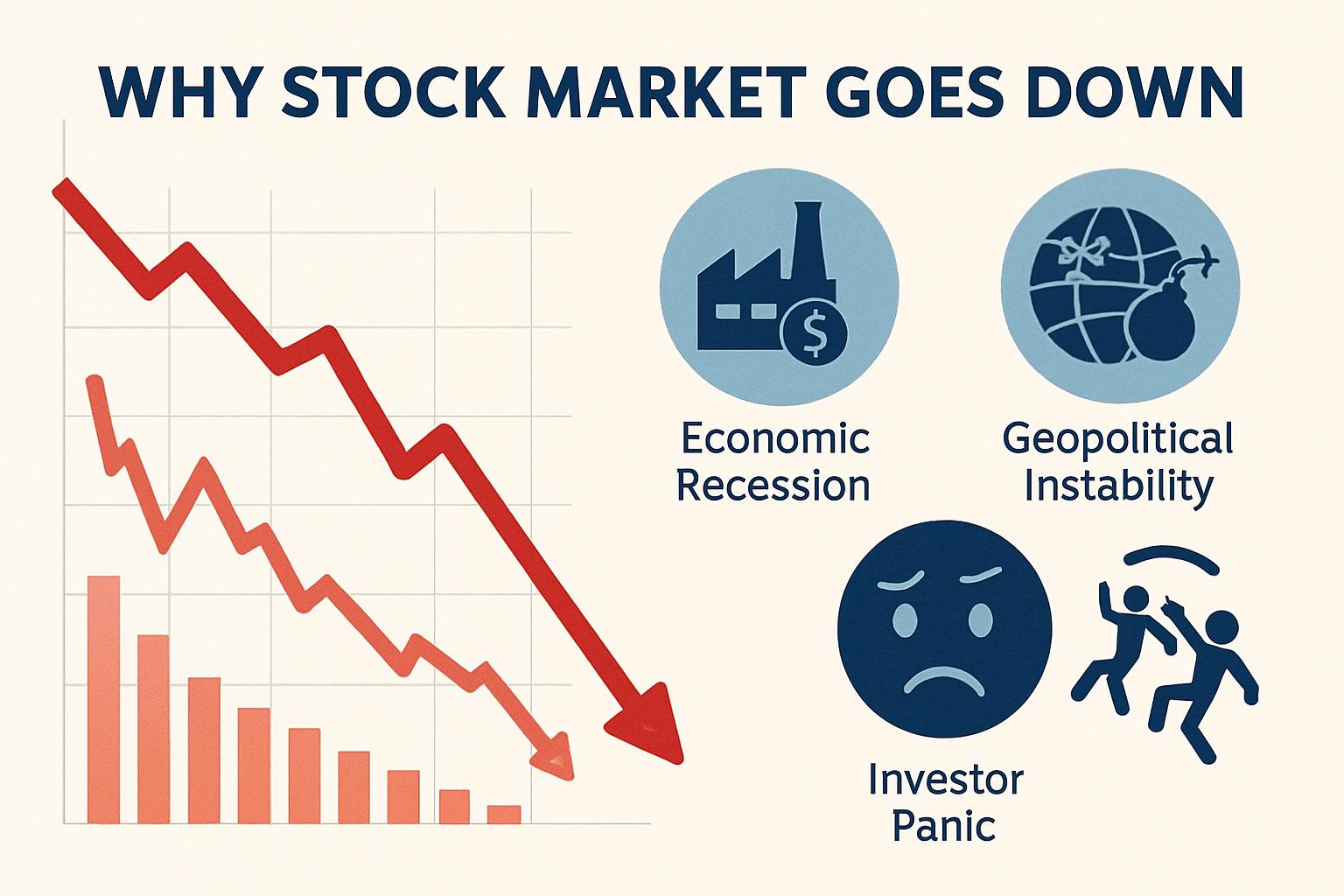
Understanding these drivers is essential for any disciplined investor. By deconstructing the reasons behind a downturn, you can move from reactive panic to informed strategy.
1. Macroeconomic Indicators and Monetary Policy
The most common reason for a broad market decline is a shift in the macroeconomic landscape. Investors are constantly trying to predict the future state of the economy, and when data suggests a slowdown or a change in the cost of capital, stock prices react accordingly.
The Role of Interest Rates and the Federal Reserve
The Federal Reserve (the Fed) is perhaps the most influential force in the financial markets. Through its control of the federal funds rate, the Fed dictates the cost of borrowing. When the Fed raises interest rates to combat inflation, it becomes more expensive for companies to fund growth and for consumers to take out loans for houses or cars.
From an investment perspective, higher interest rates also make future corporate earnings less valuable in today’s dollars—a concept known as “discounted cash flow.” Furthermore, as interest rates rise, government bonds become more attractive, leading some investors to move capital out of “risky” stocks and into “safe” fixed-income assets.
Inflation Data and Consumer Price Indices
Inflation is the silent killer of purchasing power and corporate profit margins. When the Consumer Price Index (CPI) or the Producer Price Index (PPI) comes in higher than expected, the market often reacts negatively. High inflation suggests that companies will face higher input costs for raw materials and labor. If a company cannot pass these costs on to the consumer, its margins will shrink. Additionally, “hot” inflation data almost always signals that the Fed will keep interest rates high for longer, creating a double-whammy effect on stock valuations.
Labor Market Reports and Economic Growth
The health of the economy is often measured by employment data. Paradoxically, the stock market sometimes reacts negatively to “good” news in the labor market. If the monthly jobs report shows robust hiring and rising wages, investors may fear that the economy is overheating, which would necessitate further interest rate hikes. Conversely, if employment data is too weak, it sparks fears of an impending recession. The market prefers a “Goldilocks” scenario—growth that is neither too hot nor too cold.
2. Corporate Earnings and Fundamental Valuation
While the macroeconomy sets the stage, individual company performance is the lead actor. The stock market is ultimately a collection of businesses, and if those businesses aren’t performing as expected, the indices will reflect that failure.
Earnings Misses and Downward Guidance
Publicly traded companies are required to report their financial results every quarter. Stock prices are built on expectations; therefore, a company doesn’t just need to make a profit—it needs to meet or exceed the consensus estimate set by Wall Street analysts.
If a major “bellwether” company (like Apple, Microsoft, or Walmart) misses its revenue or profit targets, it can drag down its entire sector. Even more critical than past performance is “guidance”—the company’s forecast for the coming months. If a CEO expresses caution about future demand or mentions rising costs, investors will often sell the stock immediately to avoid future losses.
The “Priced to Perfection” Trap
Sometimes, the market goes down even when the news is objectively good. This often happens when stocks have been on a prolonged “bull run” and valuations have become stretched. When a stock is trading at a high Price-to-Earnings (P/E) ratio, it is said to be “priced to perfection.” In this scenario, any news that is not overwhelmingly positive can trigger a sell-off. Investors use these moments to “take profits,” locking in their gains and moving to the sidelines, which creates downward pressure on prices.

Sector-Specific Contraction
Markets rarely move in a perfectly synchronized fashion. Sometimes, a market drop is driven by a specific industry. For example, a sudden drop in oil prices will hammer the energy sector, while a change in healthcare legislation might cause pharmaceutical stocks to tumble. Because modern indices like the S&P 500 are market-cap weighted, a significant decline in a few massive tech or financial firms can make it look like the entire market is crashing, even if the average small-business stock is holding steady.
3. Geopolitical Events and External Shocks
Financial markets hate uncertainty. While investors can model interest rates and project earnings, they cannot easily account for “Black Swan” events—unpredictable occurrences that have a massive impact.
Global Conflicts and Supply Chain Disruptions
War, trade disputes, and geopolitical tensions are primary drivers of market volatility. When conflict breaks out in a region critical to global trade or energy production, it creates immediate risk. For instance, tensions in the Middle East can spike oil prices, while trade friction between the U.S. and China can disrupt the semiconductor supply chain. These events create “regime uncertainty,” where investors become unsure of the rules of global commerce, leading them to sell stocks in favor of “safe-haven” assets like gold or the U.S. Dollar.
Legislative and Regulatory Changes
Government policy can shift the profitability of entire industries overnight. If Congress announces an investigation into big tech antitrust violations, or if the SEC introduces new reporting requirements for crypto-assets, the affected sectors will likely see a sharp decline. Changes in corporate tax rates are also a major factor; if investors anticipate higher taxes, they will lower their expectations for net income, leading to a downward adjustment in stock prices.
4. Investor Psychology and Technical Trading
Not every market move is based on “rational” fundamental data. A significant portion of daily price action is driven by human emotion and automated trading systems.
Fear, Greed, and the VIX Index
The stock market is driven by two primary emotions: fear and greed. When the market begins to slip, fear can become contagious. This is often measured by the CBOE Volatility Index (VIX), commonly known as the “fear gauge.” When the VIX spikes, it indicates that investors expect significant price swings and are buying “insurance” in the form of options. This collective anxiety can lead to “panic selling,” where investors sell their holdings not because the companies are bad, but because they fear the price will be lower tomorrow.
Algorithmic Trading and Stop-Loss Cascades
In the modern era, more than 60% of trading volume is executed by computers using complex algorithms. These bots are programmed to react to specific price levels. If a major index drops below a “technical support level” (a price point where a stock has historically stopped falling), it can trigger a wave of automated sell orders. Additionally, many retail investors use “stop-loss” orders, which automatically sell a stock if it hits a certain price. When these are triggered en masse, it creates a “cascade” effect, where selling begets more selling, causing the market to drop much faster than human emotion alone would dictate.
5. Navigating the Downturn: Strategies for the Disciplined Investor
Knowing why the market went down is only half the battle; the other half is knowing how to respond. For the long-term investor, a market dip is often more of an opportunity than a crisis.
The Importance of Diversification and Asset Allocation
A well-diversified portfolio is your best defense against a market downturn. If your investments are spread across different sectors (Tech, Healthcare, Energy) and different asset classes (Stocks, Bonds, Real Estate), a hit to one area won’t wipe out your entire net worth. Rebalancing—selling assets that have performed well and buying those that have underperformed—is a systematic way to “buy low and sell high” during periods of volatility.
Dollar-Cost Averaging (DCA)
One of the most effective ways to handle a falling market is through Dollar-Cost Averaging. By investing a fixed amount of money at regular intervals, you naturally buy more shares when prices are low and fewer shares when prices are high. This removes the emotional burden of trying to “time the market.” Instead of worrying about why the market went down today, DCA investors view the drop as a chance to lower their average cost basis.
Maintaining a Long-Term Perspective
Historical data shows that the stock market has a 100% recovery rate from every downturn, correction, and crash in history. While the short term is dictated by noise and volatility, the long term is dictated by human innovation and economic growth. The most successful investors are not those who can predict why the market will fall, but those who have the emotional fortitude to stay invested when it does.
As the saying goes, “Time in the market beats timing the market.” When the market goes down, it is often a reminder to review your risk tolerance, ensure your portfolio is balanced, and remember that “red days” are simply the price of admission for long-term wealth creation.
aViewFromTheCave is a participant in the Amazon Services LLC Associates Program, an affiliate advertising program designed to provide a means for sites to earn advertising fees by advertising and linking to Amazon.com. Amazon, the Amazon logo, AmazonSupply, and the AmazonSupply logo are trademarks of Amazon.com, Inc. or its affiliates. As an Amazon Associate we earn affiliate commissions from qualifying purchases.