
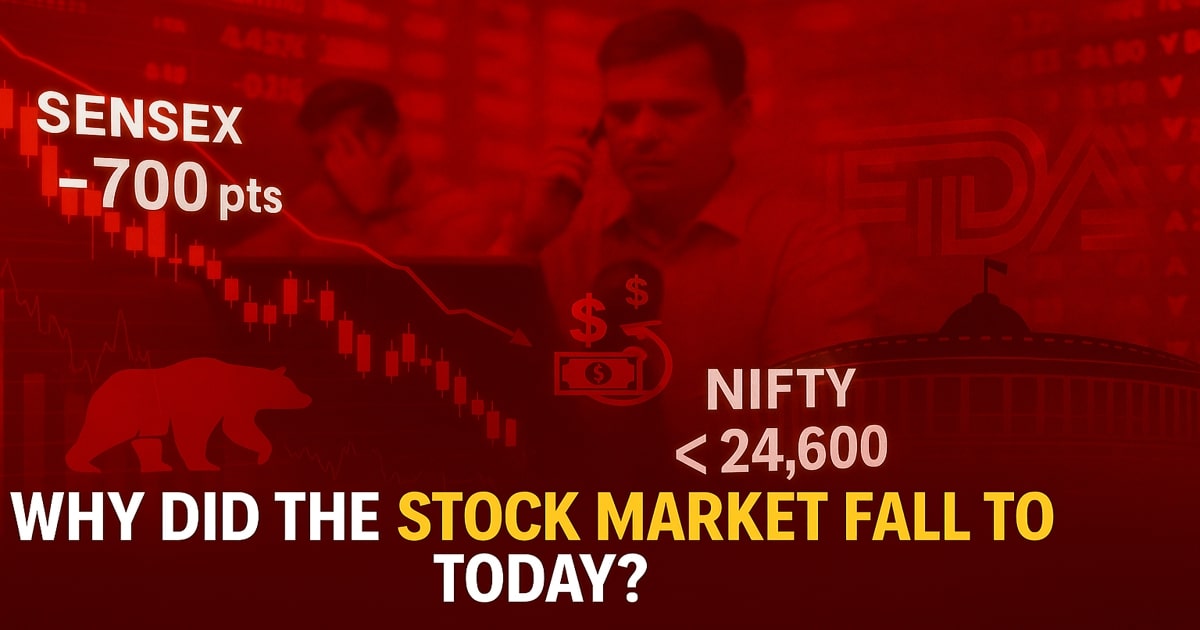
For many investors, opening a brokerage app to see a sea of red can be a jarring experience. The stock market is a complex, living ecosystem influenced by millions of variables, ranging from global geopolitical shifts to the minute-to-minute decisions of high-frequency trading algorithms. When the market takes a significant dip, it is rarely the result of a single isolated event. Instead, it is usually a “perfect storm” of economic data, monetary policy shifts, and psychological triggers.
Understanding why the market fell today requires looking beyond the ticker symbols and into the underlying mechanics of the global financial system. In this analysis, we will explore the primary catalysts for market downturns and how investors can interpret these fluctuations within the broader context of their personal finance goals.

Macroeconomic Indicators and the Shadow of Monetary Policy
The most frequent driver of market volatility is the release of macroeconomic data that deviates from investor expectations. The stock market is essentially a forward-looking machine; it prices in what it believes will happen six to twelve months from now. When new data suggests a different future, the market must “reprice” assets immediately.
Inflation and the Consumer Price Index (CPI)
Inflation remains the primary concern for modern markets. When the Consumer Price Index (CPI) or the Personal Consumption Expenditures (PCE) price index comes in higher than expected, it signals that the cost of living is rising too quickly. This devalues the future purchasing power of corporate earnings. Investors react to high inflation by selling off equities, particularly growth stocks that rely on high future cash flows, because those future dollars become less valuable in today’s terms.
The Federal Reserve’s Stance on Interest Rates
Hand-in-hand with inflation is the response from the Federal Reserve. The “Fed” has a dual mandate: stable prices and maximum employment. To combat inflation, the Fed raises the federal funds rate. Higher interest rates make borrowing more expensive for companies and consumers. This slows down expansion, reduces consumer spending, and increases the “discount rate” used to value stocks. If the market fell today, it may be because a Fed official gave a “hawkish” speech, suggesting that rates will stay “higher for longer” than the market had previously anticipated.
Employment Data and Labor Market Strength
Paradoxically, “good” news for the economy can sometimes be “bad” news for the stock market. A robust jobs report showing high employment and rising wages can lead to fears of a “wage-price spiral,” where companies raise prices to cover higher labor costs, further fueling inflation. If the labor market appears too tight, investors fear the Fed will be forced to keep interest rates high to cool the economy, leading to a market sell-off.
Global Geopolitical Tensions and Supply Chain Disruptions
Markets thrive on stability and predictability. Geopolitical instability introduces variables that are difficult to quantify, leading to an increase in the “risk premium” investors demand to hold stocks.
Regional Conflicts and Energy Prices
The global economy is deeply interconnected, particularly concerning energy and commodities. Conflict in oil-producing regions or critical shipping lanes (such as the Red Sea or the Strait of Hormuz) can lead to an immediate spike in crude oil prices. Since energy is an input cost for almost every business—from manufacturing to delivery services—surging oil prices act as a hidden tax on corporate profits. Today’s market drop could be a direct reaction to rising energy costs that threaten to squeeze profit margins across the board.
International Trade Relations and Tariffs
Trade wars or the imposition of new tariffs can disrupt established supply chains overnight. When two major economies engage in trade disputes, it creates uncertainty regarding the cost of raw materials and the accessibility of foreign markets. Companies that rely on global manufacturing may see their stock prices plummet as analysts adjust their earnings models to account for higher production costs and lower international demand.
Corporate Earnings and Sector-Specific Performance

While macroeconomic trends set the stage, individual corporate performance provides the script. Earnings season—the period when publicly traded companies report their quarterly financial results—is a high-stakes time for the market.
The Impact of “Big Tech” and Growth Stocks
In the modern market, a handful of massive technology companies (often referred to as the “Magnificent Seven” or “Big Tech”) carry a disproportionate weight in major indices like the S&P 500 and the Nasdaq 100. If one or two of these giants report disappointing earnings or provide “weak guidance” (a pessimistic outlook for the future), they can pull the entire market down with them. Even if a company beats revenue expectations, if their future outlook suggests a slowdown in AI spending or cloud growth, investors may head for the exits.
Guidance and the “Priced to Perfection” Dilemma
Sometimes, the market falls even when companies report record profits. This often happens because the stock was “priced to perfection.” If a company’s stock price has run up 50% in anticipation of a great quarter, and the company only delivers a “good” quarter, the stock may fall as investors “sell the news.” The gap between high expectations and reality is a frequent cause of localized and broader market pullbacks.
Investor Sentiment and the Psychology of the Market
The stock market is not just a collection of numbers; it is a collection of human beings (and the algorithms they program) reacting to fear and greed. Behavioral finance plays a massive role in why the market might fall on any given day.
The Fear and Greed Index
Investor sentiment can swing wildly based on news cycles. When the “Fear and Greed Index” moves toward “Extreme Fear,” a feedback loop can occur. Seeing a 1% drop in the morning can lead to panic selling in the afternoon, as investors look to “protect their gains” or “cut their losses.” This emotional reaction often ignores the fundamental value of the companies being sold.
Algorithmic Trading and Technical Sell-Offs
A significant portion of daily trading volume is driven by automated algorithms. These programs are often set to sell automatically if a stock or an index falls below a certain “technical level,” such as the 50-day or 200-day moving average. When these levels are breached, it can trigger a cascade of automated sell orders, accelerating a decline that might have started for a minor reason. This can turn a small dip into a significant intraday rout.
Strategies for Navigating a Downward Market
For the individual investor, a falling market should be viewed through the lens of strategy rather than catastrophe. While seeing your portfolio value decrease is never pleasant, it is a natural part of the economic cycle.
Diversification as a Shield
One of the most effective ways to mitigate the impact of a market fall is through a well-diversified portfolio. Not all sectors react the same way to economic news. For instance, while high-growth tech stocks might tumble during a period of rising interest rates, defensive sectors like healthcare, utilities, or consumer staples may hold their value or even gain as investors rotate into “safer” assets. Diversification ensures that you are not overly exposed to the failure of a single sector or company.
The Importance of a Long-Term Perspective
The history of the stock market is a story of resilience. Despite world wars, pandemics, and financial crises, the long-term trend of the market has historically been upward. For those investing for retirement or long-term wealth building, “time in the market” is almost always more important than “timing the market.”
Dollar-Cost Averaging: Turning Volatility into Opportunity
A falling market can actually be an advantage for disciplined investors using a dollar-cost averaging (DCA) strategy. By investing a fixed amount of money at regular intervals, you naturally buy more shares when prices are low and fewer shares when prices are high. In this context, a market dip is essentially a “sale” on high-quality assets, allowing you to lower your average cost basis over time.
In conclusion, when the stock market falls today, it is usually a response to a complex tapestry of high-interest rates, inflationary fears, geopolitical tension, or shifting corporate expectations. While these movements create short-term noise and anxiety, the successful investor remains focused on fundamental value and long-term goals, recognizing that volatility is the price of admission for long-term financial growth.
aViewFromTheCave is a participant in the Amazon Services LLC Associates Program, an affiliate advertising program designed to provide a means for sites to earn advertising fees by advertising and linking to Amazon.com. Amazon, the Amazon logo, AmazonSupply, and the AmazonSupply logo are trademarks of Amazon.com, Inc. or its affiliates. As an Amazon Associate we earn affiliate commissions from qualifying purchases.