
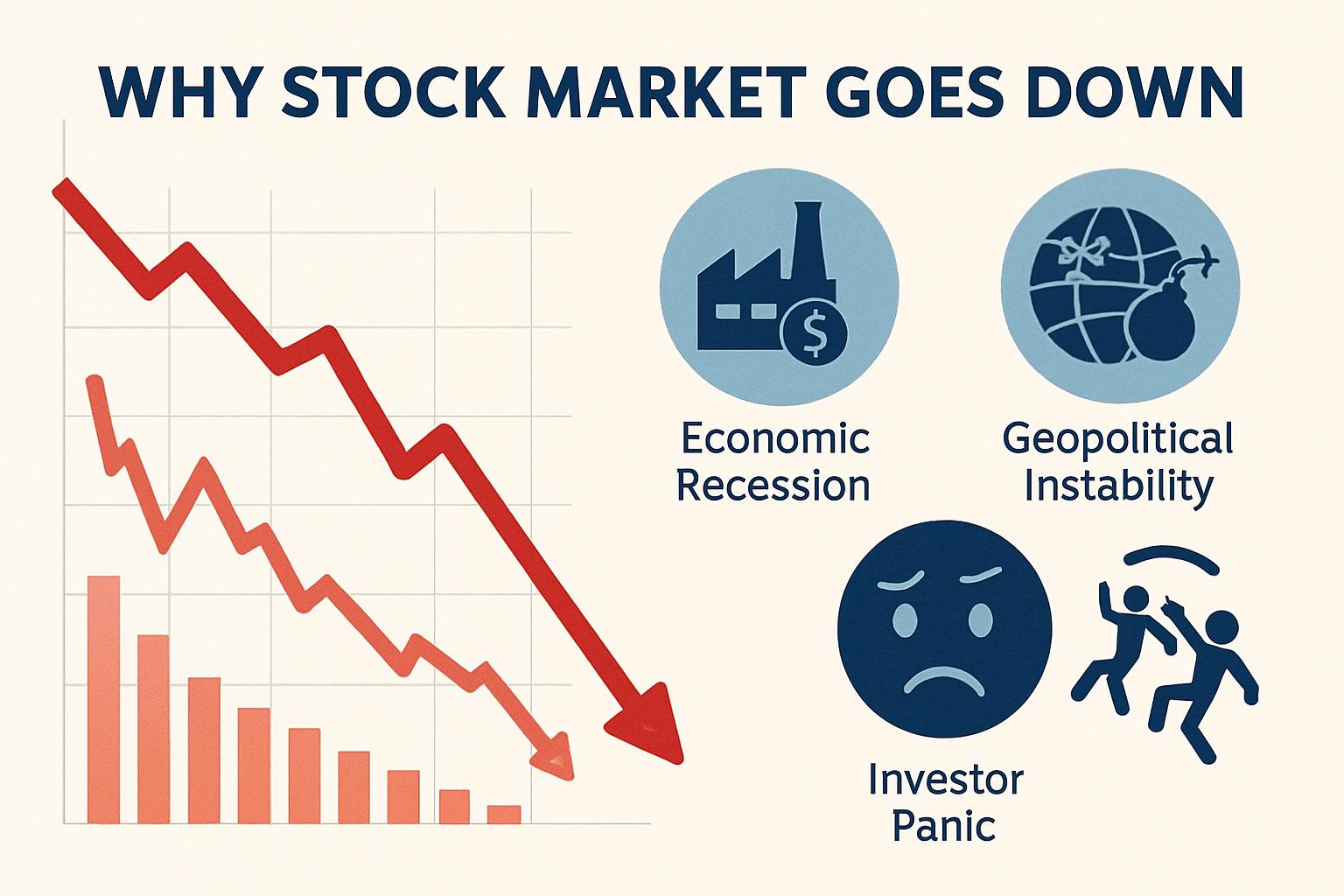
For many investors, opening a brokerage app or watching the financial news during a market downturn can be a sobering experience. The sight of red numbers and downward-sloping charts often triggers a visceral “fight or flight” response. However, market fluctuations are rarely the result of a single isolated event. Instead, they are usually the product of a complex interplay between macroeconomic policy, corporate performance, global politics, and human psychology.
Understanding why the markets are down is the first step in moving from emotional reacting to strategic investing. When we strip away the sensationalist headlines, we find a set of logical, albeit challenging, drivers that dictate the flow of capital across the globe. This article explores the primary catalysts behind market corrections and provides a framework for understanding the current financial landscape.
The Role of Central Banks and Monetary Policy
In the world of finance, liquidity is king. For much of the last decade, global markets were buoyed by “easy money”—a period of historically low interest rates and aggressive government spending. When this environment changes, the markets inevitably react.
Inflation and the Cost of Living
Inflation is perhaps the most significant “hidden tax” on an economy. When the prices of goods and services rise faster than wages, consumer purchasing power diminishes. For corporations, inflation means higher input costs—from raw materials to labor. When companies cannot pass these costs onto consumers, their profit margins shrink. Markets tend to sell off when inflation data exceeds expectations because it signals that the economy is overheating and that the “real” value of future corporate earnings is worth less today.
Interest Rate Hikes: The Impact on Borrowing and Growth
To combat inflation, central banks—such as the Federal Reserve in the United States—utilize their most potent tool: interest rates. Raising rates makes borrowing more expensive for both consumers (mortgages, car loans, credit cards) and businesses (capital expenditures, expansion loans).
As interest rates rise, the “discount rate” used by analysts to value future cash flows also increases. This particularly hurts high-growth sectors, like technology, where much of the company’s value is expected to be generated years into the future. Furthermore, higher rates make “risk-free” assets, like government bonds, more attractive. If an investor can get a guaranteed 4% or 5% return on a Treasury bond, they are less likely to risk their capital in the volatile stock market, leading to a migration of funds out of equities.
Geopolitical Instability and Global Supply Chains
The modern global economy is a tightly woven web of interdependencies. When a thread is pulled in one part of the globe, the entire tapestry can begin to unravel. Geopolitical events are often “black swan” occurrences—unpredictable events that have a massive impact on market stability.
Energy Security and Commodity Volatility
Energy is the lifeblood of industrial civilization. When geopolitical tensions rise in oil-producing regions or along critical trade routes, energy prices often spike. This creates a “supply-side shock.” Unlike demand-driven inflation, which can be cooled by raising interest rates, supply-side inflation is harder to manage. High oil and gas prices act as a drag on the entire economy, increasing transportation costs for every physical product and reducing the disposable income of the average household. Markets react negatively to this uncertainty, fearing a “stagflationary” environment where growth stalls but prices continue to rise.
Trade Relations and International Logistics
We live in an era of “just-in-time” manufacturing. This efficiency is a double-edged sword. Disruptions in international trade—whether due to diplomatic sanctions, regional conflicts, or pandemic-related lockdowns—create bottlenecks. When a manufacturer in North America cannot receive a specific microchip from Asia, production halts. These disruptions lead to lower inventory, missed earnings targets, and general economic slowing. Investors loathe uncertainty, and nothing creates uncertainty quite like a fractured global supply chain.
Corporate Performance and Growth Deceleration
Ultimately, the stock market is a collection of businesses. If the underlying businesses are struggling to grow or maintain profitability, the indices will reflect that reality.
Tech Sector Correction and Valuation Normalization
For years, the “Big Tech” firms drove the majority of market gains. However, when these companies reach a certain scale, maintaining double-digit growth becomes increasingly difficult. We often see markets go down when there is a “reversion to the mean.” This happens when stocks that were trading at massive multiples of their earnings (high P/E ratios) are reassessed by the market. If a company’s growth slows from 30% to 15%, investors may decide the stock is no longer worth its premium price, leading to a sharp sell-off that can drag down the entire index.
Shifting Consumer Behavior and Retail Struggles
Consumer spending accounts for a massive portion of GDP in developed economies. When the markets are down, it is often because data suggests the consumer is “tapped out.” High levels of household debt, combined with the rising cost of essentials, force families to cut back on discretionary spending. When major retailers report sluggish sales or mounting inventories, it serves as a canary in the coal mine for the broader economy. If the consumer isn’t buying, the economy isn’t growing, and the markets respond accordingly.
Market Psychology: Fear, Sentiment, and Speculation
While fundamentals like earnings and interest rates are vital, the market is also a reflection of human emotion. Greed drives bubbles, and fear drives crashes.
The VIX and the “Fear Factor”
The CBOE Volatility Index, or VIX, is often referred to as the “fear gauge.” It measures the market’s expectation of 30-day volatility. When the VIX spikes, it indicates that investors are buying “put options” to protect their portfolios, signaling widespread anxiety. This creates a feedback loop: as the market drops, fear increases; as fear increases, more people sell; and as more people sell, the market drops further. In these moments, the selling often becomes “indiscriminate,” meaning even high-quality companies see their stock prices fall simply because of the prevailing negative sentiment.
Algorithmic Trading and Cascading Sell-offs
In the modern era, a significant portion of market volume is driven by high-frequency trading algorithms. These programs are often set to sell automatically when certain “support levels” are broken. When the market hits a specific technical threshold, thousands of computers may trigger sell orders simultaneously. This can turn a modest decline into a rapid “flash crash.” While these technical dips are often temporary, they contribute to the feeling of chaos and instability that characterizes a down market.
Navigating the Downturn: Strategies for the Disciplined Investor
Knowing why the markets are down is only half the battle; the other half is knowing how to respond. For the individual investor, a market downturn is often a test of character and strategy.
The Power of Diversification and Asset Allocation
The oldest rule in finance remains the most important: don’t put all your eggs in one basket. A market downturn rarely hits every sector with equal force. While “growth” stocks might be plummeting, “defensive” sectors like healthcare, utilities, or consumer staples often hold their value better. Furthermore, holding assets outside of the stock market—such as real estate, commodities, or high-yield cash equivalents—can provide a buffer. Diversification doesn’t prevent losses, but it does manage risk, ensuring that a crash in one niche doesn’t wipe out your entire net worth.
Dollar-Cost Averaging in a Bear Market
One of the most effective ways to handle a down market is to change your perspective on falling prices. For a long-term investor, a market dip is essentially a “sale.” By practicing dollar-cost averaging—investing a fixed amount of money at regular intervals regardless of the price—you naturally buy more shares when prices are low and fewer shares when prices are high. This removes the need to “time the market,” a feat that even professional fund managers rarely achieve consistently. Over time, this disciplined approach lowers your average cost basis and positions you for significant gains when the market eventually enters its next cyclical upturn.
Conclusion
Markets go down because they are dynamic systems adjusting to new information. Whether the cause is a shift in Federal Reserve policy, a geopolitical crisis, or a natural correction after a period of over-speculation, these downturns are a fundamental part of the economic cycle.
While the “red” on the screen can be intimidating, it is important to remember that markets have historically been resilient. They are designed to price in risk and eventually find a new floor from which to grow. By understanding the macroeconomic, corporate, and psychological factors at play, you can strip away the emotion of the moment and focus on the long-term fundamentals of your financial journey. In the world of money, patience and perspective are often more valuable than the most sophisticated trading algorithm.
aViewFromTheCave is a participant in the Amazon Services LLC Associates Program, an affiliate advertising program designed to provide a means for sites to earn advertising fees by advertising and linking to Amazon.com. Amazon, the Amazon logo, AmazonSupply, and the AmazonSupply logo are trademarks of Amazon.com, Inc. or its affiliates. As an Amazon Associate we earn affiliate commissions from qualifying purchases.