
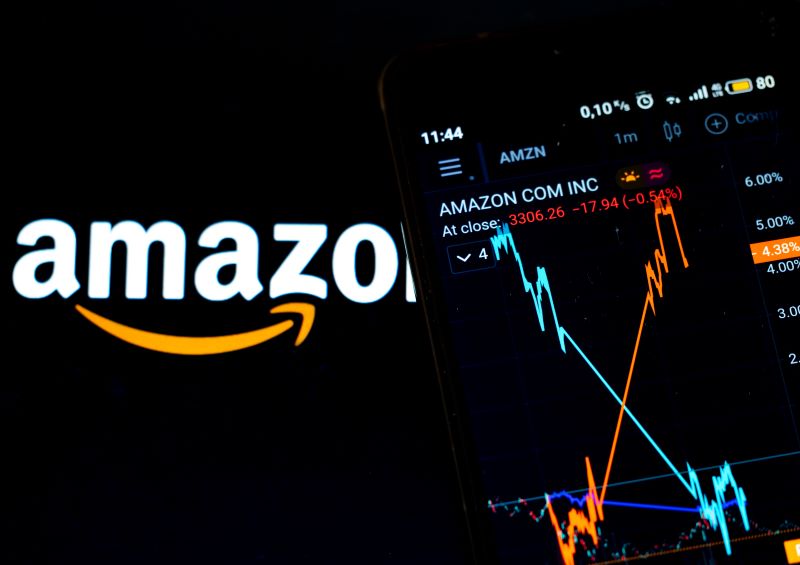
Amazon (AMZN) has long been a cornerstone of the modern investment portfolio, representing the pinnacle of e-commerce dominance and cloud computing innovation. However, even a titan of industry is not immune to the gravitational pulls of the stock market. When Amazon’s stock price dips, it sends ripples through the financial world, prompting institutional and retail investors alike to question the underlying causes. Understanding why Amazon stock is down requires a multifaceted analysis of macroeconomic pressures, internal fiscal shifts, and the evolving competitive landscape of the digital economy.

In this analysis, we will explore the specific financial drivers and market sentiments that have recently pressured Amazon’s valuation, moving beyond surface-level headlines to examine the core “Money” metrics that dictate its Wall Street performance.
1. Macroeconomic Headwinds and the Cost of Capital
The most significant factor influencing Amazon’s stock performance often has little to do with the company’s internal operations and everything to do with the broader economic environment. As a “growth stock,” Amazon’s valuation is heavily dependent on the present value of its future cash flows.
Interest Rates and the Discounted Cash Flow Model
When the Federal Reserve or other central banks raise interest rates to combat inflation, growth stocks typically suffer. Higher interest rates increase the “discount rate” used by analysts to value future earnings. Because much of Amazon’s perceived value lies in what it will earn five or ten years from now, higher rates make those future dollars less valuable today. This mathematical reality often triggers institutional sell-offs, regardless of Amazon’s current quarterly revenue.
Inflationary Pressures on Consumer Discretionary Spending
Amazon’s retail division is a barometer for consumer health. As inflation erodes the purchasing power of the average household, “discretionary spending”—money spent on non-essential items—tends to contract. While Amazon sells essentials, a significant portion of its gross merchandise volume (GMV) comes from electronics, home goods, and apparel. When the cost of living rises, consumers tighten their belts, leading to slower growth in Amazon’s North American and International retail segments.
2. The Deceleration of Amazon Web Services (AWS)
For years, AWS has been the primary engine of profit for the entire company. While the e-commerce side often operates on razor-thin margins, the cloud division provides the high-margin cash flow necessary to fund Amazon’s ambitious projects. Any sign of weakness here is a major “red flag” for investors.
The Shift Toward Cloud Cost Optimization
In a tightening economy, Amazon’s enterprise customers are looking for ways to save money. This has led to a trend known as “cloud optimization,” where businesses restructure their cloud usage to lower their monthly bills. While this is good for customer retention in the long run, it results in a short-term deceleration in revenue growth for AWS. Investors, who have grown accustomed to 30%+ growth rates, react negatively when those numbers dip into the mid-teens.
Intense Competition in the Cloud Space
Amazon no longer enjoys a near-monopoly on the cloud. Microsoft Azure and Google Cloud have become formidable competitors, often leveraging their own ecosystems (like Office 365 or Google Ads) to win over enterprise clients. As the market matures, price wars become more common, potentially squeezing the operating margins that have historically kept Amazon’s stock at a premium valuation.
3. Profitability Concerns and Massive Capital Expenditures
A recurring theme in Amazon’s financial history is its willingness to sacrifice short-term profits for long-term dominance. However, there are periods where the market loses patience with high spending, especially when the return on investment (ROI) is not immediately visible.
The Artificial Intelligence Arms Race
The sudden explosion of Generative AI has forced Amazon to invest billions of dollars into infrastructure. To compete with NVIDIA, Microsoft, and OpenAI, Amazon must purchase expensive H100 GPUs and build specialized data centers. This “CapEx” (Capital Expenditure) surge eats into the company’s free cash flow. While these investments are necessary to stay relevant in the AI era, the stock market often reacts poorly to the sudden increase in spending without a corresponding jump in immediate revenue.
Logistics and Fulfillment Overcapacity
During the pandemic, Amazon doubled its fulfillment network to meet unprecedented demand. As consumer behavior normalized, the company found itself with an excess of warehouse space and a massive workforce that was no longer optimized for current volume. The process of “right-sizing” this network—closing underperforming facilities and optimizing the “last mile” delivery—is expensive and time-consuming. Until the logistics division returns to peak efficiency, it remains a drag on the consolidated operating income.
4. Regulatory Scrutiny and Legal Risks
From a financial perspective, legal battles are more than just PR headaches; they represent significant “tail risk” that can lead to multi-billion dollar fines or even the forced divestiture of business units.
Antitrust Litigation in the US and Europe
The Federal Trade Commission (FTC) and various European regulators have intensified their focus on Amazon’s business practices. Specifically, they are investigating whether Amazon favors its own private-label products over third-party sellers and whether its “Prime” bundling creates an unfair monopoly. The mere uncertainty of these legal proceedings causes institutional investors to “de-risk” by reducing their holdings in the company, putting downward pressure on the stock price.
Third-Party Seller Dynamics
Amazon’s relationship with its third-party sellers is a delicate balance. Third-party services (fees, advertising, and fulfillment) now account for a massive portion of Amazon’s revenue. However, if Amazon increases fees too aggressively to boost its own margins, it risks driving sellers to platforms like Shopify, Walmart, or even TikTok Shop. Investors watch the “Take Rate” (the percentage Amazon keeps from each sale) closely; if it plateaus, it suggests that Amazon has reached its pricing power limit.
5. The Investor Outlook: Navigating Volatility
Despite the reasons for the current downturn, it is essential to view Amazon’s stock through the lens of valuation and long-term potential. Market pullbacks are often a correction of previous over-exuberance rather than a sign of a failing business.
Valuation Metrics: P/E vs. Price-to-Cash-Flow
Amazon has traditionally traded at a very high Price-to-Earnings (P/E) ratio, which often makes it look “expensive” compared to the S&P 500. However, savvy investors often look at “Price-to-Operating-Cash-Flow.” Because Amazon depreciates its massive investments heavily, its earnings are often artificially low. If the stock price drops while cash flow remains steady, the stock may actually be moving into “value” territory, even if the headline P/E remains high.
The Bull Case for a Recovery
Why might the stock bounce back? The answer lies in the stabilization of the economy and the maturation of AI investments. Once the current cycle of high CapEx for AI chips slows down, Amazon will likely see a massive surge in free cash flow as those investments begin to generate revenue. Furthermore, as the company continues to integrate advertising into its Prime Video and e-commerce platforms—a high-margin business—the overall profitability of the “Money” side of Amazon could improve significantly.
Conclusion: A Confluence of Factors
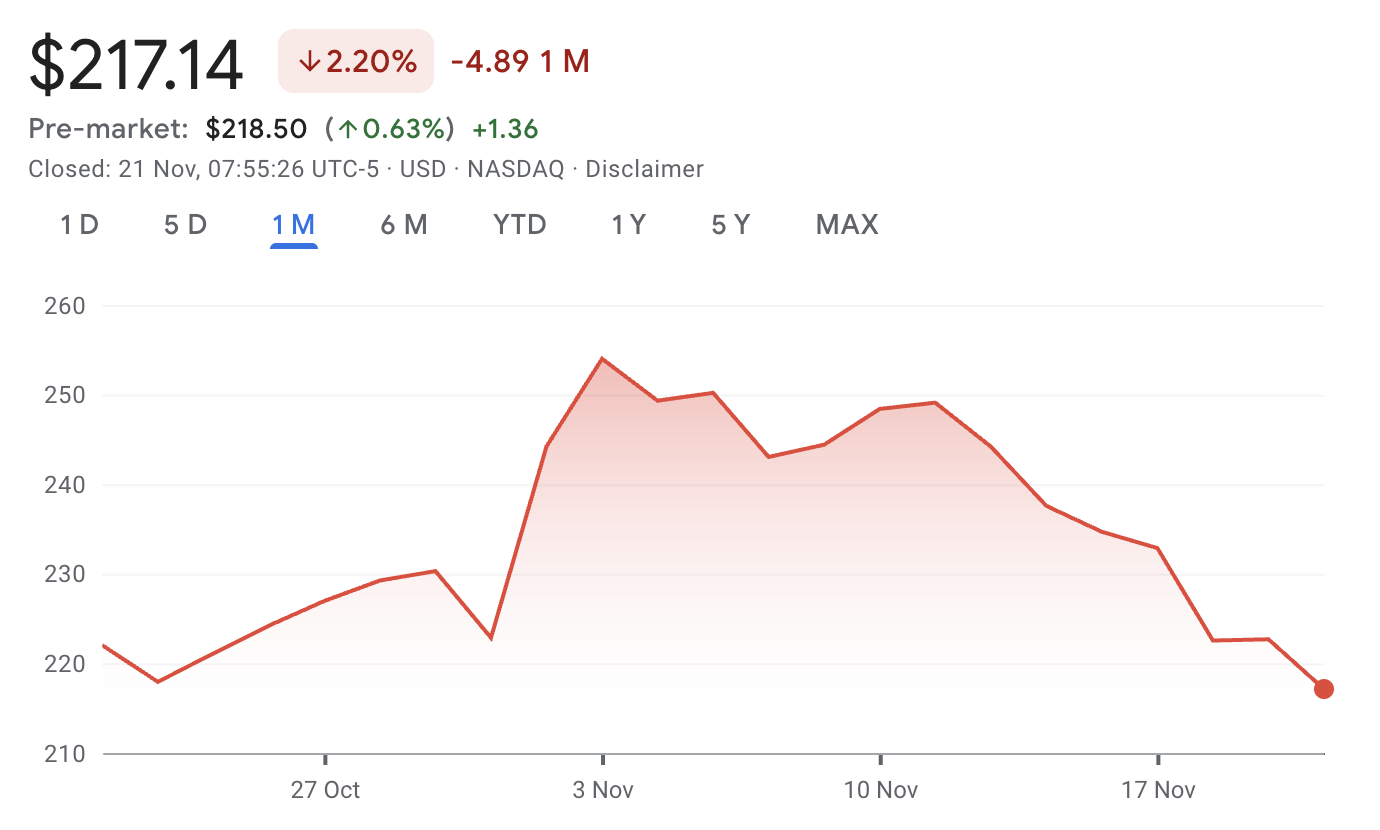
Amazon stock is down not because of a single failure, but because of a “perfect storm” of high interest rates, a necessary slowdown in cloud growth, and a massive pivot toward AI infrastructure spending. For the disciplined investor, these periods of decline are a reminder that even the most successful companies in the world must navigate the cycles of the market. Understanding the “Why” behind the dip is the first step in determining whether this is a temporary setback or a fundamental shift in the company’s investment thesis. As it stands, Amazon remains a cash-flow powerhouse, but the market is currently demanding more efficiency and clearer AI monetization before it grants the stock its next leg up.
aViewFromTheCave is a participant in the Amazon Services LLC Associates Program, an affiliate advertising program designed to provide a means for sites to earn advertising fees by advertising and linking to Amazon.com. Amazon, the Amazon logo, AmazonSupply, and the AmazonSupply logo are trademarks of Amazon.com, Inc. or its affiliates. As an Amazon Associate we earn affiliate commissions from qualifying purchases.