
The question “who was the inventor of the calculator” does not have a single-name answer. Unlike the lightbulb or the telephone, which are often attributed to specific individuals despite their collaborative histories, the calculator is the result of a multi-century technological evolution. It is a story of transition from physical gears and brass cogs to vacuum tubes, transistors, and eventually, the sophisticated silicon chips that power today’s artificial intelligence. To understand who invented the calculator, we must look at the milestones of human ingenuity that transformed mathematics from a manual labor of the mind into a seamless digital process.
The Mechanical Pioneers: Foundations of Computational Logic
Long before the first electron flowed through a circuit, the “calculator” was a masterpiece of mechanical engineering. The quest to automate arithmetic began in earnest during the 17th century, a period defined by the Scientific Revolution.
Blaise Pascal and the Pascaline
In 1642, a 19-year-old French mathematician named Blaise Pascal sought to ease the burden of his father’s grueling work as a tax collector. The result was the Pascaline, often cited as the first functional mechanical calculator. It utilized a series of geared wheels with dials numbered 0 through 9. When a wheel made a full revolution, it would “carry” a one to the next wheel via a complex internal mechanism. While it could only perform addition and subtraction directly, it established the fundamental principle of “carry” logic that would be used in mechanical computing for the next three centuries.
Gottfried Wilhelm Leibniz and the Stepped Reckoner
While Pascal’s machine was revolutionary, it lacked the ability to multiply and divide efficiently. In 1673, the German polymath Gottfried Wilhelm Leibniz—the co-inventor of calculus—advanced the technology significantly. He designed the “Stepped Reckoner,” introducing the Leibniz wheel. This was a cylinder with nine teeth of varying lengths. By shifting the mechanism, the machine could perform multiplication through repeated addition and division through repeated subtraction. Leibniz’s work was foundational not just for hardware, but for the very logic of computing; he was also a staunch advocate for the binary system, which is the bedrock of modern digital technology.
The Industrialization of Mechanics: Thomas de Colmar
For nearly two centuries, calculators were curiosities for the elite or scientific instruments rather than commercial products. This changed in 1820 when Charles Xavier Thomas de Colmar, a Frenchman, patented the Arithmometer. Based on Leibniz’s stepped drum design, the Arithmometer was the first commercially successful mechanical calculator. It was robust enough for daily office use and could perform all four basic arithmetic functions. This marked the shift from “invention” to “gadgetry,” as the device became a staple in banks and insurance companies during the Industrial Revolution.
The Transition to Portability and the First Digital Engines
As the 20th century dawned, the demand for more compact and faster calculation grew. The technology began to shift away from heavy desktop units toward miniaturization, setting the stage for the electronic revolution.
The Curta Calculator: A Miracle of Engineering
One of the most remarkable chapters in the history of mechanical technology is the Curta calculator. Invented by Curt Herzstark while he was a prisoner in the Buchenwald concentration camp during World War II, the Curta was a hand-held mechanical masterpiece. Resembling a pepper grinder, it used a sophisticated system of stepped drums to perform complex calculations with extreme precision. Until the arrival of electronic pocket calculators in the 1970s, the Curta was the ultimate “mobile tech” for engineers and scientists worldwide.
Vacuum Tubes and the Dawn of Electronic Computation
The leap from mechanical to electronic calculation occurred in the 1940s and 50s. Early electronic computers like ENIAC were essentially massive calculators, but they were the size of rooms and used thousands of vacuum tubes. The transition to a dedicated electronic desktop calculator began with the ANITA (A New Inspiration To Arithmetic/Accounting), released in 1961. This British-made machine used vacuum tubes and cold-cathode tubes for its display. While it was silent and faster than its mechanical predecessors, it was still bulky and generated significant heat.

The Integrated Circuit Revolution
The true “eureka” moment for the modern calculator came with the invention of the transistor and, subsequently, the integrated circuit (IC). In the mid-1960s, companies like Sharp, Casio, and Canon began racing to shrink the electronics. The introduction of the MOS (Metal-Oxide-Semiconductor) technology allowed for thousands of transistors to be etched onto a single silicon chip. This technological leap eliminated the need for thousands of individual components, paving the way for the “calculator on a chip” and the eventual death of the mechanical desktop machine.
The Silicon Era: How Calculators Shaped Modern Computing
By the 1970s, the calculator had become the primary driver of consumer electronics. It was the “smartphone” of its era—the device that proved high-level technology could be affordable, portable, and essential for the average person.
Texas Instruments and the Handheld Explosion
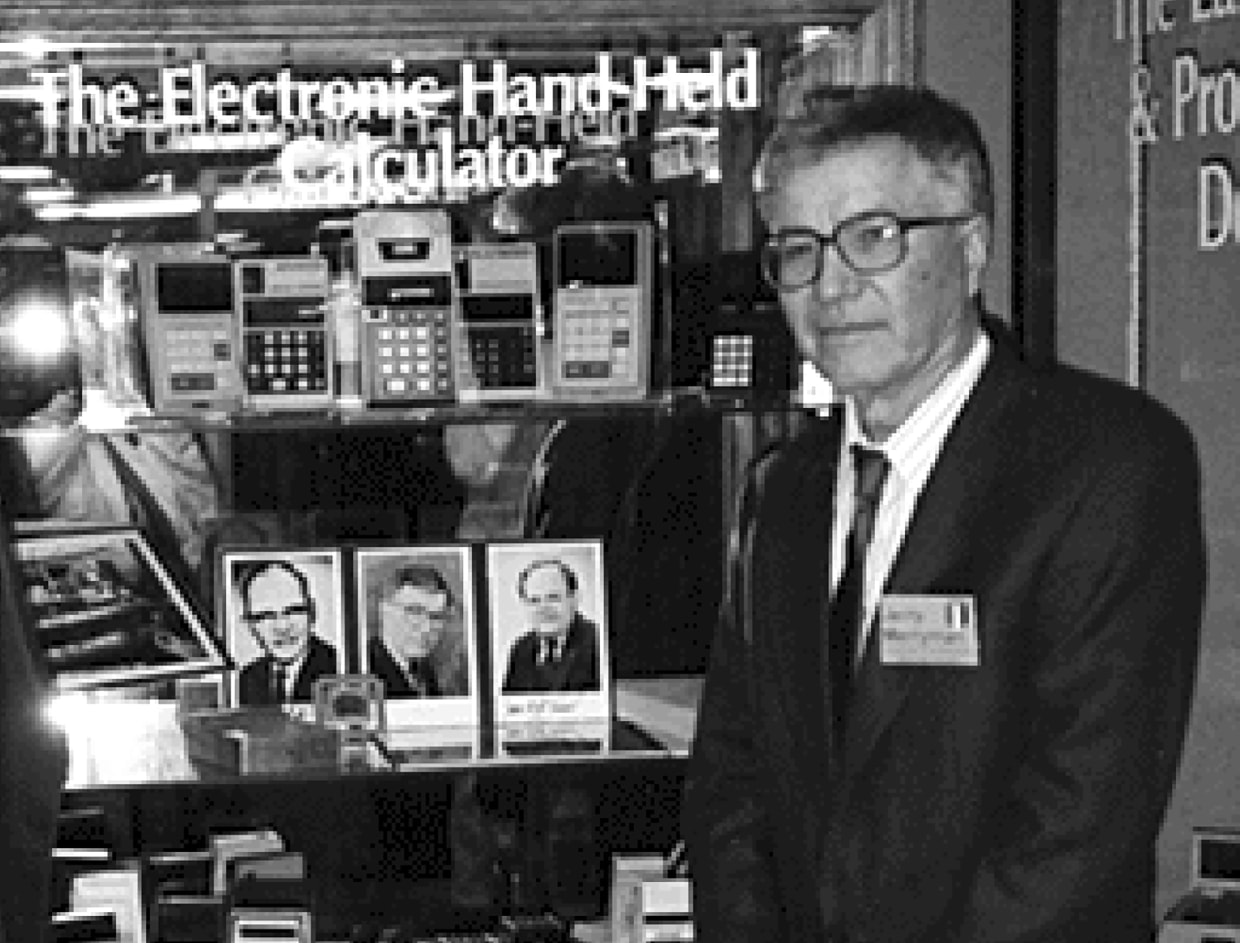
In 1967, a team at Texas Instruments, led by Jack Kilby (who won the Nobel Prize for his role in inventing the integrated circuit), developed the “Cal-Tech.” It was a prototype of a handheld electronic calculator that could perform four functions and print results on a thermal paper tape. By the early 1970s, the TI-2500 Datamath and similar devices from Bowmar and Hewlett-Packard hit the market. These devices were the first to use Light Emitting Diodes (LEDs) for displays, a massive tech trend that would eventually dominate the screens of all electronic devices.
Programmable Calculators and Early Coding Logic
The tech evolved rapidly from basic arithmetic to advanced computation. In 1974, Hewlett-Packard released the HP-65, the first handheld programmable calculator. Users could write programs on magnetic strips and feed them into the device. This was a pivotal moment in tech history; it was essentially a pocket-sized computer. It allowed engineers to run complex simulations and formulas without needing access to a mainframe. The logic used in these devices, such as Reverse Polish Notation (RPN), forced users to think algorithmically, bridging the gap between math and computer science.
The Scientific Calculator as a Gateway to Engineering
Throughout the 1980s and 90s, the scientific and graphing calculator became the most recognizable “gadget” in education. Devices like the Casio fx-7000G (the first graphing calculator) and the TI-83 series transformed how data was visualized. These were no longer just tools for finding an answer; they were platforms for visualizing functions and exploring calculus. The hardware design—LCD screens, tactile rubber membranes, and long-lasting battery life—became the gold standard for rugged, specialized tech.
The Modern Frontier: Software, Apps, and AI-Driven Computation
Today, the dedicated handheld calculator is often seen as a legacy device, yet its DNA is present in every piece of software we use. The “inventor” of the modern calculator is now a software engineer or an AI researcher.
From Dedicated Hardware to Smartphone Integration
With the rise of the smartphone, the physical calculator transitioned into an app. However, this was more than just a change in form factor. The calculator app on a modern iPhone or Android device has more processing power than the computers that sent Apollo 11 to the moon. We have moved from dedicated hardware buttons to multi-touch interfaces, allowing for seamless switching between basic, scientific, and even programming modes.
Cloud-Based Computing and WolframAlpha
The current state of “calculation tech” is defined by the cloud. Tools like WolframAlpha have moved beyond simple arithmetic to “computational intelligence.” By using vast databases and sophisticated algorithms, these tools can solve complex differential equations, perform linguistic analysis, and provide step-by-step breakdowns of mathematical proofs. The hardware is now irrelevant; the power lies in the distributed server networks that process the logic.

The Future: AI and Natural Language Math Solvers
We are now entering the era of AI-driven computation. Generative AI models and Large Language Models (LLMs) are being integrated with symbolic math engines. This allows users to photograph a handwritten equation and receive a detailed explanation of the solution instantly. The “inventor” of the calculator has evolved into the architect of the neural network. As we look forward, the calculator will likely disappear as a standalone interface, becoming an invisible layer of intelligence that interprets and solves problems through natural language and visual cues.
In conclusion, while names like Blaise Pascal, Gottfried Leibniz, and Jack Kilby stand out, the calculator was “invented” by a continuous chain of innovators. Each generation took the logic of the previous one and miniaturized it, sped it up, and made it more accessible. From the brass gears of the 1600s to the AI models of the 2020s, the calculator remains the ultimate testament to the human desire to quantify and conquer the world through technology.
aViewFromTheCave is a participant in the Amazon Services LLC Associates Program, an affiliate advertising program designed to provide a means for sites to earn advertising fees by advertising and linking to Amazon.com. Amazon, the Amazon logo, AmazonSupply, and the AmazonSupply logo are trademarks of Amazon.com, Inc. or its affiliates. As an Amazon Associate we earn affiliate commissions from qualifying purchases.