
The calculator is perhaps the most ubiquitous tool in the modern technological landscape. Long before the smartphone became a permanent fixture in our pockets, and even before the personal computer revolutionized the workplace, the calculator was the vanguard of digital logic. To ask “who was the inventor of the calculator” is to pull on a thread that unravels the entire history of human computation. There is no single “inventor”; instead, there is a lineage of visionaries who transitioned the world from manual arithmetic to mechanical precision, and eventually, to electronic intelligence.
In this exploration, we examine the technological milestones that define the calculator’s journey, focusing on the breakthroughs in hardware and software that paved the way for the sophisticated AI tools we use today.
The Mechanical Pioneers: From the Abacus to the Pascaline
The history of the calculator begins not with silicon chips, but with gears, levers, and brass. While ancient tools like the abacus served as mental aids, the quest for a machine that could perform calculations autonomously began in earnest during the 17th century.
The Ancient Roots of Calculation
Before the advent of mechanical gears, the abacus was the pinnacle of “computing tech.” Used by Greeks, Romans, and various Asian cultures, it relied on the human operator to perform the logic. The breakthrough came when mathematicians sought to offload the cognitive burden of arithmetic onto a physical device.
Blaise Pascal and the Birth of the Mechanical Calculator
In 1642, a 19-year-old French mathematician named Blaise Pascal invented what is widely considered the first functional mechanical calculator: the Pascaline. Driven by a desire to assist his father, a tax collector, Pascal designed a device that used a series of wheels and gears to perform addition and subtraction.
The Pascaline’s innovation lay in its “carry” mechanism. When a wheel moved from 9 to 0, it automatically advanced the adjacent wheel. Though it was expensive and difficult to produce, it proved that logic could be codified into physical hardware.
Gottfried Wilhelm Leibniz and the Stepped Reckoner
Three decades after Pascal, the German polymath Gottfried Wilhelm Leibniz expanded the horizon of mechanical computing. In 1673, he debuted the “Stepped Reckoner.” Unlike the Pascaline, which was limited to addition and subtraction, Leibniz’s machine could multiply and divide.
Leibniz’s most profound contribution to technology, however, was his advocacy for the binary system—the 1s and 0s that form the foundation of all modern computer architecture. His mechanical designs sought to implement this logic, though the manufacturing precision of the 17th century struggled to keep up with his theoretical genius.
The Industrial Revolution and the Shift to Mass Production
As the 19th century dawned, the need for accurate calculation shifted from the laboratories of philosophers to the counting houses of the Industrial Revolution. Engineering, navigation, and global trade required a level of precision that manual calculation could no longer guarantee.
Thomas de Colmar’s Arithmometer
In 1820, Charles Xavier Thomas de Colmar, a Frenchman, patented the Arithmometer. While Pascal and Leibniz created prototypes, Thomas de Colmar created an industry. The Arithmometer was the first commercially successful mechanical calculator. It was robust enough for daily use in offices and remained the gold standard for nearly a century. This era marked the transition from “invention” to “product,” a critical step in the tech lifecycle that mirrors today’s transition of AI from research labs to consumer apps.
The Impact of Mechanical Calculators on 19th-Century Engineering
The availability of reliable calculators allowed for a surge in complex engineering projects. From bridge building to the calculation of astronomical tables, these mechanical devices reduced human error. However, they were still massive, heavy, and purely mechanical. The next leap required a change in the very medium of computation: from kinetic energy to electricity.
The Electronic Revolution: Scaling Down the Mainframe

The mid-20th century witnessed a radical shift. The invention of the vacuum tube and, subsequently, the transistor, allowed engineers to replace physical gears with electronic pulses.
The Transition from Vacuum Tubes to Transistors
The first electronic calculators were anything but portable. Machines like the ENIAC (Electronic Numerical Integrator and Computer) could perform calculations at lightning speed but filled entire rooms. In the early 1960s, machines like the ANITA (A New Inspiration To Arithmetic) introduced electronic calculation to the desktop. These devices used cold-cathode tubes and were silent compared to their clattering mechanical ancestors, yet they were still bulky and expensive.
The Race for the First Handheld Calculator
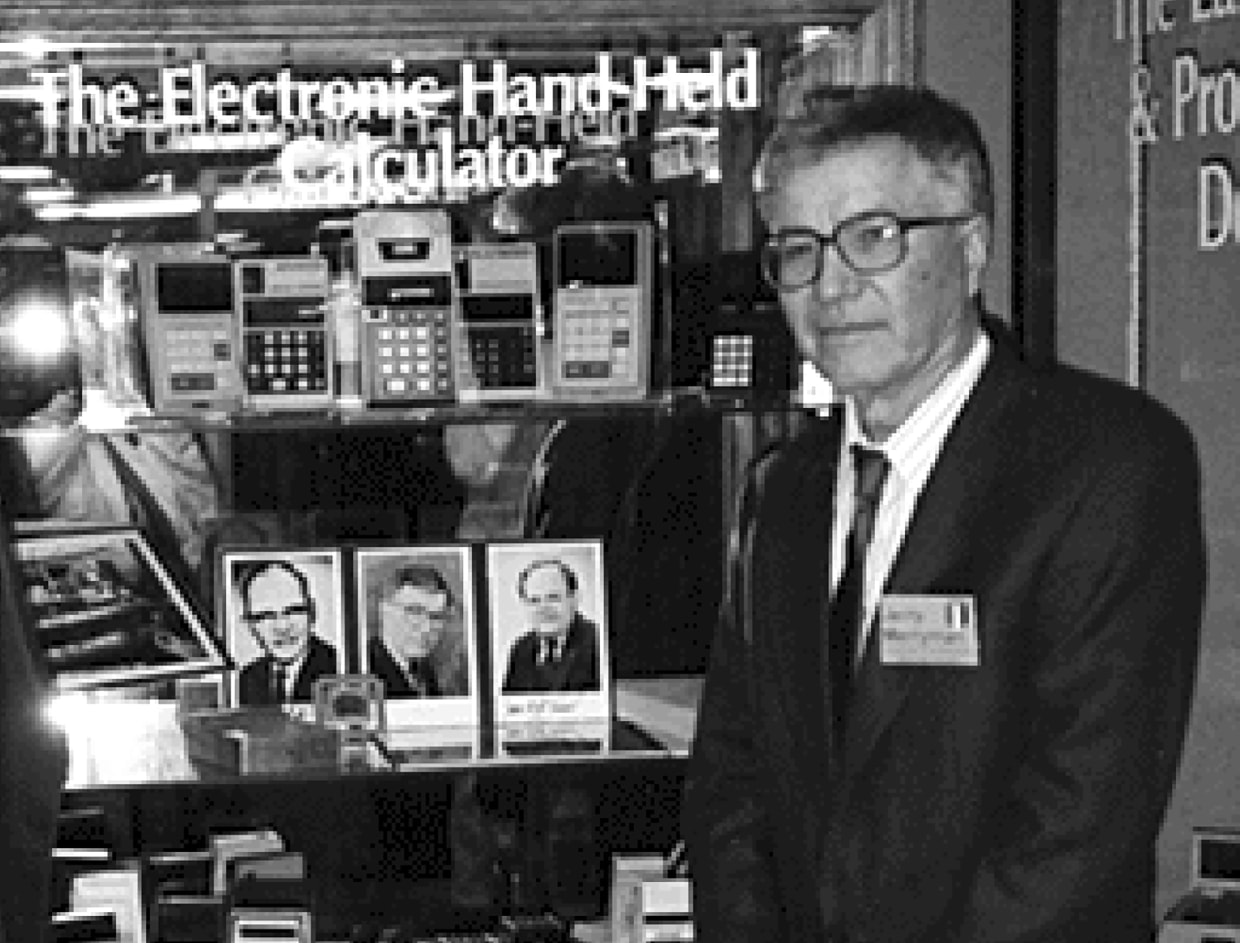
The true “tech” revolution occurred in the late 1960s. Jack Kilby, an engineer at Texas Instruments (and co-inventor of the integrated circuit), led a team to develop the “Cal-Tech” prototype in 1967. This was the world’s first handheld calculator.
By the early 1970s, the market exploded. Companies like Sharp and Canon competed to reduce power consumption and size. The introduction of the Liquid Crystal Display (LCD) and the move toward Single-Chip CMOS (Complementary Metal-Oxide-Semiconductor) technology allowed calculators to become smaller, cheaper, and battery-powered. This period established the “gadget” culture we recognize today, where miniaturization is the ultimate benchmark of technological progress.
The Digital Era: Software, Scientific Computing, and the Smartphone
As the 1980s and 90s progressed, the physical calculator began to branch into specialized niches. It was no longer just about basic arithmetic; it was about data visualization and complex programming.
The Rise of Programmable and Graphing Calculators
The introduction of the Hewlett-Packard HP-65 in 1974 marked the first programmable handheld calculator. Later, in the mid-80s, Casio and Texas Instruments (with the legendary TI-80 series) introduced graphing capabilities. These were essentially mini-computers, capable of plotting functions and running basic software scripts. For a generation of engineers and students, the graphing calculator was the first programmable device they ever owned, serving as a gateway to computer science.
The Integration of Calculation into Modern Operating Systems
With the rise of the Personal Computer (PC), the standalone calculator faced its first existential threat. Software-based calculators became a standard utility in Windows and macOS. However, the most significant disruption occurred in 2007 with the launch of the iPhone. By integrating a high-performance calculator app into a device with an always-on internet connection, the smartphone rendered the basic electronic calculator obsolete for the average consumer.
The Future of Calculation: AI, Cloud Computing, and Beyond
Today, the question of “who invented the calculator” has evolved into “how is calculation being redefined?” We have moved past the era of pressing buttons to get a sum; we are now in the era of computational intelligence.
Beyond Simple Arithmetic: The Role of AI Engines
Modern calculation tools like WolframAlpha or AI-driven platforms (such as ChatGPT’s Advanced Data Analysis) do not just compute numbers; they understand context. If you ask a modern “calculator” to determine the trajectory of a rocket or the future value of a volatile stock, it uses symbolic computation and vast datasets to provide an answer. This is the culmination of Leibniz’s dream: a machine that doesn’t just calculate, but “reasons.”
The Calculator as a Gateway to Quantum Computing
As we look toward the future, the next frontier of calculation is quantum computing. Traditional calculators operate on bits (0s and 1s), but quantum calculators use qubits, which can exist in multiple states simultaneously. This technology promises to solve calculations that would take a modern supercomputer thousands of years. Just as Pascal’s gears gave way to Kilby’s circuits, today’s silicon-based logic will eventually give way to quantum algorithms.

Conclusion
The inventor of the calculator is not one person, but a collective of innovators spanning four centuries. From Blaise Pascal’s brass gears to Jack Kilby’s integrated circuits, each leap in technology was driven by a fundamental human need: to make the complex simple.
In the tech world, the calculator remains the ultimate success story. It is a tool that has successfully navigated the transition from mechanical hardware to electronic gadgets, and finally to invisible software. As we move deeper into the age of Artificial Intelligence, the spirit of the calculator—precision, speed, and logical clarity—continues to be the heartbeat of every device we use. The calculator was the world’s first “smart” technology, and its evolution is far from over.
aViewFromTheCave is a participant in the Amazon Services LLC Associates Program, an affiliate advertising program designed to provide a means for sites to earn advertising fees by advertising and linking to Amazon.com. Amazon, the Amazon logo, AmazonSupply, and the AmazonSupply logo are trademarks of Amazon.com, Inc. or its affiliates. As an Amazon Associate we earn affiliate commissions from qualifying purchases.