
Tesla, Inc. (TSLA) is more than just a pioneer in the electric vehicle industry; it is a cornerstone of the modern financial markets. As one of the most valuable companies in the world, its stock performance dictates the movement of major indices and the portfolios of millions of investors. For anyone looking to understand the mechanics of the market, the question of ownership is paramount. Who holds the power? Who dictates the direction of the company through voting rights? And whose buying or selling patterns cause the massive swings in valuation that Tesla is known for?
Understanding the ownership structure of Tesla requires a multi-layered analysis of individual insiders, massive institutional asset managers, and a uniquely dedicated base of retail investors. Each of these groups plays a distinct role in the liquidity, volatility, and long-term strategic vision of the company.
The Architect of Equity: Elon Musk’s Dominant Stake
No discussion regarding Tesla’s ownership is possible without starting at the top. Elon Musk, the CEO and “Technoking” of Tesla, remains the company’s largest individual shareholder. His ownership stake is not merely a financial asset; it is the primary engine of his personal net worth and the source of his control over the company’s disruptive trajectory.
The Evolution of Musk’s Holdings
At the time of Tesla’s initial public offering (IPO) in 2010, Musk held a significant but far smaller portion of the company compared to the current era. Over the years, his stake grew primarily through performance-based stock option awards rather than traditional salary. The most notable of these was the 2018 CEO Performance Award, a high-stakes compensation package that granted him options to buy millions of shares if the company hit specific market capitalization and operational milestones.
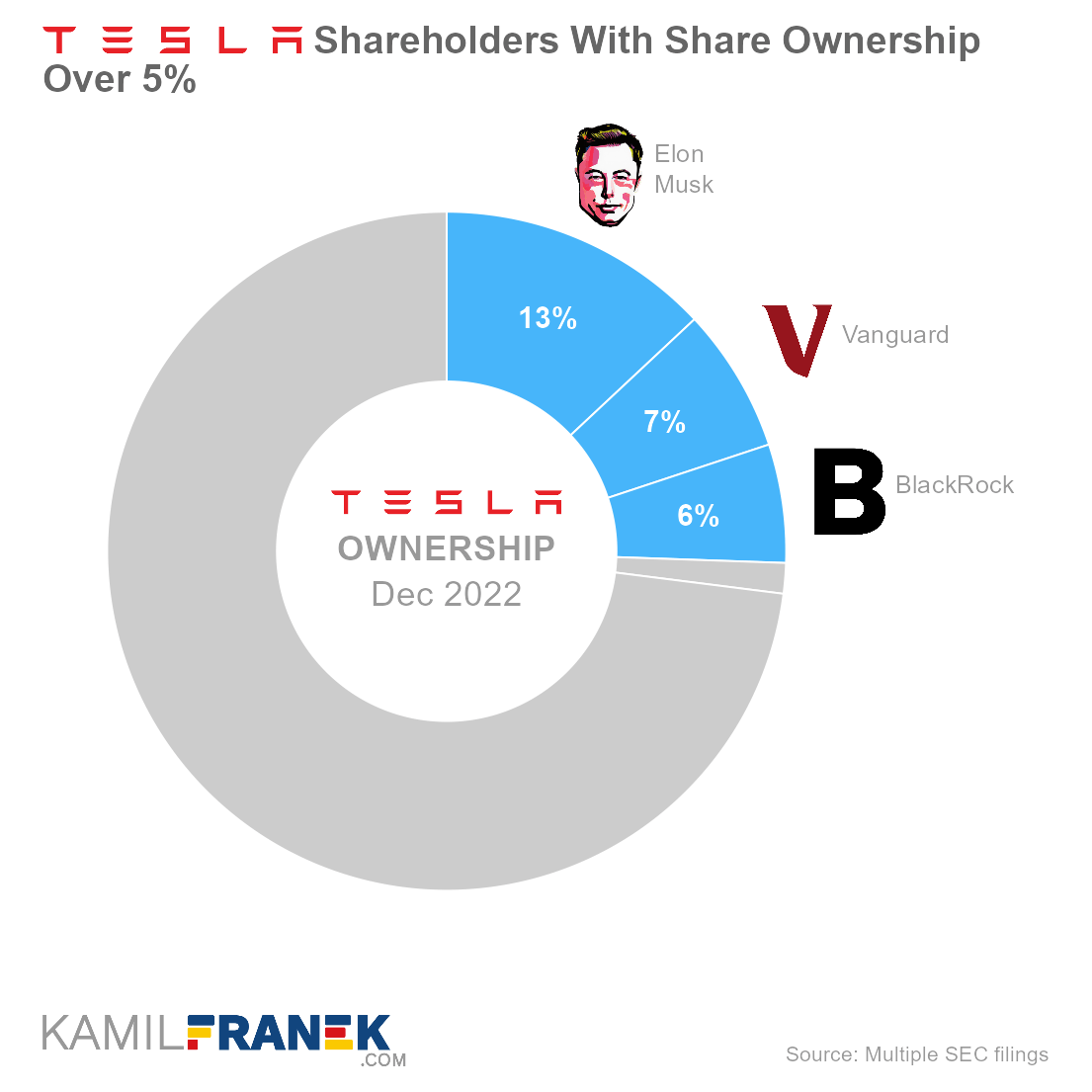
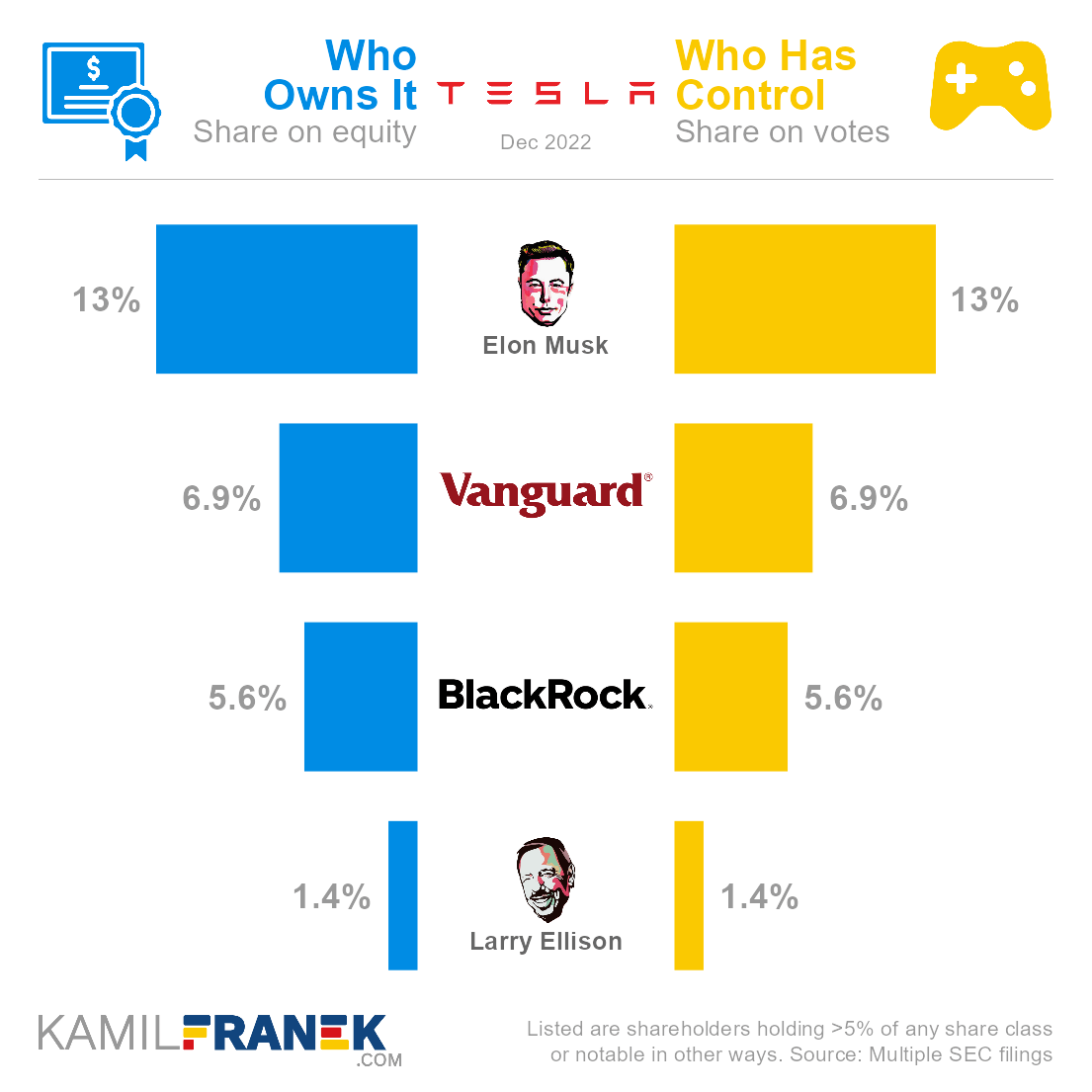
As of recent SEC filings, Musk owns approximately 13% of Tesla’s outstanding common stock. However, this figure is often subject to change due to his use of stock as collateral for loans and his high-profile liquidations. In 2022 and 2023, Musk sold tens of billions of dollars worth of Tesla stock to fund his acquisition of the social media platform X (formerly Twitter). Despite these sales, he remains the undisputed lead shareholder, holding significantly more equity than any other individual or entity.
The Power of Exercisable Options
It is important to distinguish between “shares owned” and “shares controlled.” Musk often holds millions of exercisable options. If these are included in the calculation, his theoretical ownership percentage can climb toward 20%. This level of concentration is rare for a company with a market cap in the hundreds of billions, giving Musk a level of influence that few CEOs in the S&P 500 enjoy. For investors, this means that Tesla’s stock price is inextricably linked to Musk’s personal brand, his public statements, and his outside business ventures.
Institutional Heavyweights: The Power of Index Funds and Asset Managers
While Elon Musk is the face of Tesla, the backbone of its ownership structure is comprised of institutional investors. These are the massive financial entities—banks, pension funds, and mutual fund companies—that manage trillions of dollars on behalf of their clients. Because Tesla is a major component of the S&P 500 and the Nasdaq-100, almost every major institutional investor has a “must-buy” relationship with the stock.
The Big Three: Vanguard, BlackRock, and State Street
The largest institutional owners of Tesla are the “Big Three” of the indexing world.
-
The Vanguard Group: Often holding between 6% and 8% of Tesla, Vanguard is typically the second-largest shareholder after Musk. As a leader in passive investing, Vanguard’s ownership is driven by the sheer volume of capital flowing into its S&P 500 index funds. When an investor buys a Vanguard total market fund, they are indirectly buying Tesla.
-
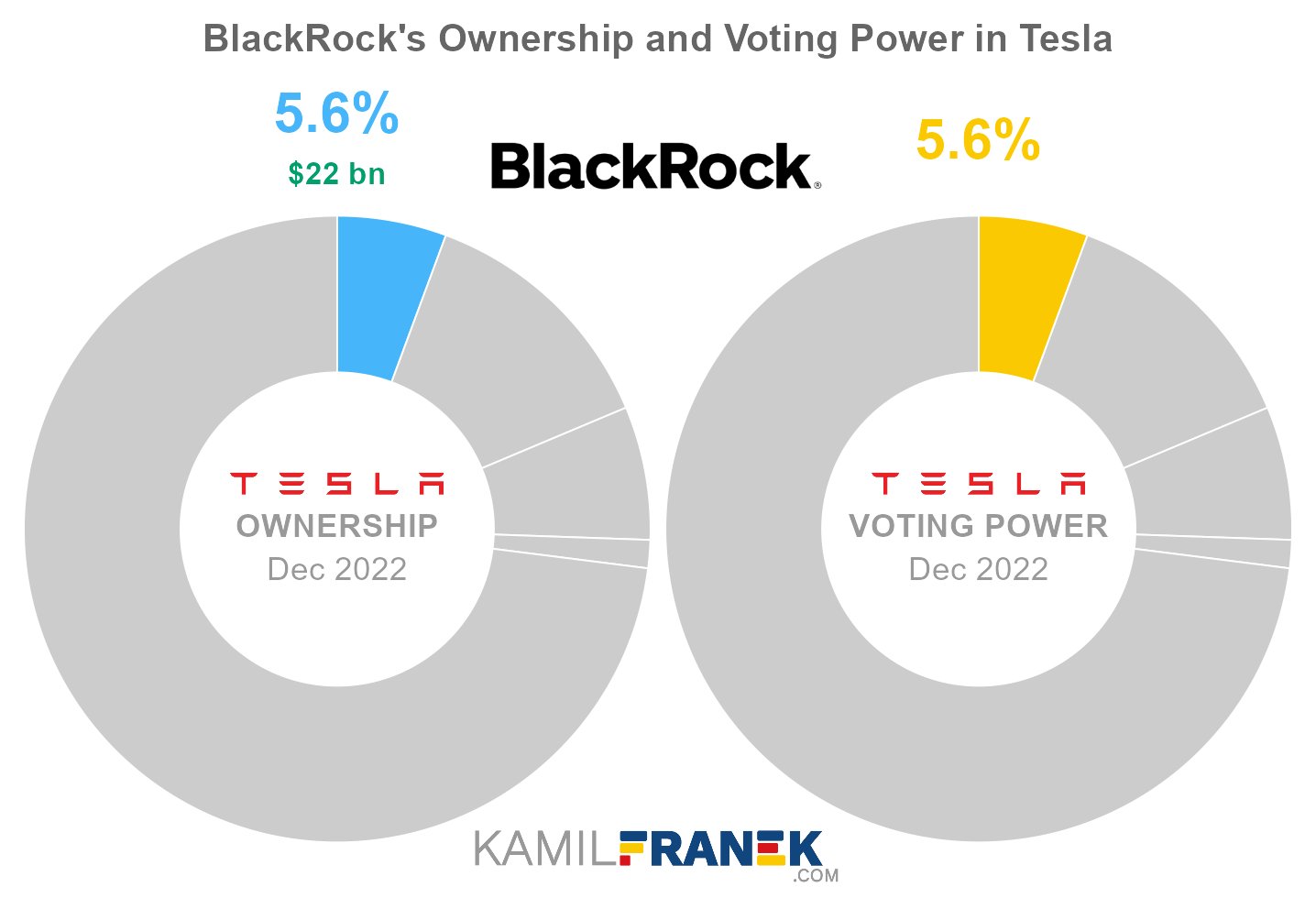
BlackRock, Inc.: Closely following Vanguard, BlackRock usually holds between 5% and 6% of the company. Through its iShares line of ETFs, BlackRock provides the liquidity that allows Tesla to remain a staple of institutional portfolios.
-
State Street Corporation: Through its SPDR S&P 500 ETF (SPY), State Street maintains a stake of approximately 3%.
These institutions are “passive” owners, meaning they generally do not seek to change the company’s management or strategy. However, their voting power on ESG (Environmental, Social, and Governance) proposals and executive compensation packages is immense. When Musk’s 2018 pay package was challenged in court, the voting behavior of these institutions became a focal point of financial news.
Active Managers and Hedge Funds
Beyond the index giants, active managers like Cathie Wood’s ARK Invest have historically played a major role in the Tesla narrative. While their total percentage of ownership may be smaller than Vanguard’s, their “high-conviction” buying and selling often signals market sentiment to other investors. Unlike passive funds, these active managers can choose to exit their positions if they believe the company is overvalued, making their quarterly 13F filings a subject of intense scrutiny for retail traders.
Retail Investors and the “Cult of Tesla”
One of the most unique aspects of Tesla’s ownership structure is the disproportionately high level of retail—or individual—ownership. While many blue-chip stocks are owned almost entirely by institutions (often 80% or more), Tesla has historically seen retail ownership percentages fluctuate between 30% and 40%.
The Role of the Individual Shareholder
Retail investors are individual people buying shares through brokerages like Schwab, Fidelity, or Robinhood. Tesla has cultivated a “fan-base” style of investing that is rarely seen in the corporate world. This group is often characterized by long-term “HODL” (hang on for dear life) mentalities, driven by a belief in the company’s mission to accelerate the world’s transition to sustainable energy.
This high level of retail ownership contributes to Tesla’s famous volatility. Retail investors are often more reactive to news, social media trends, and Elon Musk’s tweets than institutional algorithms. During periods of market euphoria, retail buying can drive Tesla’s valuation to heights that fundamental analysts struggle to justify. Conversely, when sentiment turns, the rush of individual investors to the exits can lead to sharp, rapid price corrections.
Impact on Corporate Governance
Because retail investors hold such a large slice of the pie, Tesla’s management often engages with them more directly than other companies do. Tesla frequently sources questions from retail shareholders for its quarterly earnings calls and has used its massive social media presence to rally individual voters during proxy battles. This “democratization” of ownership has made Tesla a case study in modern corporate finance, proving that a dedicated army of small investors can rival the influence of Wall Street’s largest banks.
Insider Ownership and the Board of Directors
Beyond Elon Musk, other insiders hold significant stakes that, while smaller in percentage, are worth billions of dollars. These individuals are often board members or early executives who have been with the company since its formative years.
Kimbal Musk and the Board
Kimbal Musk, Elon’s brother and a long-time board member, is consistently among the top individual shareholders. His periodic stock sales are often flagged by investors as potential indicators of internal sentiment, though they are usually executed through pre-planned 10b5-1 trading sessions. Other notable insiders include Robyn Denholm, the Chairperson of the Board, and various early venture capital partners who have retained portions of their original holdings.
Strategic Implications of Insider Stakes
High insider ownership is generally viewed as a positive sign by the market, as it aligns the interests of the management team with those of the shareholders. If the leaders of the company win only when the stock price goes up, they are incentivized to drive long-term value. However, in Tesla’s case, the heavy concentration of stock in the hands of a few insiders also creates “key person risk.” If a major insider were forced to liquidate their position suddenly, it could create downward pressure on the stock that institutional buyers might struggle to absorb.
The Strategic Impact of Ownership Distribution
The way Tesla’s stock is distributed across these different groups creates a unique dynamic that affects every aspect of its financial life, from its cost of capital to its day-to-day trading volume.
Volatility and Liquidity
The combination of a dominant, outspoken founder and a massive retail following creates a “liquidity trap” of sorts. While there are millions of shares traded daily, a large portion of the float is held by people who have no intention of selling, or by index funds that are legally required to hold the stock. This can lead to exaggerated price movements when news breaks, as the “active” float—the shares actually available for trading—becomes a battleground for speculators.
Future Outlook: Institutionalization vs. Retail Loyalty
As Tesla matures from a high-growth “disruptor” into a high-volume manufacturing powerhouse, its ownership structure is likely to continue shifting. We may see a gradual increase in institutional ownership as the company is added to more conservative value-oriented funds and dividend-seeking portfolios.
However, as long as Elon Musk remains at the helm, the tension between his concentrated ownership and the diversified holdings of the “Big Three” will remain a central theme for investors. For those looking to put money into Tesla, understanding who owns the stock is just as important as understanding the cars the company builds. It is a story of power, belief, and the shifting landscape of 21st-century capitalism, where a single individual and a global crowd of believers can challenge the traditional dominance of the Wall Street elite.
aViewFromTheCave is a participant in the Amazon Services LLC Associates Program, an affiliate advertising program designed to provide a means for sites to earn advertising fees by advertising and linking to Amazon.com. Amazon, the Amazon logo, AmazonSupply, and the AmazonSupply logo are trademarks of Amazon.com, Inc. or its affiliates. As an Amazon Associate we earn affiliate commissions from qualifying purchases.