
Nvidia Corporation (NVDA) has evolved from a niche manufacturer of graphics processing units (GPUs) for gamers into the undisputed backbone of the global artificial intelligence revolution. As its market capitalization has surged past the $3 trillion mark, joining the elite ranks of Apple and Microsoft, a fundamental question has emerged for investors and financial analysts alike: Who actually owns Nvidia?
In the world of high-stakes finance, ownership is synonymous with influence, risk distribution, and long-term strategic direction. Nvidia is a publicly traded company, meaning its ownership is distributed across millions of entities and individuals. However, the concentration of that ownership reveals a fascinating story of institutional trust, founder-led vision, and the democratization of stock through retail participation. Understanding the layers of Nvidia’s ownership is essential for any investor looking to grasp the stability and future trajectory of the world’s most important semiconductor firm.
The Institutional Powerhouses: Who Holds the Reins?
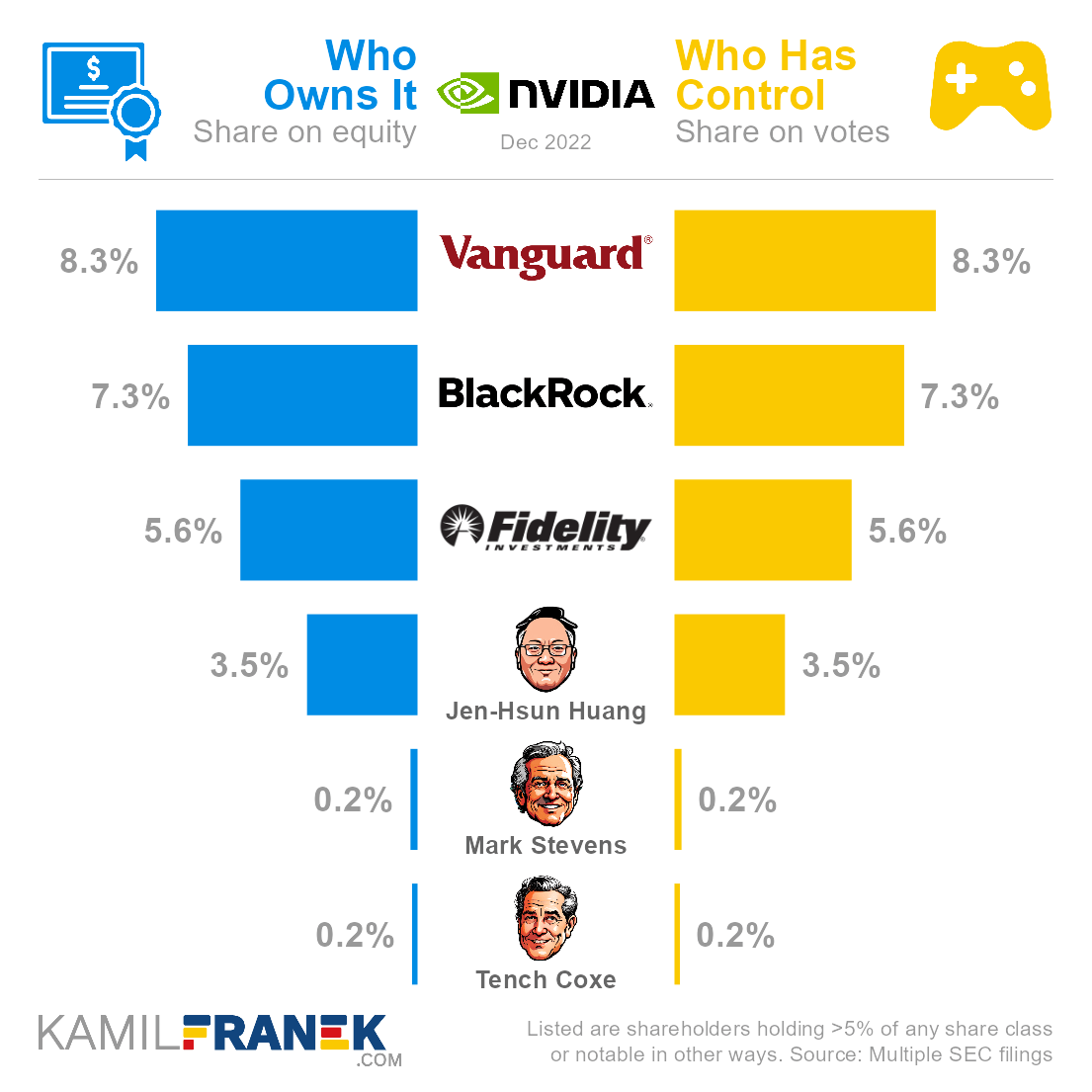
The vast majority of Nvidia is owned by institutional investors. These are large organizations—such as mutual funds, pension funds, and insurance companies—that trade securities in quantities large enough to qualify for preferential treatment and lower commissions. For Nvidia, institutional ownership accounts for approximately 65% to 70% of its total shares outstanding. This level of institutional commitment is generally viewed as a sign of corporate maturity and financial health.
Vanguard and BlackRock: The Passive Giants
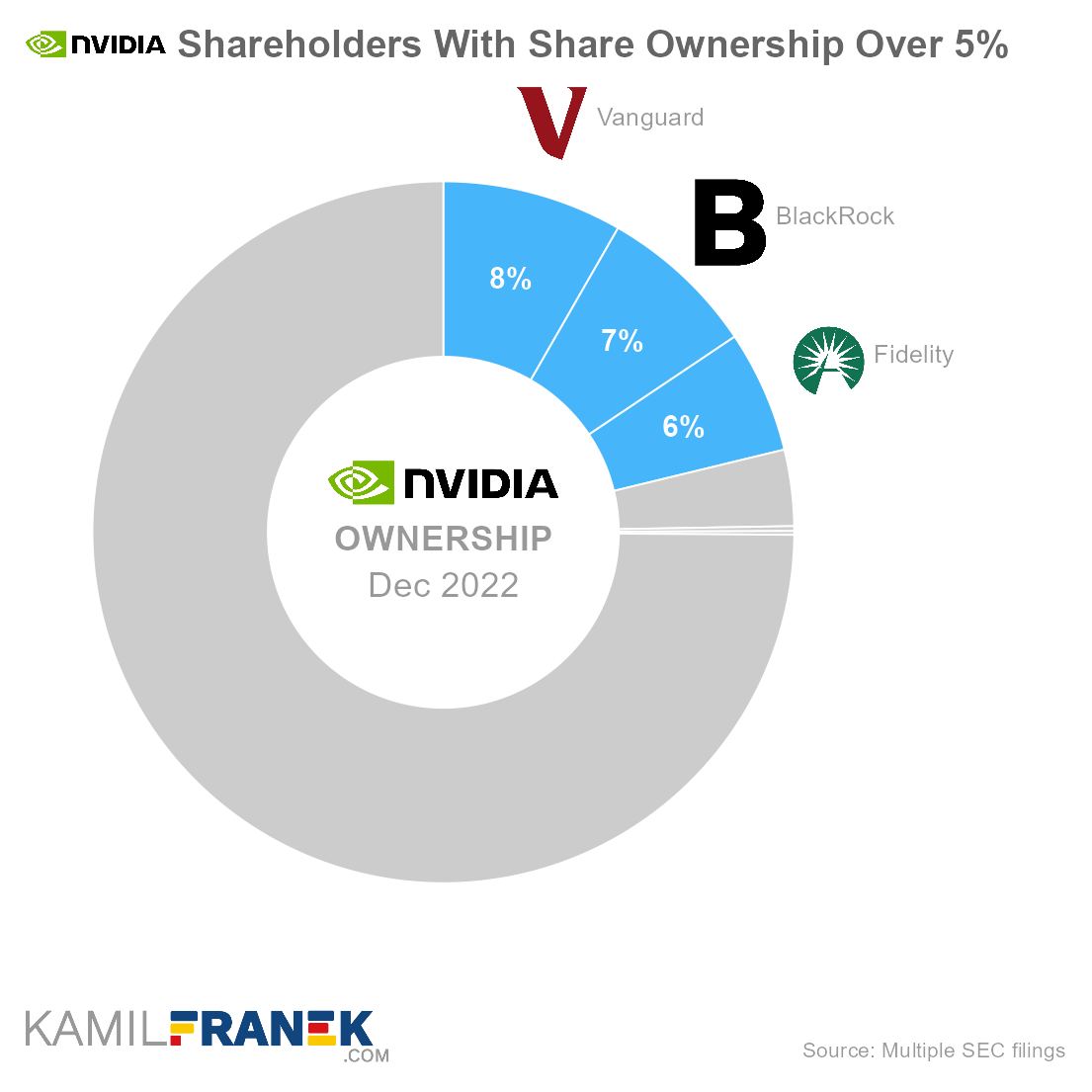
The two largest shareholders of Nvidia are Vanguard Group and BlackRock, Inc. These are not just investment firms; they are the architects of the modern index fund economy. As of the most recent SEC filings, Vanguard typically holds around 8% to 9% of Nvidia’s shares, while BlackRock follows closely with a stake of approximately 7%.
It is important to note that these firms do not “own” Nvidia in the traditional sense of seeking to control its daily operations. Instead, they hold these shares on behalf of millions of individual investors through exchange-traded funds (ETFs) and mutual funds. Because Nvidia is a primary component of the S&P 500, the Nasdaq-100, and various tech-heavy indices, any person with a standard retirement account or a total market index fund likely owns a piece of Nvidia through Vanguard or BlackRock. This provides Nvidia with a massive, stable capital base that fluctuates less based on emotion and more based on global capital flows.
Fidelity and State Street: Strategic Institutional Positions
Following the “Big Two,” firms like Fidelity (FMR LLC) and State Street Global Advisors hold significant positions, often hovering between 3% and 4% each. Unlike purely passive indexers, some of these institutions manage actively traded funds where portfolio managers have made a conscious, strategic decision to overweight Nvidia relative to its benchmark. Their continued holding suggests a high degree of confidence in Nvidia’s “moat”—its competitive advantage in the AI chip market—and its ability to generate sustained free cash flow.
The Visionary at the Helm: Jensen Huang’s Ownership Stake
While institutions provide the financial foundation, the heart of Nvidia’s ownership lies with its co-founder and CEO, Jensen Huang. In the realm of corporate finance, “insider ownership” is a critical metric because it aligns the interests of the company’s leadership with those of the external shareholders.
Skin in the Game: Why Insider Ownership Matters
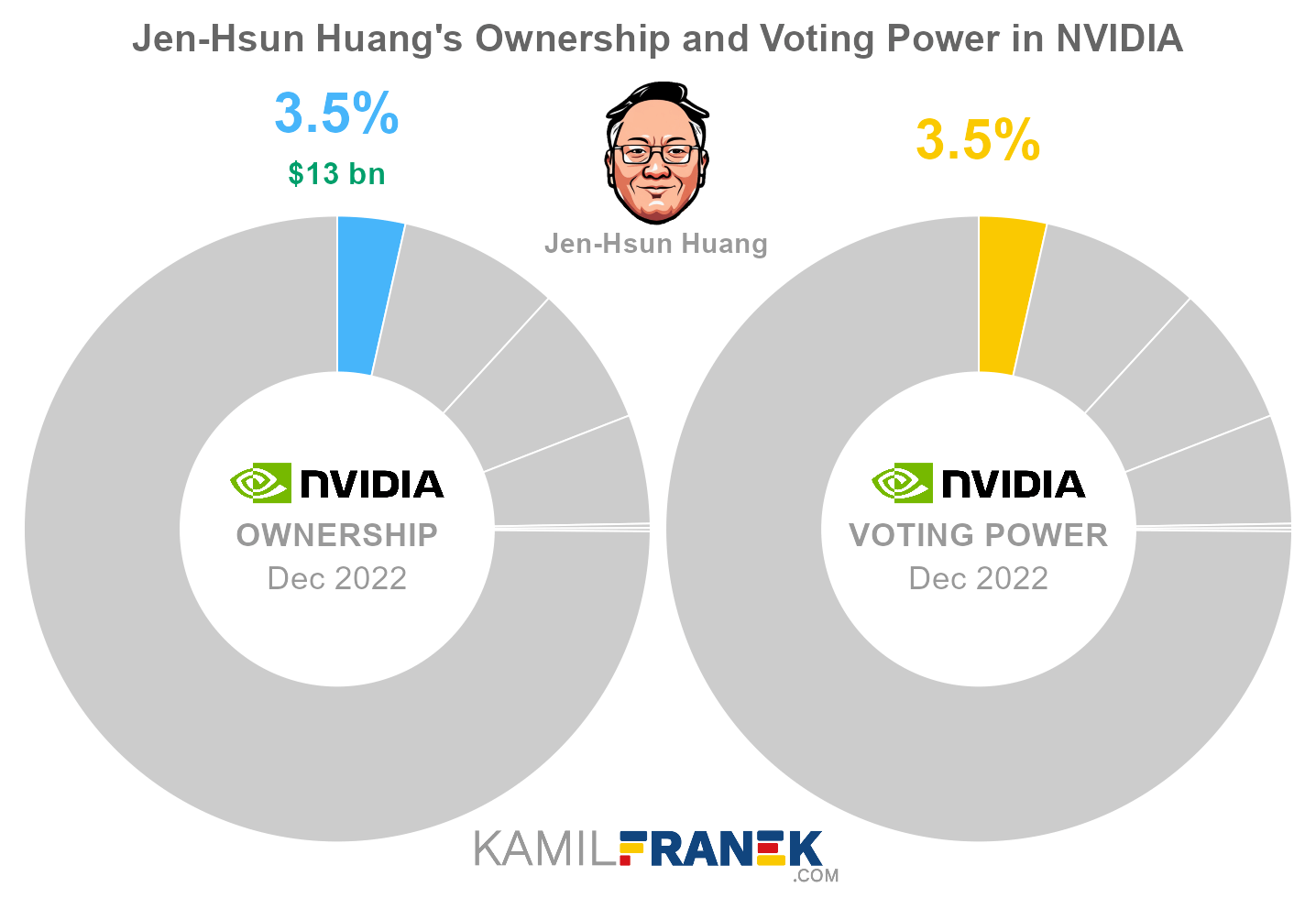
Jensen Huang is one of the largest individual shareholders of Nvidia. He currently owns approximately 3.5% to 4% of the company’s total shares. While this percentage might sound small compared to institutional giants, in the context of a multi-trillion-dollar valuation, it represents a personal fortune exceeding $100 billion.
Huang’s significant stake is a powerful signal to the market. It suggests that the CEO is not merely a “hired gun” executive but a founder who remains deeply invested in the long-term success of the enterprise. Historically, founder-led companies with high insider ownership tend to outperform the broader market because the leadership is less likely to prioritize short-term quarterly earnings at the expense of long-term innovation.
The Voting Power Dynamic
Beyond the monetary value, Huang’s ownership provides him with substantial voting power. While Nvidia does not have a dual-class share structure (the kind used by Meta or Alphabet to give founders absolute control), Huang’s stature and his multi-decade track record of success give him immense influence over the Board of Directors and the company’s strategic pivot toward AI and data centers. Other insiders, including board members and long-term executives like Co-founder Chris Malachowsky, also hold notable stakes, though significantly smaller than Huang’s.
Retail Investors and the Public Market
The remaining portion of Nvidia’s ownership—roughly 30%—is held by “retail investors.” These are individual people buying and selling stocks through brokerage apps like Robinhood, Charles Schwab, or E-Trade. The surge in retail ownership is a relatively recent phenomenon, driven by the explosive growth of “AI fever” and Nvidia’s meteoric rise in stock price.
The “Magnificent Seven” Effect on Individual Portfolios
Nvidia is a cornerstone of the so-called “Magnificent Seven” (alongside Apple, Microsoft, Alphabet, Amazon, Meta, and Tesla). For many individual investors, Nvidia is the “pure play” on artificial intelligence. The hype surrounding ChatGPT and generative AI in 2023 and 2024 led to a massive influx of retail capital. For many, owning Nvidia is seen as a hedge against a world that is becoming increasingly automated; if AI is the future, owning the company that builds the engines for that future is a logical financial move.
How Stock Splits Influence Ownership Demographics
A key factor in Nvidia’s ownership structure has been its use of stock splits. In June 2024, Nvidia executed a 10-for-1 stock split. From a financial theory perspective, a split doesn’t change the value of the company—it’s like cutting a pizza into ten slices instead of one. However, in practice, it significantly affects ownership. By lowering the price per share from over $1,000 to approximately $100, Nvidia made it much easier for retail investors to purchase “round lots” (100 shares) and participate in options trading. This “democratization” of the stock typically increases the total number of individual shareholders, further diversifying the ownership base.
The Financial Implications of Nvidia’s Ownership Structure
The way Nvidia is owned has profound implications for its stock market behavior, its cost of capital, and its role in the global economy. A company’s ownership profile is a “map” of its financial stability.
Market Capitalization and S&P 500 Concentration
Because Nvidia is so heavily owned by institutional index funds, its performance has a disproportionate impact on the broader market. Currently, Nvidia accounts for a significant percentage of the S&P 500’s total value. This creates a feedback loop: as the stock price rises, index funds are forced to buy more of it to maintain their weighting, which in turn can drive the price higher. This concentration means that “who owns Nvidia” is effectively “everyone with a 401(k).” The systemic importance of the company cannot be overstated; a major shift in Nvidia’s valuation can single-handedly move the entire US stock market.
Stability vs. Volatility: The Role of Long-term Holders
The high percentage of institutional ownership usually provides a “floor” for the stock price during market downturns. Large institutions like Vanguard and State Street rarely exit positions entirely; they rebalance. However, the growing percentage of retail and momentum-driven ownership can introduce volatility. Retail investors are often more prone to “panic selling” during bad news or “FOMO buying” during rallies.
Nvidia’s ownership structure represents a delicate balance. On one hand, you have the steady, methodical accumulation by institutions and the visionary, long-term holding of Jensen Huang. On the other hand, you have a highly active retail base that reacts to every technological breakthrough or geopolitical tension in the semiconductor supply chain.
In conclusion, “who owns Nvidia” is a multi-layered answer. It is a company owned by the giants of Wall Street, driven by a billionaire founder with a singular vision, and fueled by the aspirations of millions of individual investors worldwide. As Nvidia continues to define the financial landscape of the 21st century, the composition of its shareholders will remain a critical indicator of its enduring strength and market dominance.
aViewFromTheCave is a participant in the Amazon Services LLC Associates Program, an affiliate advertising program designed to provide a means for sites to earn advertising fees by advertising and linking to Amazon.com. Amazon, the Amazon logo, AmazonSupply, and the AmazonSupply logo are trademarks of Amazon.com, Inc. or its affiliates. As an Amazon Associate we earn affiliate commissions from qualifying purchases.