
Microsoft Corporation (NASDAQ: MSFT) stands as one of the most valuable companies in history, frequently vying for the top spot in global market capitalization. For investors, financial analysts, and business enthusiasts, the question of “who owns Microsoft” is not merely about a single name on a deed. Instead, it is a complex tapestry of institutional power, individual legacy, and the collective wealth of millions of retail investors worldwide.
As a publicly-traded entity, Microsoft’s ownership is fragmented across billions of shares of common stock. However, by peeling back the layers of SEC filings and proxy statements, we can identify the true power players who steer the financial destiny of this Redmond-based giant. This article explores the transition from founder control to institutional dominance and what this ownership structure means for the broader financial markets.

The Evolution from Founder-Led to Publicly Owned
The story of Microsoft’s ownership begins in 1975 with Bill Gates and Paul Allen. In the early days, the company was a private partnership, with Gates holding the majority stake. When Microsoft went public in 1986, it was one of the most anticipated IPOs of the decade. At the time, Bill Gates retained 45% of the company, a stake that would eventually make him the wealthiest person on earth for decades.
The Bill Gates Era and the Great Sell-Off
For many years, the answer to “who owns Microsoft” was simply “Bill Gates.” However, over the last two decades, Gates has systematically diversified his wealth. Through a planned divestment strategy, he sold or donated the vast majority of his shares to fund the Bill & Melinda Gates Foundation and to diversify his personal portfolio through his private investment vehicle, Cascade Investment LLC.
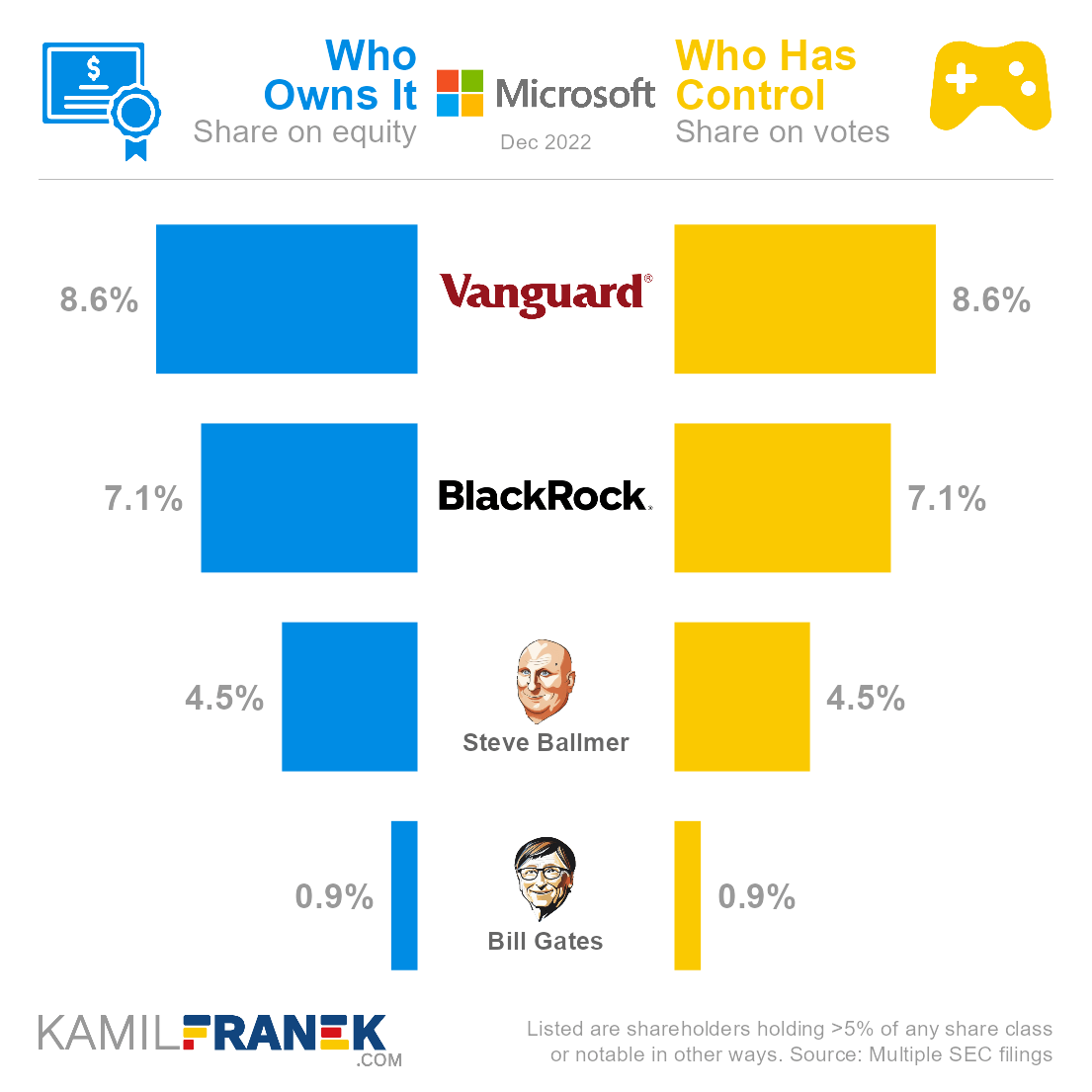
As of the latest filings, Gates owns roughly 1% of Microsoft’s total outstanding shares. While this remains a multi-billion dollar position, he is no longer the primary owner or even the largest individual shareholder. This shift represents a classic evolution in the lifecycle of a mega-cap corporation: the transition from a founder-controlled “growth” company to a mature, institutionally-owned “value and growth” powerhouse.
Steve Ballmer’s Remaining Stake
Interestingly, the title of the largest individual shareholder currently belongs to Steve Ballmer, Microsoft’s former CEO. Ballmer, who joined the company in 1980 as its 30th employee, retained a significant portion of his equity after retiring in 2014. Estimates suggest Ballmer owns approximately 4% of the company’s shares. Because he did not follow Gates’ aggressive path of diversification, Ballmer’s net worth remains heavily tethered to Microsoft’s stock performance, making him a unique outlier in the world of retired tech executives.
The Power of Institutional Investors
If individuals no longer own the majority of Microsoft, who does? The answer lies in the “Big Three” of asset management. In the modern financial era, Microsoft is primarily owned by massive institutional investors that manage mutual funds, ETFs, and pension funds. Approximately 70% to 75% of Microsoft’s outstanding shares are held by these institutions.
The Big Three: Vanguard, BlackRock, and State Street
The Vanguard Group is typically the largest shareholder of Microsoft, holding roughly 8% to 9% of the company. Following closely behind is BlackRock, the world’s largest asset manager, with a stake of approximately 7%. State Street Global Advisors usually rounds out the top three with around 4%.
It is important to understand that these firms do not “own” Microsoft in the traditional sense of personal wealth. Rather, they hold these shares on behalf of millions of individual investors who own shares in the Vanguard S&P 500 ETF (VOO) or the BlackRock iShares funds. Because Microsoft is a cornerstone of the S&P 500 and the NASDAQ-100, any investor with a standard retirement account or a target-date fund likely owns a fractional piece of Microsoft through these institutions.
Why Institutional Dominance Matters for Retail Investors
The high level of institutional ownership provides Microsoft with a certain degree of stock price stability. Large institutions tend to hold shares for the long term, which reduces day-to-day volatility compared to companies owned primarily by speculative retail traders. For the individual investor, this means Microsoft is often viewed as a “safe haven” asset—a blue-chip stock that offers both growth through its cloud and AI initiatives and stability through its diversified institutional base.

Microsoft’s Internal Stakeholders: Executives and Board Members
Beyond the founders and the giant fund managers, a crucial slice of Microsoft is owned by its current leadership. This is often referred to as “insider ownership.” While the percentage of shares held by insiders is small compared to the total (usually less than 1%), the dollar value is immense, ensuring that the interests of the management team are aligned with those of the shareholders.
Satya Nadella’s Skin in the Game
Since taking the helm in 2014, CEO Satya Nadella has overseen a massive resurgence in Microsoft’s market value. Nadella’s compensation is heavily weighted toward stock-based awards rather than cash. This means his personal net worth is directly tied to the company’s ability to innovate and maintain its profit margins. SEC filings indicate that Nadella holds hundreds of thousands of shares, worth hundreds of millions of dollars. This “skin in the game” is a critical metric for financial analysts, as it signals that the CEO has a vested interest in long-term share appreciation.
Stock-Based Compensation as a Growth Driver
Microsoft uses equity ownership as a primary tool for talent retention. By issuing Restricted Stock Units (RSUs) to its engineers and managers, Microsoft effectively turns its employees into owners. This ownership culture is a key financial driver; it reduces the immediate cash drain on the company’s balance sheet while incentivizing the workforce to build products that increase the company’s overall valuation.
The Financial Significance of Microsoft’s Ownership Structure
The way Microsoft is owned has a direct impact on its financial policies, particularly regarding how it handles its massive cash reserves. When ownership is concentrated in the hands of institutional investors, there is often pressure on the company to return value to shareholders in predictable ways.
Impact on Dividend Policy and Share Buybacks
Institutional owners like Vanguard and BlackRock prioritize consistent returns. Consequently, Microsoft has become a reliable dividend payer. Since initiating its dividend in 2003, the company has increased its payout for nearly two decades. Furthermore, Microsoft frequently engages in multi-billion dollar share buyback programs. By owning and then “retiring” its own shares, the company reduces the total supply, which increases the ownership percentage (and earnings per share) for all remaining shareholders.
Market Capitalization and Index Weighting
Because of its massive ownership base and high stock price, Microsoft carries immense weight in global indices. In a standard market-cap-weighted index, Microsoft’s performance can single-handedly pull the entire market up or down. For investors, this means that Microsoft is not just a company—it is a systematic financial pillar. If you own an “all-market” fund, your portfolio’s health is intrinsically linked to Microsoft’s success.
Investing in Microsoft Today: What Owners Need to Know
For those considering becoming a part-owner of Microsoft by purchasing shares, the financial landscape is currently dominated by the company’s shift toward Artificial Intelligence and Cloud computing (Azure). These “growth engines” are what maintain the stock’s premium valuation.
Valuation Metrics and Long-Term Outlook
When you buy into Microsoft, you are paying for more than just current earnings; you are paying for a piece of the future of enterprise software. Analysts look at the Price-to-Earnings (P/E) ratio and the Price-to-Sales (P/S) ratio to determine if the “entry price” for ownership is fair. Currently, Microsoft often trades at a premium compared to the broader tech sector, reflecting the market’s confidence in its diversified revenue streams—ranging from LinkedIn and Xbox to Office 365 and Azure.
Conclusion: A Global Collective Ownership
Ultimately, no one person “owns” Microsoft. While the ghosts of its founders’ influence remain, the company has transitioned into a global asset. It is owned by the pension funds of teachers, the 401(k) plans of office workers, the massive portfolios of asset management titans, and the visionary leaders currently sitting in the boardroom.
This decentralized ownership structure is the hallmark of a successful, mature corporation. It ensures that Microsoft is accountable to a wide range of stakeholders, from the individual retiree looking for dividend income to the institutional manager seeking aggressive capital appreciation. As Microsoft continues to expand its footprint in the AI revolution, its ownership will likely remain one of the most stable and coveted in the financial world. For the savvy investor, understanding this hierarchy of ownership is the first step in recognizing why Microsoft remains a foundational element of any sophisticated financial portfolio.
aViewFromTheCave is a participant in the Amazon Services LLC Associates Program, an affiliate advertising program designed to provide a means for sites to earn advertising fees by advertising and linking to Amazon.com. Amazon, the Amazon logo, AmazonSupply, and the AmazonSupply logo are trademarks of Amazon.com, Inc. or its affiliates. As an Amazon Associate we earn affiliate commissions from qualifying purchases.