
Alphabet Inc., the parent company of Google, stands as one of the most influential and valuable entities in the global economy. For investors, financial analysts, and those interested in the mechanics of corporate power, the question of “who owns Alphabet” is more complex than a simple list of names. It involves a sophisticated multi-class share structure designed to balance public capital with private control. Understanding the ownership of Alphabet requires a deep dive into institutional holdings, insider equity, and the unique voting rights that allow its founders to maintain a firm grip on the company’s destiny.

The Architecture of Alphabet’s Multi-Class Share Structure
To understand who owns Alphabet, one must first understand the three distinct classes of stock the company employs. This structure is a cornerstone of Alphabet’s financial identity and sets the precedent for how many Silicon Valley giants manage their equity.
Class A (GOOGL): The Standard Voting Shares
Class A shares, traded under the ticker GOOGL, are what most retail investors hold. Each share of Class A stock entitles the owner to one vote. These shares represent the traditional way of participating in the company’s growth while having a theoretical say in corporate governance. When institutional investors like pension funds or mutual funds buy into Alphabet, they often accumulate significant blocks of Class A shares to exert influence on board decisions.
Class B: The Founders’ Super-Voting Shares
Class B shares are the primary reason why “ownership” and “control” are two different concepts at Alphabet. These shares are not traded on public exchanges; they are held exclusively by the company’s founders and a few select insiders. Crucially, each Class B share carries ten votes. This “super-voting” mechanism ensures that even if the founders own a minority of the total equity, they retain a majority of the voting power. This structure was designed during Google’s IPO in 2004 to protect the founders’ long-term vision from the short-term pressures of Wall Street.
Class C (GOOG): Capital Without Control
The Class C shares, traded under the ticker GOOG, were created via a stock split in 2014. These shares carry no voting rights whatsoever. They were introduced to allow the company to issue stock-based compensation to employees and to fund acquisitions without further diluting the voting power of the founders. For the average investor focused purely on price appreciation rather than corporate governance, Class C shares provide an identical economic interest in the company’s profits as Class A shares, usually at a slightly different price point.
The Dominant Power of Larry Page and Sergey Brin
While Alphabet is a publicly-traded company with thousands of shareholders, the ultimate authority rests in the hands of two men: Larry Page and Sergey Brin. Their ownership stake is the most critical component of Alphabet’s financial narrative.
Concentrated Control in a Public Company
As of the most recent SEC filings, Larry Page and Sergey Brin collectively hold the majority of the Class B shares. When combined with their holdings in Class A and Class C, their total economic stake in the company is substantial, but it is their voting power that is truly remarkable. Despite owning roughly 11% to 12% of the total outstanding shares, the ten-to-one voting ratio of their Class B stock gives them more than 51% of the total voting power. This means that, for all intents and purposes, no major decision—from board appointments to massive capital expenditures—can be made without their approval.
The Long-Term Vision of the Founders
The concentration of ownership among the founders is often defended as a safeguard for innovation. In the “Money” niche, this is known as a founder-led premium. By insulating Page and Brin from activist investors who might demand immediate dividends or cost-cutting measures, the ownership structure allows Alphabet to invest billions into “Moonshots”—high-risk, high-reward projects like Waymo (autonomous driving) and Verily (life sciences). For investors, owning Alphabet means betting on the founders’ ability to allocate capital toward future technologies that may not see a return for a decade.
Institutional Giants: The Silent Owners of Big Tech
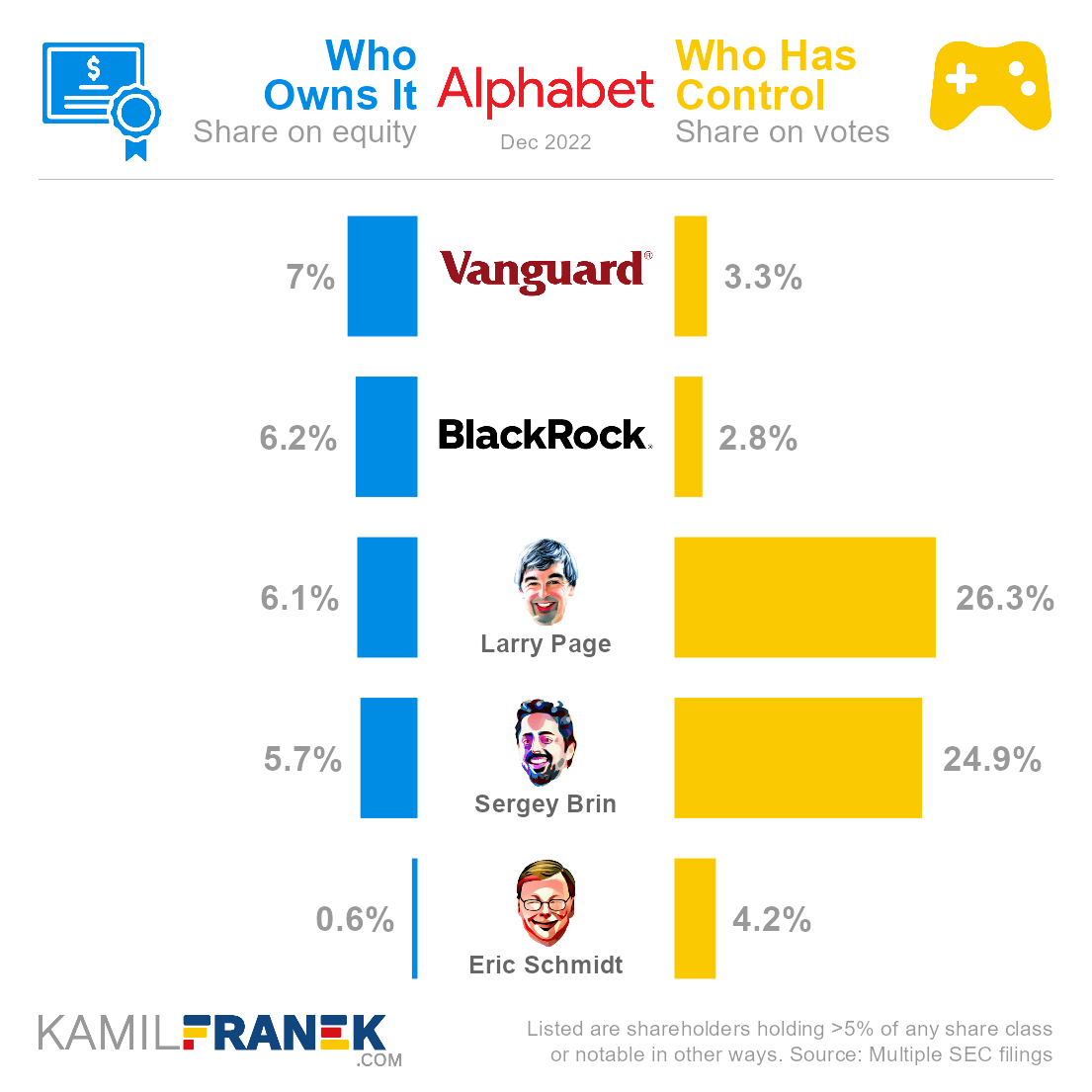
While the founders control the votes, institutional investors own the largest slice of the economic pie. These institutions represent the interests of millions of individual savers, 401(k) participants, and pension beneficiaries.
Vanguard and BlackRock’s Massive Stakes
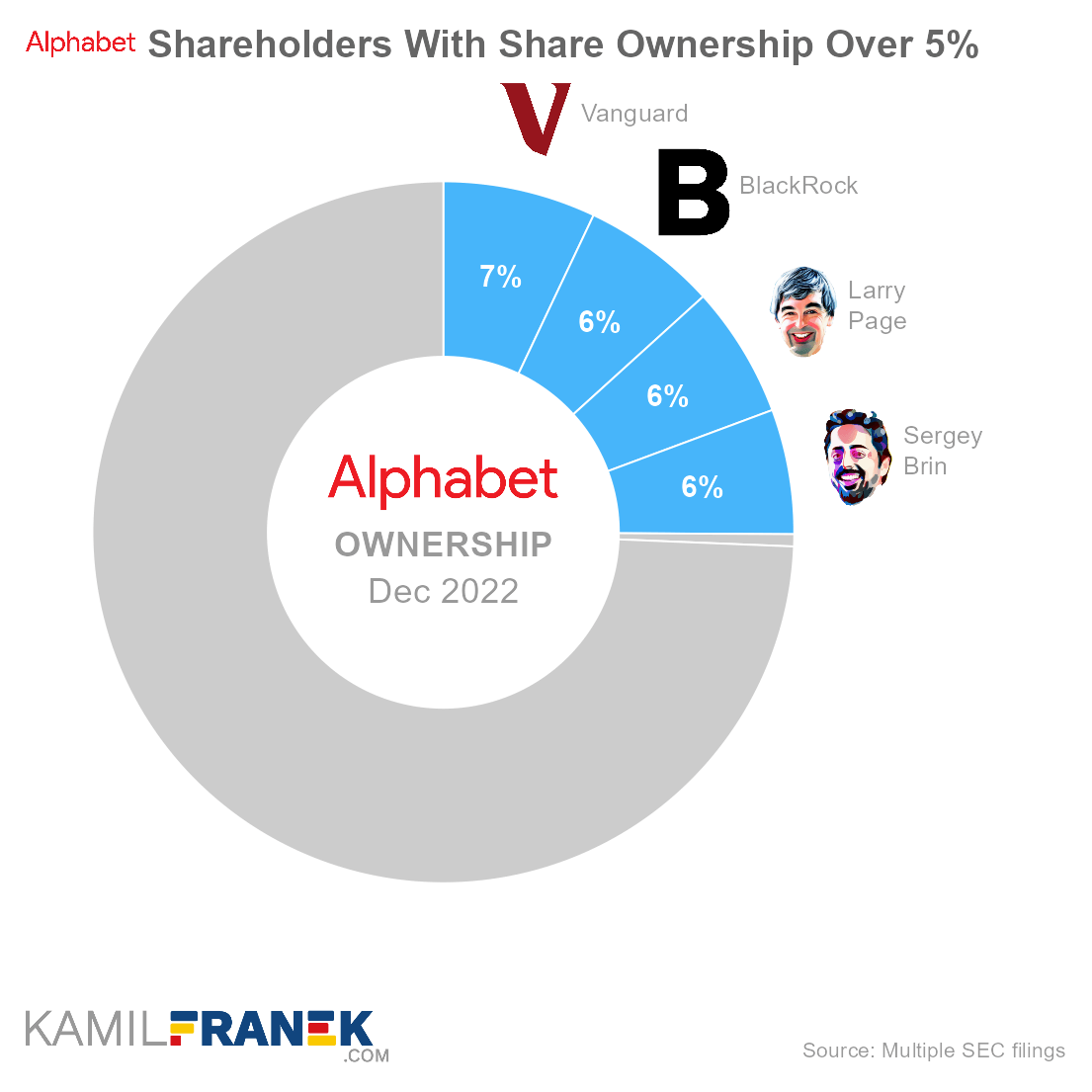
The two largest institutional owners of Alphabet are almost always Vanguard Group and BlackRock, Inc. These firms are the titans of the indexing world. Because Alphabet is a core component of the S&P 500 and the Nasdaq-100, any index fund tracking these benchmarks must hold a proportionate amount of Alphabet stock. Vanguard typically holds around 7% to 8% of the company, while BlackRock follows closely behind. While these firms hold significant voting power through their Class A shares, they rarely challenge the founders, instead focusing on broad ESG (Environmental, Social, and Governance) standards and long-term fiduciary duty.
The Role of Mutual Funds and ETFs
Beyond the index giants, major actively managed funds also hold significant positions. T. Rowe Price and State Street Global Advisors are frequent fixtures in the list of top ten shareholders. The presence of these institutions provides Alphabet with a stable capital base. For the retail investor, the fact that these sophisticated financial entities hold tens of billions of dollars in Alphabet stock serves as a signal of the company’s perceived financial stability and long-term growth potential.
Executive Ownership and Insider Holdings
Beyond the founders, a small group of executives and board members hold significant equity, aligning their personal wealth with the company’s market performance.
Sundar Pichai’s Equity and Compensation
As the CEO of both Google and Alphabet, Sundar Pichai is one of the most high-profile individual shareholders. His ownership is primarily built through performance-based stock units (PSUs) and restricted stock units (RSUs). Pichai’s compensation packages are frequently tied to Alphabet’s performance relative to other S&P 100 companies. This “pay-for-performance” model ensures that while he does not have the voting control of Page or Brin, he has a massive financial incentive to drive the share price higher and maintain fiscal discipline.
Other Key Insiders and Their Influence
Other insiders, including CFO Ruth Porat and board members like John Hennessy, also hold notable amounts of stock. Insider ownership is a key metric for investors because it suggests that the people running the company have “skin in the game.” At Alphabet, the level of insider ownership is exceptionally high for a company of its size, which generally correlates with a more cautious approach to debt and a more aggressive approach to reinvesting profits into R&D.
What Alphabet’s Ownership Means for the Individual Investor
For someone looking to put money into Alphabet, the ownership structure is a double-edged sword that requires careful consideration of governance and financial risk.
Assessing Governance Risks
The primary risk of Alphabet’s ownership structure is the lack of “shareholder democracy.” Because Page and Brin hold the majority of the voting power, common shareholders have very little recourse if they disagree with the company’s direction. If Alphabet makes a poor acquisition or overspends on a failing subsidiary, shareholders cannot easily vote to change the board of directors. This “controlled company” status is a factor that some institutional investors view as a risk, though it has not historically hindered the stock’s performance.
Financial Stability and Market Valuation
On the positive side, the stable ownership structure has allowed Alphabet to build a fortress-like balance sheet. With over $100 billion in cash and cash equivalents and a dominant position in the digital advertising market, the company’s ownership of its core business is undisputed. Investors often value Alphabet not just on its current earnings, but on the “sum of the parts” of its various holdings. The ownership of YouTube, Google Cloud, and the “Other Bets” portfolio makes Alphabet a diversified holding company in its own right.
In conclusion, “who owns Alphabet” is a question with two answers. Economically, the company is owned by the global public, led by institutional giants like Vanguard and BlackRock. However, in terms of control, Alphabet is owned and directed by Larry Page and Sergey Brin. For the modern investor, navigating this trillion-dollar entity requires an appreciation for this delicate balance of power, where the capital of many is guided by the vision of a few. Understanding this financial framework is essential for anyone looking to capitalize on the continued growth of one of the world’s most dominant business enterprises.
aViewFromTheCave is a participant in the Amazon Services LLC Associates Program, an affiliate advertising program designed to provide a means for sites to earn advertising fees by advertising and linking to Amazon.com. Amazon, the Amazon logo, AmazonSupply, and the AmazonSupply logo are trademarks of Amazon.com, Inc. or its affiliates. As an Amazon Associate we earn affiliate commissions from qualifying purchases.