
Microsoft Corporation (MSFT) stands as a titan of the global economy, frequently vying for the title of the world’s most valuable company. With a market capitalization that has breached the $3 trillion mark, the question of “who owns Microsoft” is not merely a matter of curiosity—it is a study in modern capital distribution, institutional power, and the evolution of individual wealth. In the world of high-stakes finance, ownership of such a massive entity is rarely concentrated in a single pair of hands. Instead, it is a complex tapestry of institutional behemoths, individual visionaries, and millions of retail investors.
To understand the ownership structure of Microsoft is to understand the mechanics of the S&P 500 and the broader financial markets. Because Microsoft is a publicly-traded company, its “owners” are its shareholders. However, the influence over the company’s direction is tiered, ranging from the passive holdings of index funds to the strategic stakes held by current and former executives.
The Institutional Powerhouse: Who Really Controls the Shares?
In the current financial landscape, the majority of Microsoft is owned by institutional investors. These are massive organizations—mutual funds, pension funds, and insurance companies—that manage money on behalf of millions of individual clients. As of recent filings, institutional investors own approximately 70% to 72% of Microsoft’s outstanding shares. This high level of institutional ownership is a hallmark of “blue-chip” stocks, signaling deep market confidence and stability.
The Big Three: Vanguard, BlackRock, and State Street
When looking at the top of the shareholder list, three names consistently appear: The Vanguard Group, BlackRock, Inc., and State Street Corporation. These firms do not “own” Microsoft in the traditional sense of personal wealth; rather, they hold the shares in various exchange-traded funds (ETFs) and mutual funds.
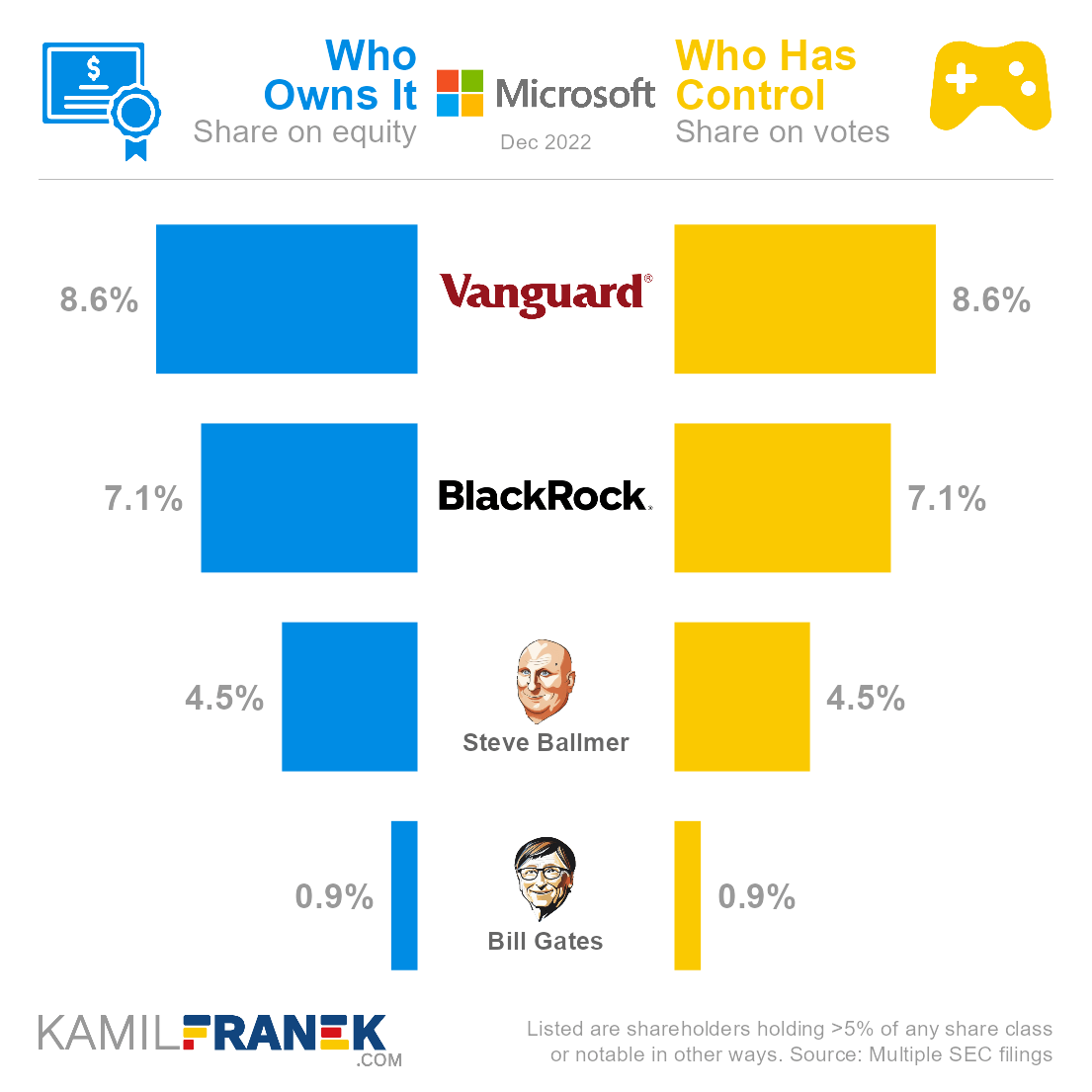
- The Vanguard Group: Often the largest shareholder, Vanguard typically holds between 8% and 9% of Microsoft’s total shares. This ownership is driven largely by their popular S&P 500 index funds. Because Microsoft is a top-weighted component of the index, any investor putting money into a Vanguard S&P 500 fund is indirectly owning a piece of Microsoft.
- BlackRock, Inc.: As the world’s largest asset manager, BlackRock holds a similar stake, usually hovering around 7%. Through its iShares brand, BlackRock exerts significant influence over corporate governance through proxy voting, a key aspect of how “money” translates into “power” in the boardroom.
- State Street Corporation: Generally the third-largest institutional holder, State Street manages the SPDR funds. Their stake typically sits around 4%.
The Role of Passive vs. Active Management
The dominance of these institutions highlights a major trend in business finance: the shift toward passive investing. Because these giants own shares to mirror market indices, they are “permanent” owners. They do not sell based on quarterly earnings fluctuations. For Microsoft, this provides a massive “floor” of capital that stabilizes the stock price, making it a cornerstone of the global financial system.
Why Institutional Dominance Matters for the Economy
The sheer volume of Microsoft shares held by institutions means that the company’s performance is inextricably linked to the retirement accounts and pension plans of the global workforce. If Microsoft prospers, the financial tools used by teachers, firemen, and office workers grow in value. Conversely, a significant downturn in Microsoft’s valuation has a ripple effect across the entire financial sector.
Inside the Individual Stakeholders: From Founders to Modern Leadership
While institutions own the bulk of the company, the narrative of Microsoft’s ownership is often told through the lens of individuals. The shift from a founder-led company to a professionally managed enterprise is reflected clearly in the dwindling stakes of its original creators and the rising importance of its current executive suite.
The Evolution of Bill Gates’ Stake
For decades, Bill Gates was the face and the primary owner of Microsoft. At the time of its IPO in 1986, Gates owned about 45% of the company. However, over the last thirty years, Gates has systematically divested his holdings to fund his philanthropic endeavors through the Bill & Melinda Gates Foundation and to diversify his personal investment portfolio via his private holding company, Cascade Investment LLC.
Today, Gates’ direct ownership has dropped to a point where he is no longer required to report his holdings in the same way a major “insider” or 5% owner would. While he remains one of the world’s wealthiest individuals, his wealth is now spread across various asset classes, from farmland to clean energy, rather than being concentrated solely in Microsoft stock.
Steve Ballmer: The Largest Individual Shareholder
Interestingly, the largest individual shareholder of Microsoft is not Bill Gates, but his successor, Steve Ballmer. Ballmer, who served as CEO from 2000 to 2014, retained a massive portion of his equity after retirement. Estimates suggest Ballmer owns roughly 4% of the company. In terms of “Money,” this makes Ballmer one of the few people to become a multi-decabillionaire primarily as an employee rather than a founder—though his early-stage involvement was critical to the company’s growth.

Satya Nadella and the Executive Compensation Model
The current CEO, Satya Nadella, and other top executives like Amy Hood (CFO) and Brad Smith (President) also hold significant shares. However, their ownership is largely the result of stock-based compensation. In modern corporate finance, executives are paid in “units” that vest over time, aligning their personal financial interests with those of the shareholders. While Nadella’s holdings are worth hundreds of millions of dollars, they represent a small fraction of the total shares outstanding compared to the institutional giants.
The Financial Impact: Dividends, Buybacks, and Market Cap
To understand “who owns Microsoft,” one must also understand what that ownership provides. Ownership in a company of this scale isn’t just about a “share” of the name; it’s about a share of the massive cash flows the company generates.
The Dividend Engine
Microsoft is a premier “dividend growth” stock. For investors focused on income, owning Microsoft provides a quarterly payout that has historically increased every year for nearly two decades. In the fiscal year 2023 alone, Microsoft returned billions of dollars to its owners through dividends. For institutional owners like Vanguard, these dividends are reinvested, compounding the wealth of the underlying fund holders.
Share Buybacks: Increasing Ownership by Stealth
One of the most powerful financial tools Microsoft uses is the share buyback program. When Microsoft uses its excess cash to buy its own shares back from the open market and “retire” them, the remaining shares become more valuable. For the existing owners, their percentage of the company increases without them having to spend a single extra dollar. This is a primary strategy for returning value to shareholders and has been a major driver of the stock’s long-term capital appreciation.
Microsoft as a Benchmark Asset
In the world of personal finance and investing, Microsoft is often categorized as a “core” holding. Because of its diversified revenue streams—ranging from cloud computing (Azure) to business software (Office 365) and gaming (Xbox)—it is viewed as a “defensive” tech stock. It possesses the growth potential of a technology company with the financial stability of a traditional utility.
Investing in Microsoft: What the Ownership Structure Means for You
For the retail investor—the individual using a side-hustle income or a monthly salary to build a portfolio—the ownership structure of Microsoft offers several strategic takeaways.
Accessibility via ETFs
Most people “own” Microsoft without realizing it. Because of its weight in the S&P 500 and the Nasdaq-100, Microsoft is a primary component of almost every major diversified stock fund. If you own an “All-Cap” or “Large-Cap” fund, a significant portion of your financial future is tied to Microsoft’s success.
Direct Ownership vs. Fractional Shares
Modern financial tools and apps have made direct ownership of Microsoft more accessible. Previously, the high price per share might have been a barrier for some, but the advent of “fractional shares” allows an investor to own $10 worth of Microsoft. This democratization of ownership allows the “small” investor to participate in the same growth as the institutional giants.
The Importance of Diversification
While Microsoft is a financial powerhouse, its ownership structure teaches a lesson in diversification. Even Bill Gates, the man who built the company, chose to sell the majority of his shares to invest in other areas. For a personal finance strategy, Microsoft is often a “foundation” piece, but rarely the only piece. The institutional owners provide the stability, the executives provide the growth strategy, and the retail investors provide the liquidity.

Conclusion: A Shared Global Stake
The question of “who owns Microsoft” reveals a sophisticated ecosystem of global finance. While the names on the filings are BlackRock and Vanguard, the ultimate owners are the millions of people whose retirement accounts, education funds, and personal savings are invested in these institutions.
Microsoft is no longer a “founder-owned” company in the way a small startup might be. It is a massive, publicly-owned utility of the digital age. Its ownership is decentralized, spread across every corner of the globe, and managed by the world’s most powerful financial entities. For the investor, Microsoft represents more than just a software company; it is a vehicle for wealth preservation and growth, a testament to the power of compound interest, and a central pillar of the modern financial world. Whether you are a billionaire like Steve Ballmer or a retail investor with a few fractional shares, owning Microsoft means owning a piece of the infrastructure that powers the global economy.
aViewFromTheCave is a participant in the Amazon Services LLC Associates Program, an affiliate advertising program designed to provide a means for sites to earn advertising fees by advertising and linking to Amazon.com. Amazon, the Amazon logo, AmazonSupply, and the AmazonSupply logo are trademarks of Amazon.com, Inc. or its affiliates. As an Amazon Associate we earn affiliate commissions from qualifying purchases.