
The calculator is perhaps the most ubiquitous piece of technology in the modern world. It exists as a physical device on engineers’ desks, a standard app on every smartphone, and a core component of complex financial software. However, the question of “who invented the calculator” does not have a single-name answer. Instead, the history of the calculator is a multi-century saga of technological evolution, moving from wooden beads and mechanical gears to vacuum tubes and silicon chips. To understand the inventor of the calculator is to understand the history of human logic and the relentless pursuit of computational efficiency.

The Mechanical Dawn: From the Abacus to Blaise Pascal
Long before the advent of electricity, the need for rapid calculation was driven by commerce, astronomy, and navigation. While the ancient abacus served as the world’s first “manual” calculator, the quest for a machine that could perform calculations automatically began in the 17th century.
The Schickard and Pascaline Breakthroughs
The first significant leap toward a mechanical calculator occurred in 1623 when Wilhelm Schickard, a German polymath, designed the “Calculating Clock.” It used a system of cylinders and gears to perform addition and subtraction. Unfortunately, Schickard’s prototypes were destroyed in a fire, and his work remained largely unknown for centuries.
The title of “inventor” is most frequently attributed to the French mathematician and philosopher Blaise Pascal. In 1642, at the age of 19, Pascal created the “Pascaline” to help his father, a tax collector, with laborious arithmetic. The Pascaline was a revolutionary piece of tech for its time; it was the first device to feature a carry mechanism, allowing a wheel to advance the adjacent wheel once it completed a full rotation. While it was commercially unsuccessful due to its high cost and complexity, it established the fundamental architecture for mechanical computing.
Leibniz and the Step Reckoner
Following Pascal, Gottfried Wilhelm Leibniz, the co-inventor of calculus, sought to improve the mechanical design. In 1673, he debuted the “Step Reckoner.” Unlike the Pascaline, which primarily handled addition and subtraction, Leibniz’s machine introduced the “Leibniz wheel,” which enabled the device to perform multiplication and division through repeated addition and shifts. Leibniz also famously championed the binary system—the 1s and 0s that form the backbone of all modern digital technology.
Industrialization and the Birth of Mass-Produced Calculation
The 19th century transformed the calculator from a philosopher’s curiosity into a practical tool for the burgeoning industrial world. As global trade and engineering projects scaled, the demand for reliable, repeatable results led to the first commercially viable machines.
Thomas de Colmar’s Arithmometer
In 1820, Charles Xavier Thomas de Colmar patented the Arithmometer. This was the first mechanical calculator strong enough and reliable enough for daily office use. Based on Leibniz’s stepped drum mechanism, it became the first mass-produced calculator in history. Its success proved that there was a massive market for “computational hardware,” paving the way for the professionalization of accounting and engineering.
The Curta: A Mechanical Marvel in Your Palm
Before the digital age, the pinnacle of mechanical calculation was the Curta. Invented by Curt Herzstark while he was a prisoner in a concentration camp during World War II, the Curta was a small, hand-held mechanical calculator that resembled a pepper grinder. It was a masterpiece of miniaturization, capable of performing all four basic arithmetic functions with incredible precision. Until the early 1970s, the Curta was the go-to gadget for rally car drivers, engineers, and scientists who needed “mobile” tech.
The Electronic Revolution: From Vacuum Tubes to Microchips
The mid-20th century marked a paradigm shift. The limitations of physical gears—friction, wear, and speed—were bypassed by the use of electricity. This era saw the transition from “calculating machines” to the “electronic calculators” that resemble the tools we use today.
The First Desktop Electronic Calculators
In the early 1960s, the world saw the first fully electronic desktop calculators. Machines like the ANITA (A New Inspiration To Arithmetic) utilized vacuum tubes and cold-cathode tubes. These devices were silent and incredibly fast compared to their mechanical predecessors, but they were the size of a typewriter and required a constant power outlet.
The real tech breakthrough came with the transition from vacuum tubes to transistors. Companies like Sharp and Casio began competing to shrink the hardware. In 1965, the Casio 001 became the first electronic calculator with a memory function, a critical milestone in the development of user-friendly interfaces.
The Pocket Revolution: Texas Instruments and Sharp
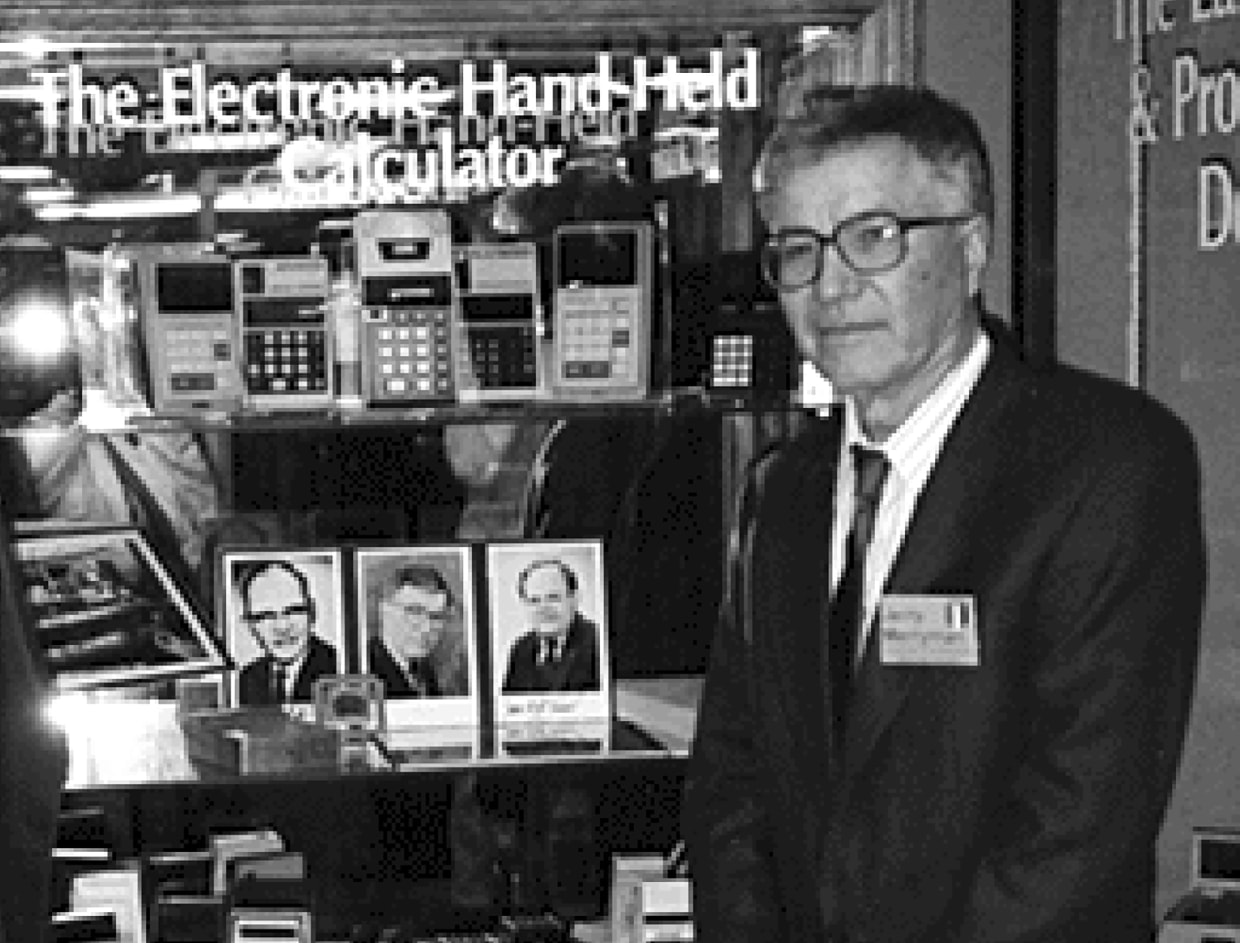
The “Holy Grail” of 1960s tech was the handheld electronic calculator. This required two major innovations: the integrated circuit (IC) and the Light Emitting Diode (LED) display. In 1967, Texas Instruments released the “Cal-Tech” prototype, a device that could fit in the palm of a hand and print results on a small strip of paper.
By the early 1970s, the “calculator wars” were in full swing. Japanese firms like Sharp and Canon competed with American firms like Hewlett-Packard (HP) and Texas Instruments. The release of the HP-35 in 1972 changed everything; it was the world’s first pocket-sized scientific calculator. It was so powerful it effectively rendered the slide rule—the tool used to design the Apollo rockets—obsolete overnight.
The Digital Era: Software, Scientific Graphing, and App Integration
As computing power became cheaper and more compact, the calculator evolved from a luxury gadget into a standard educational and professional tool. The focus shifted from “how to build it” to “what it can do.”
Graphing Calculators and Education
In the 1980s and 90s, the invention of the graphing calculator by Casio (the fx-7000G in 1985) and the subsequent dominance of the Texas Instruments TI-81 series redefined mathematics education. These devices were essentially specialized computers with screens capable of plotting functions and handling complex variables. They became the gateway for millions of students to interact with high-level technology and data visualization.
The Shift to App-Based and Cloud Calculation
Today, the “inventor” of the calculator is often a software engineer. With the advent of the smartphone, the physical calculator has been largely subsumed by software. The “Calculator” app on an iPhone or Android device has more processing power than the computers used to put a man on the moon.
Furthermore, we have moved into the era of symbolic computation and cloud-based engines. Tools like WolframAlpha and Desmos have moved calculation into the realm of natural language processing. Users no longer need to know “Reverse Polish Notation” or complex button sequences; they can type a query in plain English, and the software interprets the mathematical intent.
The Future of Computational Tools in the Age of AI
As we look toward the future, the calculator is undergoing its most significant transformation since the invention of the microchip. We are moving beyond “arithmetic” and into “augmented intelligence.”
Beyond Arithmetic: Predictive and Quantum Computing
The next generation of calculators will not just provide answers; they will provide insights. Integrated AI tools now allow calculators to recognize handwritten formulas via a camera and solve them in real-time. In the professional sphere, calculators are evolving into “predictive engines” that use machine learning to forecast financial trends or simulate physical stresses in engineering models.
Moreover, the nascent field of quantum computing promises a future where “calculators” can solve problems that are currently impossible for classical silicon-based chips. While we are still in the early stages, the quantum calculator will eventually revolutionize cryptography, material science, and pharmaceutical research by performing billions of calculations simultaneously.

The Legacy of Innovation
From Blaise Pascal’s brass gears to the liquid crystal displays of the 1980s and the neural networks of today, the calculator remains the ultimate “productivity hack.” Its history is a testament to the human desire to offload tedious tasks to machines, allowing the mind to focus on higher-level creativity and problem-solving. While there is no single inventor, every milestone—from the Arithmometer to the modern smartphone app—represents a link in a chain of technological brilliance that continues to shape our digital world.
aViewFromTheCave is a participant in the Amazon Services LLC Associates Program, an affiliate advertising program designed to provide a means for sites to earn advertising fees by advertising and linking to Amazon.com. Amazon, the Amazon logo, AmazonSupply, and the AmazonSupply logo are trademarks of Amazon.com, Inc. or its affiliates. As an Amazon Associate we earn affiliate commissions from qualifying purchases.