
Nvidia, a name synonymous with high-performance graphics processing units (GPUs), has evolved far beyond its gaming roots to become a pivotal force in artificial intelligence (AI), data centers, professional visualization, and autonomous vehicles. Its ascent has been meteoric, driven by technological innovation and strategic market dominance, particularly with its CUDA platform for parallel computing. However, no company, regardless of its market leadership, operates in a vacuum. Nvidia faces a multifaceted competitive landscape, with rivals vying for market share across its diverse business segments, pushing the boundaries of innovation in a rapidly evolving technological arena. Understanding who these competitors are requires a deep dive into each of Nvidia’s core areas of influence, from silicon design to software ecosystems.

Understanding Nvidia’s Technological Dominance and Strategic Pillars
Nvidia’s journey from a niche GPU manufacturer to a technology titan is rooted in several strategic decisions and relentless innovation. Its competitive position is fortified by a combination of superior hardware performance, a robust software ecosystem, and strategic foresight in emerging technologies like AI.
GPU Market Leadership: Gaming, Professional Visualization, and AI
At its core, Nvidia’s dominance stems from its graphics processing units. In the consumer gaming market, its GeForce series has long set performance benchmarks, offering cutting-edge features like real-time ray tracing and DLSS (Deep Learning Super Sampling). This leadership is not just about raw power; it’s about a complete platform experience that includes driver stability, software optimizations, and an expansive developer community.
Beyond gaming, Nvidia’s professional visualization Quadro and RTX Ada Generation GPUs power workstations used in CAD, content creation, scientific research, and medical imaging. These GPUs are designed for extreme reliability, precision, and the ability to handle complex datasets, making them indispensable tools in professional environments.
Crucially, Nvidia recognized early on the immense potential of GPUs for parallel processing beyond graphics. This insight led to the development of its CUDA platform, which repurposed GPUs for general-purpose computing. This pivot proved to be a game-changer, especially in the nascent field of artificial intelligence, where GPUs became the accelerators of choice for training complex neural networks. This foundational strength in GPUs, coupled with CUDA, forms the bedrock of Nvidia’s competitive moat.
AI and Data Center Prowess: From CUDA to Mellanox
The AI revolution has been a primary catalyst for Nvidia’s recent growth, transforming its data center segment into its largest revenue generator. The company’s A100 and H100 Tensor Core GPUs are the gold standard for AI training and inference in hyperscale data centers, scientific supercomputing, and enterprise AI deployments. What makes Nvidia’s data center offering particularly powerful is not just the hardware but the comprehensive software stack built around CUDA. This includes libraries like cuDNN, NCCL, and frameworks like TensorRT, which optimize AI workloads.
Nvidia further cemented its data center dominance with the acquisition of Mellanox Technologies in 2020. This strategic move brought industry-leading high-speed networking solutions (InfiniBand and Ethernet) into Nvidia’s portfolio, enabling seamless data flow between GPUs and CPUs in large-scale AI and HPC clusters. This integrated approach – high-performance GPUs, a mature software ecosystem, and ultra-fast networking – creates a formidable, end-to-end solution for data centers that is difficult for competitors to replicate.
Diversification into Automotive, Robotics, and the Omniverse
Nvidia isn’t content to rest on its laurels in GPUs and data centers. The company is aggressively expanding into new frontiers, betting on technologies that leverage its core competencies in AI and parallel computing.
In the automotive sector, Nvidia Drive platform offers a scalable, end-to-end solution for autonomous vehicles, from AI inference chips (Drive Orin, Drive Thor) to software stacks for perception, mapping, and planning. It’s not just about silicon; it’s about providing a comprehensive computing platform for self-driving cars.
Robotics is another burgeoning area, with Nvidia Jetson platforms providing AI at the edge for industrial automation, drones, and service robots. These platforms enable complex AI models to run efficiently on low-power devices.
Perhaps the most ambitious long-term play is the Nvidia Omniverse, a platform for building and operating metaverse applications and digital twins. Omniverse leverages Nvidia’s core graphics and AI technologies to enable real-time collaborative 3D design, simulation, and training in virtual environments. This platform aims to become the operating system for industrial digitalization, bringing together design, engineering, and manufacturing in a shared virtual space. These diversification efforts aim to create new markets and revenue streams, further entrenching Nvidia in critical future technologies.
Core GPU Competitors: The Silicon Showdown
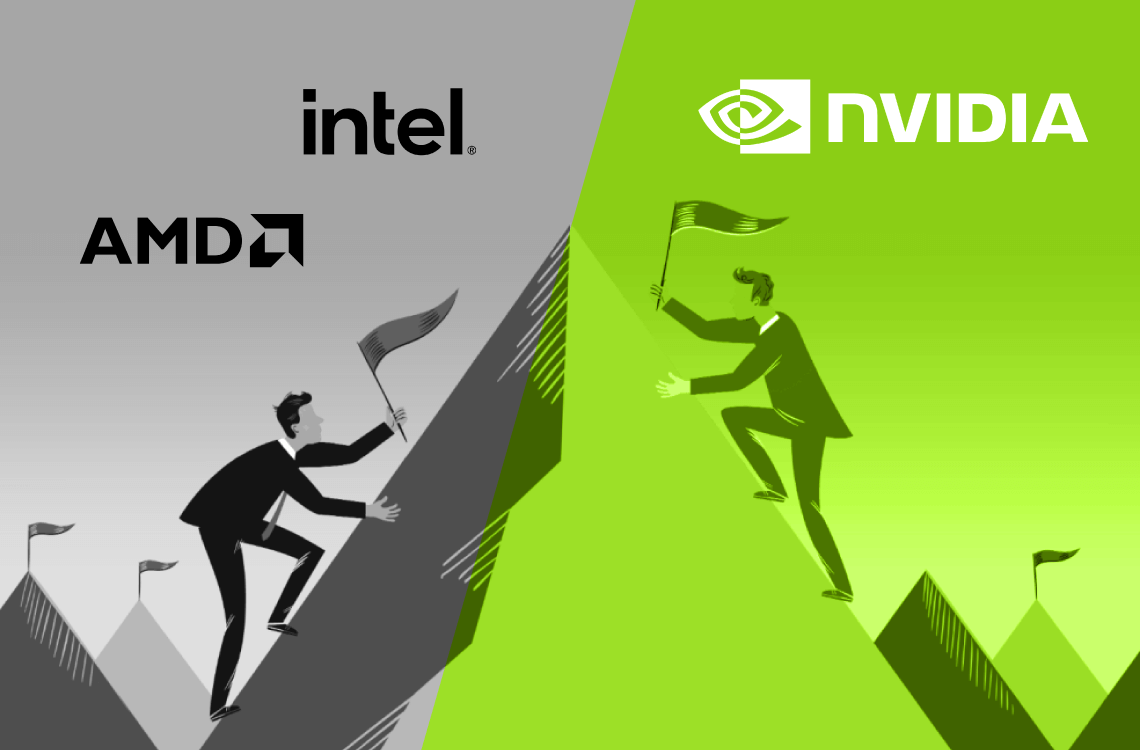
While Nvidia holds significant sway, particularly in high-end GPUs and AI accelerators, several formidable competitors are constantly challenging its position, each with unique strengths and strategies.
AMD: The Perennial Challenger with an Integrated Approach
Advanced Micro Devices (AMD) is Nvidia’s most direct and enduring rival in the GPU market. For decades, AMD’s Radeon GPUs have competed directly with Nvidia’s GeForce series in the consumer gaming space, offering compelling performance-to-price ratios. AMD has also made significant strides in professional visualization with its Radeon Pro line and in data centers with its Instinct accelerators, which compete directly with Nvidia’s Tensor Core GPUs for AI and HPC workloads.
AMD’s unique competitive advantage lies in its ability to offer both high-performance CPUs (Ryzen and EPYC) and GPUs. This allows for integrated platform solutions, especially beneficial in the server market where AMD can provide a full stack of CPU and GPU compute, potentially optimizing performance and power efficiency more holistically. The company’s recent focus on its ROCm open-source software platform is also a direct challenge to Nvidia’s proprietary CUDA, aiming to foster an alternative ecosystem for AI and HPC development.
Intel: The Resurgent Giant Entering Discrete Graphics and AI Accelerators
Intel, the world’s largest semiconductor company, has historically dominated the CPU market but has been a minor player in discrete GPUs until recently. With its re-entry into the discrete GPU market with the Intel Arc graphics series for consumers and its Ponte Vecchio architecture for data centers, Intel is signaling serious intent to challenge Nvidia. Intel’s vast manufacturing capabilities, deep pockets, and strong ties with OEMs and cloud providers make it a formidable long-term competitor.
Furthermore, Intel is a major player in AI acceleration with its Gaudi AI accelerators (from its acquisition of Habana Labs) and its OpenVINO toolkit for AI inference. Intel’s strategy often involves leveraging its dominant x86 CPU architecture and integrated graphics solutions to provide a broader compute portfolio, aiming for a “full stack” advantage similar to AMD, but on a much larger scale. While Intel faces a steep climb, its sheer engineering talent and financial resources cannot be underestimated.

Emerging GPU Players: Specialization and Niche Markets
While AMD and Intel are the primary direct competitors, other players emerge in specific segments. Qualcomm, for instance, is a dominant force in mobile SoCs (System on a Chip), where its Adreno GPUs power a vast majority of Android smartphones and increasingly, edge AI devices. While not directly competing with Nvidia’s high-end discrete GPUs, Qualcomm’s prowess in low-power, high-performance integrated graphics is a threat in the edge AI and embedded systems market. Similarly, numerous startups are exploring new GPU architectures or specialized AI chips (covered next) that could eventually chip away at Nvidia’s market share in specific niches.
AI and Data Center Rivals: Beyond Traditional GPUs
Nvidia’s stronghold in AI and data centers is formidable, largely due to CUDA’s developer ecosystem. However, this lucrative market has attracted intense competition from various angles, including specialized hardware and in-house solutions from hyperscalers.
Specialized AI Hardware: ASICs and Alternative Architectures
Beyond general-purpose GPUs, a new wave of specialized AI accelerators (ASICs – Application-Specific Integrated Circuits) is emerging. Companies like Graphcore (with its IPU – Intelligence Processing Unit), Cerebras Systems (with its Wafer-Scale Engine), and Groq (with its Tensor Streaming Processor) are designing chips specifically optimized for AI workloads, often promising superior performance or energy efficiency for certain types of models compared to GPUs. These challengers aim to carve out niches where their architectures provide a decisive advantage, particularly for large language models or specific neural network designs.
Cloud Providers’ In-house Chips: AWS, Google, and Microsoft
Perhaps one of the most significant long-term threats to Nvidia in the data center market comes from its own customers: the hyperscale cloud providers. Companies like Google, Amazon Web Services (AWS), and Microsoft Azure are investing heavily in designing their own custom AI accelerators.
Google’s Tensor Processing Units (TPUs) have been instrumental in powering its own AI infrastructure and are increasingly offered to cloud customers. AWS has developed Inferentia for inference and Trainium for training AI models, which are deeply integrated into its cloud ecosystem. Microsoft is also developing custom chips like Maia (AI accelerator) and Cobalt (ARM-based CPU) for its Azure cloud. These in-house chips offer cloud providers greater control over their hardware stack, potentially reducing costs, improving optimization, and differentiating their services from competitors who rely solely on third-party silicon. This trend represents a strategic effort to reduce dependency on Nvidia and optimize for their specific workloads.
Software Ecosystem Competition: Open-source Alternatives to CUDA
Nvidia’s CUDA platform is a significant competitive barrier, locking developers into its ecosystem. However, efforts are underway to create open-source alternatives. AMD’s ROCm platform is the most direct contender, striving to offer a comparable environment for high-performance computing and AI workloads. Projects like OpenCL, SYCL, and various domain-specific frameworks also seek to provide vendor-agnostic programming models. While CUDA’s maturity and vast developer base still give Nvidia an edge, the push for open standards and frameworks could slowly erode this advantage, allowing greater flexibility for developers to switch between hardware platforms.
Automotive and Edge Computing Competitors: The Race for Intelligent Devices
Nvidia’s expansion into automotive and edge AI faces a diverse set of competitors, ranging from established automotive suppliers to other semiconductor giants specializing in embedded systems.
Traditional Automotive Suppliers and SoC Designers
In the automotive sector, Nvidia competes with traditional automotive electronics suppliers like Mobileye (an Intel company), which provides computer vision systems for advanced driver-assistance systems (ADAS) and autonomous driving. Qualcomm, with its Snapdragon Ride platform, is another major player, leveraging its extensive experience in mobile SoCs to offer integrated solutions for autonomous vehicles and infotainment systems. Other chipmakers like NXP Semiconductors and Renesas Electronics also have strong footholds in the automotive embedded market, providing microcontrollers and processors for various vehicle functions. These companies often have established relationships with automakers and extensive experience with automotive safety and reliability standards.
Other Chip Designers in Autonomous Vehicles and Edge AI
Beyond traditional suppliers, new entrants and specialized chip designers are emerging in the autonomous vehicle and broader edge AI space. Tesla, for example, famously designed its own Full Self-Driving (FSD) chip, demonstrating the trend towards vertical integration in complex systems. Various startups are also developing highly specialized processors for specific AI tasks at the edge, focusing on ultra-low power consumption or specific neural network architectures. These companies aim to capture segments of the vast and growing market for intelligent edge devices, from smart cameras to industrial robots, which Nvidia addresses with its Jetson platform.
The Broader Ecosystem and Strategic Landscape
Ultimately, the competitive landscape for Nvidia is not just about direct product comparisons but also about the interplay of different technologies and strategic positioning within the broader tech ecosystem.
CPU-GPU Interplay and Full-Stack Solutions
The ongoing convergence of CPUs and GPUs, particularly in high-performance computing and AI, creates a dynamic where companies offering both can present integrated, optimized solutions. AMD, with its CPU and GPU portfolio, and Intel, with its long-standing CPU dominance and renewed GPU efforts, are best positioned to offer such “full-stack” solutions. This integrated approach can potentially simplify development, reduce latency, and offer better overall performance for certain workloads, challenging Nvidia’s singular focus on GPUs and accelerators. The future might see a greater emphasis on heterogeneous computing platforms where various processing units work seamlessly together.
Innovation Race and Future Technologies
The technology industry is characterized by relentless innovation. While Nvidia currently leads in many areas, the pace of technological advancement means that today’s leader can quickly be challenged by tomorrow’s breakthrough. Research into new computing paradigms like quantum computing, neuromorphic computing, and advanced materials could usher in entirely new architectures that bypass the current strengths of GPU-based computing. Companies that invest in these next-generation technologies today could become formidable competitors in the distant future. The race is not just about optimizing current architectures but about inventing the next one.
In conclusion, while Nvidia enjoys a commanding lead in several critical technology sectors, it operates within an intensely competitive and rapidly evolving environment. Its competitors range from established semiconductor giants like AMD and Intel, to specialized AI hardware startups, and increasingly, its own cloud service customers designing in-house chips. Nvidia’s continued success will depend not only on maintaining its hardware leadership and strengthening its software ecosystem but also on its ability to innovate and adapt to these diverse challenges across its multiple strategic pillars.
aViewFromTheCave is a participant in the Amazon Services LLC Associates Program, an affiliate advertising program designed to provide a means for sites to earn advertising fees by advertising and linking to Amazon.com. Amazon, the Amazon logo, AmazonSupply, and the AmazonSupply logo are trademarks of Amazon.com, Inc. or its affiliates. As an Amazon Associate we earn affiliate commissions from qualifying purchases.