
The electronic calculator, a ubiquitous device now often integrated into smartphones and computers, has a surprisingly complex and fragmented origin story. While no single individual can lay sole claim to its invention, its development was a collaborative effort, spanning decades and involving numerous brilliant minds and pioneering companies. Tracing the lineage of the electronic calculator is a journey through the evolution of electronics itself, from vacuum tubes to integrated circuits, marking a relentless pursuit of efficiency, miniaturization, and accessibility in the realm of computation. This article delves into the technological milestones and key players that collectively gave birth to this indispensable tool.
The Dawn of Calculation: Pre-Electronic Eras
Before the hum of electronics, humanity relied on a fascinating array of mechanical and manual aids to tackle complex arithmetic. Understanding these precursors is crucial to appreciating the revolutionary leap represented by the electronic calculator.
Early Mechanical Marvels: Abacus to Pascaline
The concept of mechanical assistance for calculation dates back millennia. The abacus, an ancient counting frame, provided a visual and tactile method for performing basic arithmetic, demonstrating an early human desire to externalize computation. Fast forward to the 17th century, and the first true mechanical calculators began to emerge. Blaise Pascal, the brilliant French mathematician and philosopher, invented the Pascaline in 1642. Designed to assist his tax-collector father, this device could perform addition and subtraction through a series of gears and dials. While revolutionary for its time, the Pascaline was complex to manufacture and operate, and only a limited number were ever produced.
Leibniz and the Stepped Reckoner
Inspired by Pascal’s work, Gottfried Wilhelm Leibniz, another polymath of the 17th century, significantly advanced the field. In 1672, Leibniz developed the “Stepped Reckoner” (Staffelrechner), which could not only add and subtract but also multiply and divide using a clever mechanism involving a stepped drum. This was a monumental improvement, demonstrating the potential for machines to handle all four basic arithmetic operations. Leibniz’s machine, though mechanically fragile and prone to error, laid crucial groundwork for future mechanical calculators and even the conceptual design of computers.
Babbage’s Vision: The Analytical Engine
Perhaps the most visionary precursor to modern computers and, by extension, advanced calculators, was Charles Babbage’s work in the 19th century. His Difference Engine (designed to automate the calculation of polynomial functions) and, more importantly, his Analytical Engine (a general-purpose mechanical computer) were far ahead of their time. Though never fully built in his lifetime due to technological limitations and funding issues, Babbage’s designs incorporated concepts like a “mill” (CPU), “store” (memory), and input/output mechanisms that are fundamental to computing even today. While purely mechanical, Babbage’s theoretical contributions highlighted the ultimate potential of automated calculation.
Pioneering the Electronic Revolution
The transition from gears and levers to electron flows marked the true birth of the electronic calculator. This shift was enabled by breakthroughs in fundamental electronic components.
The Theoretical Foundations: Vacuum Tubes and Transistors
The 20th century brought rapid advancements in electronics, beginning with the invention of the vacuum tube. These bulky, power-hungry components were the building blocks of early electronic computers like ENIAC, providing the switching capability necessary for digital logic. While these early computers could perform calculations, they were massive, required immense power, and were certainly not “calculators” in the portable sense. The real revolution came with the invention of the transistor at Bell Labs in 1947 by John Bardeen, Walter Brattain, and William Shockley. Transistors were smaller, more reliable, consumed less power, and generated less heat than vacuum tubes, making them ideal for creating more compact and efficient electronic devices. This invention was the single most critical step toward miniaturizing electronic computation.
Early Prototypes and Industrial Computing
Before dedicated electronic calculators, the first electronic computers of the 1940s and 50s were, in essence, very powerful and complex calculators. They performed scientific, military, and business calculations with unprecedented speed. However, their size and cost meant they were accessible only to large institutions. The idea of a personal electronic calculating device began to percolate as electronics became more refined. Early attempts at “desk calculators” still often relied on relay technology (electromechanical switches) or a mix of vacuum tubes and transistors, bridging the gap between purely mechanical and fully electronic.
The Birth of the Desktop Electronic Calculator
The true lineage of the electronic calculator, as we recognize it, began to crystallize in the late 1950s and early 1960s. The challenge was to create a device that could perform arithmetic electronically, be compact enough for a desktop, and be commercially viable. This required pushing the boundaries of transistor technology and manufacturing. These early electronic desktop models were still large and expensive compared to today’s standards, but they offered undeniable speed and silence compared to their clunky mechanical predecessors.
Key Innovators and Early Commercial Success
The race to develop and commercialize the electronic calculator saw several companies and individuals make significant contributions, each bringing different innovations to the market.
Casio and the Relay Calculator

While often associated with modern electronic calculators, Casio entered the scene relatively early with electromechanical devices. In 1957, Casio introduced the 14-A, which was touted as the world’s first compact all-electric (relay) calculator. Though not fully electronic in the sense of using transistors for all its logic, it was a pivotal step, demonstrating the feasibility of an electrically powered, gear-free calculating machine for office use. It signaled a clear move away from purely mechanical systems and towards the electronic future.
Bell Punch Company and the Anita Mark VII
Often credited with launching the world’s first all-electronic desktop calculator, the ANITA (A New Inspiration to Arithmetic/Accounting) Mark VII was developed by the British Bell Punch Company and first shipped in 1961 (or 1962, depending on the source). Crucially, the ANITA Mark VII used cold-cathode vacuum tubes (dekatrons) for its display and much of its logic, rather than the newer transistors or relays. While technically still using tubes, it eliminated mechanical moving parts for calculation, making it truly “electronic.” It was a bulky, heavy, and very expensive machine, but it proved the market for silent, fast electronic calculation.
Texas Instruments and the Pocket Calculator
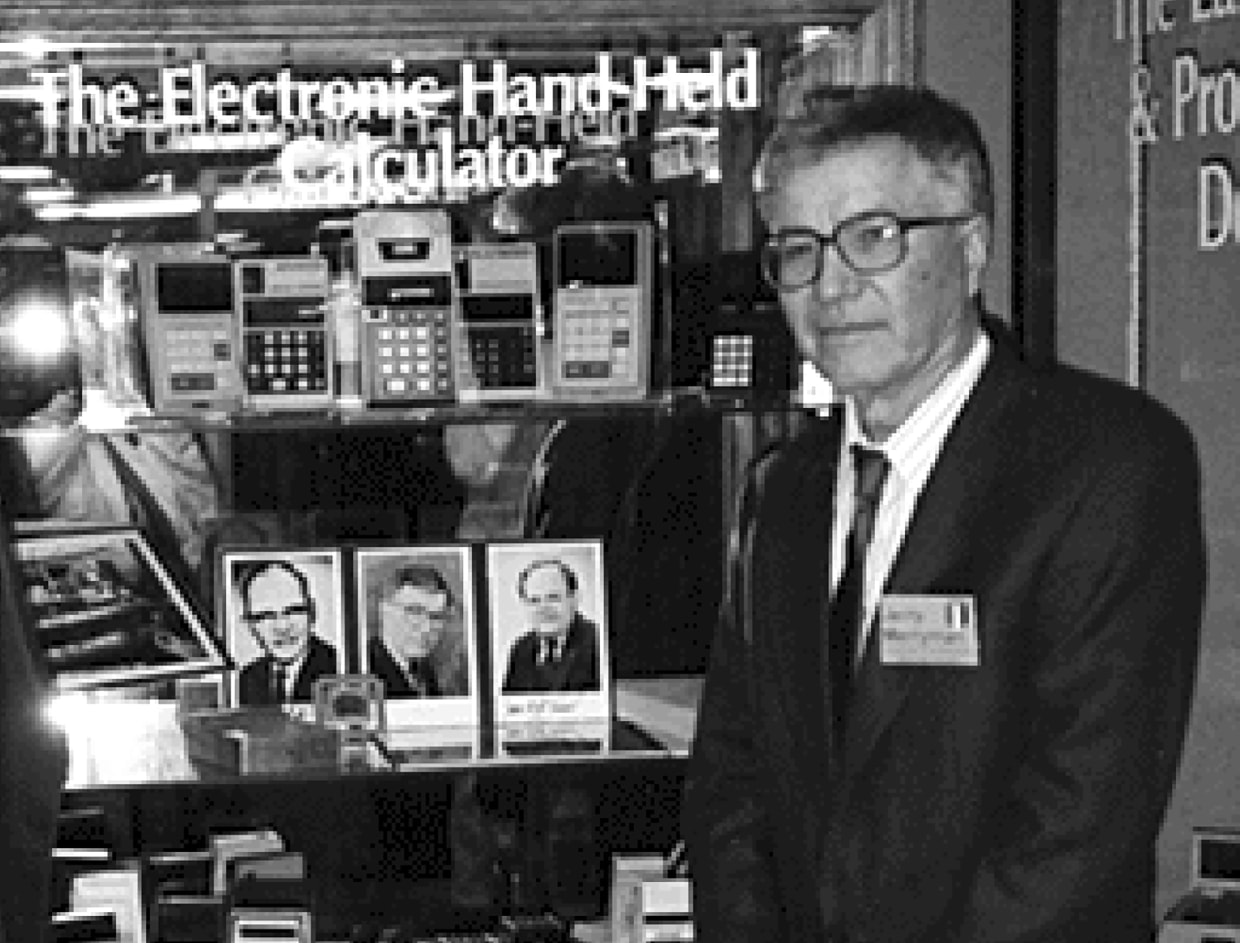
While others were perfecting desktop versions, the vision for a truly personal, handheld electronic calculator emerged from the US. Texas Instruments (TI), a company known for its semiconductor innovations, played a pivotal role. In 1967, a team at TI, including Jack Kilby (a co-inventor of the integrated circuit), Jerry Merryman, and James Van Tassel, developed a prototype handheld calculator called the “Cal-Tech.” This revolutionary device could add, subtract, multiply, and divide, and print its results on a thermal printer. It was the first true handheld electronic calculator, powered by integrated circuits. Although TI licensed its technology for manufacturing to others, their work laid the foundation for the mass production of portable calculators. The first commercial pocket calculator to hit the market using TI’s integrated circuits was the Busicom LE-120A “HANDY” in 1971, utilizing a TI chip.
The Race for Miniaturization and Affordability
The invention of the integrated circuit (IC) was the ultimate game-changer, enabling the relentless miniaturization and cost reduction that made calculators ubiquitous.
Integrated Circuits: The Game Changer
The integrated circuit, developed independently by Jack Kilby at Texas Instruments in 1958 and Robert Noyce at Fairchild Semiconductor in 1959, allowed for thousands of transistors and other electronic components to be fabricated on a single silicon chip. This invention dramatically reduced the size, cost, and power consumption of electronic devices. For calculators, this meant transforming them from desktop behemoths into truly portable, handheld devices. The ability to put the entire “brain” of a calculator on a single chip, or a few chips, was the technological leap that democratized electronic calculation.
HP’s Scientific Calculators
Hewlett-Packard (HP) entered the calculator market with a focus on engineering and scientific applications. In 1972, HP introduced the HP-35, the world’s first handheld scientific calculator. It was a revolutionary device that could perform complex functions like trigonometric, logarithmic, and exponential calculations at the touch of a button. Its use of Reverse Polish Notation (RPN) became a signature feature for many HP calculators. The HP-35 was aimed at professionals who previously relied on slide rules or mainframe computers, making advanced computation personal and portable.
The Japanese Domination and Market Saturation
The early 1970s saw a fierce price war, primarily driven by Japanese manufacturers like Casio, Sharp, and Canon. Leveraging efficient mass production techniques and continuous innovation in IC design, they rapidly brought down the cost of calculators. This period led to “calculator wars,” where prices plummeted from hundreds of dollars to mere tens, making calculators affordable for students, businesses, and households worldwide. The market quickly became saturated, with a vast array of models offering different features, from basic arithmetic to financial and programmable capabilities. This fierce competition ultimately pushed calculators into nearly every home and classroom.
The Calculator’s Enduring Legacy and Future
From its humble beginnings as a luxury office machine, the electronic calculator has evolved into an indispensable tool, profoundly impacting education, business, and daily life.
From Dedicated Device to Ubiquitous Feature
The dedicated electronic calculator’s journey saw it shrink from the size of a typewriter to fit comfortably in a shirt pocket. However, its ultimate evolution wasn’t just in size, but in integration. With the advent of personal computers, then smartphones, the core functionality of a calculator became a standard software application. Today, most people interact with a calculator app on their phone or computer, often without realizing the complex history behind the simple interface. This shift demonstrates a common pattern in technology: as a specialized device matures and its core function becomes a commodity, it often gets absorbed into more general-purpose platforms.
Specialized Calculators and Software
Despite the ubiquity of general-purpose calculator apps, dedicated calculators continue to thrive in specialized niches. Financial calculators (like the HP 12c or TI BA II Plus) remain essential tools for finance professionals and students. Graphing calculators (such as the TI-83/84 and Casio fx-9750GII) are still mainstays in secondary and tertiary education for algebra, calculus, and statistics, offering powerful computational and visualization capabilities. Similarly, specialized calculators exist for engineering, surveying, and other technical fields. Beyond hardware, calculator functionality is now embedded in countless software applications, from spreadsheets to scientific modeling programs, demonstrating its fundamental importance across diverse domains.

The Calculator in Modern Education and Industry
The electronic calculator has irrevocably changed how we approach mathematics and problem-solving. In education, it has shifted the emphasis from rote calculation to conceptual understanding and higher-order thinking. Students can explore complex mathematical ideas without being bogged down by tedious arithmetic. In industry, calculators continue to be vital for quick estimations, data analysis, and on-the-spot calculations in field work, engineering, and finance. While its form may change, the electronic calculator, in its various manifestations, remains a testament to human ingenuity and the enduring quest to master the language of numbers. Its invention was not a single moment but a continuous chain of innovations, driven by the desire to make computation faster, easier, and more accessible for everyone.
aViewFromTheCave is a participant in the Amazon Services LLC Associates Program, an affiliate advertising program designed to provide a means for sites to earn advertising fees by advertising and linking to Amazon.com. Amazon, the Amazon logo, AmazonSupply, and the AmazonSupply logo are trademarks of Amazon.com, Inc. or its affiliates. As an Amazon Associate we earn affiliate commissions from qualifying purchases.