
The calculator is often perceived as a humble tool, a fixture of high school classrooms and accounting desks. However, in the realm of technology, the calculator is nothing less than the direct ancestor of the modern computer. The quest to automate mathematics is a journey that spans centuries, involving some of history’s greatest engineering minds. To answer the question of who invented the calculator, one must look past a single name and instead explore a lineage of innovation that transitioned from mechanical gears to the silicon chips that now power our world.

The Mechanical Pioneers: Engineering the First Calculation Engines
The story of the calculator does not begin with electronics, but with sophisticated mechanical engineering. Before the digital age, the challenge was to create a physical device that could mimic the logic of arithmetic through the movement of gears and cogs.
Blaise Pascal and the Pascaline (1642)
While various counting frames like the abacus existed for millennia, the first true mechanical calculator is widely attributed to the French mathematician and philosopher Blaise Pascal. At just 19 years old, Pascal sought to ease the burden of his father’s work as a tax supervisor. His invention, the Pascaline, utilized a series of geared wheels. Each wheel represented a digit (ones, tens, hundreds), and when a wheel completed a full rotation, it would mechanically “carry” a one to the next wheel. Although it could only perform addition and subtraction, the Pascaline proved that human logic could be codified into a physical machine.
Gottfried Wilhelm Leibniz and the Stepped Reckoner (1673)
Building upon Pascal’s foundation, the German polymath Gottfried Wilhelm Leibniz aimed to create a machine that could perform all four arithmetic operations: addition, subtraction, multiplication, and division. Leibniz’s “Stepped Reckoner” introduced the Leibniz wheel—a cylinder with nine teeth of varying lengths. This mechanism remained a staple in mechanical calculator design for over 200 years. More importantly, Leibniz was an early advocate for the binary system, the very language that modern computers use today.
Thomas de Colmar and the Arithmometer (1820)
While Pascal and Leibniz created prototypes, the first commercially successful mechanical calculator was the Arithmometer, patented by Charles Xavier Thomas de Colmar. This device was robust enough for daily office use and marked the transition of the calculator from a scientific curiosity to a practical business tool. It dominated the market for decades, proving that there was a massive demand for automated computation in a rapidly industrializing world.
The Shift to Electronics: From Vacuum Tubes to the Desktop
The mid-20th century marked a paradigm shift. As the limitations of mechanical gears—such as friction, physical wear, and slow speeds—became apparent, engineers turned to the burgeoning field of electronics.
The Era of Vacuum Tubes and Large-Scale Logic
The first electronic calculators were not “pocket-sized”; they were massive machines that lived on tabletops or filled entire rooms. In the early 1960s, companies like Bell Punch in the UK released the ANITA (A New Inspiration To Arithmetic/Accounting). This machine replaced mechanical parts with vacuum tubes and cold-cathode switching tubes. While it was silent and incredibly fast compared to its predecessors, the heat generated by the tubes and the sheer size of the components made it clear that a new form of hardware was needed.
The Transistor Revolution
The invention of the transistor at Bell Labs was the “Big Bang” moment for modern technology. Transistors allowed engineers to switch and amplify electronic signals without the fragility and heat of vacuum tubes. This led to the creation of the first fully transistorized calculators, such as the Sharp CS-10A in 1964. These machines were the precursors to the integrated circuits (ICs) that would eventually define the “Tech” sector as we know it today.
The Transition to Integrated Circuits
By the late 1960s, the goal was miniaturization. The development of Large-Scale Integration (LSI) allowed thousands of transistors to be etched onto a single silicon chip. This technological leap reduced the part count of a calculator from thousands of discrete components to just a handful of chips, drastically lowering costs and increasing reliability. It was during this period that the calculator became the primary driver of semiconductor research and development.
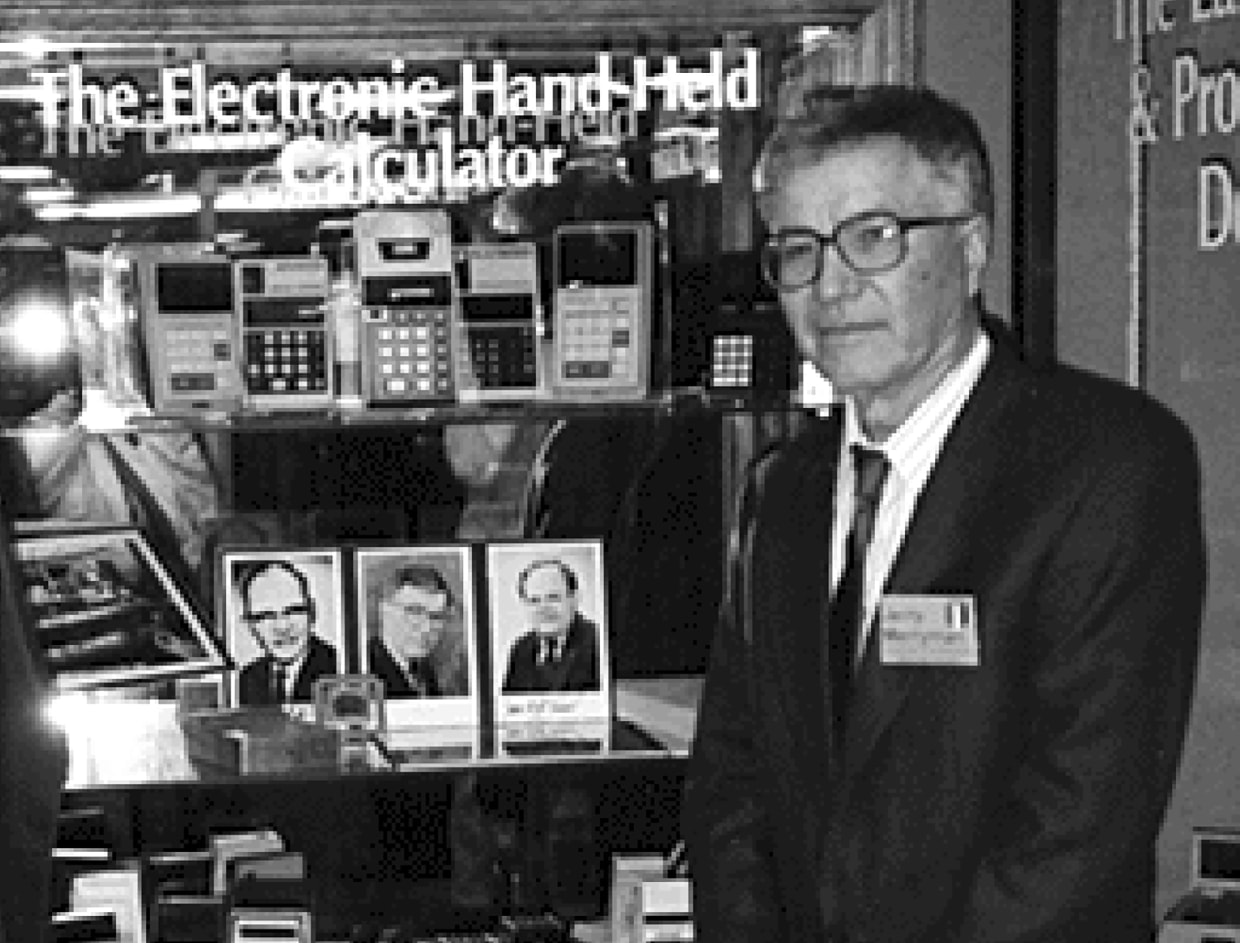
The Microprocessor Revolution: Putting Power in the Palm of Your Hand
Perhaps the most significant moment in the history of the calculator—and indeed, all of technology—occurred in 1971. This was the year the calculator gave birth to the microprocessor, the “brain” of every computer, smartphone, and server in existence today.
The Busicom Project and the Intel 4004
In 1969, a Japanese company called Busicom approached a young American firm named Intel to design specialized chips for a new line of calculators. Intel engineer Ted Hoff proposed a radical idea: instead of creating several custom chips for different functions, why not create one general-purpose processor that could be programmed with software? This led to the Intel 4004, the world’s first commercially available microprocessor. The calculator was the “killer app” that necessitated the invention of the CPU, effectively launching the digital age.
Texas Instruments and the Pocket Boom
As chips became smaller, so did the devices. In 1967, Texas Instruments (TI) developed the “Cal-Tech” prototype, a battery-powered device that could fit in the palm of a hand and print results on a small strip of paper. By the early 1970s, the market exploded with consumer handhelds. Companies like TI, Hewlett-Packard (HP), and Bowmar raced to shrink components, leading to the first LED (Light Emitting Diode) and LCD (Liquid Crystal Display) screens, which are now ubiquitous in modern gadgets.
The HP-35 and Scientific Computing
In 1972, Hewlett-Packard released the HP-35, the world’s first scientific pocket calculator. Before this, scientists and engineers relied on slide rules or massive mainframe computers. The HP-35 introduced complex functions like trigonometry and logarithms into a handheld device. It was a technological marvel that utilized Reverse Polish Notation (RPN) and proved that portable tech could handle high-level computational tasks previously reserved for laboratories.
The Digital Frontier: From Hardware to High-Level Software and AI
In the 21st century, the calculator has largely transcended its physical form. While dedicated hardware still exists for specialized fields, the “calculator” is now a sophisticated piece of software integrated into every digital ecosystem.
Integration into Operating Systems and Mobile Apps
From the early versions of Windows and Mac OS to the modern iOS and Android platforms, a calculator app is a foundational utility. However, these are no longer simple arithmetic tools. Modern mobile calculators have more processing power than the computers used to send Apollo 11 to the moon. They utilize complex UI/UX design to provide graphing capabilities, unit conversions, and financial modeling, all within a touch-screen interface.
Cloud Computing and Advanced Computational Engines
The evolution of the calculator has led to the rise of computational intelligence engines like WolframAlpha. Unlike a traditional calculator that requires a specific sequence of inputs, these platforms use natural language processing (NLP) to understand complex queries. They tap into massive cloud-based databases to solve differential equations, visualize 3D data, and provide step-by-step solutions. This represents a shift from “calculating” to “computing,” where the tool understands the context of the problem.
AI-Driven Problem Solving and the Future
Today, we are witnessing the integration of Artificial Intelligence (AI) into the world of calculation. Large Language Models (LLMs) like GPT-4 and specialized AI tools can now interpret handwritten equations via a smartphone camera (Computer Vision) and solve them instantly. These AI tools don’t just provide an answer; they explain the underlying logic, acting as a tutor. As we move forward, the boundary between a “calculator” and an “AI assistant” will continue to blur, with software capable of predicting the user’s computational needs based on their workflow.

The Legacy of the Calculator in Modern Tech
Who invented the calculator? The answer is a mosaic of innovators: Pascal provided the gears, Leibniz provided the binary vision, Intel provided the silicon brain, and modern software engineers provided the intelligence.
The calculator was the first device to prove that human thought—specifically mathematical logic—could be automated. Every time we use a smartphone, we are using the descendant of the Pascaline and the Intel 4004. The drive to make calculators smaller, faster, and more efficient directly funded and inspired the semiconductor industry, leading to the laptops and AI-driven worlds we inhabit today. The calculator is not just a tool for math; it is the blueprint for the digital revolution. As we look toward the future of quantum computing and advanced AI, we continue to build upon the simple desire of a 19-year-old Pascal to make a difficult task just a little bit easier through the power of technology.
aViewFromTheCave is a participant in the Amazon Services LLC Associates Program, an affiliate advertising program designed to provide a means for sites to earn advertising fees by advertising and linking to Amazon.com. Amazon, the Amazon logo, AmazonSupply, and the AmazonSupply logo are trademarks of Amazon.com, Inc. or its affiliates. As an Amazon Associate we earn affiliate commissions from qualifying purchases.