
The calculator is perhaps the most ubiquitous piece of technology in human history, yet its “discovery”—or more accurately, its invention—is not the result of a single “eureka” moment by one individual. Instead, it is a multi-generational saga of engineering brilliance, mathematical necessity, and the relentless pursuit of automation. From the ancient abacus to the high-powered AI-driven processors of the 21st century, the calculator represents the foundational DNA of modern computing. To understand who discovered the calculator is to understand the very trajectory of technological progress itself.

The Pioneers of Mechanical Calculation: The Birth of Hardware
The journey toward the modern calculator began centuries before the first microchip was ever conceived. In the mid-17th century, the world was undergoing a scientific revolution that demanded more precise and faster data processing than the human mind or the wooden abacus could provide.
Blaise Pascal and the Pascaline
In 1642, a young French mathematician and physicist named Blaise Pascal set out to alleviate the burden of his father’s tedious work as a tax collector. At just 19 years old, Pascal invented what is widely considered the first mechanical calculator: the Pascaline.
The Pascaline used a series of gears and wheels to perform addition and subtraction. Each wheel represented a digit (ones, tens, hundreds), and a complex “carry” mechanism allowed the machine to move to the next decimal place automatically when a wheel completed a full rotation. While it was a masterpiece of clockwork engineering, it was expensive and difficult to produce, making it a luxury item for the elite rather than a tool for the masses.
Gottfried Wilhelm Leibniz and the Stepped Reckoner
Building upon Pascal’s foundation, the German polymath Gottfried Wilhelm Leibniz expanded the capabilities of mechanical calculation in 1673. Leibniz was not content with mere addition; he wanted a machine that could multiply and divide.
He invented the “Leibniz wheel” (or stepped drum), a cylinder with teeth of varying lengths. This innovation allowed his machine, the Stepped Reckoner, to perform all four basic arithmetic operations. Perhaps more importantly for the future of tech, Leibniz was a fierce advocate for the binary system—the 1s and 0s that would eventually become the language of every computer on the planet. His work bridged the gap between physical gears and the logical frameworks of modern software.
The Industrialization of Mechanics: Thomas de Colmar
It took nearly 150 years after Leibniz for a calculator to become commercially viable. In 1820, Charles Xavier Thomas de Colmar, a Frenchman, patented the Arithmometer. This was the first mechanical calculator robust enough for daily office use. By standardizing the production of gears and levers, de Colmar turned the calculator from a laboratory curiosity into a commercial technology product, setting the stage for the massive data-processing needs of the Industrial Revolution.
The Digital Revolution: From Vacuum Tubes to Integrated Circuits
As the 20th century dawned, the limitations of mechanical gears became a bottleneck for scientific advancement. The “Tech” of the calculator needed a paradigm shift from physical movement to the speed of electrons. This era marked the transition from “calculators” as machines to “calculators” as the precursor to the digital age.
The ANITA and the Shift to Electronics
The 1960s saw the death of the mechanical desk calculator. In 1961, the Bell Punch Co. in the UK released the ANITA (A New Inspiration To Arithmetic/Accounting). It was the world’s first all-electronic desktop calculator. Instead of gears, it used vacuum tubes and cold-cathode tubes to perform operations. It was silent, instantaneous, and signaled a massive shift in how technology was built—moving away from Newtonian physics and toward quantum mechanics and electronics.
Texas Instruments and the Pocket Calculator Breakthrough
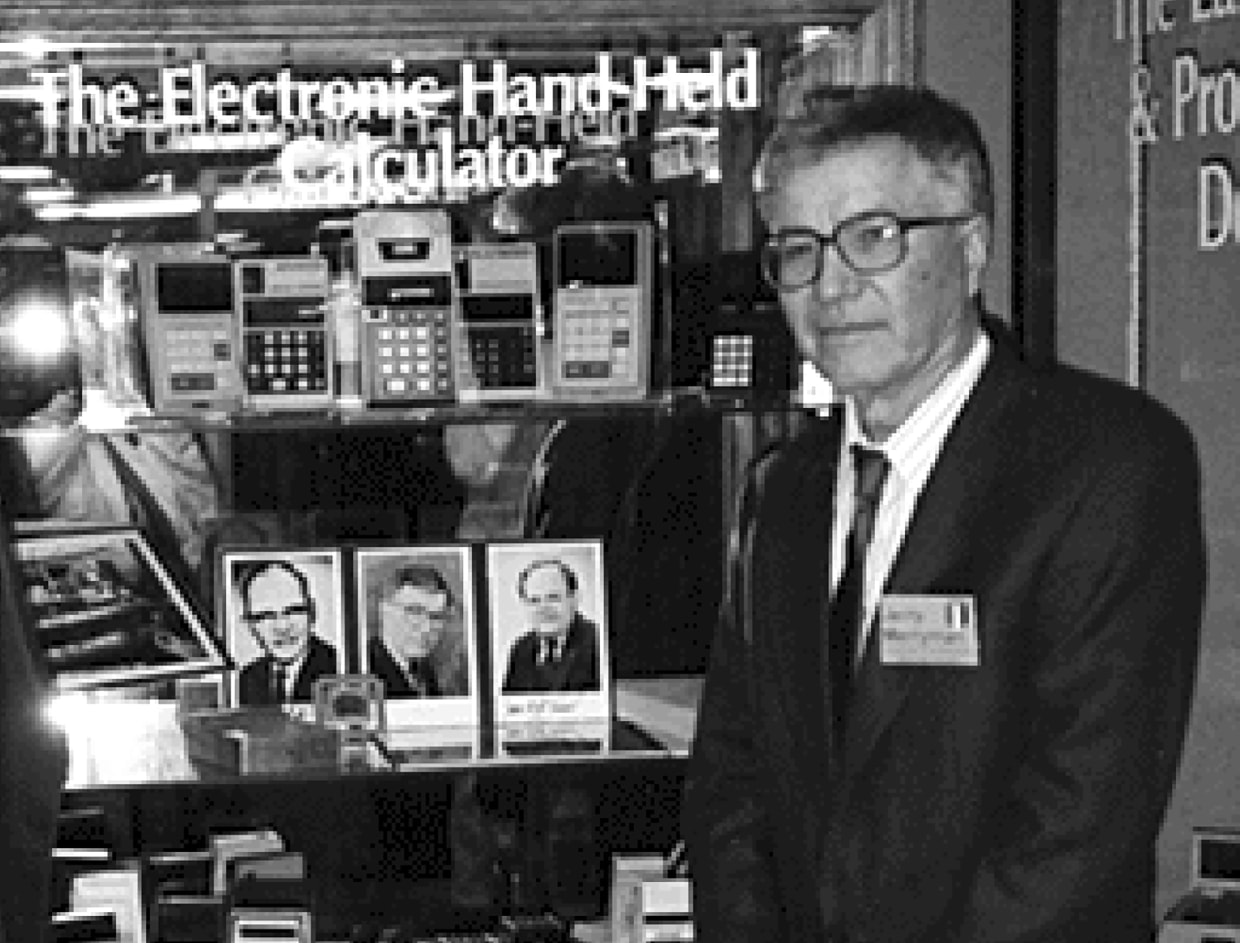
The true “tech” milestone that mimics the gadgets we use today occurred in 1967. A team at Texas Instruments (TI), led by Jack Kilby (the co-inventor of the integrated circuit), developed the “Cal-Tech” project. This was the first handheld, battery-powered electronic calculator.
The breakthrough here wasn’t just the math; it was the miniaturization. By fitting thousands of transistors onto a single silicon chip, TI proved that powerful computing could be portable. This development is arguably the most important moment in consumer technology history, as it led directly to the development of the microprocessor—the “brain” inside every smartphone and laptop today.
The Role of Moore’s Law in Calculator Shrinkage
The 1970s and 80s were defined by a race to the bottom—in terms of size and price. As companies like Casio, Hewlett-Packard (HP), and Sharp entered the market, the calculator became the first true “consumer tech” gadget. This period perfectly illustrated Moore’s Law (the observation that the number of transistors on a microchip doubles roughly every two years). Calculators that once cost $400 and filled a suitcase were suddenly $10 items that fit in a shirt pocket. This democratization of technology changed education, engineering, and daily life forever.
Software-Driven Computation and the Modern Tech Stack
In the contemporary landscape, the “calculator” has evolved beyond a physical device. It has transitioned into a software feature, integrated into the very fabric of our operating systems and cloud environments.
From Dedicated Hardware to Smartphone Apps
Today, most people do not carry a standalone calculator. Instead, they use the native “Calculator” app on their iOS or Android devices. However, these apps are far more technologically sophisticated than the TI-83s of the past. They leverage the device’s main CPU and GPU to perform complex scientific functions, unit conversions, and currency exchanges in real-time. The “discovery” of the calculator in the 21st century is the discovery of the “API” and the “App”—where the functionality of a physical tool is abstracted into code.
Scientific and Graphing Calculators in the Educational Tech Space
While smartphones have replaced basic calculators, the niche of high-end graphing calculators (like the TI-Nspire or HP Prime) remains a vital part of the “EdTech” (Educational Technology) sector. These devices are now essentially specialized handheld computers. They feature high-resolution color screens, rechargeable lithium-ion batteries, and the ability to run Python script. They represent the bridge between basic arithmetic and professional programming, teaching students the logic of algorithms through the lens of mathematical calculation.
Cloud-Based Computing and Specialized Web Tools
The modern tech stack has also moved calculation to the “edge.” Web-based tools like WolframAlpha have redefined what a calculator is. It is no longer a device that just adds numbers; it is a “computational intelligence engine.” By utilizing massive databases and cloud processing, these tools can solve complex differential equations, provide demographic data, and visualize three-dimensional vectors. The calculator has evolved from a mechanical wheel to a distributed network of servers.
The Future of Calculation: AI and Quantum Processing
We are currently entering a new era where the “discovery” of the calculator is being redefined by Artificial Intelligence. The next generation of calculating technology is not about inputting numbers; it is about interpreting intent and processing unstructured data.
Natural Language Processing (NLP) in Calculation
The integration of Large Language Models (LLMs) and AI into the tech of calculation means that we can now “talk” to our calculators. Tools like ChatGPT or Google Gemini act as advanced calculators that understand context. Instead of typing (500 * 0.15) + 500, a user can simply ask, “What is a 15% tip on a 500-dollar bill including tax?” The “discovery” here is the shift from syntax-based input to natural language, making computational power accessible to everyone regardless of their technical proficiency.
The Integration of Predictive Analytics
In the tech sector, modern “calculators” are now used for predictive modeling. Financial tech (FinTech) apps use calculators integrated with machine learning to predict future stock prices or calculate risk in real-time. This isn’t just arithmetic; it’s the application of probability theory at scale.
As we look toward the future, the arrival of quantum computing promises to be the next major “calculator” discovery. Quantum calculators will use “qubits” to perform calculations that would take a modern supercomputer thousands of years to solve. This will revolutionize cryptography, material science, and digital security—marking the next great leap in the evolution of the machine Blaise Pascal started nearly 400 years ago.

Conclusion: The Legacy of the Calculating Machine
The question of who discovered the calculator does not have a single name as an answer. It is a lineage of innovators: Pascal provided the mechanical heart, Leibniz provided the binary logic, Kilby provided the silicon soul, and modern software engineers provided the cloud-based brain.
The calculator was the first technology that allowed humans to outsource cognitive labor to a machine. By automating the “how” of math, it allowed the human mind to focus on the “why” of science and engineering. Today, every time we unlock our phones or run a complex simulation in the cloud, we are using a descendant of those early wooden gears. The calculator didn’t just change how we count; it built the digital world we live in today.
aViewFromTheCave is a participant in the Amazon Services LLC Associates Program, an affiliate advertising program designed to provide a means for sites to earn advertising fees by advertising and linking to Amazon.com. Amazon, the Amazon logo, AmazonSupply, and the AmazonSupply logo are trademarks of Amazon.com, Inc. or its affiliates. As an Amazon Associate we earn affiliate commissions from qualifying purchases.